I'm an Australian author of contemporary and historical romances, plus history non-fiction.
My books range from sexy to erotic, late 1700s to the mid 1800s, and with a dash of Australia thrown into the mix. My heroes and heroines challenge tradition and my stories often expose the seamier levels of life.
I now live in a sunny part of Australia after spending many years in developing countries in the South Pacific. My greatest loves are traveling, anywhere and everywhere, meeting crazy characters, and visiting the Australian outback.
I hope my books bring history alive and you have fun adventuring with my roguish heroes and feisty heroines.
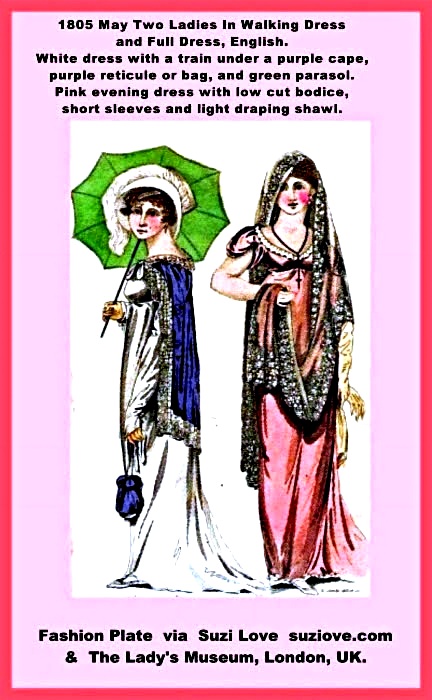
1805 May Two Ladies In Jane Austen Style Walking Dress and Full Dress, English. White dress with a train under a purple cape, purple reticule or bag, and green parasol. Pink evening full dress with low cut bodice, short sleeves and light draping shawl. via Vernon and Hood at The Lady’s Monthly Museum, London, U.K. Definition Reticule, or Ridicule, or Bag or Purse: Often with a drawstring to pull closed and usually made of cloth or covered cardboard and often decorated with beading or embroidery. A reticule, or purse, or handbag, was usually carried by a woman during the Regency period to carry all their daily necessities. Earlier, women used pockets that tied at the waistline and were hidden in the folds of their skirts. Empire style, or early 1800s, high-waisted dresses made it impossible to either sewn in a pocket or to tie on a pocket. So women began carrying small, decorated bags called Reticules, or ridicules, which generally pulled close at the top with a drawstring.
What was fashionable outdoor wear for the Bridgerton ladis, Jane Austen, and their contemporaries? Reticules, Spencers, and Pelisses, or Walking Dresses, Or Redingotes. History Notes Books 3, 4, and 5 By Suzi Love.
What was fashionable for purses in past centuries? Call them what you like: purses, bags, handbags, reticules, ridicules, clutches, or pocket replacements. They all did the same job and they changed greatly with the prevailing fashions of time. books2read.com/suziloveReticules
What was fashionable in women’s jackets in the Regency Era? Call them what you like: Spencers, short jackets, or Regency jackets. They provided modesty and warmth and they changed greatly with the prevailing fashions of the time. Take a look at the jackets being worn by women in the early 1800s. books2read.com/suziloveSpencers
What sort of coats did women wear during the Regency years? them what you like: Coat, Pelisse, Redingote, Walking Dress, Promenade Dress. Take a look at what was being worn by women, men, and children. books2read.com/suzilovePelisse
HN_4_Spencers, Or Jackets. #Regency #Georgian #Victorian #Fashion History Notes Book 4 By Suzi Love.
1780-1789 Linen Stays Or Corset, Great Britain. Stays, 1780-1789 (made). Linen, lined with linen and reinforced with whalebone, trimmed with pale blue silk ribbon. Hand sewn with linen thread, applied ribbon, chamois and whalebone.
Stays were an essential item of underwear for women during the 18th century. By the 1780s, the fashionable torso consisted of an inverted cone shape. Achieving smoothness of profile and firmness of contour were the primary function of 18th-century stays, rather than emphasising the bust or constricting the waist. Although custom-made and very intricately designed, stays were usually very plain. In this example a narrow blue ribbon covering the seams is the only decoration.
The narrow rows of very fine, even hand-stitching form the compartments into which thin strips of whalebone were inserted. Although the stays appear very rigid, whalebone was quite flexible. It had the added advantage of softening with the heat of the wearer’s body, allowing the stays to mould to her shape. When worn, the shaped and boned tabs at the lower edge would splay over the wearer’s hips, giving further fullness to the petticoat tied at the waist over the stays. Given by Mrs Strachan. Museum Number T.172-1914. Victoria and Albert Museum, London, U.K.
1813 October White Empire style, or high-waisted, Carriage Dress, English. Brown shawl, brown boots, and a lace cap tied under the chin. Typical of the carriage fashions that would have been worn by Jane Austen and her contemporaries. Fashion Plate via The Lady’s Magazine Or Entertaining Companion for the Fair Sex.
Definition Empire Style Dress: High-waisted white gown defined women’s fashion during the Regency Era. ‘Empire’ is the name given to the period when Napoleon Bonaparte built his French Empire. High-waisted, loose gowns were adopted by the aristocracy as a symbol of turning away from the fussy, elaborate and expensive clothing worn in the 1700s. https://books2read.com/SuziLoveFashion1810-1814
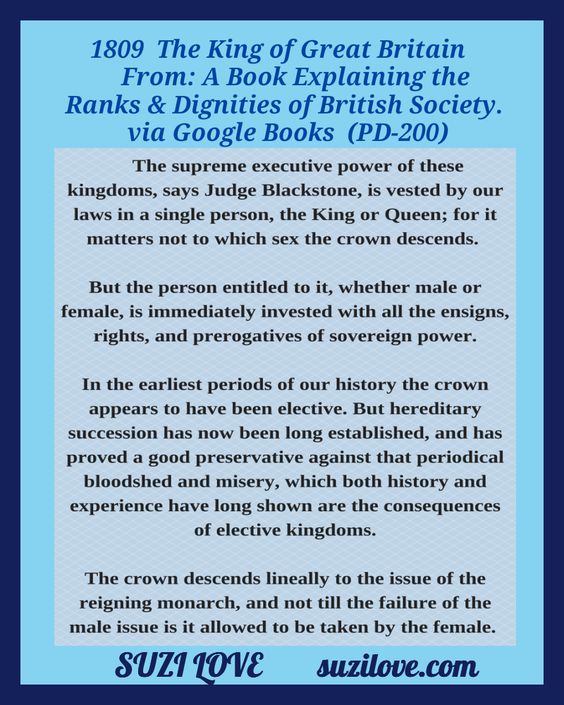
1809 The King Of Great Britain. From: 1809 A Book Explaining The Ranks and Dignities Of British Society. via Google Books. (PD-180) BRITISH RANKS, The King Of Great Britain and His Or Her Powers during Jane Austen’s lifetime.
BRITISH RANKS, THE KING .
The supreme executive power of these kingdoms is vested by our laws in a single person, the King or Queen, for it matters not to which sex the crown descends, but the person entitled to it, whether male or female, is immediately invested with all the ensigns, rights, and prerogatives of sovereign power .
In the earliest periods of our his tory the crown appears to have been elective. But hereditary succession has now been long established , and has proved a good preservative against that periodical bloodshed and misery, which both history and experience have long shewn are the consequences of elective kingdoms. The crown descends lineally to the issue of the reigning monarch , and not till the failure of the male issue is it allowed to be taken by the female.
Lawyers say the King of England is a mixed person, a priest as well as a prince and at his coronation he is anointed with oil, as the priests and kings of Israel were, to intimate that his person is sacred. The principal duty of the king is to govern his people according to law and these are the terms of the oath administered usually by the Archbishop of Canterbury at his coronation, in the presence of the people, who on their parts do reciprocally take the oath of allegiance to the crown : “ The archbishop, or bishop, shall say, Will you solemnly promise and swear to govern the people of this kingdom of England , and the dominions thereto belonging, according to the statutes in parliament agreed on and the laws and customs of the same?
The king or queen shall say , I solemnly promise so to do . Archbishop , or bishop .Will you to your power cause law and jus tice , in mercy , to be executed in all your judgments?
King or queen, I will, Archbishop , or bishop – Will you to the utmost of your power maintain the laws of God , the true profession of the gospel and the protestant reformed religion established by the law? And will you preserve unto the bishops and clergy of this realm, and to the churches com mitted to their charge, all such rights and privileges as by law do or shall appertain unto them or any of them ?
King or queen, All this I promise to do .
After this , the king or queen , laying his or her hand upon the holy gospels , shall say , The things which I have here before promised , I will perform and keep : so help me God . And then shall kiss the book .
One of the principal bulwarks of our liberty is the certain and definite limitation of the king’s prerogative, the extent and restrictions of which are marked out with the greatest clearness. But in the exertion of those powers which the LAW has given him , the king is irresistible and absolute. He is considered by the laws of England as the head and supreme governor of the national church and, in virtue of this authority, he convenes , prorogues , rogues , restrains , regulates , and dis solves all ecclesiastical synods or convocations. He has the supreme right of patronage over all ecclesiastical benefices and if they are not presented to within the time prescribed , their lapse becomes the advantage of the crown. In regard to foreign concerns, the king is the delegate or representative of his people. He has power, by his prerogative, with out any act of parliament, to make war or peace, conclude treaties, grant safe conducts, give commissions for raising and regulating fleets and armies, as well as for erecting, manning, and governing forts, and other places of strength. He can prohibit the exportation of arms and ammunition out of the kingdom, can dispose of magazines, castles, ships, public moneys, etc. and all that is done in regard to foreign powers by the royal authority, is the act of the whole nation. He has the sole power of sending ambassadors to foreign states, and receiving ambassadors at home. He convokes, adjourns, prorogues, and dissolves parliaments and may refuse his assent to any bill passed by both houses, without giving his reason for it .
He may increase the number of members of either house at plea sure, by creating new peers and bestowing privileges on other towns for sending burgesses to Parliament, but the last has by late kings been given up.
The sole power of conferring dignities and honors is entrusted to him so that all degrees of nobility and knighthood, and other titles, are received by immediate grant from the crown. And the king has also the prerogative of conferring privileges upon private persons such as granting place or precedence to any of his subjects such is also the power to enfranchise an alien and make him a denizen, and the prerogative of erecting corporations. The coining of money too, as well as the settling thedenomination or value for which it shall pass current, is the act of the sovereign power.
But to take all the characters into view in which the king is considered in domestic affairs would be almost endless for from thence an abundant number of prerogatives arise. All lands re covered from the sea , gold and silver mines, royal fishes etc. be long to him. He can unite, separate, enlarge, or contract the limits of ecclastical benefices and, by his letters, erect new bishoprics, colleges etc. He can dispense with the rigor of ecclesiastical laws except those which have been con firmed by act of parliament, or declared by the bill of rights. He has also power to moderate the rigor of the law to pardon a man condemned by law except in appeals of murder, and in case of impeachment by the house of commons, and to interpret by his judges in statutes and cases which are not defined by law.
But though he be entrusted with the whole executive power of the law, yet he cannot sit in judgment in any court for justice must be administered according to the powers committed and distributed to the several courts.
As the king is declared to be the supreme head in matters both civil and ecclesiastical so no suit can be brought against him even in civil matters because no court can have jurisdiction over him. The law also ascribes to the king in his political capacity absolute perfection. The king can do no wrong, by which ancient and fundamental maxim we are not to understand that every transaction of government is of course just and lawful but that whatever is exceptionable in the conduct of public affairs is not to be imputed to the king nor is he answerable for it personally to his people and farther that the prerogative of the crown extends not to do any injury. It is created for the benefit of the people and therefore cannot be exerted to their prejudice. In the king there can be no negligence and therefore no delay will bar his right. In the king also there can be no infamy, stain, or corruption of blood. And the law ascribes a kind of perpetuity, or immortality to him. His death is termed his demise , because the crown is thereby demised to another. He is not in law liable to Death, being a corporation of him self that lives for ever. There is no interregnum but the moment one king dies, his heir is king, fully and absolutely, without any coronation , ceremony etc. To these it may be added that by the law the king is said in a manner to be every where in all courts of judicature , which he alone has the right of erecting and therefore cannot be nonsuited.
The power of issuing proclamations is vested in the king alone, considered as the fountain of justice. The laws make it high treason barely to imagine or intend the death of the king, and because the destruction of the king may ensue that of his great counsellors or officers, it is felony in any of the king’s subjects to conspire even that. Some things the king cannot do. He cannot divest himself or successor of any part of the regal prerogative or authority and there are two things which he cannot do without the consent of Parliament:the making of new laws and the raising of new taxes. The king cannot dispense with the laws nor do any thing contrary to law. In England the law is as much superior to the king , as to any of his subjects and the obedienceof the king of England to the laws is his greatest glory while it is the security of the rights and liberties of his people who are the greatest as well as the freest people on the face of the earth , merely because their sovereigns are obliged to live insubjection to the written laws of the land.
The title of grace was first given to our kings about the time of Henry IV and that of majesty first to Henry VIII. The title of his present Majesty is , GEORGE the Third , King of the United Kingdom of Great Britain and Ireland, Defender of the Faith, Sovereign of the Orders of the Garter, Thistle, Bath and St. Patrick, Duke and Elector of Brunswick Lunenburg, Bishop of Osnaburg and Arch Treasurer of the Holy Roman Empire.
Michael Brandon travels to introduce the woman he loves to family but is shocked when his missing brother arrives. Four years ago, Melissa called herself a widow to protect her daughter. When her past lover returns from the dead, she’s forced to reveals the truth to him, and to her new love. Will the brothers forgive her deceit? https://books2read.com/suziloveDS
Keep Calm and Read my Scandalous Siblings Series Books 1-3. The scientifically gifted Jamison siblings beg assistance from the St. Martin clan to battle a greedy railway investment syndicate. https://books2read.com/suziloveES
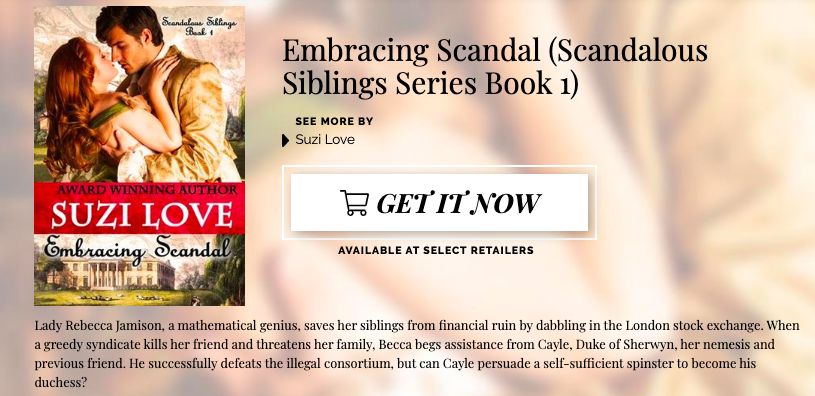
Embracing Scandal By Suzi Love Book 1 Scandalous Siblings. Lady Rebecca Jamison saves her family from financial ruin by investing in railways, but when a greedy syndicate murders her friend, Becca is forced to beg assistance from Cayle St. Martin, the new Duke of Sherwyn. https://books2read.com/suziloveES
Scenting Scandal Book 2 Scandalous Siblings Series. Lady Laura Jamison uses her extraordinary olfactory senses to sniff out her perfect match, but after she evades an assassin’s bullets, twice, she is forced to accept the protection of their family friend, and her nemesis, Richard St. Martin, the Earl of Winchester. https://books2read.com/suziloveSS
The Jamisons join the St. Martins at the duke’s country estate but a December snowstorm doubles guest numbers. #Holidays #FamilySaga #HistoricalRomance https://books2read.com/suziloveDS
ES_ Embracing Scandal Book 1 Scandalous Siblings Series D2D_ES_ https://books2read.com/suziloveES
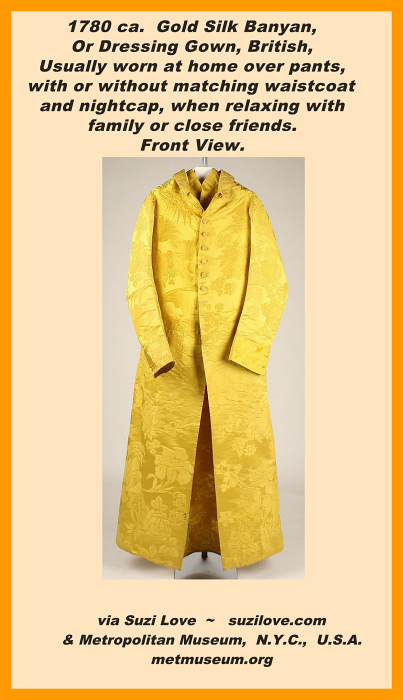
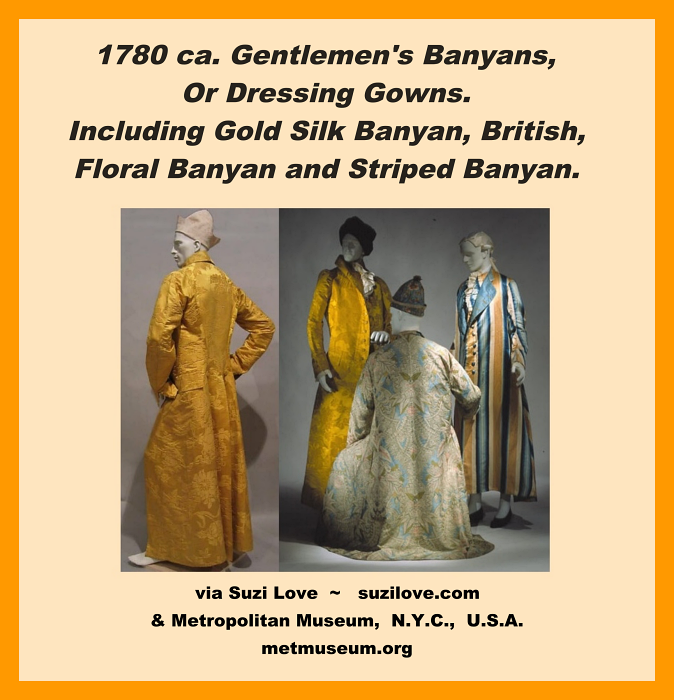
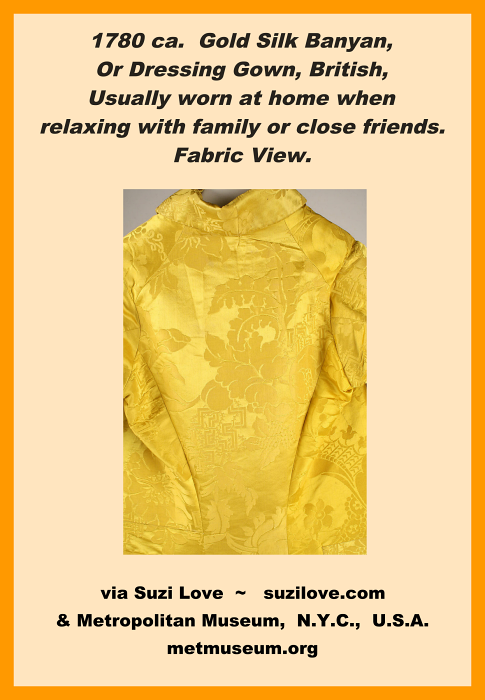
1780 ca. Gold Silk Banyan, British. For at-home wear, a gentleman had a dressing gown, often with a matching waistcoat, and an undress cap or turban. “This yellow damask banyan with its bold Chinese Chippendale – inspired pattern would have been an imposing sight on the streets or in the drawing rooms of London.” via Metropolitan Museum New York City, U.S.A. metmuseum.org Credit: Catharine Breyer Van Bomel Foundation Fund, 1978 Accession Number:1978.135.1
From the Curator: ‘For at-home wear, a gentleman had a dressing gown, often with a matching waistcoat, and an undress cap or turban.As for breeches, they were not designed especially for this casual ensemble, but rather borrowed from other suits.The dressing gown was cut like a man’s loose coat and usually hung to the floor, though there were also versions that stopped below the knees. Since there were no fastenings, the wearer overlapped the dressing gown in front when he walked so that the sides did not billow out behind him.The sleeves were originally rolled back to form cuffs, but later dressing gowns display the fashionable cuff of their period.In England these dressing gowns were called “banyans” or “Indian nightgowns” because of their kimono-like form and Eastern origin. Banyans were made in a variety of fabrics, including silk brocades, damasks, and printed cottons. By the 1780s, gentlemen ventured out of doors in this comfortable and stylish costume. According to Town and Country Magazine in 1785: “Banyans are worn in every part of the town from Wapping to Westminster, and if a sword is occasionally put on it sticks out of the middle of the slit behind. This however is the fashion, the ton, and what can a man do? He must wear a banyan.”This yellow damask banyan with its bold Chinese Chippendale – inspired pattern would have been an imposing sight on the streets or in the drawing rooms of London.’ via Metropolitan Museum New York City, U.S.A. metmuseum.org
1780 ca. Front View. 1780 ca. Back View.1780 ca. Back View. 1780 ca. Fabric View. RL_2_D2D_RetailerBuyLink_RL_2
https://books2read.com/suziloveYGD
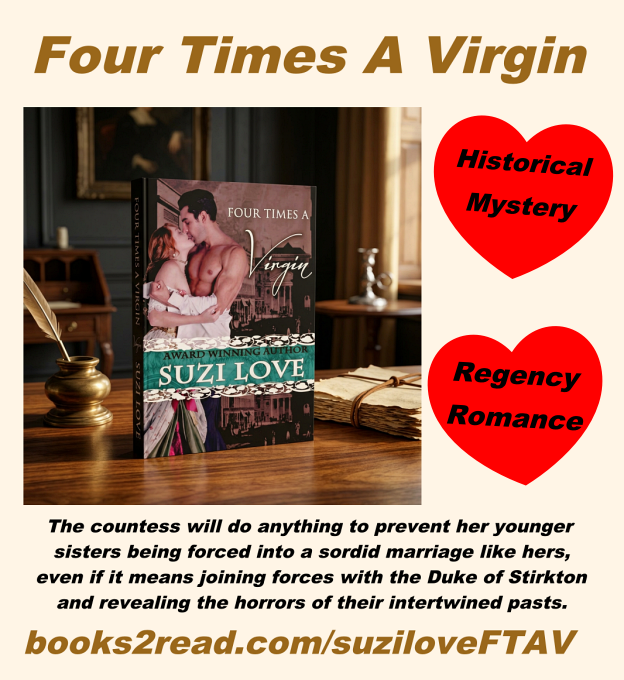
As the Duke of Stirkton, Max was well accustomed to being watched. Young pups copied his dress style. Toad-eaters mimicked his behavior in futile attempts to ingratiate themselves into his life. Conservative groups applauded his somber public behavior, while cartoonists ridiculed his straight-laced demeanor and suggested he take a mistress. Or two.
Whichever way people viewed him, no one had dared ridicule him to his face. Until this evening. The Countess had side-stepped his butler and marched into his drawing room as if an unannounced call upon an unmarried duke was something she did regularly. Max had informed her, in great detail, of the extensive search he and his cousin had undertaken to locate her and the other women. She’d huffed and rolled her eyes.
Normally, his month-about- mistresses gleefully accepted his proposal because sharing a duke’s bed for a month would set them up for the rest of their lives. Apart from the financial benefits, he was a generous lover. One benefit of his abnormal upbringing had been an early and full education into what women wanted in a bed partner. Until the Countess had laughed at him, he’d never had reason to doubt his sexual prowess. In the brief time she’d been in his house, she’d challenged several of his beliefs.
“It’s the ideal solution.” And something he needed. “I will help you search my grandfather’s boxes by day and, in exchange, you’ll make yourself available to me in the evenings.” Max waited, unsure what to expect. An odd situation for a man who prided himself on reading adversaries as easily as he tallied the accounts. books2read.com/suziloveFTAV