1787 December Yellow striped dress, red hat with a white feather and a large fur muff, French. via Magasin des Modes.



1787 December Yellow striped dress, red hat with a white feather and a large fur muff, French. via Magasin des Modes.
1815 Arundel Fete Dress and Baronial Helmet, English. White dress with purple bodice and hem with matching shawl and plumed headdress. Skirt of white crape over white satin, a double row of novel and elegant trimmings on the bottom, two falls of the crape, set on full, are edged with silk. Body comes high on each side of the bosom and is shaped so as to display the neck and shoulders, and both body and sleeves are formed and trimmed in the most exquisitely tasteful manner. A superb cord and tassels confines the waist and ties in front. The Baronial Helmet is striking and made of white sarsnet or satin and white lace and superbly ornamented with feathers. Jewelry set, or Grand Parure, of necklace, bracelets. ear-rings, and small French locket of pearl. White kid slippers and gloves. Full Dress for evening would most likely be a dress of silk or satin, perhaps with a transparent overlay of netting, tulle etc., embellished with taffeta, ruffles and ribbons, and with a full range of accessories including a Grand Parure of tiara and other matching jewelry. https://books2read.com/SuziLoveFashionWomen1815-1819
La Belle Assemblee: Fashion Plate via John Belle’s La Belle Assemblée or, Bell’s Court and Fashionable Magazine, London. Many of the fashion plates seen in La Belle Assemblée and The Repository of Arts were designed by Mrs. Bell who had her dressmaking showroom in Bedford Square, London, and was related to John Bell who published La Belle Assemblée. It seems that she designed for at least two fashion magazines and so there is a cross-over of designs in different magazines.
Grand Parure: A Parure is a matched set of jewelry, including a necklace, bracelet, earrings, pin etc. and a Grand Parure often includes a tiara or other headdress.


And no wonder it took both sexes so long to dress every day, often changing clothes four or five times a day!
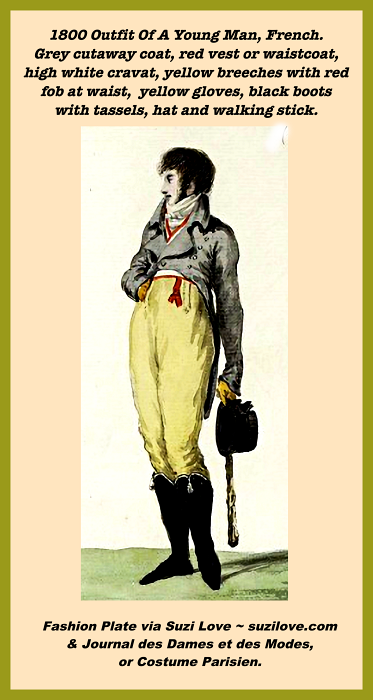
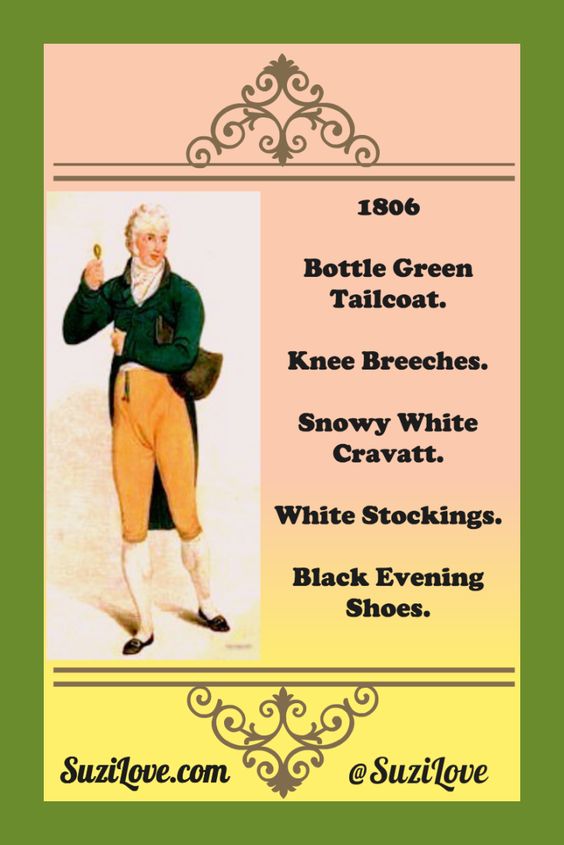
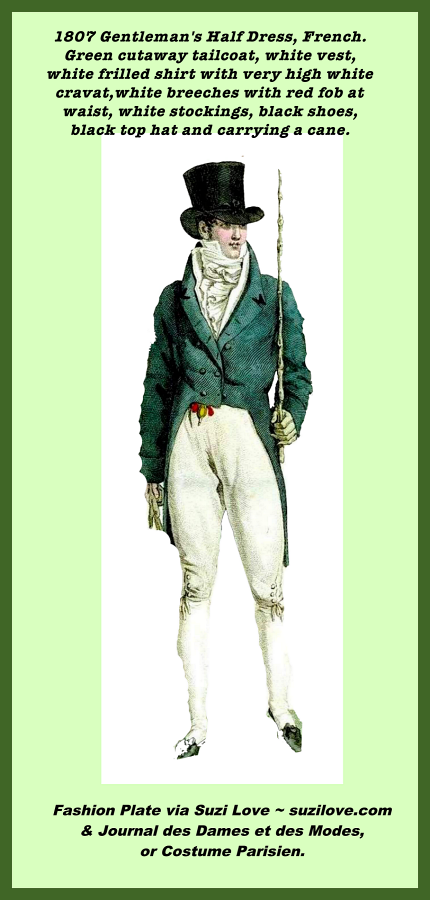
Early on were Breeches – Short, close-fitting trousers that fastened just below the knees or above the ankles, with a horizontal front flap called the ‘fall’ and were worn with stockings. Boys of 3 – 6 years stopped wearing loose dress-type children’s garments and went into short pants instead, and were considered ‘breeched. In Regency times, breeches were worn tighter to show off a manly physique.
Then of course we had Pantaloons
By the late 1810s and beyond, these became popular and eventually they evolved into full length trousers. Originally pantaloons were made to suit shorter Hessian boots that fell below the typical knee-breech level and they were worn very form-fitting.
Buckskins – Fashionable trousers made from deer skin also showed off every curve of the man’s figure. How could ladies not want to peek? Oooh, what a display of fine, manly figure!! Swoon!
And so to more modern Trousers – The word Trouser came into usage in the late 1600?s, so we’ve had trousers around for a long time. But at first, they were mostly for lower classes. Revolutionary France started a trend for sans-culottes, which meant trousers or pantaloons instead of culottes, or knee breeches, which were associated with the aristocracy.
The styles of the revolution moved across to England and were taken up by those who either sided with revolutionary ideals or who took them up as part of a protest against the establishment set.
Early trousers looked strange because they were generally a bit looser than pantaloons or breeches, and ended at the ankles with slits on the side for foot access. They often needed under-the-foot straps to fix them in place.
Now here’s a couple of insider tips from a gentleman’s valet for you to remember –
– False calves can be created by padding so that a master’s calves fill out his stockings and make him look more muscular, especially when he is wearing knee-breeches. Every woman’s dream!
– For rotund gentlemen, tightly pulled corsets help keep the paunch to a minimum and enhance his figure.
– To keep trousers in place and prevent disgrace, braces( suspenders) can be worn under vests.
Even in cases of his master’s over-imbibing, or just plain clumsiness, a valet can ensure his lordship remains correctly clothes at all times when representing the household in public by taking a few early precautions.
Imagine the poor valet’s work if – a gentleman rode before breakfast – changed to join the family– spent the morning boxing with friends in looser attire – changed for lunch at his club with peers – changed for afternoon calls or a drive in the park with the women- changed for dinner with friends – changed into evening dress for a formal ball- arrived home just before daylight to change into his banyan( robe) to smoke his cheroot before bed – then rose 3 hours later expecting his clothes laid out so he could do it all over again.!!
No, I seriously do not want to go back in time and become either a lady’s maid or a gentleman’s valet
– although, if I had the choice…
Hmmmm….being in a gentleman’s bedroom…. does hold a certain appeal.
Suzi Love





Regency Life Series: Images, information, funny anecdotes give overview of Jane Austen’s and Bridgerton times. #bridgerton #RegencyEra #JaneAusten #BritishHistory https://books2read.com/suziloveROver
Continue reading →1879-1885 ca. Linen Riding Corset, English. https://books2read.com/SuziLoveCorsetBook19 Woven linen corset, weighs 0.14kg, and worn for riding. Made on a loom with pockets for bones and busk, woven corsets were lightweight, flexible, washable and patented in France in 1832 by Jean Werly. Stitched corsets made from seamed pattern pieces provided more support when on horseback. Manufacturer: Charles Bayer. via Victoria and Albert Museum, London, UK.
What did an older lady do and wear in the Regency Era? Information & pictures for readers and writers of early 1800s history, nonfiction and fiction. books2read.com/suziloveOLD
The older lady’s day usually started with her toilette in her bedroom, where her maid helped her dress for the day and styled her hair. After that, she would join her family downstairs for breakfast unless she preferred a tray with either tea or hot chocolate in her bedroom as she prepared for her busy day. Her day would be made up of speaking with the housekeeper and the cook about the week’s menus, assuring that the servants were all available that day and no one was ill, and checking the list of foods needed. She would also enquire if the laundry was up to date and that they had enough good linen to make up all the beds before extended family members and guests arrived. If she was in the country and hosting a weekend house party, she would assign rooms to the guests on her lists and query that all was in readiness for their arrival.
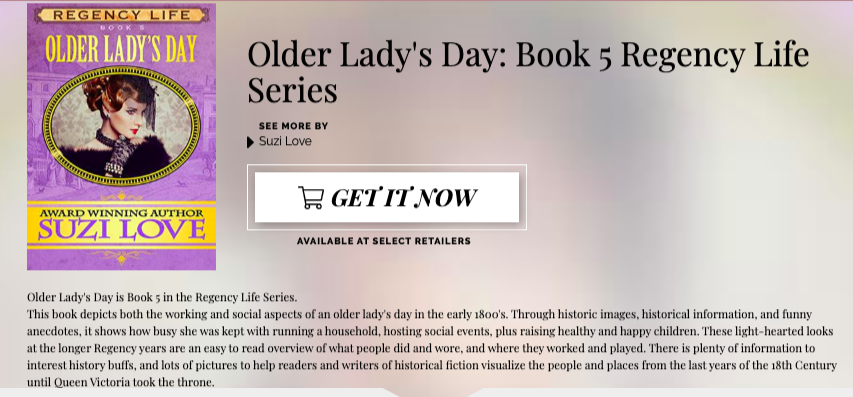
What was fashionable for women in Jane Austen’s times? Mourning, riding, daytime, evening clothing, plus underclothing, corsets and accessories. Fashion Women 1810-1814 History Notes Book 27 This book looks at what was fashionable for women in Jane Austen’s times, or the early 1800s, or the Regency Era in Britain. Wars were being fought around the globe so women’s fashion adopted a military look in support of soldiers. Fashions, like the lifestyle, became progressively more extravagant and accessories went from colorful to over-the-top. https://books2read.com/SuziLoveFashion1810-1814
The Lady’s Magazine said of the basis of women’s fashion that was popular for the first twenty years of the 1800s, ‘White is still the prevailing color for robes. For morning dresses, linen gowns, in large diamonds or squares, are fashionable. Indian muslins, plain or embroidered, are preferred to Florence and satins. The designs of embroidery for shawls are of infinite variety. Long gloves, which reach above the elbow, are not yet laid aside. Medallions are hung around the neck from crossed chains and some of these medallions are shaped like the bags, called ridicules. These reticules are of the lozenge or hexagon shape, with a small tassel at each angle. Reticules, or ridicules, are in lozenge or hexagon shapes with a small tassel at each angle. In capotes, or hats, and ribbands, the violet and dark green prevail over jonquil. Bracelets in hair, pear-shaped ear-rings, medallions on square plates, saltiers of colored stones, are still in fashion.’
What did ladies do and wear in Jane Austen’s time, or early 1800s? #Regency #History #nonfiction Books 4 and 5 Regency Life Series. Young Lady’s Day and Older Lady’s Day in Books 4 and 5 in the Regency Life Series.
These books depict the often-frivolous life and fashions of ladies in the early 1800’s, or during the lifetime of Jane Austen, but also gives a glimpse into the more serious occupations ladies may undertake. Through historic images, historical information, and funny anecdotes, they show how a lady fills her day, where she is permitted to go, and who she spends time with. These light-hearted looks at the longer Regency years are an easy to read overview of what people did and wore, and where they worked and played. There is plenty of information to interest history buffs, and lots of pictures to help readers and writers of historical fiction visualize the people and places from the last years of the 18th Century until Queen Victoria took the throne. Young Lady’s Day ~ Older Lady’s Day

1818 ca. Elegant black evening dress as would have been worn in the times of Jane Austen when attending evening events, such as dinners, concerts, musical evenings or the opera. British, Empire style, or high-waisted dress of machine-made silk net, embroidered with silk, trimmed at the hem with padded black satin rouleaux and rosettes, long straight sleeves under shoulder puffs. Machine-made net was a very popular background for embroidery and laces in early 1800s and the airy texture suited loose and flowing Empire style fashions. Victoria and Albert Museum, London, UK.
collections.vam.ac.uk.

1805-1810 ca. High-waisted evening gown, French, and shawl. Typical of the dresses and shawls in the wardrobe of every woman in the times of Jane Austen. Evening dress of white muslin, embroidered all over in white cotton in French knots, with collar, hem, and centre stripe in chain stitch, low square neck adjusted with draw-cord, high waist, skirt gathered at back, short sleeves with vandyke trim.
Typical Neo-classical dress imitating Greek and Roman sculptures, white muslin fabric either
imported from India or made in Europe to imitate Indian materials. Scarf of knitted silk printed in
similar pattern to popular Indian cashmere shawls. via Victoria and Albert Museum, London, UK. collections.vam.ac.uk.

