Top Hat Styles Chart during the 1800s, from the Regency Era through to the Victorian years. Most popular style was cone shaped and tall in height. Originally made of beaver and very short but later from silk and taller. Tall crown, widens at top, narrow brim turns up slightly at sides. https://books2read.com/SuziLoveFashionMen1800-1819
1818 Walking Dress and Redingote, French. White walking dress under a royal blue redingote, or pelisse, or coat, with a wide fur trim and high shawl collar and with a large bonnet with black plume. The type of outfit young Regency Era ladies would have worn if they were out shopping on Bond Street, walking in a park, or taking a carriage ride through Hyde Park. Fashion Plate via Journal des Dames et des Modes, or Costume Parisien. .
Definition Redingote Or Pelisse Or Walking Dress Or Coat: French word developed from English words, riding coat. Long fitted outdoor coat worn over other garments for warmth. Often left open at the front to show off the dress underneath. Sometimes cut away in front. Originally made with several capes and trimmed with large buttons. French fashion plates call these coats Redingotes and they are designed for women, men and children. English fashion plates call them a Pelisse, a walking dress, Promenade dress, or Carriage dress.
1790-1810 ca. Woman’s Black Wool Shoes. Pointed toe and low wedge heel covered in same fabric, black tape binding, leather straight or symmetrical sole, linen insole and lining. Wool satin with wool twill tape binding, plain weave linen lining, and leather sole. Place of Use: Lexington, Massachusetts, United States. Place of Manufacture: possibly Massachusetts, United States Provenance: Worn by a member of the Robbins family; inherited by Ellen A. Stone; gift to MFA, 1899. Credit Line Gift of Miss Ellen A. Stone via Museum of Fine Arts, Boston, U. S.A.
In Jane Austen’s years, she and her contemporaries spent a lot of time outdoors. Fragile slippers were worn for balls and evening events but for walking sturdier shoes were needed, In the early 1800s, these were typically made of leather and were flat or had a very small heel.
1808 Two Ladies, French. Apricot Evening Dress Or Moire Brochee, French. Patterned dress with very low cut bodice, short sleeves, long white gloves, and holding a Lorgnette, or looking glass, and a handkerchief. Grey Redingote with high waist and holding a red shawl. Fashion Plate via Journal des Dames et des Modes, or Costume Parisien.
The French magazine, Journal des Dames et des Modes, frequently made fashion plates with a single woman, two women or a woman with a man where they wear the same outfit. The two variations show innovative ideas for decorating plain white muslin dresses with a range of colorful accessories, and the early 1800s were definitely the years when accessories were the fashion highlight. Add a pair of colorful long gloves, a draped shawl or scarf, a reticule, handkerchief, fan or looking glass and the typical white dress is given individuality and personality.
Here is the companion to the above fashion plate with the single lady in her apricot dress. The lady in a grey Redingote is added.
1808 Two Ladies, French. Apricot Evening Dress Or Moire Brochee, French. Patterned dress with very low cut bodice, short sleeves, long white gloves, and holding a Lorgnette, or looking glass, and a handkerchief. Grey Redingote with high waist and holding a red shawl. Fashion Plate via Journal des Dames et des Modes, or Costume Parisien. Fashion Women 1805-1809 History Notes Book 26 What did Jane Austen and friends wear? https://books2read.com/SuziLoveFashionWomen1805-1809
1818 Blue Spencer Of Levantine, French. White cotton print dress with ruffled hem, high plumed bonnet and a neck scarf.
Definition Levantine: Stout silk cloth in twill weave. First made in the Levant, a large area in the Eastern Mediterranean region of Western Asia.
Definition Spencer: Short jacket, cropped at the waist, worn over a dress, or gown. These close-fitting, tight sleeved, waist length jackets were modeled on a gentleman’s riding coat, but without tails. Delicate and regency dresses provided so little protection from the cold, so over garments were essential for warmth, modesty and good health.
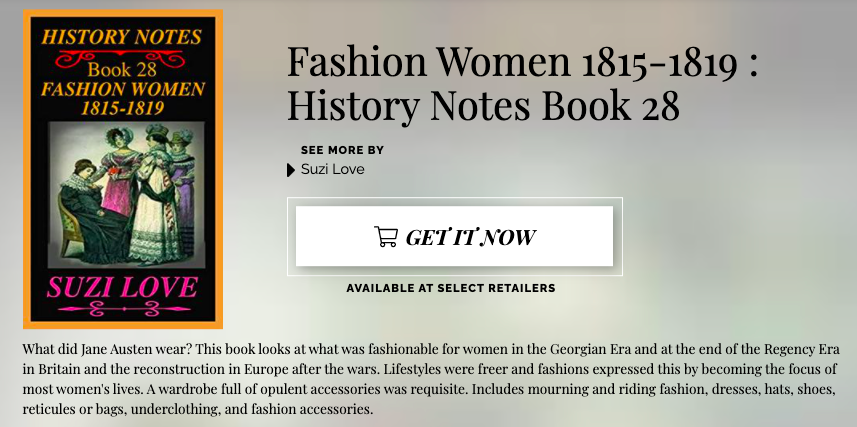
Fashion Women 1815-1819 History Notes Book 28 https://books2read.com/SuziLoveFashionWomen1815-1819
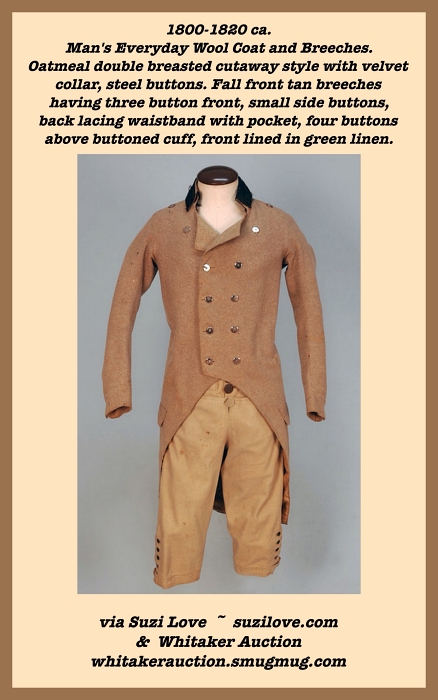
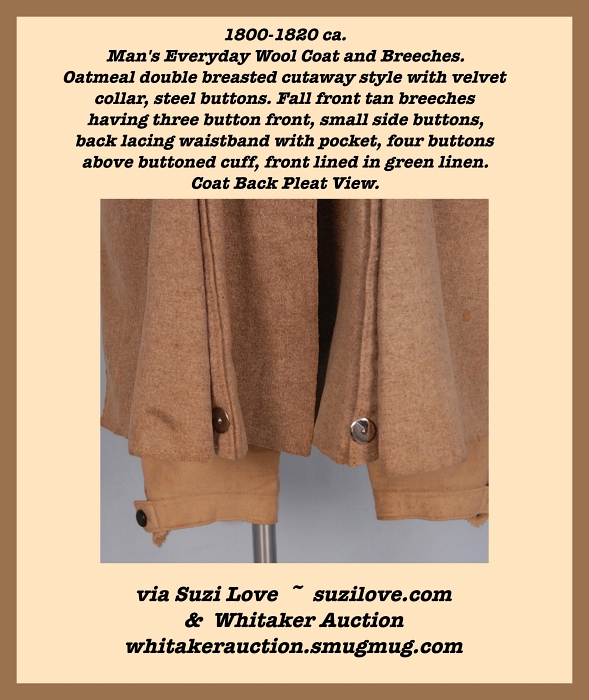
1800-1820 ca. Man’s Everyday Oatmeal Colored Wool Suit With Breeches. Can you picture Jane Austen’s male relatives and friends wearing this? Oatmeal colored double breasted cutaway style coat with velvet collar, steel buttons, rear flap pockets, back vent flanked by stitched down pleats having top and bottom button detail, glazed linen lining. Fall front tan breeches having three button front, small side buttons, back lacing waistband with pocket, four buttons above buttoned cuff, front lined in green linen. via Whitaker Auction whitakerauction.smugmug.com
1836-1840 ca. Floral Print Cotton Dress With Silk Satin Piping, English. Cotton printed in soft pink, red, white, and green floral motif on light brown, edged with green silk satin piping and lined with linen and cotton. Sleeves tightly gathered, loose at elbow, skirt gathered from tight fitting bodice edged with green satin piping. via Victoria and Albert Museum, London, UK. collections.vam.ac.uk.From the Museum: Soft colours and floral patterns are a distinctive feature of many 1830s day dresses. Here, pink, red and white flowers harmonise with the brown ground and green piping. The construction of the sleeves is also interesting as they are tightly gathered at the top and loose around the elbow. This accentuates the slope of the shoulder and the tightness of the wrist.
1797 Elegant Couple Dancing At A Ball. Man: Bottle green tailcoat, yellow knee breeches, white stockings, red vest and black dancing slippers. Lady: White spotted dress with a pale pink overdress open at the front, high belted waist, red and green turban and a parure, or jewelry set. via Fashion Plate via Journal des Dames et des Modes, or Costume Parisien.
HN_2_D2D_Fashion Men 1700s
books2read.com/suziloveFashMen1700
1800-1815 ca. Fan of Bone and Silk, French. Jane Austen and her family and friends would have carried this style of fan when attending assemblies, musical evenings and balls. Metropolitan Museum New York City, U.S.A. metmuseum.org
1800-1815 ca. Fan of Bone and Silk, French. via Metropolitan Museum New York City, U.S.A. metmuseum.orgHN_27_D2D_fashwomen1810-1814
https://books2read.com/SuziLoveFashion1810-1814
1808 January Trio In Half Dress Walking Ensembles, English. Lady on left wearing a pink dress and green coat and carrying a reticule. Lady on right in a white trained dress, long draping shawl and fitted hat. Gentleman in a blue tailcoat, white vest, extra high white cravat, knee breeches, shoes, and black top hat. Fashion Plate via Le Beau Monde. The sort of outfits ladies and gentlemen in Jane Austen’s times would have worn while out walking, shopping, or going to visit friends.
Fashion Women 1805-1809 History Notes Book 26 What did Jane Austen and friends wear? https://books2read.com/SuziLoveFashionWomen1805-1809