18th Century Gustavian Sofa with Bow Carving. via 1st Dibs Auctions.




18th Century Gustavian Sofa with Bow Carving. via 1st Dibs Auctions.
1798 Gentleman’s Outfit, French. Long green overcoat with yellow buttons, tan gloves, black boots topped with yellow band, gloves with three seams across the back of the hand, high white cravat, black hat, fob at his waist and holding a cane. Fashion Plate via Journal des Dames et des Modes, or Costume Parisien.


19th Century Early Women’s Cotton Caps. Worn as morning caps, night caps, or under other hats. With lappets, hanging ties, or tails, which were also called ‘follow me lads’, or ‘flirtation ribbons’. via Museum of Fine Arts, Boston, U.S.A. mfa.org. via Museum of Fine Arts, Boston, U.S.A. mfa.org
Definition Caps: Worn as morning caps, night caps, or under other hats. Jane Austen and her family and female friends would have worn caps like these, sometimes during the morning at home, to bed to keep their long hair from becoming knotted, or under a bonnet to hold a hairstyle in place.
Caps sometimes had hanging ties, or tails, were also called ‘follow me lads’, or ‘flirtation ribbons’.
Definition Lappets: Two long strips of material, often lace, hanging from top of head down back or over shoulders. Sometimes extensions of a headdress and a requirement for court dress.


19th Century First Half Woman’s Embroidered Cap, French. In the 19th Century, women wore some sort of headwear during the day and the evening. Finely decorated cotton caps were worn during the morning with informal or At-Home, dress and at night with nightwear. These caps had fine embroidery, ruffles, lace edgings on the streamers, embroidered, pointed edges of the ruffles, ties, and streamers, known as ‘follow me lads’ or ‘flirtation ribbons’.
19th Century First Half Woman’s Embroidered Cap, French. Cotton mull with cotton embroidery, linen bobbin lace insertion, silk ribbon, round gathered crown with spoked wheel design in center surrounded by long leafed wreath, outside this a wreath of carnations, same carnations around forehead band and neck band, design embroidered with white linen thread, white taffeta ribbon run through the embroidered net casing and tied in center back. via Museum of Fine Arts, Boston, U.S.A. mfa.org

Chatelaines and Chains History Notes Book 9 By Suzi Love. What do you know about Chatelaines and Chains worn in Jane Austen’s and Bridgerton times? Women in charge of households carried important items with them. History Notes Book 9 Chatelaines and Chains. books2read.com/SuziLoveChatelaines
Personal Necessities, keys, or chatelaines was a set of useful items hung from waist by decorative chain. Chatelaines and Chains. History Notes Book 9 By Suzi Love. Women in charge of households dangled long chains from their waists to keep essentials within easy reach e.g. keys, notebook and pen, watch, sewing items, vinaigrette or perfume, or magnifying glass. Early chatelaine were simple essentials. Later chatelaine were decorative and expensive. http://books2read.com/SuziLoveChatelaines

Definition Chatelaine: The word Chatelaine is French and means the keeper of the keys. Chatelaine” derives from the Latin word for castle. In Medieval times, the chatelaine was in charge of the day-to-day running of the castle. Women in charge of households dangled long chains from their waists to keep essentials within easy reach e.g. keys, notebook and pen, watch, sewing items, vinaigrette or perfume, or magnifying glass. Early chatelaine were simple essentials. Later chatelaine were decorative and expensive. books2read.com/SuziLoveChatelaines
What did a chatelaine do? Most important task was keeper of the keys. Also ordered supplies, did bookkeeping, supervised servants, taught castle children, and organized guests.
hat were chatelaines used for?

1815 Blue Striped Dress, Norway. Empire style, or high-waisted, dress with short puffed sleeves over long straight sleeves and gold trim. I can picture Jane Austen and her female friends and family wearing this sort of dress to an evening event. via Nordiska Museet, Nordic Museum, Stockholm, Sweden. digitaltmuseum.se


1810–1850 ca. Corset, American or European. Front lacing, extra wide straps for under a
square neckline dress. via Metropolitan Museum, N.Y.C., U.S.A. metmuseum.org

Surviving stays, or corsets as they became to be called in the nineteenth century, show that both longline and shorter corsets were worn and that they were made of cotton, silk and sateen. A lot of these corsets were front fastening, plus many were laced at both the front and the back so our aristocratic fictional heroines could indeed dress and undress themselves without the assistance of a maid.
Corsets 1810-1830 History Notes Book 17 This book shows how corsets changed to fit well under clothing, give maximum support and comfort. Corsets pushed up breasts and showed off the bust line beneath a square-cut and low-cut neckline as in the early 1800s, or Regency years. Jane Austen and her female and friends wore these corsets. https://books2read.com/SuziLoveCorsetBook17
1810-1850 ca. Bridgerton or Jane Austen Style Front Lacing Corset With Extra Wide Straps, American Or European. #Bridgertons #JaneAusten #RegencyFashion #Corset #RomanticEra https://books2read.com/SuziLoveCorsetBook17 Share on X
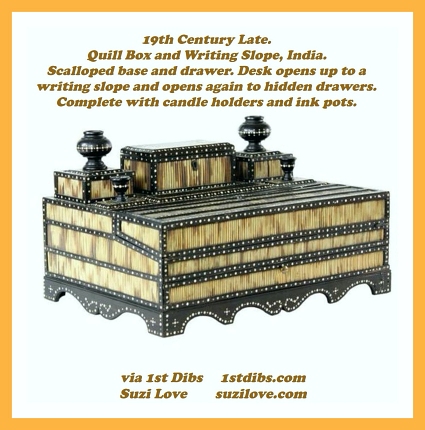
19th Century Late. Quill Box and Writing Slope, India. Scalloped base and drawer. Desk opens up to a writing slope and opens again to hidden drawers. Complete with candle holders and ink pots. The type of inkstand that households woulds have in Jane Austen’s times for writing letters and keeping track of estate matters. Many of these exotic and decorative items were brought to England by gentlemen doing their Grand Tour through Europe and Asia. via 1st Dibs Auctions ~ 1stdibs.com
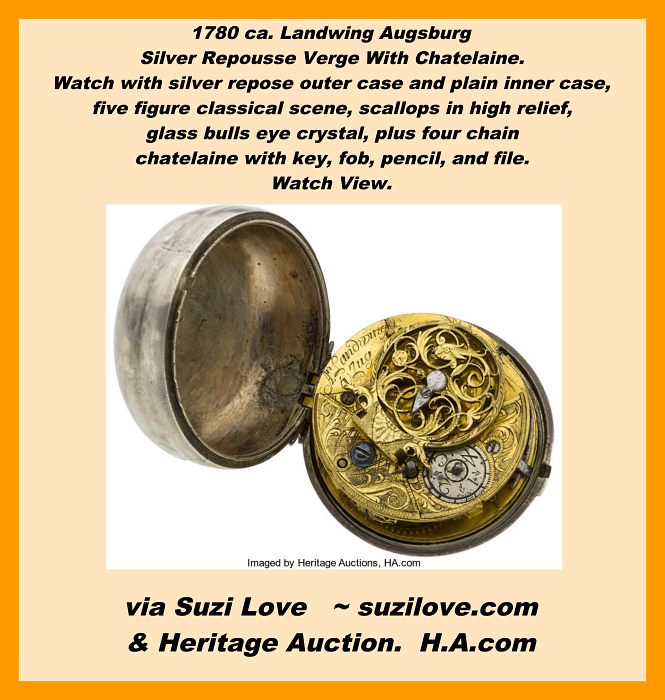
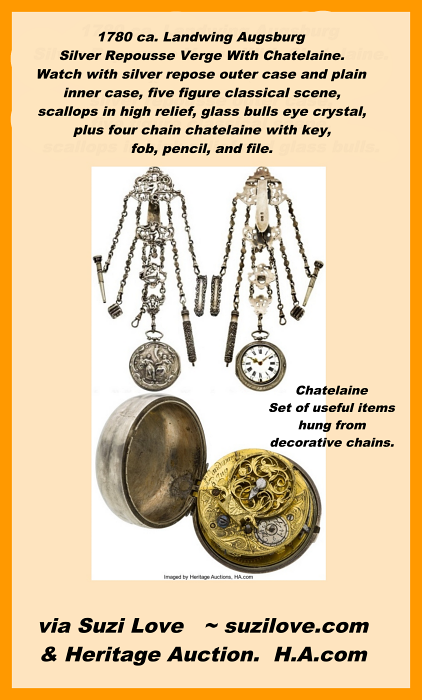
1780 Watch on a Chatelaine, Germany. Silver Repousse Verge With four chain chatelaine. via Heritage Auction H.A.com.
Definition Chatelaine: The word Chatelaine is French and means the keeper of the keys. Chatelaine” derives from the Latin word for castle. In Medieval times, the chatelaine was in charge of the day-to-day running of the castle. What did a chatelaine do? Most important task was keeper of the keys. Also ordered supplies, did bookkeeping, supervised servants, taught castle children, and organized guests. books2read.com/SuziLoveChatelaines
What were chatelaines used for?


1798 Woman’s Light Blue Douillette, Or Housecoat, French. Trimmed with pink velvet, pink fan, black slave sandals, apricot hat with black trim. Fashion Plate via Journal des Dames et des Modes, or Costume Parisien.
Description Douillette: A coat or housecoat, sometimes quilted, worn in France.

