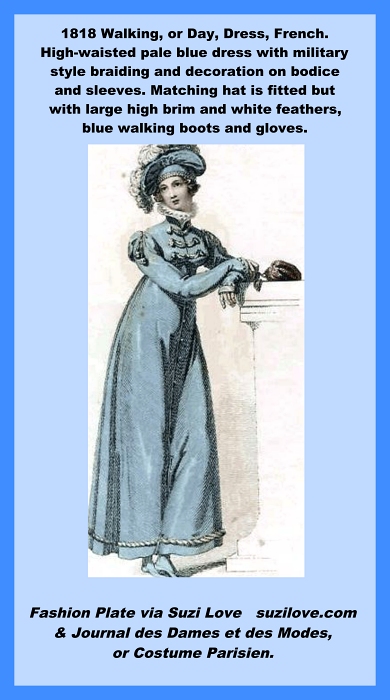
1787 December Yellow striped dress, red hat with a white feather and a large fur muff, French. via Magasin des Modes.


1787 December Yellow striped dress, red hat with a white feather and a large fur muff, French. via Magasin des Modes.


And no wonder it took both sexes so long to dress every day, often changing clothes four or five times a day!
Early on were Breeches – Short, close-fitting trousers that fastened just below the knees or above the ankles, with a horizontal front flap called the ‘fall’ and were worn with stockings. Boys of 3 – 6 years stopped wearing loose dress-type children’s garments and went into short pants instead, and were considered ‘breeched. In Regency times, breeches were worn tighter to show off a manly physique.
Then of course we had Pantaloons
By the late 1810s and beyond, these became popular and eventually they evolved into full length trousers. Originally pantaloons were made to suit shorter Hessian boots that fell below the typical knee-breech level and they were worn very form-fitting.
Buckskins – Fashionable trousers made from deer skin also showed off every curve of the man’s figure. How could ladies not want to peek? Oooh, what a display of fine, manly figure!! Swoon!
And so to more modern Trousers – The word Trouser came into usage in the late 1600?s, so we’ve had trousers around for a long time. But at first, they were mostly for lower classes. Revolutionary France started a trend for sans-culottes, which meant trousers or pantaloons instead of culottes, or knee breeches, which were associated with the aristocracy.
The styles of the revolution moved across to England and were taken up by those who either sided with revolutionary ideals or who took them up as part of a protest against the establishment set.
Early trousers looked strange because they were generally a bit looser than pantaloons or breeches, and ended at the ankles with slits on the side for foot access. They often needed under-the-foot straps to fix them in place.
Now here’s a couple of insider tips from a gentleman’s valet for you to remember –
– False calves can be created by padding so that a master’s calves fill out his stockings and make him look more muscular, especially when he is wearing knee-breeches. Every woman’s dream!
– For rotund gentlemen, tightly pulled corsets help keep the paunch to a minimum and enhance his figure.
– To keep trousers in place and prevent disgrace, braces( suspenders) can be worn under vests.
Even in cases of his master’s over-imbibing, or just plain clumsiness, a valet can ensure his lordship remains correctly clothes at all times when representing the household in public by taking a few early precautions.
Imagine the poor valet’s work if – a gentleman rode before breakfast – changed to join the family– spent the morning boxing with friends in looser attire – changed for lunch at his club with peers – changed for afternoon calls or a drive in the park with the women- changed for dinner with friends – changed into evening dress for a formal ball- arrived home just before daylight to change into his banyan( robe) to smoke his cheroot before bed – then rose 3 hours later expecting his clothes laid out so he could do it all over again.!!
No, I seriously do not want to go back in time and become either a lady’s maid or a gentleman’s valet
– although, if I had the choice…
Hmmmm….being in a gentleman’s bedroom…. does hold a certain appeal.
Suzi Love


Are you a Bridgerton fan? Love Jane Austen? Love history? Take a look at a Young Gentleman’s Day in early 1800s. Young Gentleman’s Day Regency Life Series Books 2 by Suzi Love. Easy to read books on what a young gentleman did, wore, and lived during the early 1800s, or the Regency Era when King George 3rd was mad and his son, Prince George, was the Regent in Britain. #Regency #JaneAusten #amwriting books2read.com/suziloveYGD


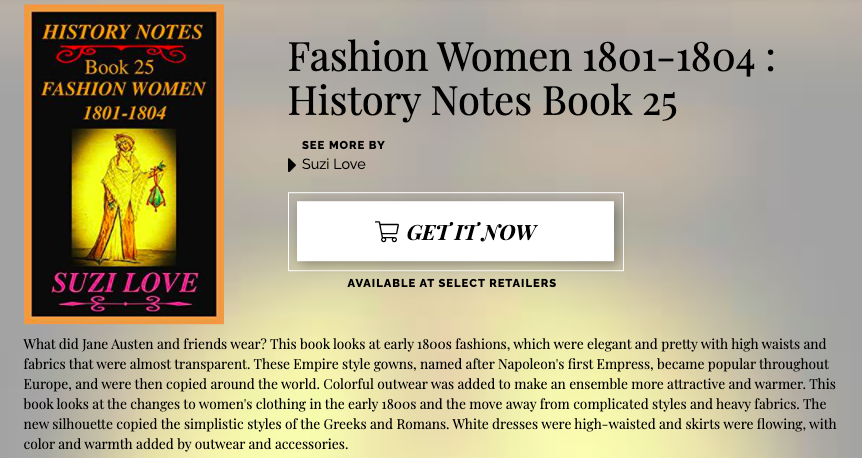
Writer Or Reader Of Regency Era?What did Jane Austen and friends wear? Women’s clothing changed dramatically in early 1800s. New silhouette copied simplistic styles of Greeks and Romans. High-waisted white dresses and flowing skirts with color and warmth added by outerwear and accessories. Fashion Women 1801-1804 History Notes Book 25 https://books2read.com/SuziLoveFashionWomen1801-1804
Definition Empire Style Dress: High-waisted white gowns defined women’s fashion during the Regency Era. ‘Empire’ is the name given to the period when Napoleon Bonaparte built his French Empire. High-waisted, loose gowns were adopted by the aristocracy as a symbol of turning away from the elaborate clothing worn in the 1700s. This sort of high-waisted dress would have been worn by Jane Austen and her contemporaries in England.
Definition Shawls: The shawl started off in India as a fine wool garment for men that could be worn as a scarf, turban or as a mantle: the word comes from the Persian shäl. Originally imported from the East, European Kashmir shawls were made first in Norwich and Edinburgh in Britain in the late 18th century. Shawls were an essential item in the early 1800s to cover the thin gowns women wore. They were made of muslin, gauze, silk, wool, and velvet, though cashmere shawls were the softest and most prized.
Fan of the Bridgerton Series? Jane Austen Lover? Writer Or Reader Of Regency Era? What did they wear in early 1800s? #christmas #bridgerton #RegencyFashion #JaneAusten #HistoricalFashion https://books2read.com/SuziLoveFashionWomen1801-1804 Share on X
What did an older lady do and wear in the Regency Era? Information & pictures for readers and writers of early 1800s history, nonfiction and fiction. books2read.com/suziloveOLD
The older lady’s day usually started with her toilette in her bedroom, where her maid helped her dress for the day and styled her hair. After that, she would join her family downstairs for breakfast unless she preferred a tray with either tea or hot chocolate in her bedroom as she prepared for her busy day. Her day would be made up of speaking with the housekeeper and the cook about the week’s menus, assuring that the servants were all available that day and no one was ill, and checking the list of foods needed. She would also enquire if the laundry was up to date and that they had enough good linen to make up all the beds before extended family members and guests arrived. If she was in the country and hosting a weekend house party, she would assign rooms to the guests on her lists and query that all was in readiness for their arrival.


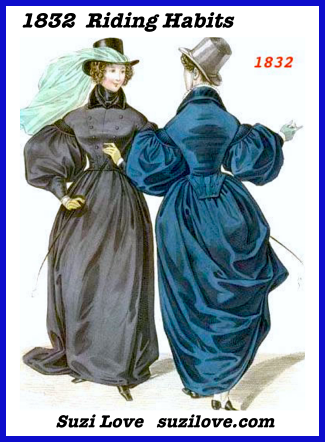
Love the Bridgerton family and Jane Austen? Reader Or Writer of Regency Era stories? Mourning and riding fashion, dresses, hats, shoes, reticules or bags, underclothing and fashion accessories.
books2read.com/SuziLoveFashionWomen1815-1819
History Notes 28 Fashion Women 1815-1819: This book looks at what was fashionable for women in the Georgian Era and at the end of the Regency Era in Britain and the reconstruction in Europe after the wars. Lifestyles were freer and fashions expressed this by becoming the focus of most women’s lives. A wardrobe full of opulent accessories was requisite. Includes mourning and riding fashion, dresses, hats, shoes, reticules or bags, underclothing, and fashion accessories.


Have you read Suzi Love’s Books? Romance, Mystery, Military and History. Regency, historical and contemporary romance. Plus non-fiction history and writing.

The Viscount’s Pleasure House Book 1 Irresistible Aristocrats Disenchanted Viscount tutoring three Regency Ladies. What could go wrong? #Regency Erotic https://books2read.com/suziloveTVPH
Four Times A Virgin Book 2 Irresistible Aristocrats: The countess will do anything to prevent her younger sisters being forced into sordid marriages like hers, even if it means joining forces with the Duke of Stirkton and revealing the horrors of their intertwined pasts. books2read.com/suziloveFTAV
Pleasure House Ball Book 3 Irresistible Aristocrats: Lord Mallory attends his first courtesan’s ball in ten years to appease his concerned friends, though he’d rather stay home and read to his motherless daughters. Though mortified that Brenton unmasks her at a scandalous ball, Lady Lillian Armstrong doesn’t regret their night together. books2read.com/suzilovePHB
Petunia and the Pearl Diver Book 4 Irresistible Aristocrats Series: The pearl diver needs a working girl to rouse his body. Petunia needs money to save her family. A night at a London brothel could be the solution to both problems. But walking away is impossible when one night leaves them craving more…and more. https://books2read.com/suzilovePetPD
Loving Lady Katharine Book 5 Irresistible Atistocrats: When Lady Katharine Montgomery flees London after her scandalous husband was murdered, the Pacific islands of the New Hebrides (Vanuatu) become her haven. Her life changes when Lord Alexander St. John, British ship’s captain and trader, sails into Port Vila. https://books2read.com/suzi
Embracing Scandal Book 1 Scandalous Siblings: Lady Rebecca Jamison saves her family from financial ruin by investing in railways, but when a greedy syndicate murders her friend, Becca is forced to beg assistance from Cayle St. Martin, the new Duke of Sherwyn. https://books2read.com/suziloveES
Scenting Scandal Book 2 Scandalous Siblings Series: Richard, Earl of Winchester, may not know it yet, but he’s Lady Laura Jamison’s perfect match. Lady Laura Jamison believes her extraordinary olfactory senses will sniff out her perfect match, but will Richard prove her theory wrong? https://books2read.com/suziloveSS
December Scandal Book 3 Scandalous Siblings: The Jamison family joins the Duke of Sherwyn and the St. Martin clan at the duke’s country estate, but guest numbers double when early December snowfalls make roads impassable. #HistoricalRomance https://books2read.com/suziloveDS
Love After Waterloo: When Lady Melton and son join antagonistic Captain Belling and the last group of wounded British soldiers evacuating Waterloo, she anticipates hardship and trouble with deserters. Not her relationship with a belligerent Captain. #RegencyRomance #military books2read.com/suziloveLAW
Self Publishing: Absolute Beginner’s Guide.
Information, contacts, and checklists steer you towards professionally produced books. Helps both fiction and non-fiction authors and available in digital and paperback.
Co-Authored by two Australians: multi-published Imogene Nix and best-selling and award winning Suzi Love. http://books2read.com/selfpublishing
History Notes Books 1-28: Do you need more factual and visual information for your historical fiction? Non-fiction Series: Fashion, music and social manners in the 18th and 19th centuries books2read.com/suziloveFashWomen1700s
Regency Life Series Books 1-5: Historic images, historical information, and funny anecdotes give an overview of life in the early 1800s, or the Jane Austen and Bridgerton years. Information for history buffs and pictures to help readers and writers of historical fiction visualize the people and places of the long Regency period. https://books2read.com/suziloveROver
books2read.com/suziloveROver books2read.com/suziloveYGD books2read.com/suziloveOGD

What was fashionable for women in Jane Austen’s times? Mourning, riding, daytime, evening clothing, plus underclothing, corsets and accessories. Fashion Women 1810-1814 History Notes Book 27 This book looks at what was fashionable for women in Jane Austen’s times, or the early 1800s, or the Regency Era in Britain. Wars were being fought around the globe so women’s fashion adopted a military look in support of soldiers. Fashions, like the lifestyle, became progressively more extravagant and accessories went from colorful to over-the-top. https://books2read.com/SuziLoveFashion1810-1814
The Lady’s Magazine said of the basis of women’s fashion that was popular for the first twenty years of the 1800s, ‘White is still the prevailing color for robes. For morning dresses, linen gowns, in large diamonds or squares, are fashionable. Indian muslins, plain or embroidered, are preferred to Florence and satins. The designs of embroidery for shawls are of infinite variety. Long gloves, which reach above the elbow, are not yet laid aside. Medallions are hung around the neck from crossed chains and some of these medallions are shaped like the bags, called ridicules. These reticules are of the lozenge or hexagon shape, with a small tassel at each angle. Reticules, or ridicules, are in lozenge or hexagon shapes with a small tassel at each angle. In capotes, or hats, and ribbands, the violet and dark green prevail over jonquil. Bracelets in hair, pear-shaped ear-rings, medallions on square plates, saltiers of colored stones, are still in fashion.’


The 26th December was St. Stephen’s Day, the first Christian martyr and patron saint of horses, so Boxing Day became associated with horse racing and sports. It was also when the English churches alms boxes were opened and the contents given to the poor of the parish. In the song Good King Wenceslas, the king gave the poor man meat, wine and wood “on the feast of Stephen.” Written by John Mason Neale and first published in 1853, the lyrics celebrate the spirit of Boxing Day which was generosity. King Wenceslas watches a poor man “gath’ring winter fuel. and he then brings the peasant food and logs for his fire. In parts of Europe, St. Stephen’s Day is considered the second day of Christmas.
On the Boxing Day holiday, servants, apprentices, and the poor were presented with gifts. The origin of the holiday is unknown, but was probably first observed in the Middle Ages and the name may come from the opening of alms boxes that had been placed in churches over the holidays for distribution to the poor. It may also be because servants opened their gift boxes on the day after Christmas because on Christmas Day they were busy cooking and serving a large festive meal for their employers. December 26th is also the feast day of St. Stephen, the first Christian martyr and patron saint of horses, so Boxing Day has now become associated with horse racing and sports.
One of the earliest records of these box gifts dates from 1663. In an entry in his diary, English Parliamentarian Samuel Pepys writes that he sent a coach and messenger to his shoemaker to deliver “something to the boys’ box against Christmas” in addition to funds to cover his bill. During Queen Victoria’s reign, Boxing Day became a chance for church parishioners to deposit donations into a box that was put out for the purpose by the clergyman. The money in the boxes was given to the poor.
Some villages followed the custom of the Hunting of the Wren, where small boys captured a wren, killed it, and then mounted it on a pole and carry to every house in the village while singing a song. Money collected was used for a village dance. In London, and in many other parts of Europe, large families and establishments keep regular lists of tradesman’s servants, apprentices, and other persons, who come about making a sort of annual claim on them for a Christmas box on this day.’
‘The custom of annual donations at Christmas, and on New Year’s-day, is very ancient, being copied by the Christians from the Polytheists of Rome, at the time the public religion was changed. These presents, now-a-days, are more commonly made on the morrow of Christmas. From this circumstance the festival of St. Stephen has got the nickname of Christmas Boxing-day, and by corruption, Boxing-day.’ From:- The Lady’s Monthly Museum, Vernor & Hood: Christmas-boxes, 1824.
‘On the day after Christmas, tradespeople are visited by persons in the employment of their customers for a “Christmas-box,” and every man and boy who thinks he is qualified to ask, solicits from those on whom he calculates as likely to bestow.
A writer, in 1731, describes Boxing-day at that time from his own experience. ” By that time I was up, my servants could do nothing but run to the door. Inquiring the meaning, I was answered, the people were come for their Christmas-box : this was logic to me; but I found at last, that, because I had laid out a great deal of ready-money with my brewer, baker, and other tradesmen, they kindly thought it my duty to present their servants with some money for the favor of having their goods.
This provoked me a little; but being told it was ‘ he custom,’ I complied. These were followed by the watch, beadles, dustmen, and an innumerable tribe; but what vexed me the most was the clerk, who has an extraordinary place, and makes as good an appearance as most tradesmen in the parish; to see him come a boxing, alias begging, I thought was intolerable: however I found it was ‘ the custom’ too, so I gave him half-a-crown; as I was likewise obliged to do to the bellman, for breaking my rest for many nights together.’ From The Every-day book and table book by William Hone, 1839
Boxing Day is one of the many customs and traditions associated with Christmas that is featured in History of Christmases Past (Book 1 History Events) by Suzi Love.


Love After Waterloo by Suzi Love.
“I remember who you are, Lady Melton,” Captain Belling said in a cold voice, barely glancing over his shoulder at them. “The only thing I don’t know is why the hell you and that child are still anywhere near Waterloo, when all women were ordered to evacuate a week ago.”
“That child has a name, Captain. His name is Daniel, or if you are a stickler for formality, Viscount Melton.”The captain turned and frowned down at her son, who stared back at him with blatant curiosity and a small amount of animosity, as forthright as any young and intelligent child. Even at his young age, Daniel was a shrewd judge of character, and had been instructed by his uncles to be careful about trusting strangers. When the Captain turned back to the tattered maps spread over his makeshift desk, Anne ignored his unspoken dismissal and used the time to observe the infuriating man without having his condemning gaze fixed on her, as it had been a week earlier at the Duke and Duchess of Richmond’s extravagant Brussels ball. If she and Daniel were to travel with his group of wounded soldiers, Anne wanted to learn as much as possible about their leader. Her son’s survival depended on her being well informed and prepared for any eventuality.
Dust filtered down through a gaping hole in the high roof and settled in the Captain’s hair, turning it a darker brown than his normal golden yellow, though a bucketful of dust wouldn’t make any difference to the state of his stained uniform. His left pants’ leg had been sliced open to the knee, the two sides pinned clear of the large bandage winding down most of his leg, while a spindly wooden crutch was propped against the table.
His large physique had attracted her even before their dance at the ball, though his striking physical attributes didn’t compensate for his belligerent attitude, or for his obvious displeasure at encountering her both in Brussels and near the battlefield. Still, the Captain had undoubtedly scowled in a similar fashion at many women he’d met either in Brussels or at Waterloo, as she’d heard him spout his narrow-minded view at the ball to his fellow officers. The Captain believed that in the vicinity of battles only men should be allowed. Not women, and especially not ladies.
https://books2read.com/suziloveLAW