An early 1800’s glimpse into both the frivolous and more serious occupations filling a young lady’s day in the lifetime of Jane Austen, or the Regency Era. Historic images and historical information show her fashions and frolics. Shows the often-frivolous life and fashions of a young lady in the early 1800’s, plus a glimpse into the more serious occupations a young lady may undertake. Through historic images, historical information, and funny anecdotes, it shows how a young lady fills her day. Young Lady’s Day Regency Life Series Book 4 by Suzi Love. https://books2read.com/suziloveYLD
1805 Pink Redingote With Train, French. White dress with high neck frill, green shawl, velvet hat with leaf shapes to decorate the front, necklace, silk scarf as a belt and white gloves.Fashion Plate via Journal des Dames et des Modes, or Costume Parisien.
Jane Austen and her contemporaries would have wore long coats like this one to keep warm when out and about, visiting, shopping etc. The thin muslin dresses worn in the early 1800s were little protection against European winters so coats of some sort were added, plus colorful accessories like this shawl and the hat to add color and another layer of warmth.
Definition Redingote Or Coat Or Pelisse: Long fitted outdoor coat worn over other garments for warmth. French word developed from English words, riding coat. French fashion plates call these coats Redingotes and they are designed for women, men and children. English fashion plates call them a Pelisse, a walking dress, Promenade dress, or Carriage dress.
1807 Lady In A Trained White At-Home Dress With Blue Trim Taking Tea, French. Very low cut bodice and white lace cap. Fashion Plate via suzilove.com and Journal des Dames et des Modes, or Costume Parisien.
The Journal des dames et des modes was a French fashion magazine published between 1797 and 1839 and was the second oldest fashion magazine published in France, replacing the Cabinetdes Modes (1785-1793). The magazine was the main source for French fashions, both in France and internationally. Pierre de la Mesangere was editor and main journalist for most of the time the magazine was in existence and he published a magazine every five days, which is why there is an abundance of French fashion plates from these years. The magazine had eight pages of text, one or two colored fashionplates, plus poetry, theatre reviews, current social news and fiction. During the Napoleonic wars, everything to do with France was unpopular, especially in Britain, yet French fashions thrived and so did the Journal des Dames et des Modes, despite the numerous other fashion magazines that copied the magazine.
Love the Bridgerton Series? Fan of Jane Austen? What did men wear in the early 1800s? Suits, hats, shoes, underclothing, military and bedroom fashions. #Bridgerton #RegencyFashion #JaneAusten #BritishHistory.
The Regency Era saw a wide variety of acceptable pants for men. Breeches were worn as part of a man’s daily outfit during the early 1800s and were necessary for formal occasions, such as court appearances, during the entire Regency Era. However, younger gentlemen moved away from breeches for daytime wear around 1807 and adopted a variety of long pants called trousers, pantaloons, buckskins or inexpressables. Knee-length breeches, worn with stockings, continued to be worn by older gentlemen through the entire Regency Era.
Around 1807, upper class gentlemen wore trousers held up by suspenders or pantaloons, which were closely fitted and worn with tall boots. Buckskins, made from deerskin, were comfortable to wear for riding. Inexpressibles were very tight leggings that left little to the imagination of young ladies. Every Regency man’s outfit included a hat, gloves, shoes or boots, and a selection of added accessories from a walking stick, watch on a chain, fobs, coin purse and a handkerchief.
1809 Pink Evening Dress Of Levantine, French. V-neck bodice, decorated hem, long gloves and Toque hat with feathers, or aigrette. Fashion Plate via Journal des Dames et des Modes, or Costume Parisien.
Definition Fabric Levantine: Stout silk cloth in twill weave. First made in the Levant, a large area in the Eastern Mediterranean region of Western Asia.
Definition Aigret, aigrette, egret: Upright plume of feathers or jeweled ornament in shape of feathers worn on head or hats. 19th century favorite feathers osprey and heron.
1810 Three Piece Gentleman’s Purple Court Suit, French. Worn by a rich and fashionable gentleman after Napoleon Bonaparte revived court traditions when he crowned himself Emperor of France in 1804. Gentlemen were expected to wear extravagant court dress, but the working class despised these luxurious fashions and royal overspending. Wastage of France’s money spurred French peasants to rise up in revolt and create the French Revolution. via Metropolitan Museum, N.Y.C., U.S.A.metmuseum.org
1830 ca. Collection of Four Tiny Purses, or Reticules with drawstrings to close. via Ruby Lane Antiques. As would have been carried by ladies in Jane Austen and Bridgerton years.
Definition Of A Reticule; Bag or purse, often with a drawstring to pull closed and usually made of cloth or covered cardboard and often decorated with beading or embroidery. A reticule, or purse, or handbag, was usually carried by a woman during the Regency period to carry all their daily necessities. Earlier, women used pockets that tied at the waistline and were hidden in the folds of their skirts. Empire style, or early 1800s, high-waisted dresses made it impossible to either sewn in a pocket or to tie on a pocket, so women began carrying small, decorated bags called Reticules, or ridicules, which generally pulled closed at the top with a drawstring. These Reticules, or bags, were the forerunners of our modern day purses.
An overview of women’s fashions in the first twenty years of the 19th century. What was fashionable for women in Jane Austen’s times, or the early 1800s. Wars were being fought around the globe so women’s fashion adopted a military look in support of soldiers. In Britain, the Prince Regent ruled instead of his father, King George III, so fashions, like the lifestyle, became more extravagant and accessories went from pretty to opulent. This set includes books 12, 25, 26, 27 and 28.
What was fashionable for women in Jane Austen’s times, or 1800s, or Regency Era. High-waisted dresses were extravagantly accessorized and hats, shoes, parasols and bags were added. Set includes History Notes Books 12, 25, 26, 27 and 28.
1815-1825 ca. Back lacing, hand embroidered cotton sateen corset. The type of corset worn by Jane Austen and her female friends and family. Entirely hand sewn, cotton cord bones, dark cream embroidered flowers, centre front busk channel, bone eyelets and with the monogram ‘MS’ embroidered twice. via Augusta Auctions. augusta-auction.com
1815-1825 ca. Cream cotton sateen back lacing corset. Entirely hand sewn, cotton cord, boning, dark cream embroidered flowers, centre front busk and busk channel, bone eyelets, embroidered with ‘MS’ twice. via Augusta Auctions.1815-1825 ca. Cream cotton sateen back lacing corset. Entirely hand sewn, cotton cord, boning, dark cream embroidered flowers, centre front busk and busk channel, bone eyelets, embroidered with ‘MS’ twice. via Augusta Auctions.1815-1825 ca. Cream cotton sateen back lacing corset. Entirely hand sewn, cotton cord, boning, dark cream embroidered flowers, centre front busk and busk channel, bone eyelets, embroidered with ‘MS’ twice. via Augusta Auctions.1815-1825 ca. Cream cotton sateen back lacing corset. Entirely hand sewn, cotton cord, boning, dark cream embroidered flowers, centre front busk and busk channel, bone eyelets, embroidered with ‘MS’ twice. via Augusta Auctions.1815-1825 ca. Cream cotton sateen back lacing corset. Entirely hand sewn, cotton cord, boning, dark cream embroidered flowers, centre front busk and busk channel, bone eyelets, embroidered with ‘MS’ twice. via Augusta Auctions.1815-1825 ca. Cream cotton sateen back lacing corset. Entirely hand sewn, cotton cord, boning, dark cream embroidered flowers, centre front busk and busk channel, bone eyelets, embroidered with ‘MS’ twice. via Augusta Auctions.1815-1825 ca. Bridgeton and Jane Austen style Back Lacing Cotton Corset. #Bridgerton #JaneAusten #RegencyEra #Corset #HistoricalFashion https://books2read.com/SuziLoveCorsetBook17 Share on XHN_17_D2D_Corset_1810-1830
1801-1818 ca. ‘Diablo, or devil on two sticks’. Lessons In The Devil Series Plate 55: Man teaching a woman how to play diabolo, or devil on two sticks. via 1801-1818 Le Bon Genre, French. Gentleman in blue tailcoat, high white shirt and cravat, pants and black shoes. Lady in white dress with high frilled neckline, long sleeves and wearing green walking boots. Hand-colored etching. Published by: Pierre La Mésangère. Via British Museum, London, UK britishmuseum.org (PD-Art)
Jane Austen and Games: In Jane Austen’s times, games were a part of daily life. Families played all sorts of games, indoors and outside, to pass the time, especially at house parties or family gatherings.
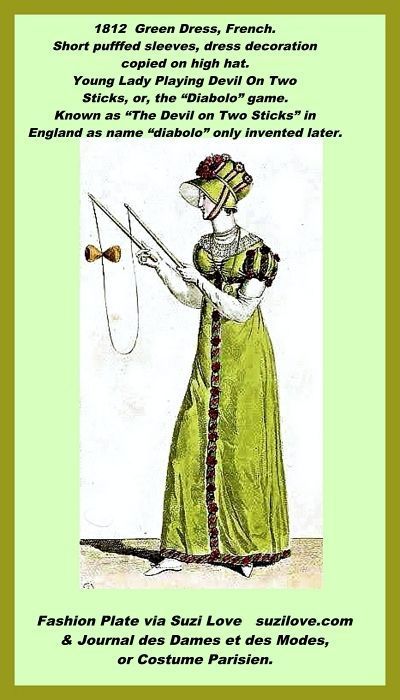
Diablo, Or Devil On Two Sticks: Double cone type of yo-yo that is twirled, spun, tossed and caught on a string attached to two hand sticks. The toy, or Diablo, is kept spinning by manipulating it back and forth along the string and by tossing into the air. Numerous tricks can be performed e.g. toss, trapeze, cat’s tail and the umbrella.