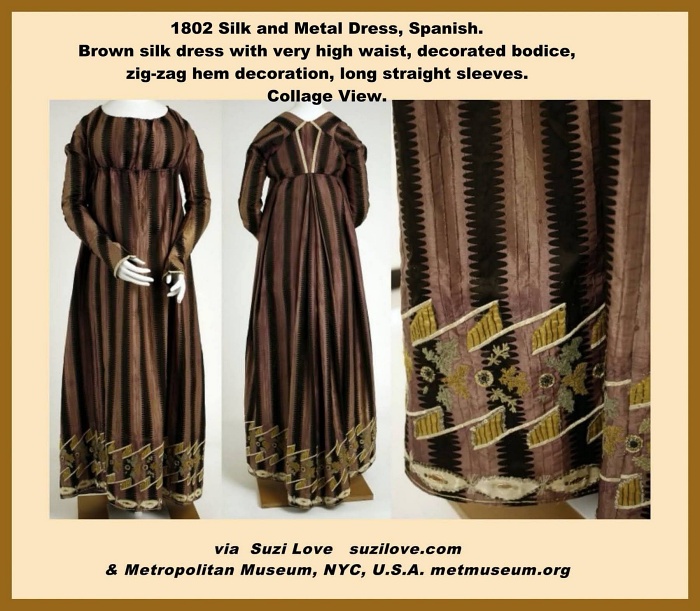
1818 Brown Silk Dress, English. Regency Fashion. Empire style, high-waisted dress with long sleeves, and with dark brown velour trim on the square neckline and hem. via The Metropolitan Museum, New York City, USA. metmuseum.org
Definition Empire Style Dress: Named after the First Empire in France. Empire dresses had a low neckline and skirts started directly under the bust and flowed into the classical relaxed wide styles of Greece and Rome. This style of dress is associated with Jane Austen and her contemporaries as a high-waisted dress was worn most days. Cotton, silk or taffeta were the popular fabrics. Only the very wealthy could afford white dress in this style as the cottons were imported from India and had to be carefully cleaned, usually by a lady’s maid.
1818 Brown Silk Dress, English, As Worn By the Bridgertons. #Bridgerton #RegencyFashion #HistoricalFashion #metmuseum books2read.com/SuziLoveFashionWomen1815-1819 Share on X Fashion Women 1815-1819 History Notes Book 28
What did Jane Austen wear? This book looks at what was fashionable for women in the Georgian Era and at the end of the Regency Era in Britain and the reconstruction in Europe after the wars. Lifestyles were freer and fashions expressed this by becoming the focus of most women’s lives. A wardrobe full of opulent accessories was requisite. Includes mourning and riding fashion, dresses, hats, shoes, reticules or bags, underclothing, and fashion accessories.
D2D_HN_28_https://books2read.com/SuziLoveFashionWomen1815-1819
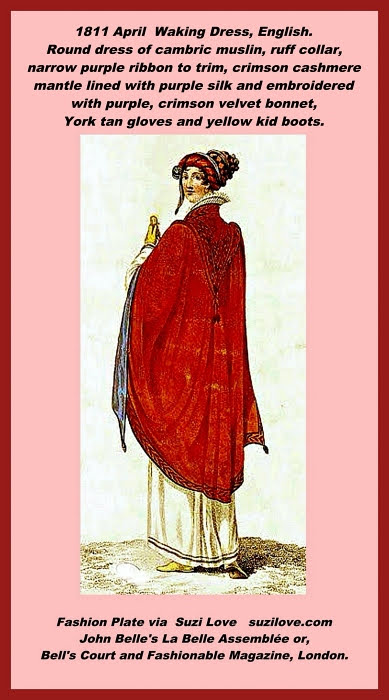
1811 August Walking Dress for a Mother and a child, English. Mother wears a typical Regency or Jane Austen style high round robe with full long sleeve trimmed with Van Dyke lace at the throat and cuffs and ornamented around the bottom with a Tuscan border in needlework. Short capuchin cloak of buff shot sarsenet fastened with broaches on shoulders and trimmed with deep Chinese silk fringe. Moorish turban bonnet gathered into a broach in centre of the forehead. Purple ridicule, or bag, with gold snap and tassels. Buff kid half boots, parasol with deep Indian awning. Child wears a short sleeved Spanish vest and trousers in one, which looks like a skeleton suit, a tight coat or jacket buttoned to a pair of high-waisted trousers. An Indian dimity waistcoat with long sleeves and collar trimmed with a narrow border of muslin, high shoes of purple morocco and a college cap of purple velvet with a crimson band and carries a parasol. via Rudolph Ackermann’s ‘The Repository of Arts’.
Definition Skeleton Suit: Shirt and trousers made as one connecting piece, often buttoned together, and were one of the earliest fashions designs made especially for children and were worn from the 1790s to the 1820s.
1810 ca. Typical Regency Era Day Dress of Sprigged White Muslin, England. High-waisted, hand sewn, bibbed front bodice fastens at shoulders with self covered buttons, net lace insertions on front bodice, squared neck, long tapered sleeves, gathered at shoulders, ankle length skirt, apron panels tied with cotton tapes at back and lined bodice. Via Museum Of applied Sciences, Australia. collection.maas.museum
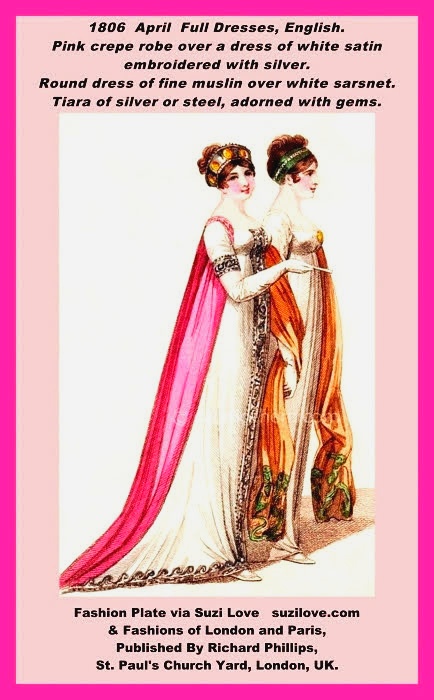
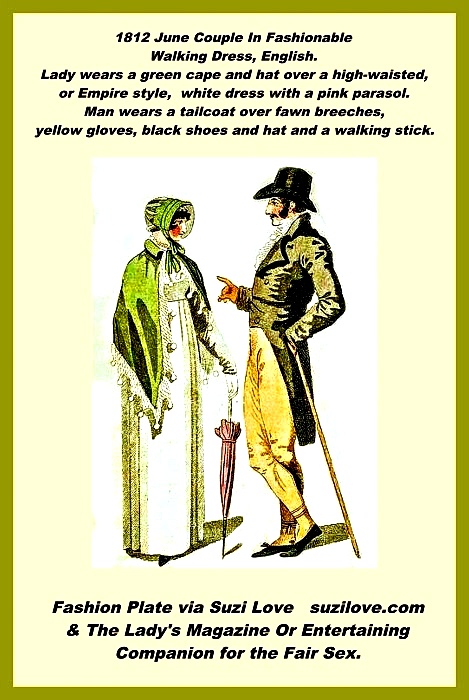
Definition Empire Style Dress: High-waisted white gown defined women’s fashion during the Regency Era. ‘Empire’ is the name given to the period when Napoleon Bonaparte built his French Empire. High-waisted, loose gowns were adopted by the aristocracy as a symbol of turning away from the fussy, elaborate and expensive clothing worn in the 1700s. This sort of high-waisted dress would have been worn by Jane Austen and her contemporaries in England and in the television series, Bridgerton.
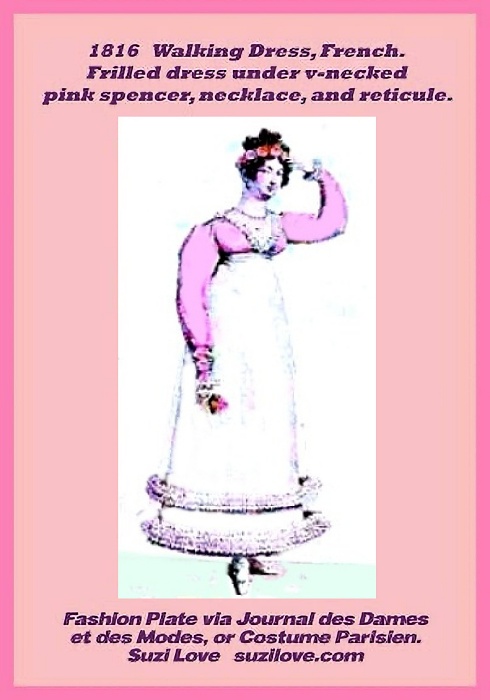
1818 High-waisted Promenade Dress, English. White dress with multiple layers of lace from hem upwards. Narrow striped scarf of bright colors, large brimmed hat decorated with flowers and a pink parasol. Fashion Plate via John Belle’s La Belle Assemblée or, Bell’s Court and Fashionable Magazine, London.
Definition Empire Style Dress: High-waisted white gown defined women’s fashion during the Regency Era. ‘Empire’ is the name given to the period when Napoleon Bonaparte built his French Empire. High-waisted, loose gowns were adopted by the aristocracy as a symbol of turning away from the fussy, elaborate and expensive clothing worn in the 1700s.
1812 October Autumnal Carriage Or Morning Costume, English. Loose white jaconet muslin dress, high in the neck, with double frills of deep vandyke lace that fall over the Spencer. Blue satin Spencer ornamented with silver cord and buttons ‘en militaire’ and held at the throat with a cord and tassels, a quartered foundling cap of lace tied under the chin with a full band and decorated with an autumnal flower. Grey kid shoes, lemon gloves and a ridicule, or bag, of purple velvet. Fashion Plate via Rudolph Ackermann’s ‘The Repository of Arts’.
Dress – Morning: Worn either at home, out shopping, or for walking in the park or country. Presentable but not overly accessorized.
Spencer: Short body-hugging jacket worn for warmth &modesty. Said to have originated in accident to Lord Spencer in hunting when coattails torn off.
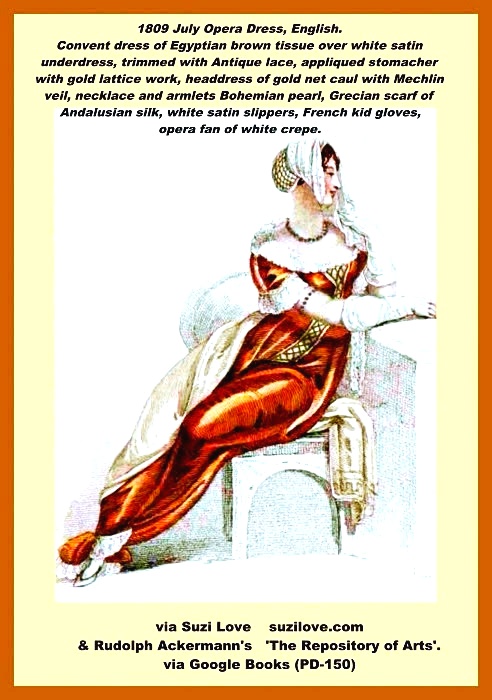
1811 Evening Dress, French. Red cashmere dress over white under shirt with short puffed sleeves, carrying a white shawl, long white gloves, earrings and white evening shoes. Fashion Plate via Journal des Dames et des Modes, or Costume Parisien. Though this is a French fashion plate, the outfit is typical of the dresses worn by Jane Austen and her contemporaries. An Empire style, or high-waisted, dress with a white underdress and for warmth there is an extra layer with the shawl.
Definition Cashmere: Soft, fine wool, historically used for costly dress fabric, usually in twill weave. Originally made of yarn handspun from the wool of Cashmere goats but later from other soft wools. Used for dresses, infants’ coats.
1816 January Blue Carriage Dress, English. High neck but no collar, front is fitted but back has slight fullness and very short bodice. Puffed roll to decorate the hem, trimmed in bias cut blue satin, long sleeves finished at wrists with satin, gloves of white kid and ‘sandals’ or shoes of blue kid leather. Head-dress à la mode de Paris is an unusual cap of white lace and decorated with two rolls of ribbon. “We are indebted to the tasteful fancy of Mrs. Bean, of Albemarle Street, for both our dresses this month.” Fashion Plate via Rudolph Ackermann’s ‘The Repository of Arts’.
Jane Austen and her contemporaries would have worn this style of outdoor, or carriage ensemble with a coat over a dress. These outdoor dresses were labelled a variety of names. In England, this might also have been called a Walking Or Promenade dress, or Pelisse. In Europe, it would be called a Redingote.
Definition: Pelisse, Walking Dress, Carriage dress, Promenade Dress, Redingote. Long, fitted coat sometimes cut away in front to show off the dress underneath. Originally made for men with several capes and trimmed with large buttons, they were adapted to add an additional, and warmer, layer to the typical white muslin dresses worn in the early 1800s. Those light weight dresses were good in summer but not suited to harsh winters. Over the carriage dress, a shawl could be added as well as a muff to give a warm and comfortable outfit for traveling by carriage.
1800s A Young Lady Riding and Carriage Driving, England. #Riding #Regency #Victorian #Cartoon From: 1860 Mr. Sponge’s Sporting Tour by Robert Smith Surtees. via Google Books (PD-100)
A Lady On The Hunt Riding Side-Saddle. From: 1860 Mr. Sponge’s Sporting Tour by Robert Smith Surtees. via Google Books (PD-100) suzilove.comA bold young man kissing a young lady at the hunt. via 1860 Mr. Sponge’s Sporting Tour By Robert Smith Surtees. via Google Books (PD-150) suzilove.com1860 Rebellious Lady driving and smoking a cigar.via 1860 Mr Sponge’s Sporting Tour by Robert Smith Surtees via Google Books (PD-100)1860 A Day at the Turf. Lady riding side-saddle with gentleman. From- 1860 Mr Sponge’s Sporting Tour by Robert Smith Surtees. via Google Books (PD-100) suzilove.comA lady and a gentleman in a carriage. Lady driving and smoking. via 1860 Mr. Sponge’s Sporting Tour by Robert Smith Surtees. via Google Books (PD-100) suzilove.com
1804–1805 ca. Evening Dress, French. Narrow white dress of sheer cotton mull, probably from India, and with sheer short sleeves, extra wide neckline, vertical white embroidery which was very fashionable at the time. The cotton fabric was probably imported from India already embroidered with heavy white cotton thread in transparent mull. At the beginning of the nineteenth century, this sort of dress was considered shocking and immodest after the wider hooped dresses of the eighteenth century. This style of dress was worn by most women in Jane Austen’s time, but only the wealthy could afford the best quality mull. Vertical white embroidery was very fashionable in the early 1800s, with the sheer cotton mull probably imported from India already embroidered with this heavy white cotton thread. These daring items of clothing copied the Grecian idea of loosely draped clothing and were the first of many changes to women’s outfits. Heavy fabrics were abandoned, especially in summer, in favor of lighter materials that allowed women to move about easier.
From the museum curator: “On December 24, 1803, Jerome Bonaparte (1784—1860), brother of Napoleon, wed Elizabeth Patterson (1785—1879) of Baltimore. The beautiful and fashionable young American was married in a dress of muslin and lace that, according to a contemporary, “would fit easily into a gentleman’s pocket.” Although originally thought to have been Patterson’s wedding dress, the formal gown illustrated here probably dates from 1804, when this type of vertical white embroidery became fashionable. Napoleon had the marriage annulled in 1805. Jerome was made king of Westphalia in 1807 and he married the princess of Wurttemberg. Elizabeth, banned from France by the emperor, remained in Baltimore with her son, Jerome Napoleon Bonaparte (1805—1870). Metropolitan Museum, New York City, USA.