1807 Fashionable French Couple. Man: Blue cutaway coat and yellow breeches. Lady: Lemon and blue dress and bonnet. Typical of the ensembles worn by Jane Austen and her family and friends. Fashion Plate via Journal des Dames et des Modes, or Costume Parisien.
1804–1815 ca. Fawn Cotton Dress With Embroidery Beading, Austrian. Simple Empire style dress with A-line skirt from a high waistline and short bodice as Jane Austen and contemporaries across Europe would have worn. Fawn colored cotton with deep bead embroidered hem, embroidery on the wrists and around the wide scooped neckline. Transparent fabrics of the early were beginning to be replaced with fabrics with more weight that were less likely to tear. Plain silks in vivid colors were at first made up in the simple lines of muslin dresses but then plain gowns began to be decorated with intricate contrasting applications and beading. This dress was part of “The Fine Art of Costume” exhibition, 1954 October 15th at the Met Museum, N.Y.C. via Metropolitan Museum, NYC, U.S.A. metmuseum.org.
Empire Style Dress: Named after the First Empire in France. Empire dresses had a low neckline and skirts started directly under the bust and flowed into the classical relaxed wide styles of Greece and Rome. This style of dress is associated with Jane Austen and her contemporaries as a high-waisted dress was worn most days. Cotton, silk or taffeta were the popular fabrics.
1804-1815 ca. Front Fawn Cotton Dress with Bead Embroidery, Austrian.
1804-1815 ca. Back Fawn Cotton Dress with Bead Embroidery, Austrian.
1804-1815 ca. Side Fawn Cotton Dress with Bead Embroidery, Austrian.
1804-1815 ca. Black and White. Fawn Cotton Dress with Bead Embroidery, Austrian.
1804-1815 ca. Black and White Group. Fawn Cotton Dress with Bead Embroidery, Austrian.
1804-1815 ca. Beading View. Fawn Cotton Dress with Bead Embroidery, Austrian.
1804-1815 ca. Beading View. Fawn Cotton Dress with Bead Embroidery, Austrian.
1804-1815 ca. Beading View. Fawn Cotton Dress with Bead Embroidery, Austrian.
1804-1815 ca. Beading View. Fawn Cotton Dress with Bead Embroidery, Austrian.
1804-1815 ca. Beading View. Fawn Cotton Dress with Bead Embroidery, Austrian.
1804-1815 ca. Fawn Cotton Dress With Embroidery Beading, Austrian. #Regency #JaneAusten #Fashion https://books2read.com/SuziLoveFashionWomen1805-1809 Share on X Fashion Women 1805-1809 History Notes Book 26 What did Jane Austen and friends wear? https://books2read.com/SuziLoveFashionWomen1805-1809
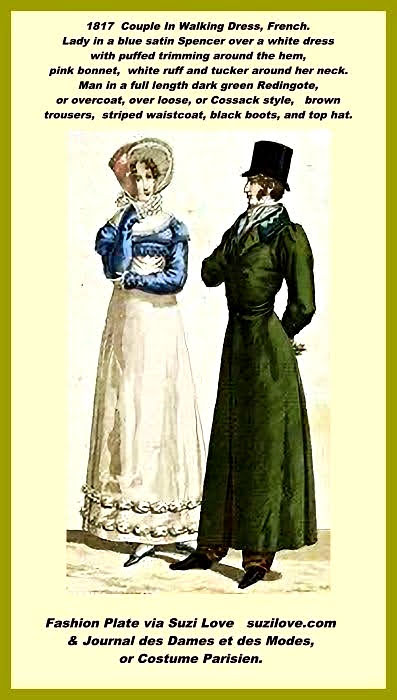
1817 Couple In Jane Austen and Bridgerton style Walking Dress and Gentleman in Same Green Redingote.
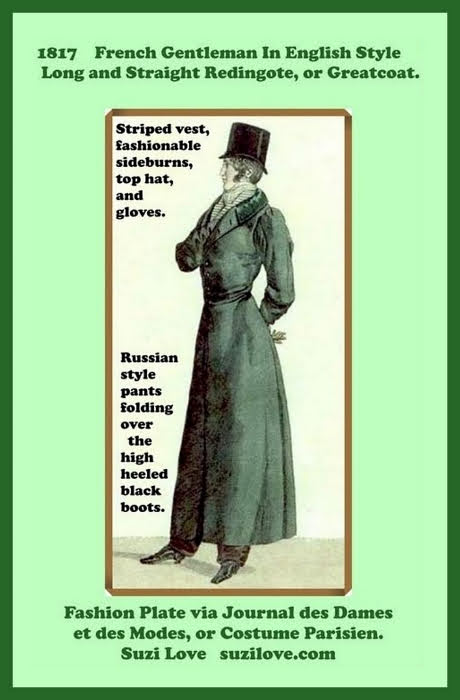
Lady: Blue satin Spencer over a white dress with puffed trimming around hem, pink bonnet, white ruff and tucker. Man: Long green Redingote, or overcoat, in the English style. Long brown trousers, striped waistcoat or vest, top hat, gloves and boots. Fashion Plate via Journal des Dames et des Modes, or Costume Parisien. Definition Redingote Or Coat Or Pelisse: Long fitted outdoor coat worn over other garments for warmth. French word developed from English words, riding coat. French fashion plates call these coats a Redingote and English plates call them a Pelisse, Or Walking Dress, or Carriage Costume. These are the types of outfits worn by Jane Austen and contemporaries in English magazines, where French fashions were obsessively copied despite the two countries being at war for many years.
This same Fashion Plate is seen below for the gentleman.
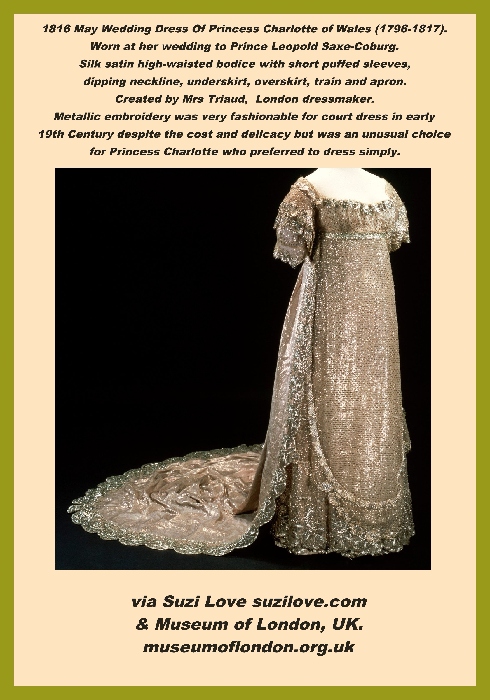
1816 May Wedding Dress Of Princess Charlotte of Wales (1796-1817). Worn at her wedding to Prince Leopold Saxe-Coburg. Silk satin high-waisted bodice with short puffed sleeves, dipping neckline, underskirt, overskirt, train and apron. Created by Mrs Triaud, London dressmaker although this may not be the original skirt. Metallic embroidery was very fashionable for court dress in early 19th Century despite the cost and delicacy but was an unusual choice for Princess Charlotte who preferred to dress simply. via Museum of London, UK. museumoflondon.org.uk
The wedding dress of Princess Charlotte Augusta as described in La Belle Assemblee magazine for May, 1816.
“As we have been gratified with a sight of the wedding dresses of this amiable and illustrious female, a particular yet concise account of them cannot but be acceptable to our fair readers. The Royal Bride, happy in obtaining him whom her heart had selected, and whom consenting friends approved, wore on her countenance that tranquil and chastened joy which a female so situated could not fail to experience.
Her fine fair hair, elegantly yet simply arranged, owed more to its natural beautiful wave than to the art of the friseur; it was crowned with a most superb wreath of brilliants, forming rosebuds with their leaves. Her dress was silver lama [lamé] on net, over a silver tissue slip, embroidered at the bottom with silver lama in shells and flowers. Body and sleeves to correspond, elegantly trimmed with point Brussels lace.
The manteau was of silver tissue lined with white satin, with a border of embroidery to answer that on the dress, and fastened in front with a splendid diamond ornament. Such was the bridal dress … The jewellery of the royal bride is most superb; beside the wreath, are a diamond cestus, ear- rings, and an armlet of great value, with a superb set of pearls.
1802 Jane Austen Style Riding Habit, French. Blue riding habit made of castor, worn with a Fichu of white lace to cover her chest and preserve her modesty and carrying a long riding whip. Fashion Plate via Journal des Dames et des Modes, Costume Parisien.
Riding Habit: Early 1800s riding habits still copied men’s riding fashion and usually made by male tailors. They were often a close-fitting jacket worn over a shirt, or with a fichu covering the neck. A skirt with train had either a waistband or straps over the shoulders to keep it in place. Sometimes, habits were made in one piece with the skirt and bodice joined.
Are you a reader or writer of Regency Romance? Love Jane Austen’s books? Want to know more about the mourning, riding, underclothing and other Regency Era women’s fashions in Regency romances? What was fashionable for women in Jane Austen’s times? Mourning, riding, daytime, evening clothing, plus underclothing, corsets and accessories. This book looks at what was fashionable for women in Jane Austen’s times, or the early 1800s, or the Regency Era in Britain. Wars were being fought around the globe so women’s fashion adopted a military look in support of soldiers. Fashions, like the lifestyle, became progressively more extravagant and accessories went from colorful to over-the-top. https://books2read.com/SuziLoveFashion1810-1814
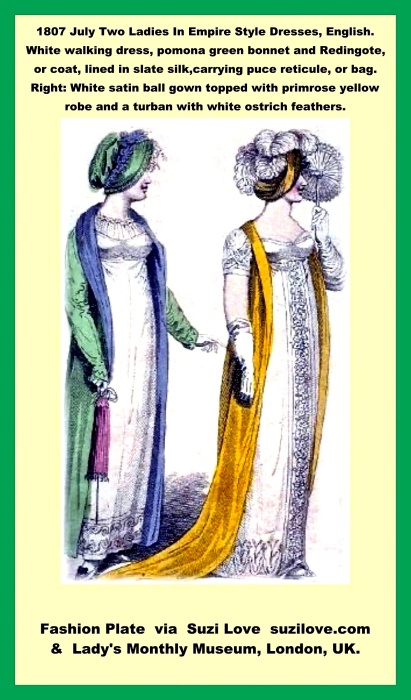
1807 July Two Ladies In Empire Style Dresses, English. White walking dress, Pomona green bonnet and Redingote, or coat, lined in slate silk, carrying puce reticule, or bag. Right: White satin ball gown topped with primrose yellow robe and a turban with white ostrich feathers. Fashion Plate via Lady’s Monthly Museum, London, UK.
Gorgeous Regency Era clothing came in a wide range of styles to suit every season and occasion. Ladies in Jane Austen’s times wore Empire style dresses which were usually of light fabric and floaty in style so accessories were essential to keep women warm.
Definition Reticule Or Ridicule Or Bag or Purse: Often with a drawstring to pull closed and usually made of cloth or covered cardboard and often decorated with beading or embroidery. A reticule, or purse, or handbag, was usually carried by a woman during the Regency period to carry all their daily necessities. Earlier, women used pockets that tied at the waistline and were hidden in the folds of their skirts. Empire style, or early 1800s, high-waisted dresses made it impossible to either sewn in a pocket or to tie on a pocket. So women began carrying small, decorated bags called Reticules, or ridicules, which generally pulled close at the top with a drawstring.
Definition Aigret, aigrette, egret: Plume of feathers or jeweled ornament in shape of feathers worn on head or hats. During the early 19th century., or Jane Austen’s lifetime, the favorite feathers were osprey and heron.
Redingote, or Pelisse, or Walking Dress, or Promenade Dress: Going by many names, this is a coat copied from men’s overcoats but worn by both men and women. Generally, opens down the front, worn for warmth over a dress or coat and breeches, and has a military look with front vertical buttoning or decoration.
1813 October White Empire style, or high-waisted, Carriage Dress, English. Brown shawl, brown boots, and a lace cap tied under the chin. Typical of the carriage fashions that would have been worn by Jane Austen and her contemporaries. Fashion Plate via The Lady’s Magazine Or Entertaining Companion for the Fair Sex.
Definition Empire Style Dress: High-waisted white gown defined women’s fashion during the Regency Era. ‘Empire’ is the name given to the period when Napoleon Bonaparte built his French Empire. High-waisted, loose gowns were adopted by the aristocracy as a symbol of turning away from the fussy, elaborate and expensive clothing worn in the 1700s. https://books2read.com/SuziLoveFashion1810-1814
1800-1810 ca. Gown, dark green taffeta, square neckline, long sleeves. the type of high-waisted dress worn across Europe in Jane Austen’s time. Gemeentemuseum Den Haag
An overview of women’s fashions in the first twenty years of the 19th century. What was fashionable for women in Jane Austen’s times, or the early 1800s. Wars were being fought around the globe so women’s fashion adopted a military look in support of soldiers. In Britain, the Prince Regent ruled instead of his father, King George III, so fashions, like the lifestyle, became more extravagant and accessories went from pretty to opulent.
Reader Or Writer of Regency Era? Love Jane Austen and Bridgerton fashions? What was fashionable for women in Jane Austen’s times, or 1800s, or Regency Era. High-waisted dresses were extravagantly accessorized and hats, shoes, parasols and bags were added. Set includes History Notes Books 12, 25, 26, 27 and 28. https://books2read.com/SuziLoveFashionWomenBoxSet
Ladies clothing in the early 1800’s featured a high waist line called an Empire Line, or Empire style dress, with a waist line just under the natural bust line and much higher than the natural waist. The high-waisted, or short-bodied, Regency styles shifted focus away from the natural waist and so left the natural waist unconstricted, in direct contrast to previous and future styles. Britain took these simple European styles and progressively made them more elaborate by adding more and more complicated embroidery onto white fabrics to create the white on white look popular for many years.
The empire look of fine muslin dresses left women more exposed than in the Georgian Era when fabrics had been thicker and styles bulkier. Women, especially in England, preserved their modesty by adding lace, frills, flounces, ruches, and fabric plaits to dresses to adequately cover any parts that might inadvertently be exposed. Outer layers, such as Spencers, Redingotes or Pelisses or coats, and shawls, were also added for warmth and to brighten outfits. This Empire fashion was totally dependent on a supply of fine, translucent cotton muslin – at first imported from India, then later, less exclusive imitations often woven and printed or embroidered in Britain. Fabrics were soft and lightweight and muslins and other cotton fabrics from India and other Asian countries were in high demand.