From 1700 until the early 1800s, pockets with waist ties were worn by women to keep essential items on their person. Generally of linen or some other cotton fabric, they were often quilted, or embroidered and gifted or handed down to others. In the 18th century, women’s pockets were not sewn into their gowns. Instead they were attached to a tape and tied around the waist as separate garments. Worn under the hoops and petticoats, they were accessed through openings in the gown and petticoat seams. By the early 1800s, round gowns were both flowing and almost transparent so pockets could no longer be worn under dresses, so ridicules, or bags, or reticules were carried instead. Jane Austen and her female friends and family would have worn pockets under their out layers.
From the Curator Victoria and Albert Museum, London: Quilting was a popular form of decoration for a variety of garments including pockets. However, hand-quilting was a time-consuming method of decoration. The increased demand for quilted petticoats, waistcoats and pockets led to the invention of woven quilting.
1700-1725 ca. Pair of Linen Twill Women’s Pockets With Crewel Embroidery and Waist Ties, British. Embroidered in yellow, green and pink worsted thread with chain and stem stitches, design of flower pot with flowering plant, bound with green worsted tape and sewn to linen tape tie. Designs are similar but not identical, suggesting both hand-drawn and possibly work of an amateur. Pockets may have been handed down to another person who found them too small as each pocket has been extended at top by 4 cms. via Victoria and Albert Museum, London, UK. collections.vam.ac.uk.
by 4 cms. via Victoria and Albert Museum, London, UK. collections.vam.ac.uk.
1750-1800 ca. Woman’s Pocket With Waist Ties, New England, America. Linen plain weave, cotton plain weave, wool embroidery. Dimensions 39.5 cm x 27.5 cm. Polychrome crewels on cotton and linen, vine with buds, flowers and leaves and initials M.W. in center. In 18th century, women’s pockets were tied around waist with tape as separate garments, worn under hoops and petticoats, accessed through openings in gown and petticoat seams. via Museum of Fine Arts, Boston, U.S.A. mfa.org
1750-1800 ca. Woman’s 1750-1800 ca. Woman’s Pocket With Waist Ties, New England, America. Linen plain weave, cotton plain weave, seams. via Museum of Fine Arts, Boston, U.S.A. mfa.orgHN_1 Fashion Women Late 1700s History Notes Book 1 by Suzi Love.
What was fashionable for women in the late 1700s? Extravagant colors and fabrics and outrageous styles were all seen in these flamboyant fashions.
books2read.com/suziloveFashWomen1700s
A sedan chair is a portable enclosed chair for a single passenger. It was generally carried by two “chairmen” holding poles attached to either side of the chair. Sedan chairs were fashionable in England and Europe during the 17th, 18th and early 19th centuries and were an important part of the social life of the times. They were very useful for negotiating crowded, unsafe, narrow, winding and often filthy streets and were particularly used by “invalids, ladies and party goers”. Sedan chairs had the advantage of being able to be carried up and down stairs and could deliver the passenger from inside their own home to inside their destination without having to step outside.
1784 Sedan Chair. ‘The return from a masquerade. A morning scene.’ A young lady dressed as shepherdess with staff slumps in a sedan chair. Asleep or drunk her head and shoulders hang outside window. Two porters smile and dwarf chimney sweep carries a mask.’ By Robert Dighton and Cari.
The 19th century English author, Elizabeth Gaskell, described the use and function of the sedan perfectly in her novel “Wives and Daughters” when she reminisced how the Browning sisters chose to be transported to a ball by sedan chair, which ‘came into the parlor, and got full of the warm air, and nipped you up, and carried you tight and cosy into another warm room, where you could walk out without having to show your legs by going up steps, or down steps.’
The Bath Chair was invented in Bath, England, in the mid 18th Century to transport the wealthy and the sick around the city. It could be steered by the passenger and rivaled and then outdid the Sedan Chair as only one chairman was needed to operate it. The last Bath Chairman retired in 1949.
Typical 1700s, or Eighteenth Century Sedan Chair. Portable enclosed chair for single passenger usually carried by two chairmen holding poles attached to either side of chair. Fashionable during 17th, 18th and early 19th centuries when needed to negotiate crowded, unsafe, narrow, and dirty streets. Used by invalids, ladies and party goers. The sedan chair comprises a small kiosk with a curved timber roof which is covered with leather and studded with brass nails. The front and side panels are painted in green with floral decorations of cherubs and flowers. The back panel is of plain timber. Access to the chair was via a hinged door at the front. Inside, the chair is upholstered in silk and features padded upholstered arm rests. The windows have raw silk curtains which are gathered with tassels. The present brackets and poles are reproductions made in 1986 prior to display in the Transport exhibition. The total length of the new poles are 80 inches. The sedan chair door lock features the initials “V.F.” and a set of crossed keys with the wording “PARIS” and the number “34”. Via Powerhouse Museum, Sydney, Australia.
The longest journey recorded in a sedan chair was made by Princess Amelia, youngest daughter of King George III, who in 1728 was carried by 8 chairmen working in reliefs from London to Bath, a distance of 172 kms (107 miles). This sedan chair door lock features the initials “V.F.” and a set of crossed keys with the wording “PARIS” and the number “34”.
HN_10_D2D_RetailerBuyLink_ History Notes Book 10 books2read.com/SuziLoveTravel
19th Century Early Chemise or Shift, American. Linen and embroidery. Chemise: Worn next to the skin under stays or corset. via Metropolitan Museum New York City, U.S.A. metmuseum.org
Chemise Or Shift: Sleeveless, mid-calf length garment of white cotton or muslin was worn next to the skin under stays or corset. Called ‘Shift’ from early Georgian (1700-1750) until Late Georgian (1750-1790) to replace ‘Smock’. By 1800, name replaced by ‘Chemise’.
19th Century Early Woman’s Plain Weave Linen Chemise, Or Shift, American. Shift with scoop neck with drawstring, three-quarter length sleeves with drawstrings and lighter-weight linen ruffles. Lexington, Massachusetts, United States. Probably worn by Abigail Robbins (1759-1850) and Inherited by Ellen A. Stone; Gift to MFA, 1899. via Museum of Fine Arts, Boston, U.S.A.HN_25_D2D_fashwomen1801-1804 https://books2read.com/SuziLoveFashionWomen1801-1804
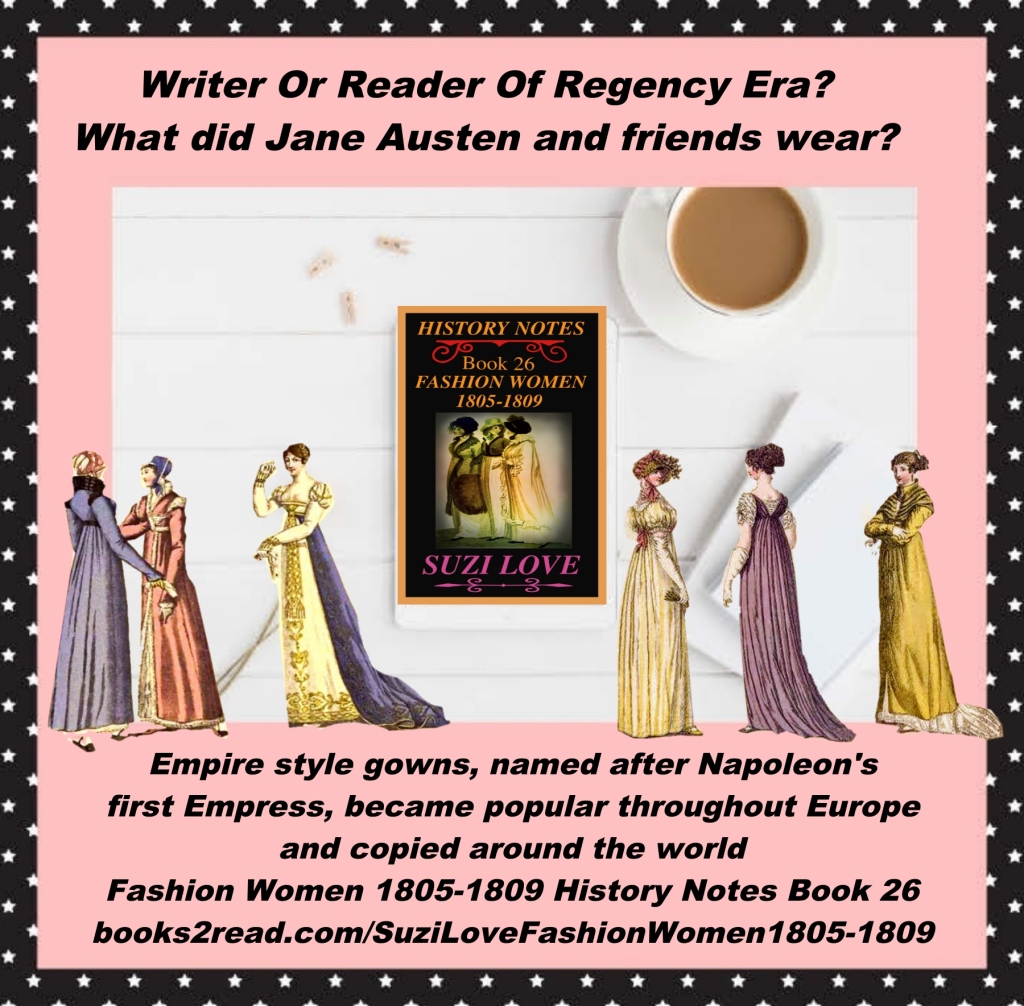
What did Jane Austen and friends wear? Early 1800s fashions were elegant and pretty with high waists and fabrics that were almost transparent. These Empire style gowns, named after Napoleon’s first Empress, became popular throughout Europe, and were then copied around the world. Colorful outwear was added to make an ensemble more attractive and warmer. History Notes Book 26 Fashion Women 1805-1809. https://books2read.com/SuziLoveFashionWomen1805-1809
What did Jane Austen and friends wear? Early 1800s fashions were elegant and pretty with high waists and fabrics that were almost transparent. These Empire style gowns, named after Napoleon’s first Empress, became popular throughout Europe, and were then copied around the world. Colorful outwear was added to make an ensemble more attractive and warmer.
https://books2read.com/SuziLoveFashionWomen1805-1809
Fashion Women 1805-1809 History Notes Book 26 What did Jane Austen and friends wear? https://books2read.com/SuziLoveFashionWomen1805-1809
What was fashionable outdoor wear for the Bridgerton ladis, Jane Austen, and their contemporaries? Reticules, Spencers, and Pelisses, or Walking Dresses, Or Redingotes. History Notes Books 3, 4, and 5 By Suzi Love.
What was fashionable for purses in past centuries? Call them what you like: purses, bags, handbags, reticules, ridicules, clutches, or pocket replacements. They all did the same job and they changed greatly with the prevailing fashions of time. books2read.com/suziloveReticules
What was fashionable in women’s jackets in the Regency Era? Call them what you like: Spencers, short jackets, or Regency jackets. They provided modesty and warmth and they changed greatly with the prevailing fashions of the time. Take a look at the jackets being worn by women in the early 1800s. books2read.com/suziloveSpencers
What sort of coats did women wear during the Regency years? them what you like: Coat, Pelisse, Redingote, Walking Dress, Promenade Dress. Take a look at what was being worn by women, men, and children. books2read.com/suzilovePelisse
HN_3-4-5_Fashion-accessories-reticules-spencers-redingotes.-regency-fashion-history-.-history-notes_books2read.comsuzilovespHN_4_Spencers, Or Jackets. #Regency #Georgian #Victorian #Fashion History Notes Book 4 By Suzi Love.
Are you a reader or writer of Regency Romance? Love Jane Austen and the Bridgertons? Want to know more about the mourning, riding, underclothing and other Regency Era women’s fashions in Regency romances? What was fashionable for women in Jane Austen’s times? Mourning, riding, daytime, evening clothing, plus underclothing, corsets and accessories. This book looks at what was fashionable for women in Jane Austen’s times, or the early 1800s, or the Regency Era in Britain. Wars were being fought around the globe so women’s fashion adopted a military look in support of soldiers. Fashions, like the lifestyle, became progressively more extravagant and accessories went from colorful to over-the-top.
History Notes book 27
What was fashionable for women
in Jane Austen’s times?
Mourning, riding, daytime, evening clothing,
plus underclothing, corsets and accessories.
Wars were being fought so women adopted
military looks in support of soldiers.
https://books2read.com/SuziLoveFashion1810-1814
Lover of Bridgerton and Jane Austen fashions? What was fashionable for their outer wear? Different names in different countries: Pelisse, Redingote, Or Walking Dress. #Regency #Fashion #History http://books2read.com/suzilovePelisse
The Pelisse or Redingote was essentially a coat or robe like garment worn both indoors and out. Worn indoors open to reveal a dress, the outdoor version was made of heavier materials and of darker colors than the type worn indoors. The name comes from the term ‘riding coat.’ In the Georgian Era, Redingotes were worn by men, women and children when outdoors and especially as part of a riding costume by both sexes.
In England, the Pelisse was the main sort of fashionable outerwear, or coat, for women in the Regency Era, or Jane Austen’s times. Though this sort of coat was popular from the late 1700s until around 1850. In the early 1800s, this sort of Empire style coat reached the hip or knee but around 1810 the Pelisse lengthened to become a full length coat. Around 1812, the Pelisse often had a broad, cape-like collar with fur trim and thanks to the Napoleonic Wars and an avid interest in all things military, a Pelisse took on a military look with epaulettes and braiding very popular.
While the terms Redingote and Pelisse are often used interchangeably, Pelisse and Walking Dress and Carriage Costume were the names used in English Fashion Plates, whereas French Fashion Plates refer to the longer style of coats as a Redingote and the shorter shoulder capes worn by military men as a Pelisse.
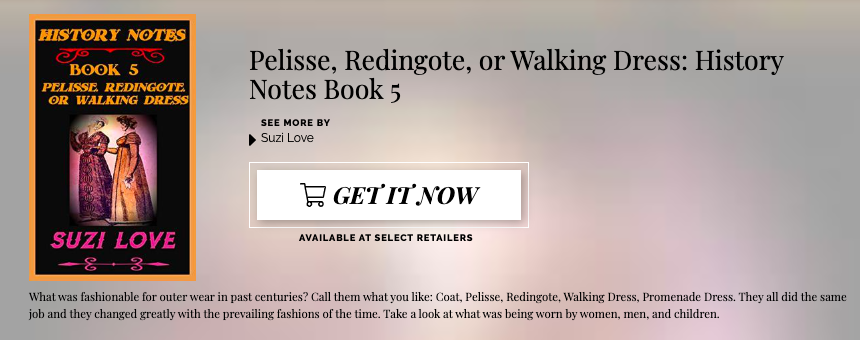
Pelisse, Redingote, Or Walking Dress. History Notes Book 5 By Suzi Love. What was fashionable for outer wear in past centuries? Call them what you like: Coat, Pelisse, Redingote, Walking Dress, Promenade Dress. Take a look at what was being worn by women, men, and children. books2read.com/suzilovePelisseD2D_RetailerBuyLink_HN_5_books2read.com/suzilovePelisse
What did Jane Austen and friends wear? Early 1800s fashions were elegant and pretty with high waists and fabrics that were almost transparent. These Empire style gowns, named after Napoleon’s first Empress, became popular throughout Europe, and were then copied around the world. Colorful outwear was added to make an ensemble more attractive and warmer. History Notes Book 26 Fashion Women 1805-1809. https://books2read.com/SuziLoveFashionWomen1805-1809
The Empire waist gown defined women’s fashion during the Regency Era. ‘Empire’ is the name given in France to the period when Napoleon built his French Empire. High-waisted, loose gowns were adopted by the aristocracy as a symbol of turning away from the fussy, elaborate and expensive clothing worn in the 1700s. Jean-Jaques Rousseau advocated copying peasants and returning to a simpler life and more natural fashions. Unrestricting clothing was part of the new Democracy in France and these simpler and flowing fashions were adopted all over Europe, including Britain and despite the continual wars being fought against France during the early 1800s. Not even war stopped fashions from being copied everywhere.
Fashion Women 1805-1809 History Notes Book 26
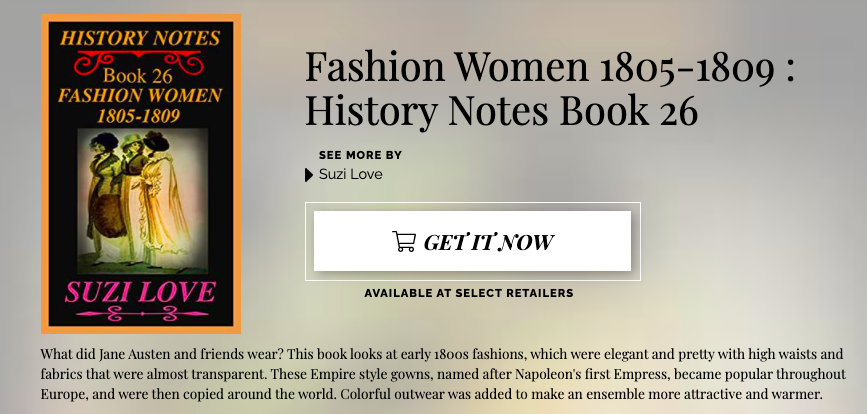
What did Jane Austen and friends wear? This book looks at early 1800s fashions, which were elegant and pretty with high waists and fabrics that were almost transparent. These Empire style gowns, named after Napoleon’s first Empress, became popular throughout Europe, and were then copied around the world. Colorful outwear was added to make an ensemble more attractive and warmer.
https://books2read.com/SuziLoveFashionWomen1805-1809HN_26_D2D_FsshionWomen1805-1809
16th-19th Centuries Gentlemen’s Banyans. Banyan’s were worn before the Georgian Era and continued to be popular through the Regency and Victorian Eras for Men’s At-Home Fashion. After this, banyans were replaced buy shorter smoking jackets, yet all through these many hundred years banyans served the same purpose of being a comfortable yet respectable item of clothing that could be worn at home by men when they spent time in the evenings with family or friends.
Fabrics imitating animal patterns and colors appeared in European fashionable dress as early as the 18th century, when elaborate trompe l’oeil silk designs emulated exotic furs intertwined with expensive laces. Such fabrics communicated a sense of luxury, wealth and power. Cultural crossdressing was a long-established tradition among merchants working in the East. While it helped them to assimilate into the local community, adopting exotic forms of dress at home also played an important part in fashioning their identity as a worldly traveller. International experience heightened social standing so wearing a banyan showed a high social status. Surviving garments from the 18th and 19th centuries show that it changed little over time, other than to loosely reflect the fashionable line of menswear of the period in the cut of the skirts, choice of collar and fit of the body.
16th-19th Centuries. Collage of Gentlemen’s BanyansDefinition Banyan: Loose coat worn by men as a dressing gown. Often worn with a matching waistcoat over shirt and pants in the comfort of their own home.
HN_23_d2d_fashionmen1800-1819
https://books2read.com/SuziLoveFashionMen1800-1819