Top Hat Styles Chart during the 1800s, from the Regency Era through to the Victorian years. Most popular style was cone shaped and tall in height. Originally made of beaver and very short but later from silk and taller. Tall crown, widens at top, narrow brim turns up slightly at sides. https://books2read.com/SuziLoveFashionMen1800-1819
1790-1810 ca. Woman’s Black Wool Shoes. Pointed toe and low wedge heel covered in same fabric, black tape binding, leather straight or symmetrical sole, linen insole and lining. Wool satin with wool twill tape binding, plain weave linen lining, and leather sole. Place of Use: Lexington, Massachusetts, United States. Place of Manufacture: possibly Massachusetts, United States Provenance: Worn by a member of the Robbins family; inherited by Ellen A. Stone; gift to MFA, 1899. Credit Line Gift of Miss Ellen A. Stone via Museum of Fine Arts, Boston, U. S.A.
In Jane Austen’s years, she and her contemporaries spent a lot of time outdoors. Fragile slippers were worn for balls and evening events but for walking sturdier shoes were needed, In the early 1800s, these were typically made of leather and were flat or had a very small heel.
1800-1830 ca. Drawstring Bag, German. Basket-shaped, Ecru cotton knit embroidered with colored glass beads in design of grapevine on upper half, open work embroidered with weaving motif on lower half. Wired at center, cardboard at base. Green silk cord drawstring. The Elizabeth Day McCormick Collection via Museum of Fine Arts, Boston, U.S.A. mfa.org
Definition Reticule Or Ridicule Or Bag or Purse: Often with a drawstring to pull closed and usually made of cloth or covered cardboard and often decorated with beading or embroidery. A reticule, or purse, or handbag, was usually carried by a woman during the Regency period to carry all their daily necessities. Earlier, women used pockets that tied at the waistline and were hidden in the folds of their skirts. Empire style, or early 1800s, high-waisted dresses made it impossible to either sewn in a pocket or to tie on a pocket. So women began carrying small, decorated bags called Reticules, or ridicules, which generally pulled close at the top with a drawstring.
1800-1830 ca. Reticule, or Bag, American. Bottom of bag shaped like basket and made of stiff deep cream colored mohair with minute blue figure, two panels of light blue painted silk moiré, upper part of bag of deep cream colored figured silk, blue silk ribbon, drawstring and bows trimming lower part of bag. via Museum of Fine Arts, Boston, U.S.A. mfa.orgD2D_RetailerBuyLink_HN_3 http://books2read.com/suziloveReticules
What was fashionable for outer wear in past centuries? Different names in different countries: Pelisse, Redingote, Coat, Or Walking Dress. The Bridgertons and Jane Austen and her contemporaries wore long coats like these to keep warm when out and about, visiting, shopping etc. The thin muslin dresses worn in the early 1800s were little protection against European winters. http://books2read.com/suzilovePelisse
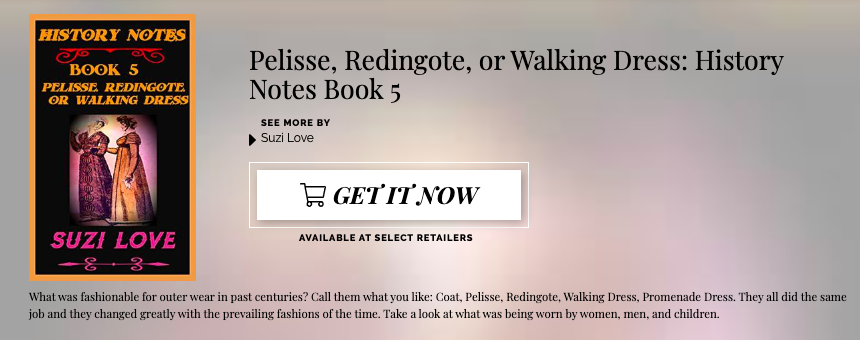
Pelisse, Redingote, Or Walking Dress. History Notes Book 5 By Suzi Love. What was fashionable for outer wear in past centuries? Call them what you like: Coat, Pelisse, Redingote, Walking Dress, Promenade Dress. Take a look at what was being worn by women, men, and children. books2read.com/suzilovePelisseD2D_RetailerBuyLink_HN_5_books2read.com/suzilovePelisse
19th Century Early Reticule, Or Bag, New England, England or U.S.A. Septagonal, or four sided, with embroidery and silk tassels. White satin embroidered with polychrome silks, silver threads, silver sequins. On front, in center of wreath of roses tied with blue bow, is written VALUE THE TRIFLE. On back, in similar wreath, is FRIENDSHIP. On sides are floral motifs, one of sweetpeas and the other of pansies. On all sides a border of silver threads in chain motif entwined with curling brown vine. Primarily worked in satin stitch. Thirteen silk tassels attached. White ribbon ties. via Museum of Fine Arts, Boston, U.S.A. mfa.org
Definition Reticule Or Ridicule Or Bag or Purse: Often with a drawstring to pull closed and usually made of cloth or covered cardboard and often decorated with beading or embroidery. A reticule, or purse, or handbag, was usually carried by a woman during the Regency period to carry all their daily necessities. Earlier, women used pockets that tied at the waistline and were hidden in the folds of their skirts. Empire style, or early 1800s, high-waisted dresses made it impossible to either sewn in a pocket or to tie on a pocket. So women began carrying small, decorated bags called Reticules, or ridicules, which generally pulled close at the top with a drawstring.
1820 ca. Collection of Reticules, or Purses. Silk silver gauze, netting, fine crochet. Bags have drawstrings, chains and tassels. via Ruby Lane Auctions. #RegencyFashion #JaneAusten #British
Definition Of A Reticule; Bag or purse, often with a drawstring to pull closed and usually made of cloth or covered cardboard and often decorated with beading or embroidery. A reticule, or purse, or handbag, was usually carried by a woman during the Regency period to carry all their daily necessities. Earlier, women used pockets that tied at the waistline and were hidden in the folds of their skirts. Empire style, or early 1800s, high-waisted dresses made it impossible to either sewn in a pocket or to tie on a pocket, so women began carrying small, decorated bags called Reticules, or ridicules, which generally pulled close at the top with a drawstring. These Reticules, or bags, were the forerunners of our modern day purses.
1820 ca. Collection of Reticules, or Purses. Silk silver gauze, netting, fine crochet. Bags have drawstrings, chains and tassels. via Ruby Lane Auctions.1830 ca. Collection of Four Tiny Purses, or Reticules with drawstrings to close. via Ruby Lane Antiques.D2D_RetailerBuyLink_HN_3 http://books2read.com/suziloveReticules
In Jane Austen’s years of the early nineteenth century, women often wore light-weight dresses under which was worn a range of underclothing to stop gowns appearing transparent and sticking to a lady’s body. To preserve modesty, underclothing included a chemise next to the skin, then a corset, and then petticoats to give shape to a dress and to keep it away from her body.
1818 Printed Cotton Gown, American. Brown high-waisted, or Empire line, gown as would have been worn during Jane Austen’s lifetime. Sleeves are puffed at the shoulders with unusual puffs to decorate the long straight sleeves. Hem has multiple rows of ruffles to decorate. via Metropolitan Museum New York City, U.S.A. metmuseum.org
Fashion Women 1815-1819 History Notes Book 28 https://books2read.com/SuziLoveFashionWomen1815-1819
1807 Women’s French Coats, or Redingotes, or Pelisses, or Walking Dresses, as worn in the early 1800s, or early Regency years, or in the times of Jane Austen. Fashion plates from the 1807 volumes from the French magazine, Journal des Dames et des Modes or Costume Parisien.
The Journal des dames et des modes was a French fashion magazine published between 1797 and 1839 and was the second oldest fashion magazine published in France, replacing the Cabinet des Modes (1785-1793).
The magazine was the main source for French fashions, both in France and internationally. Pierre de la Mesangere was editor and main journalist for most of the time the magazine was in existence and he published a magazine every five days, which is why there is an abundance of French fashion plates from these years. The magazine had eight pages of text, one or two colored fashionplates, plus poetry, theatre reviews, current social news and fiction. During the Napoleonic wars, everything to do with France was unpopular, especially in Britain, yet French fashions thrived and so did the Journal des Dames et des Modes, despite the numerous other fashion magazines that copied the magazine.
1807 Green Redingote or Pelisse or Walking Dress, British. Green velvet decorated with yellow satin military style yellow shoulder trim, green Capote, or hat, trimmed with yellow satin, and matched with yellow shoes. Fashion Plate via Journal des Dames et des Modes, or Costume Parisien.1807 Blue Redingote Or Pelisse Or Coat With Yellow Trim, French. Striped short sleeves over straight blue sleeves, yellow bonnet tied under the chin, white paisley shawl. Fashion Plate via Journal des Dames et des Modes, or Costume Parisien. 1807 Blue Redingote, French. Blue drap Redingote, or Pelisse, or Walking Dress, decorated with velvet, short pleated sleeves over long straight sleeves, yellow velvet and satin hat with blue contrast, and yellow shoes. Fashion Plate via Journal des Modes et des Dames, or Costume Parisienne. 1807 Blue Redingote, French. Back view of a pleated, blue Merino wool, redingote with a high-waist and gathered short back bodice, worn with a jaunty yellow hat with a matching blue feather. Fashion Plate via Journal des Dames et des Modes, or Costume Parisien.1807 Peach Redingote, Or Pelisse, Or Walking Dress, French. With white shawl collar and a close fitting hat to match. Fashion Plate via suzilove.com and Journal des Dames et des Modes, or Costume Parisien.1807 Golden Yellow Redingote Or Pelisse, French. High collar and frill around the entire hem, short puffed sleeves over long straight sleeves. Fashion Plate via Journal des Dames et des Modes, or Costume Parisien. Fashion Women 1805-1809 History Notes Book 26 What did Jane Austen and friends wear? https://books2read.com/SuziLoveFashionWomen1805-1809