What did an older lady do and wear in the Regency Era? Information & pictures for readers and writers of early 1800s history, nonfiction and fiction. books2read.com/suziloveOLD
The older lady’s day usually started with her toilette in her bedroom, where her maid helped her dress for the day and styled her hair. After that, she would join her family downstairs for breakfast unless she preferred a tray with either tea or hot chocolate in her bedroom as she prepared for her busy day. Her day would be made up of speaking with the housekeeper and the cook about the week’s menus, assuring that the servants were all available that day and no one was ill, and checking the list of foods needed. She would also enquire if the laundry was up to date and that they had enough good linen to make up all the beds before extended family members and guests arrived. If she was in the country and hosting a weekend house party, she would assign rooms to the guests on her lists and query that all was in readiness for their arrival.
In 1931, Coca-Cola decided they wanted a more “wholesome” depiction of Santa, and contracted illustrator Haddon Sundblom to give him a makeover. Sundblom (1899-1976), who created expressive paintings of the magical Mr. Claus for the Coca-Cola Company over a period of 33 years. In 1931, Coca-Cola employed illustrator, Haddon Sundblom, to create a happier image of Santa Claus and he drew a new advertisement each year.
Clement Moore’s 1823 poem “A Visit from St. Nicholas” may have described the jolly old elf in detail, and Thomas Nast’s 1881 caricature of Saint Nick may have brought the image of Santa into focus, but not until the middle of the 20th century did one artist perfect the image of Santa and make it stick. Though he was not the first artist to create an image of Santa Claus for Coca-Cola advertising, Sundblom’s version became the standard for other Santa renditions and is the most-enduring.
What did ladies do and wear in Jane Austen’s time, or early 1800s? #Regency #History #nonfiction Books 4 and 5 Regency Life Series. Young Lady’s Day and Older Lady’s Day in Books 4 and 5 in the Regency Life Series. These books depict the often-frivolous life and fashions of ladies in the early 1800’s, or during the lifetime of Jane Austen, but also gives a glimpse into the more serious occupations ladies may undertake. Through historic images, historical information, and funny anecdotes, they show how a lady fills her day, where she is permitted to go, and who she spends time with. These light-hearted looks at the longer Regency years are an easy to read overview of what people did and wore, and where they worked and played. There is plenty of information to interest history buffs, and lots of pictures to help readers and writers of historical fiction visualize the people and places from the last years of the 18th Century until Queen Victoria took the throne. Young Lady’s Day ~ Older Lady’s Day
1826 An Affair Of Honor Decided With Pistols In Hyde Park London, U.K. A Regency Gentleman’s Life. From The English Spy By Robert Cruikshank. By the Regency Era, dueling was outlawed, yet duels still happened because the courts were made up of peers who were reluctant to charge another peer with murder as a result of a duel. Gentlemen considered a duel a matter of honor and death was preferable to being labeled a coward.
Duels had a code of honor and were fought not so much to kill the opponent as to gain satisfaction and restore honor by demonstrating a willingness to risk your life. Originally dueling was only for the male members of nobility but then extended to all members of the upper classes. At first, duels were fought with swords but by the Regency Era, duels with pistols were more common. Some duels were also fought between women.
Favorite dueling grounds near London included Hampstead Heath, Chalk Farm and the common land that extended south of the Thames over modern Battersea, Putney and Wimbledon. The windmill there was a popular landmark beneath which duelists often agreed to meet. These locations were convenient for their proximity to the city, yet also sufficiently remote to avoid interruption and in the event of a fatality, attractively close to potential getaway routes on the roads out of London.
1826 An Affair Of Honor Decided With Pistols In Hyde Park London, U.K. A Regency Gentleman’s Life. From The English Spy By Robert Cruikshank.
Writing Regency Era Fiction Or Nonfiction? Need more information on Older Gentleman’s Day in early 1800s, or the Bridgerton family or Jane Austen’s Regency Era. A lighthearted overview of an older gentleman’s clothing, social life, and responsibilities in the early 1800s. Take a look at where an older man went, what he wore, and how he managed the family’s finances and his estates. Older Gentleman’s Day Regency Life Series Book 3 books2read.com/suziloveOGD
1820 July 6th View of London Bridge and Custom House with Margate steam yachts, London, U.K. Hand colored By artists and Engravers, P. and D. Colnaghi and Co Ltd and Co (publishers) and R. Havell and Son. via Royal Museums Greenwich. collections.rmg.co.uk
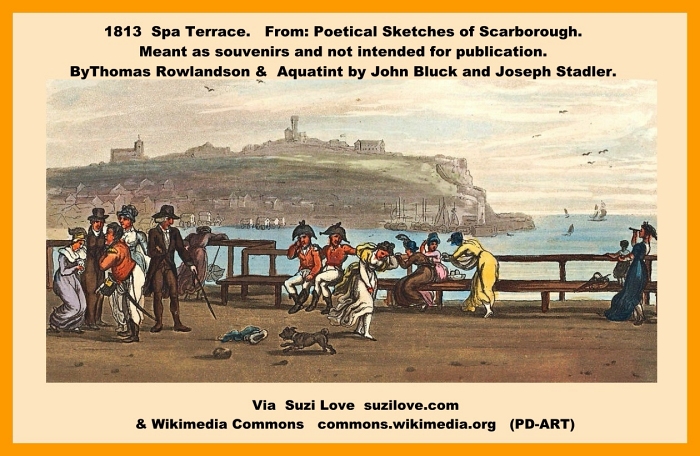
1813 Spa Terrace. From: Poetical Sketches of Scarborough. Meant as souvenirs and not intended for publication. By Thomas Rowlandson & Aquatint by John Bluck and Joseph Stadler. Via Wikimedia Commons commons.wikimedia.org (PD-ART) Spa towns were very fashionable retreats from London’s pollution for people in Jane Austen’s times.
An overview of women’s fashions in the first twenty years of the 19th century. What was fashionable for women in Jane Austen’s times, or the early 1800s. Wars were being fought around the globe so women’s fashion adopted a military look in support of soldiers. In Britain, the Prince Regent ruled instead of his father, King George III, so fashions, like the lifestyle, became more extravagant and accessories went from pretty to opulent.
Reader Or Writer of Regency Era? Love Jane Austen and Bridgerton fashions? What was fashionable for women in Jane Austen’s times, or 1800s, or Regency Era. High-waisted dresses were extravagantly accessorized and hats, shoes, parasols and bags were added. Set includes History Notes Books 12, 25, 26, 27 and 28. https://books2read.com/SuziLoveFashionWomenBoxSet
Ladies clothing in the early 1800’s featured a high waist line called an Empire Line, or Empire style dress, with a waist line just under the natural bust line and much higher than the natural waist. The high-waisted, or short-bodied, Regency styles shifted focus away from the natural waist and so left the natural waist unconstricted, in direct contrast to previous and future styles. Britain took these simple European styles and progressively made them more elaborate by adding more and more complicated embroidery onto white fabrics to create the white on white look popular for many years.
The empire look of fine muslin dresses left women more exposed than in the Georgian Era when fabrics had been thicker and styles bulkier. Women, especially in England, preserved their modesty by adding lace, frills, flounces, ruches, and fabric plaits to dresses to adequately cover any parts that might inadvertently be exposed. Outer layers, such as Spencers, Redingotes or Pelisses or coats, and shawls, were also added for warmth and to brighten outfits. This Empire fashion was totally dependent on a supply of fine, translucent cotton muslin – at first imported from India, then later, less exclusive imitations often woven and printed or embroidered in Britain. Fabrics were soft and lightweight and muslins and other cotton fabrics from India and other Asian countries were in high demand.
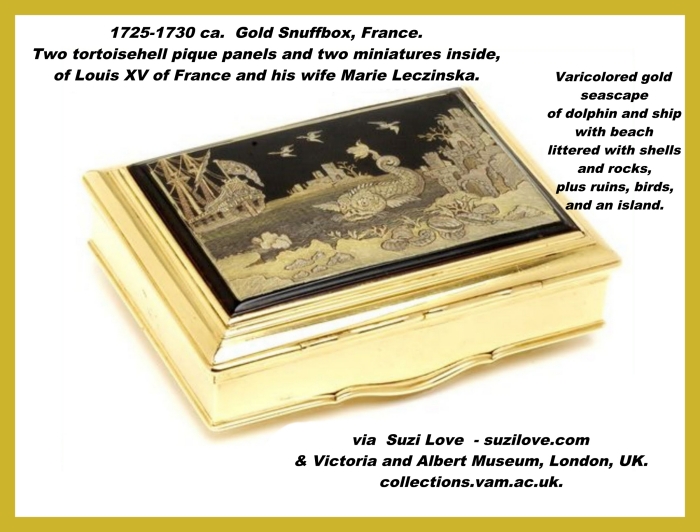
1725-1730 ca. Gold Double-Opening Snuffbox, France. Two tortoiseshell pique panels and two miniatures inside, of Louis XV of France and his wife Marie Leczinska. Made by Jean Baptiste Massé, painter.
Varicolored gold seascape of dolphin and ship with beach littered with shells and rocks, plus ruins, birds, and an island. Inside the box are miniature portraits of Louis XV of France and his wife Marie Leczinska. It has been suggested that the box commemorates the birth of the ‘dauphin’ Louis in 1729, the royal couple’s fourth child, and first son, heir to the throne. A few elements contradict this suggestion: the dolphin does not bear any regal symbol such as a crown, the marks that date the box indicate that it was initiated before the birth of Louis, when the arrival of a son was unknown. It is most probable that these delicate panels, together with the miniature of Louis XV, date from 1725-1730 and have been associated later into this gold snuffbox, and a later miniature of Queen Marie Leczinska.The miniature of the king may have been painted by Jean-Baptiste Massé – he is recorded as supplying miniatures of the king for boxes intended as diplomatic gifts from 1720-26-, or by his lesser known contemporary Jean-Baptiste Ducanel.
The lid is hinged to reveal a miniature, under glass, of Marie Leczinska, queen of France, probably 19th century or heavily restored, wearing a cloak of blue embroidered with gold fleurs-de-lis and lined with ermine overa lace-trimmed dress of red embroidered with gold. In the base is a panel of tortoiseshell pique with a cornucopia of small shells, also hinged to reveal a contemporary miniature of Louis XV of France in armour, wearing a whitestock and the sash of the Order of the Holy Ghost. The gold box, probably early 19th century or later, has plain walls, reeded borders, and a double thumbpiece.
Sir Arthur Gilbert and his wife Rosalinde formed one of the world’s great decorative art collections, including silver, mosaics, enamelled portrait miniatures and gold boxes. Arthur Gilbert donated his extraordinary collection to Britain in 1996.
Snuff Boxes: Decorative boxes of all types were prized, especially in the 18th Century when everything decorative and extravagant was in vogue and taking a pinch of snuff was fashionable. Snuff is made from ground or pulverized tobacco leaves, flavorings added, and then a pinch of snuff is placed on the back of the hand and sniffed.
1810 “A Bonnet Shop” By Thomas Rowlandson.A shopkeeper with a hat in each hand converses with an elderly woman wearing a similar hat. A child holding a rattle looks up at them at left, a plump woman wearing a bonnet sits at center, and a group of young women make bonnets in the background. Many groups of hats hang overhead in the shop. Via British Museum, London, UK. britishmuseum.org (PD-Art)