1797 Elegant Couple Dancing At A Ball. Man: Bottle green tailcoat, yellow knee breeches, white stockings, red vest and black dancing slippers. Lady: White spotted dress with a pale pink overdress open at the front, high belted waist, red and green turban and a parure, or jewelry set. via Fashion Plate via Journal des Dames et des Modes, or Costume Parisien.
1800-1815 ca. Fan of Bone and Silk, French. Jane Austen and her family and friends would have carried this style of fan when attending assemblies, musical evenings and balls. Metropolitan Museum New York City, U.S.A. metmuseum.org
1812 Gentleman’s Outfit, French. Brown overcoat, or Redingote, with front pockets, cream Drap trousers buttoned at the ankle, knotted kerchief, top hat and holding a cane. Fashion Plate via suzilove.com and Journal des Dames et des Modes, or Costume Parisien. By 1812, men no longer wore complicated styles and extravagant fabrics. Men’s fashions had simplified and these practical and relaxed clothing items were the sort worn by Jane Austen’s male family and friends when out and about in town or on their daily excursions.
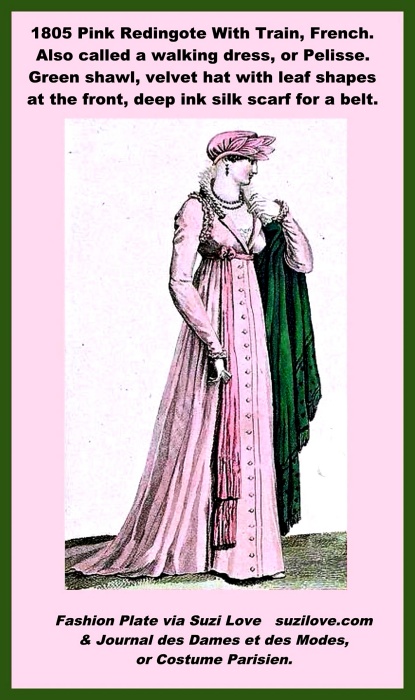
Definition Redingote Or Coat: French word developed from English words, riding coat. Long fitted outdoor coat worn over other garments for warmth. Originally made with several capes and trimmed with large buttons. French fashion plates call these coats Redingotes and they were worn by men, women, and children. English fashion plates call the coats a Pelisse, a Walking Dress, Promenade dress, or Carriage dress. Definition Drap: French equivalent for the English word cloth or stuff and generally applied to fabrics of wool or silk.
1809 White Court Dress, French. Long train lavishly decorated with blue flowers, long white gloves and evening hairstyle. Fashion Plate via Journal des Dames et des Modes, or Costume Parisien.
Definition Court Dress: Usually, the difference between a court dress and a ball dress was in the quality of fabrics used, how elaborate the design, and the number and quality of the accessories. Plus, in England in the early 1800s court dresses were required by Queen Charlotte to have hoops and in France and other European countries court dresses a long train, usually expensively decorated. During the Regency Era, white cotton dresses were considered suitable for many evening events, but definitely not for an evening event in a palace.
1800s French Palais Royal Sewing Box and Twelve Mother of Pearl Enamel Tools. This is the style of sewing box Jane Austen and her family would have used in the early 1800s, or Regency years. via via suzilove.com and 1st Dibs Auctions 1stdibs.com
Definition: Palais Royal: Name of an area around the Royal Palace in Paris, France, that specialized in making small and exquisite works of art during the 18th and 19th centuries. Palais Royal sewing tools were elaborate and usually feature mother-of-pearl, often intricately carved or engraved. During the 19th century, workboxes were often works of art with engravings, carvings, mother-of-pearl, and elaborate gilt metal mounts. Most popular were scissors with steel blades and gilt mounts, thimbles and needle cases which were often shaped like animals or other natural forms. Workmanship was exceptional and the tools almost too fragile to use.
1818 September 18th Le Palais Royal de Paris, Or ‘A Peep at the French Monstrosities’. By George Cruikshank. Two English tourists, both dressed as dandies, walk arm-in-arm under the arcade of the Palais Royal, interested in the promenading courtesans. Two Frenchmen make more direct overtures to two women. Their dress is rather similar to that of the Englishmen, but the latter wear bell-shaped top-hats, while the Frenchmen have flower-pot shaped hats. An officer wearing a large cocked hat addresses a girl, and a man, said by Reid to be Irish, jovially accosts another. Some of the women are in evening-dress, others in street costume. Behind are iron railings between the supports of the roof; on one of these is the inscription ‘Caveau des Sauvages’. Published by: George Humphrey. via British Museum.
1820 Ice Blue Figured Silk Pelisse or Redingote. Bodice with hussar-style frogging, trimmed with fringed passementerie and silk covered buttons, puffed mancherons and cuffs en tablier with satin piping and buttons, hem with deep border of blue plush and flecked fringing which gives effect of feathers. This silk pelisse shows how women’s fashions, especially outer garments, were leaning towards men’s military styles. Braiding became popular, sleeves often had layers at the shoulders of either short sleeves under long sleeves or they had the braiding and buttons and buttonholes found on military uniforms. Fabrics were luxurious as seen in this figured silk, and decorative or extravagant hems were added, like the hem fringing on this coat. Because these coats were somewhat fragile due to being made of silk, not many would have survived. Extant Pelisse, or Redingote via Kerry Taylor Auctions. Kerrytaylorauctions.com
Definition Redingote Or Pelisse Or Walking Dress Or Coat: French word developed from English words, riding coat. Long fitted outdoor coat worn over other garments for warmth. Often left open at the front to show off the dress underneath. Sometimes cut away in front. Originally made with several capes and trimmed with large buttons. French fashion plates call these coats Redingotes and they are designed for women, men and children. English fashion plates call them a Pelisse, a walking dress, Promenade dress, or Carriage dress.
Here is an example of when English magazines copied French fashion plates.
1815 December Left: French fashion plate Ensembles French and English via Journal des Dames et des Modes. White short length ball dress with tiny bodice.
Right: English fashion plate by Rudolph Ackermann in the Repository Of arts. Blue sarsnet Pelisse, or Walking dress, or Redingote. Decorated with white lace trim on neck, vertical front, and hem. Carrying red shawl and with high plumed bonnet.
1815 December Blue Walking Dress, English. Blue twilled sarsnet pelisse, or Redingote, with ribbon bows adorning the front. Decorated with white lace trim on neck, vertical front, and a border of leaves on the hem. Slashed sleeves at shoulders and wrists plus an elaborate collar would have been time consuming to make. Carrying a red shawl and with a high bonnet with a white plume, or feather. Fashion Plate via Rudolph Ackermann’s ‘The Repository of Arts’.
1815 December Blue Walking Dress, English. Decorated with white lace trim on neck, vertical front, and hem. Carrying red shawl and with high plumed bonnet. Fashion Plate via Rudolph Ackermann’s ‘The Repository of Arts’.
Below is the French version of this pelisse but with a lady in a ball dress. Possibly another example of the English magazines ‘copying’ French designs.
1815 Ensembles French and English. White short length ball dress with tiny bodice and sleeves. Blue sarsnet Redingote, or pelisse, decorated with white lace trim and border of leaves, slashed sleeves at shoulders and wrists, elaborate collar, red shawl, high bonnet with white plume, or feather. Fashion Plate via Journal des Dames et des Modes, or Costume Parisien.
I love when the same fashion plate is repeated with two ladies or a lady and a gentleman. 1808 Ladies In High Waisted Dresses, French. Green dress with short sleeves, white frill back bow and white lace headdress. White dress with short puffed sleeves, paisley shawl and red coral necklace. Fashion Plate via Journal des Dames et des Modes, or Costume Parisien. https://books2read.com/SuziLoveFashionWomen1805-1809. Gorgeous Regency Era clothing came in a wide range of styles to suit every season and occasion. Ladies in Jane Austen’s times wore Empire style dresses which were usually of light fabric and floaty in style so accessories were essential to keep women warm.
1660-1700 ca. Gaming Purse, Probably French. Green velvet trimmed with copper-gilt thread. Gaming or gambling with cards popular 17th-century pastime and any gentleman or lady not playing games like Quadrille and Basset would have been considered ‘low-bred and hardly fit for conversation’ according to ‘The Compleat Gamester’, published in 1674. Typically, gaming purses had flat, circular bases with sides gathered on a drawstring. via Victoria and Albert Museum, London, UK. collections.vam.ac.uk.