1806 Waiting For the St. Cloud Coach, Place de la Concorde, Paris. Illustrations by Francis Courboin. via Les Modes de Paris. (PD-Art) This couple is depicted waiting for the coach, which was a passenger vehicle drawn by four horses. The woman is wearing a fashionable hat or “capote” that covers her face. Her dress maintains the empire waist and has very long sleeves that also have a ‘mancheron’ or a gathered sleeve at the shoulders. The man is wearing a ‘habit du gagé’ or a coat with tails, buttoned at the waist. His hat is a ‘haut-de-forme’ or what is commonly known in English as a top hat. He wears tight, short pants tucked into large, riding boots, as was the fashion for men. Illustrations by François Courboin from Octave Uzanne‘s Les Modes de Paris. Variations du goût et de l’esthétique de la femme, 1797-1897, L. Henry May, Paris, 1898, or from the English translation of the same work: Fashion in Paris : the various phases of feminine taste and aesthetics from 1797 to 1897, William Heinemann, London, 1898. Modes de Paris VIa Brown University Library .
Blurb: Love After Waterloo: Lady Melton and her son are forced to join antagonistic Captain Belling and the last group of wounded British soldiers evacuating Waterloo and traveling back to London. https://books2read.com/suziloveLAW
Book Hook: Lady Melton’s hand flew to her mouth. “Oh, dear. I’ve taken your bed. I’ve forced you to use a mattress on the floor.”
The Captain laughed. “Believe me, that’s far better than propping against a tree and trying to snatch an hour’s sleep before battle. Or squeezing between a sea of horses and men so you stay warm and don’t expire from frostbite.”
“How long have you been with Wellesley?”
He leaned forward and rested his arms on his knees. “Too damn long.”
“So you’re pleased to be going home?”
“Pleased? No. Resigned, yes. My friends, my fellow officers, were ordered back to Brussels. I feel guilty that I’m not with them.”
“But surely they will return home soon, now that we’ve defeated Napoleon?”
“We’ve thought the war finished several times before, and I fear this time may prove the same. Nobody can predict what the Corsican will do next.”
She squeezed his thigh. “You’re worn out, Gabe. Things will be better when you’re in London once again.”
“Will they? Too much has changed there as well. I doubt I’ll fit back into society very easily.”
“Won’t your family be pleased to have you home?”
“Perhaps, but the only important one, my uncle, died three months ago. No one cares how many thousand British men have been slaughtered, or that there will be hundreds of injured soldiers in London soon who will have no homes and no employment.”
1808 Two ladies in high-waisted dresses, French. White dress with blue paisley shawl, blue shoes and red and white bonnet, blue dress with elaborate yellow trims, yellow shoes and bonnet to match.Fashion Plate via Journal des Dames et des Modes, or Costume Parisien.
These are the types of general morning dress worn by Jane Austen and contemporaries in England, as French fashion plates were obsessively copied despite the two countries being at war for many years. English fashion magazines frequently published plates copied from French fashion magazines and both French and English magazines published the same design for both single women’s fashion and for two ladies together.
Ladies clothing in the early 1800’s featured a high waist line called an Empire Line, or Empire style dress, with a waist line just under the natural bust line and much higher than the natural waist. The high-waisted, or short-bodied, Regency styles shifted focus away from the natural waist and so left the natural waist unconstricted, in direct contrast to previous and future styles. Britain took these simple European styles and progressively made them more elaborate by adding complicated embroidery and colorful accessories.
1808 Two Ladies in Jane Austen style high-waisted dresses, white and blue. #RegencyFashion #JaneAusten #HistoricalFashion https://books2read.com/SuziLoveFashionWomen1805-1809
Fashion Women 1805-1809 History Notes Book 26
What did Jane Austen and friends wear? This book looks at early 1800s fashions, which were elegant and pretty with high waists and fabrics that were almost transparent. These Empire style gowns, named after Napoleon’s first Empress, became popular throughout Europe, and were then copied around the world. Colorful outwear was added to make an ensemble more attractive and warmer.
https://books2read.com/SuziLoveFashionWomen1805-1809
1809 Blue Redingote, French. Back view of walking coat with military style trim, upstanding collar, white hat, black shoes and a handkerchief. Fashion Plate via Journal des Dames et des Modes, or Costume Parisien.
Redingotes or Pelisses were needed to cover the flimsy dresses made of lightweight fabrics of the Regency years to provide warmth and some protection from windy conditions when gowns might lift and cause modesty issues. Jane Austen and her contemporaries often walked to places and so would have needed the warmth of a Pelisse or coat in the cold British winters.
In Europe, a Redingote was a coat or robe like garment worn both indoors and out, indoors left open to reveal a dress while the outdoor version was made of heavier materials and of darker colors than the type worn indoors. The name comes from the term ‘riding coat.’
1809 Blue Redingote, French. Back view of walking coat with military style trim, white hat and holding a handkerchief. Fashion Women 1805-1809 History Notes Book 26 What did Jane Austen and friends wear? https://books2read.com/SuziLoveFashionWomen1805-1809
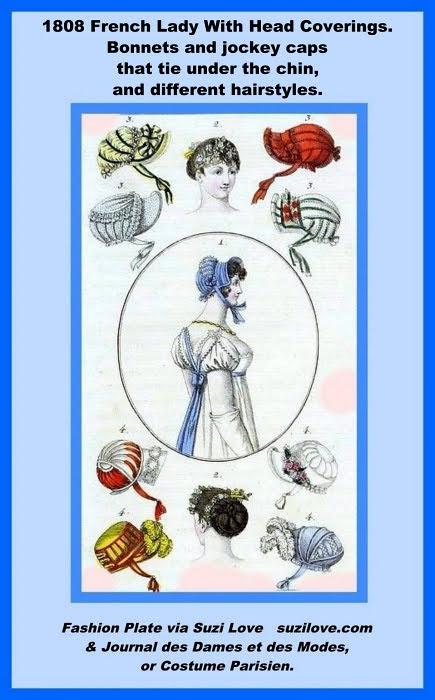
1808 French Lady With Head Coverings. Bonnets and jockey caps that tie under the chin and different hairstyles. Fashion Plate via Journal des Dames et des Modes, or Costume Parisien. French fashions like this were copied by English magazines so these styles of hats would have been worn by Jane Austen and her contemporaries.
What was fashionable for women in Jane Austen’s times? Mourning, riding, daytime, evening clothing, plus underclothing, corsets and accessories. Fashion Women 1810-1814 History Notes Book 27 This book looks at what was fashionable for women in Jane Austen’s times, or the early 1800s, or the Regency Era in Britain. Wars were being fought around the globe so women’s fashion adopted a military look in support of soldiers. Fashions, like the lifestyle, became progressively more extravagant and accessories went from colorful to over-the-top. https://books2read.com/SuziLoveFashion1810-1814
The Lady’s Magazine said of the basis of women’s fashion that was popular for the first twenty years of the 1800s, ‘White is still the prevailing color for robes. For morning dresses, linen gowns, in large diamonds or squares, are fashionable. Indian muslins, plain or embroidered, are preferred to Florence and satins. The designs of embroidery for shawls are of infinite variety. Long gloves, which reach above the elbow, are not yet laid aside. Medallions are hung around the neck from crossed chains and some of these medallions are shaped like the bags, called ridicules. These reticules are of the lozenge or hexagon shape, with a small tassel at each angle. Reticules, or ridicules, are in lozenge or hexagon shapes with a small tassel at each angle. In capotes, or hats, and ribbands, the violet and dark green prevail over jonquil. Bracelets in hair, pear-shaped ear-rings, medallions on square plates, saltiers of colored stones, are still in fashion.’
What was fashionable in Bridgerton and Jane Austen times? Mourning, riding, daytime, evening fashion plus corsets and underclothing. #Bridgerton #RegencyFashion #JaneAusten https://books2read.com/SuziLoveFashion1810-1814
Blurb: Love After Waterloo: Lady Melton and her son are forced to join antagonistic Captain Belling and the last group of wounded British soldiers evacuating Waterloo and traveling back to London. https://books2read.com/suziloveLAW
Book Hook: Lady Melton and the Captain held vastly different views on women’s roles, she instinctively knew he would convey them safely to English shores. Her son liked him, so she’d make allowances for the Captain’s abrasive manner and assume that his stiffness was due to the stress of conveying a party of injured men, a lady, and a child to London.
“Captain, despite you not wanting me to tend to your own wounds, I shall still offer to help your soldiers. Changing their bandages, massaging their limbs, and that sort of thing.”
“Good grief. You’re telling me that your brothers allowed you to massage men’s arms and legs?”
Her amenable attitude towards him dissipated faster than mist on a sunny morning. “Yes, Captain.” She shifted her sleepy son to her other hip. “Brendon is a knowledgeable physician, and he not only allowed me to massage the men’s painful limbs, but he actively encouraged it.”
“Not under my command, you won’t.”
“Perhaps each soldier should decide for himself. I’m sure they would welcome any relief, even if a mere woman offers the only available treatment. Massaging is known to stimulate blood flow which means a limb doesn’t atrophy while a wound is healing. Faster healing means less time in pain.”
“Humph. We’re British soldiers. Taught to keep a stiff upper lip and suffer in silence.”
She scowled. “Are you making a jest? Because I didn’t picture you as capable of levity.”
He snorted. “Yes, sorry. My pathetic attempt at a joke fell flat. I’m not capable of true levity at the moment. Not after spending days searching for friends, or what was left of them, and retrieving valuables and letters before the battlefield pickers stole items I would rather see returned to their loved ones.” He shook his head. “And why did our men charge over those hills and die?” He pointed towards the battleground where thousands of soldiers had been either slaughtered outright, or had passed their last hours in agony. “So that our fat and complacent Regent can congratulate himself on a brilliant battle. So Wellington can be proclaimed Britain’s greatest war hero.”
Anne winced. Gabe had reached his limit, and with good reason. His grief was palpable and she was back to feeling sorry for the wretched man.
Book Hooks: Lady Melton and the Captain held vastly different views on women’s roles. #Waterloo #regencyromance #historicalromance #BookHook https://books2read.com/suziloveLAW
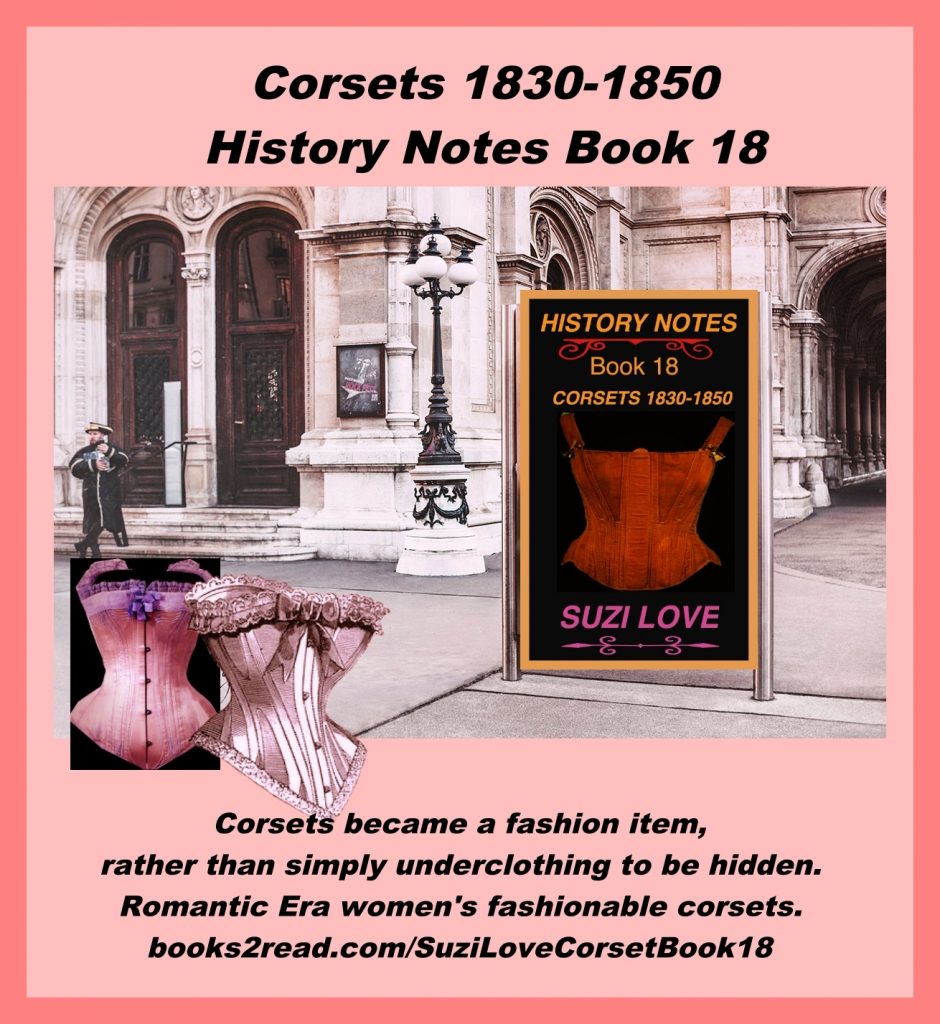
History Notes Book 18 Corsets 1830-1850This book shows how corsets changed to both provide support and also fit well under clothing to give a fashionable silhouette. Corsets started being a fashion item, rather than simply underclothing to be hidden. Romantic Era women’s fashionable corsets. Corsets worn from 1830-1850, or the Romantic Era of fashion. https://books2read.com/SuziLoveCorsetBook18
Information or drawings on corsets through both the Regency and Romantic Eras is difficult as underwear wasn’t shown in British publications for modesty sake, and only occasionally seen in French magazines. Therefore, most of our knowledge about corsets from the Regency and Romantic Eras is through actual garments, especially those donated to museums. Surviving corsets show that shorter corsets weren’t as common and corsets were generally of a longer length. Many of these corsets were still front fastening, plus many were laced at both the front and the back so our aristocratic fictional heroines could indeed dress and undress themselves without the assistance of a maid.
Corset makers became more skilled and cut garments much better, so the body was controlled and shaped by the cut and grain of the fabric. They developed long corded corsets to suit the classical gowns of the period. A wooden busk was created to help keep the undergarment garment lay flat and to lift and separate the breasts. Busks stopped women from bending at the waist, which encouraged good posture.
1830-1850 Romantic Era Corsets Provided Support and Gave Fashionable Silhouette. History Notes Book 18 #Corsets #RomanticEra #HistoricalFashion https://books2read.com/SuziLoveCorsetBook18
1810 ca. Cotton Dress Ensemble With Train, French. Cut out in back, lace shawl with sequins can be added to cover shoulders, small low cut bodice, all over embroidery and very short decorative sleeves. Front, Back and Side Views. via Metropolitan Museum New York City, U.S.A. metmuseum.org
1810 ca. Cotton Dress Ensemble With Train in Jane Austen style. #RegencyFashion #JaneAusten #historicalfashion https://books2read.com/SuziLoveFashion1810-1814
1820 ca. Typical Regency Wrap Corset.. Worn over a chemise. Cross-over fabric and lacing at the back. Tied around at the front. via Roger-Viollet Palais Galliera, Musée de la Mode de la Ville de Paris.
Corsets changed at the end of the Regency Era to fit well under clothing, give maximum support and comfort. Corsets pushed up breasts and showed off the bust line beneath a square-cut and low-cut neckline as in the early 1800s, or Regency years. The Bridgerton ladies, Jane Austen and their female friends would have worn this type of soft wrap corset. https://books2read.com/SuziLoveCorsetBook17.