1808 January Trio In Half Dress Walking Ensembles, English. Lady on left wearing a pink dress and green coat and carrying a reticule. Lady on right in a white trained dress, long draping shawl and fitted hat. Gentleman in a blue tailcoat, white vest, extra high white cravat, knee breeches, shoes, and black top hat. Fashion Plate via Le Beau Monde. The sort of outfits ladies and gentlemen in Jane Austen’s times would have worn while out walking, shopping, or going to visit friends.
1802 February, 15th. ‘Advantages of Wearing Muslin Dresses.’ during the Regency Era, or Jane Austen’s times. By James Gillray. Fat lady sitting with man and woman at tea table reacts in horror when hot poker from fire falls on her dress. Man sits helplessly while second woman upsets the table. Butler drops plate of muffins and cat scampers away from fire. Painting of Mt. Vesuvius hangs over fireplace. Via Wikimedia Commons commons.wikimedia.org (PD-ART)
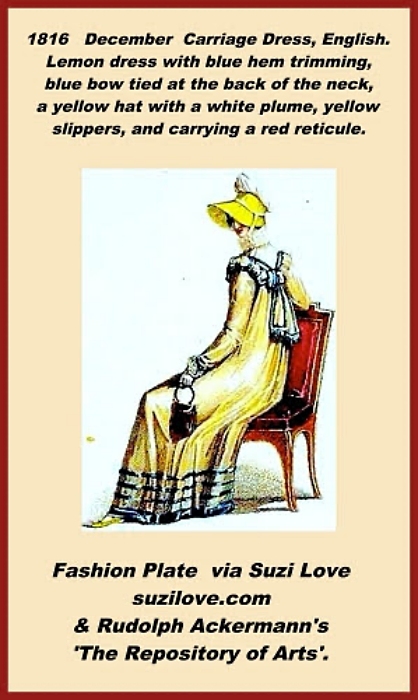
1816 December Carriage Dress, English. Fawn or lemon dress with blue silk hem trimming, blue bow tied at the back with long hanging ends, a half sleeve over a plain long sleeve, tight at the wrist and bound with blue trimming and finished with a narrow ruffle of three falls of tulle. A fichu of tulle with matching ruff. When worn as a carriage dress, the head-dress is a bonnet, the crown composed of white satin at the top and the middle and front of Leghorn. Lined with white satin and ornamented with a white satin band and strings. An indispensable India shawl, yellow slippers and carrying a black ridicule, or bag, and later called a reticule. Fashion Plate via Rudolph Ackermann’s ‘The Repository of Arts’.
Definition Fichu: Piece of lace, muslin, or other cloth worn about the neck and cleavage to preserve a lady’s modesty. From French word meaning neckerchief.
Definition Ridicule, Reticule, Indispensable, or Handbag: From the late 1700s, pockets could no longer be sewn into gowns nor could separate pockets be tied around their waists and accessed by slits in the gown and petticoats, as skirts fell from just under the bust and were full and flowing. In Jane Austen’s times, women carried small bags, known at first as ridicules and later as reticules, to keep necessary items on their person e.g. handkerchiefs, coins, vinaigrettes, calling cards, glasses etc.. For more on reticules, try my History Notes book 3 http://books2read.com/suziloveReticules
1816 June Bridal Dress, English A frock of striped French gauze over a white satin slip: the bottom of the frock is superbly trimmed with a deep flounce of Brussels lace, which is surmounted by a single tuck of byas white satin and a wreath of roses; above the wreath are two tucks of byas white satin. We refer our readers to our print for the form of the body and sleeve: it is singularly novel and tasteful, but we are forbidden either to describe it, or to mention the materials of which it is composed. The hair is dressed low at the side, and parted so as to entirely display the forehead: it is ornamented with an elegant aigrette of pearls in front, and a spring of French roses placed nearly at the back of the head. Necklace, ear-rings, and bracelets of pearl. White kid gloves, and white satin slippers. Fashion Plate via Rudolph Ackermann’s ‘The Repository of Arts’.
1810 White Promenade Half Dress, English, In Jane Austen Style. Draped yellow shawl and yellow parasol and a fitted hat with a long lace veil. A muslin dress with long sleeves and low neck, a French scarf of yellow silk, yellow silk bonnet with lace veil, yellow Parasol with a white fringe, gloves and shoes of yellow kid. Fashion plate via John Belle’s ‘La Belle Assemblee’, England. Typical of the outdoor outfit worn by Jane Austen and her contemporaries. An Empire style, or high-waisted white dress worn with a gorgeous yellow scarf and matching yellow fringed parasol.
Dress – Half Dress: Between undress and full dress, half dress is a respectable outfit but without an excess of formal accessories. Can be worn either during the day or evening.
1818 September 18th Le Palais Royal de Paris, Or ‘A Peep at the French Monstrosities’. By George Cruikshank. Two English tourists, both dressed as dandies, walk arm-in-arm under the arcade of the Palais Royal, interested in the promenading courtesans. Two Frenchmen make more direct overtures to two women. Their dress is rather similar to that of the Englishmen, but the latter wear bell-shaped top-hats, while the Frenchmen have flower-pot shaped hats. An officer wearing a large cocked hat addresses a girl, and a man, said by Reid to be Irish, jovially accosts another. Some of the women are in evening-dress, others in street costume. Behind are iron railings between the supports of the roof; on one of these is the inscription ‘Caveau des Sauvages’. Published by: George Humphrey. via British Museum.
1820 Ice Blue Figured Silk Pelisse or Redingote. Bodice with hussar-style frogging, trimmed with fringed passementerie and silk covered buttons, puffed mancherons and cuffs en tablier with satin piping and buttons, hem with deep border of blue plush and flecked fringing which gives effect of feathers. This silk pelisse shows how women’s fashions, especially outer garments, were leaning towards men’s military styles. Braiding became popular, sleeves often had layers at the shoulders of either short sleeves under long sleeves or they had the braiding and buttons and buttonholes found on military uniforms. Fabrics were luxurious as seen in this figured silk, and decorative or extravagant hems were added, like the hem fringing on this coat. Because these coats were somewhat fragile due to being made of silk, not many would have survived. Extant Pelisse, or Redingote via Kerry Taylor Auctions. Kerrytaylorauctions.com
Definition Redingote Or Pelisse Or Walking Dress Or Coat: French word developed from English words, riding coat. Long fitted outdoor coat worn over other garments for warmth. Often left open at the front to show off the dress underneath. Sometimes cut away in front. Originally made with several capes and trimmed with large buttons. French fashion plates call these coats Redingotes and they are designed for women, men and children. English fashion plates call them a Pelisse, a walking dress, Promenade dress, or Carriage dress.
1804 September Exhibition of Water Coloured Drawings, Old Bond Street, London, U.K. Designed and etched by Thomas Rowlandson. Via Wikimedia Commons commons.wikimedia.org (PD-ART)
1820 August Walking and Evening Dresses, English. Walking Dress of cambric muslin with frilled hemline. Blue-purple Spencer with epaulettes of points of satin. Bonnet to match of metallic gauze and tied under her chin, yellow Limeric gloves, reticule or bag, and blue boots. Evening Dress of Urling’s lace with aqua blue leaf decoration, earl combs, pearl necklace and ear-rings, gold chain or chatelaine with a watch, white kid gloves and white silk shoes. Via Ladies’ Monthly Museum in The Mirror of Fashion, London, U.K.
Definition Limerick Gloves: Named after County Limerick in Ireland where they were first made. Often referred to as chicken skin gloves, though actually made from skins of unborn calves. Usually cream or yellow, superior quality and very thin.
Definition Ridicule, Reticule, Indispensable, or Handbag: From the late 1700s, pockets could no longer be sewn into gowns, as skirts fell from just under the bust and were full and flowing. Instead, women began carrying small bags, known at first as ridicules and later as reticules, to keep necessary items on their person e.g. handkerchiefs, coins, vinaigrettes, calling cards, glasses etc.
Definition Spencer: Short jackets cut to match the high waistlines of Empire dresses. They often copied military styling, such as braiding, shoulder decoration, buttons and loop fasteners, and wrist adornments. They were generally of complex construction, often with a diamond shaped piece in the back. Said to have originated in an accident to Lord Spencer while hunting when his coat tails were torn off and he wore it as a short jacket.
1807 January Couple In Morning Walking Ensembles, English. Lady in white dress with lemon pelisse or coat, fitted hat and interesting reticule, or bag. Gentleman in long black tailcoat over yellow breeches, high black boots with wide tan tops, yellow gloves, cane and top hat. via Le Beau Monde, or Literary and Fashionable Magazine, London, U.K.
These are the types of outfits worn by Jane Austen and contemporaries in England and shown in their English magazines.The same designs had probably already been seen in France, because English publishers obsessively copied French fashions despite the two countries being at war for many years. https://books2read.com/SuziLoveFashionWomen1805-1809