1807 Fashionable French Couple. Man: Blue cutaway coat and yellow breeches. Lady: Lemon and blue dress and bonnet. This is the fashion styles worn by Jane Austen and her family and friends in the early 1800s. Fashion Plate via Journal des Dames et des Modes, or Costume Parisien.https://books2read.com/SuziLoveFashionMen1800-1819
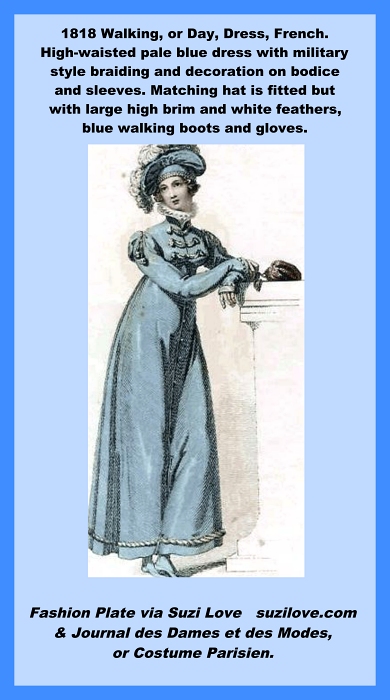
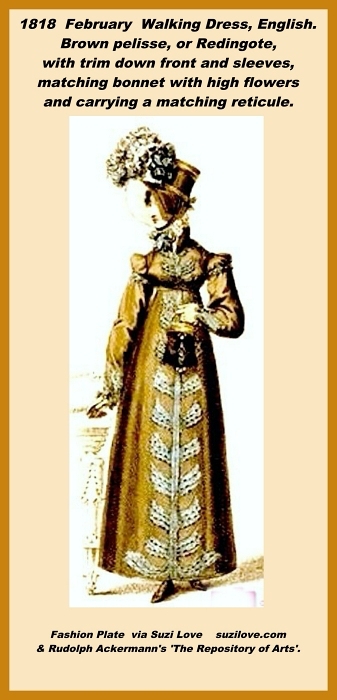
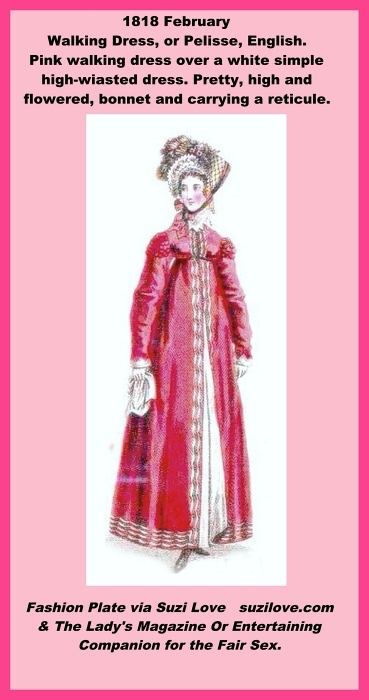
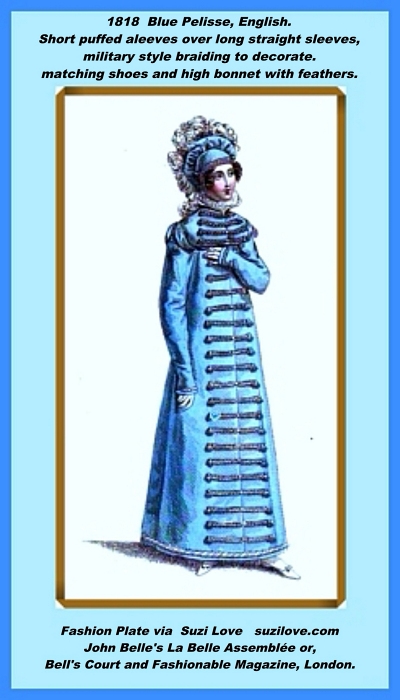
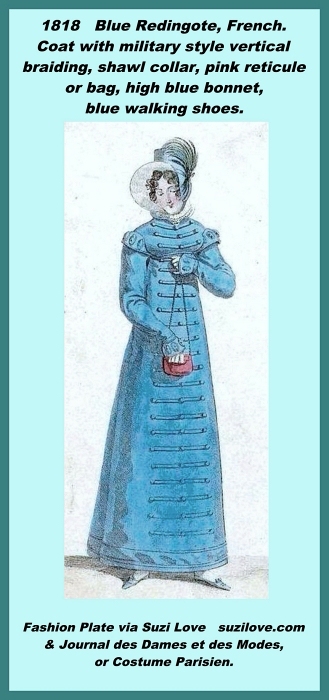
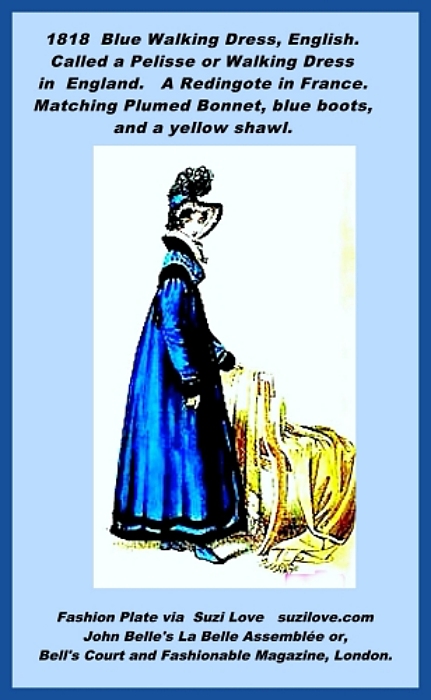
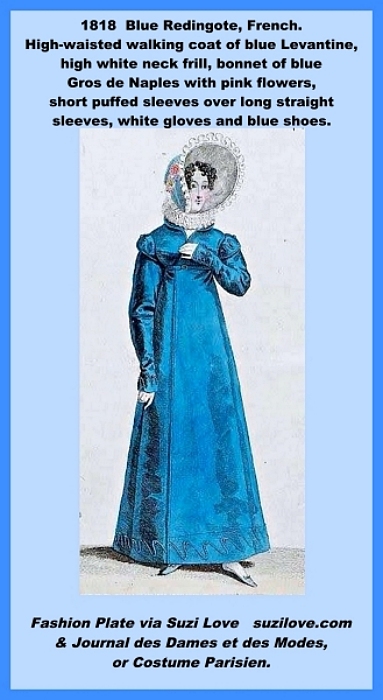
1818 Women’s outdoor fashions In the times of Jane Austen. Pelisses or coats or Redingotes, with matching hats, shoes, goves, reticules or bage, plus other accessories as displayed in various fashion magazines. Definition Redingote Or Coat Or Pelisse: Long fitted outdoor coat worn over other garments for warmth. French word developed from English words, riding coat. French fashion plates call these coats a Redingote and English plates call them a Pelisse, Or Walking Dress, or Carriage Costume.
1818 September ‘A Nice Gentleman’ By George Cruikshank. A grotesque dandy walks outdoors sucking a cane. Inscribed with names of food, e.g. red carbuncled rose is ‘Currant Jelly’, shallow broad-brimmed hat is ‘Calves Head Jelly’ and ‘Pancake’, cravat which covers neck, cheek and chin is ‘Puff Paste’, loose short trousers are ‘White Sugar Bags’, handkerchief ‘Blow Monge’ and long spurs ‘Gilt Gingerbread’. Via British Museum, London, UK. britishmuseum.org (PD-Art)
1815-1825 ca. Pink Leather Slippers. Probably French but worn in America. via Museum of Fine Arts, Boston. mfa.org. In Jane Austen’s years, fragile slippers were worn for balls and evening events but for walking sturdier shoes were needed, In the early 1800s, slippers were made of fabric such as satin or from leather, were flat or had a very small heel, slightly rounded toes and were laced up on the top. They were usually not made in right or left but instead one shoe shape and in multiples so that when one slipper wore out, another was on hand to replace it.
1812 Red Dress, French. High-waisted red Merino wool dress with short puffed sleeves, high Chako hat with a plume long white gloves and white shoes. Jane Austen and her family and friends would have worn this style of dress. Fashion Plate via Journal des Dames et des Modes, or Costume Parisien.
1800s Early Tattersall’s Horse Auctions, London, U.K.. Top sporting venue for Regency Life in London. ‘A mixture of persons of nearly all ranks’. By Pierce Egan. Via Wikimedia Commons (PD-ART)
In Jane Austen’s and Bridgerton times, or the Regency Era, horse riding was a vital mode of transport and Tattersall’s was the best place to buy and sell horses. Tattersall’s was established in 1773 near Hyde Park Corner for the sale by auction of horses, carriages, hounds and harnesses. Sales during the winter months were every Monday and Thursday, and on Mondays only during the spring and summer. On the mornings when there was no sale, Tattersall’s was a meeting place for fashionable sporting gentlemen.
Pierce Egan’s Description of Tattersall’s
A masquerade could scarcely exhibit more motley groups than the attendants of this place of fashionable resort. There were Peers, Baronets, Members of Parliament, Turf gentlemen and Turf-servants, Jockies, Grooms, Horse-dealers, Gamblers, &c. There you might see the oldest and some of the best blood in England, disguised like coachmen.
From: 1820 Sporting Anecdotes by Pierce Egan via Google Books (PD-150)
Lover of Jane Austen and the Regency Era fashions? History Notes Book 25. #JaneAusten #RegencyFashion #HistoricalFashion books2read.com/SuziLoveFashionWomen1801-1804
1816 August. Morning Dress in Bridgerton or Jane Austen style, English. White high-waisted dress worn with a blue striped spencer, blue boots, and a white hat white blue trim. Fashion Plate via Lady’s Magazine.
Description Spencer: Short jackets worn for warmth over the high-waisted Empire style gowns that were popular after the French Revolution, where there was a shift away from opulence and decadence to simpler fashion. This jacket with very short bodice and long sleeves was known as a Spencer and was named after the male coat made famous by the Earl Spencer and said to have originated in accident to Lord Spencer in hunting when coat tails torn off and a cropped jacket was invented. The dresses in the early 1800s therefore became looser, lighter, and flowing and women became cold due to their very low cut and short bodices. Short fitted jackets that went easily over the dresses and provided extra modesty and some warmth. As Europe and many other parts of the world were deep in wars in the late 1700s and early 1800s, men in uniform were found everywhere. In support of these military men, fashions leaned towards military style shoulder paddings, shoulder embellishments, loops, buttons, and braids.
1818 ‘The Stamford Dandy or A Modern Peeping Tom’. Lord Stamford rides past a row of houses looking through his glass at a woman who stands at an open first-floor window. Other women watch him from the two other windows. Dressed as a dandy with red tailcoat, high white collar and cravat, black top hat and wearing loose white trousers. Artist not known. Via British Museum, London, UK. britishmuseum.org (PD-Art)
1816 Crossing The Pont des Arts, Paris. Illustrations by Francis Courboin. via Les Modes de Paris. (PD-Art) suzilove.comThis plate depicts two women crossing the Pont des Arts, which is also known as the Passerelle des Arts. The women wear very high-waisted dresses. Both women wear a large white feather in their hats, symbolic of the white plume of Henri IV’s famous battle cry, “Ralliez-vous à mon panache blanc!” and made popular by the 1814 restoration of Louis XVIII on the throne. Restoration also brought back various styles, especially those denoting luxury, from the Ancien Regime. The woman on the left wears an ‘old-fashioned’ lace collar and the resurgence of luxury materials, such as fur are indicative of feminine styles of the Restoration period. (PD-Art) Illustrations by François Courboin from Octave Uzanne’s Les Modes de Paris. Variations du goût et de l’esthétique de la femme, 1797-1897, L. Henry May, Paris, 1898, or from the English translation of the same work: Fashion in Paris : the various phases of feminine taste and aesthetics from 1797 to 1897, William Heinemann, London, 1898. Modes De Paris