1840s Opera Boots, British. Black leather with suede leg and silk bow, hand and machine sewn. via
Victoria and Albert Museum, London, UK. collections.vam.ac.uk.



1840s Opera Boots, British. Black leather with suede leg and silk bow, hand and machine sewn. via
Victoria and Albert Museum, London, UK. collections.vam.ac.uk.
1814 Gentleman’s Ensemble, French. Gentleman in brown tailcoat, white vest, high collared white shirt, knotted white cravat, white pants and white gaiters above black shoes. The style of outfit worn by the men in Jane Austen’s life. Fashion Plate via Journal des Dames et des Modes, or Costume Parisien.


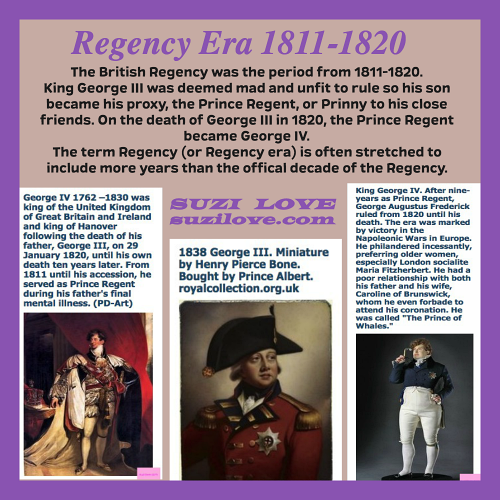
1811-1820 Regency Era Overview. The British Regency was the period from 1811-1820. King George III was deemed mad and unfit to rule so his son became his proxy, the Prince Regent, or Prinny to his close friends. This was the era during which Jane Austen wrote her books. Books that are still read and discussed today.
As a period in Britain’s official history, the Regency lasted less than ten years, although scholars apply the term Regency to a much longer period. It began in 1811, when George Ill was declared mad and the Prince of Wales was appointed Regent. It ended in 1820 when the King finally died and the Regent was crowned George IV. However, the Regency was a period in Britain’s history that had an effect on the social and cultural life for four decades, from the start of the French Revolution in 1789 to the passing of Britain’s Great Reform Act in 1832.
The decision to make George IV the Regent took a lot of political debate. After nearly two and a half months of political wrangling, the British government agreed to grant the title of Prince Regent on George. The Act of Parliament was finally passed by a commission in the House of Lords on February 5th 1811 and the Prince was formally sworn in as Regent at Carlton House the next day. He continued to rule as Regent until 1820 when, on his father’s death, he assumed the title George IV and reigned until his own death in 1830.
During the Regency, royalty and upper class ladies and lords, or the Beau Monde, lived elegant and extravagant lives that also allowed excesses and depravity. Britain was united behind exceptional heroes in long wars against France, but internally divided by class distinction and political agitation. The foundations of a modem industrial nation were laid by engineers, inventors and scientists. while Romantic poets and visionary artists dreamt of escape to earlier times and more ideal worlds. From: Queen’s Gallery, London, U.K.

1795-1812 ca. Lord Nelson’s Vice-Admiral Undress Coat. Blue cloth tail coat, double breasted, nine gilt buttons on each lapel., two rows gold lace each sleeve with three buttons between, three buttons below each pocket flap, two buttons on skirt pleats, narrow band of wool cloth and two eyelet holes on shoulders to attach epaulettes, fastened edge to edge with three hooks and eyes, four embroidered stars of Nelson’s orders on left, Order of the Bath, Order of St Ferdinand Merit, Order of Crescent, Order of San Joachim. This is Nelson’s Trafalgar Coat worn by Nelson (1758-1805) at Battle of Trafalgar with bullet hole on left shoulder, close to epaulette. Damage to epaulette and blood stains on tails and left sleeve. National Maritime Museum, Greenwich, London, U.K. www.rmg.co.uk
For most of Jane Austen’s life, Britain was involved in conflicts and wars across the world. The Napoleonic Wars only ended in 1815, just two and a half years before Austen died. During her childhood, Britain was fighting the American Revolutionary War and when she was 14 years old, the French Revolution upset traditional roles of the monarchy, aristocracy and landed gentry in Britain, France and many other European countries.

1800s A Young Lady Riding and Carriage Driving, England. #Riding #Regency #Victorian #Cartoon From: 1860 Mr. Sponge’s Sporting Tour by Robert Smith Surtees. via Google Books (PD-100)


1807 Cotton Linen Shirt, British. Non-regulation shirt worn under uniform. High collar to allow room for a stock, fullness and pleated sleeves enable wearer to fit into tight arms popular in coats. The men in Jane Austen’s life would have worn a shirt like this, especially if they were in the military as many men were during the Napoleonic Wars. via Royal Museums Greenwich collections.rmg.co.uk




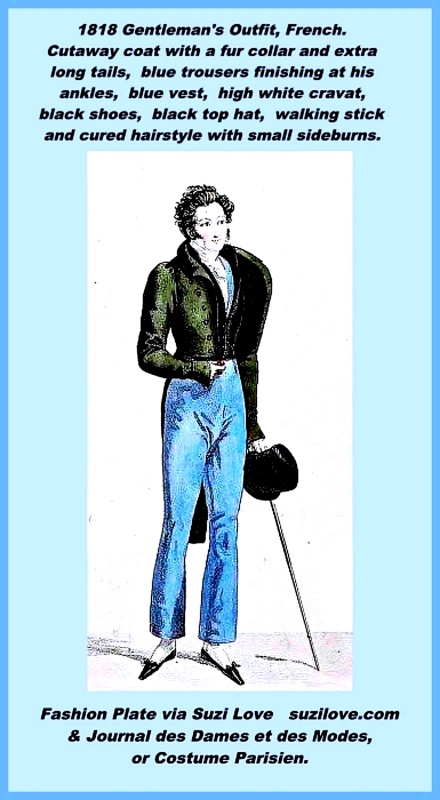
1818 Gentleman’s Outfit, French. Cutaway coat with a fur collar and extra long tails, blue trousers finishing at his ankles, blue vest, high white cravat, black shoes, black top hat, walking stick and cured hairstyle with small sideburns. Fashion Plate via Journal des Dames et des Modes, or Costume Parisien.
Want a glimpse into the life of a young lady in Jane Austen and the Bridgerton years? #bridgerton #RegencyEra #JaneAusten
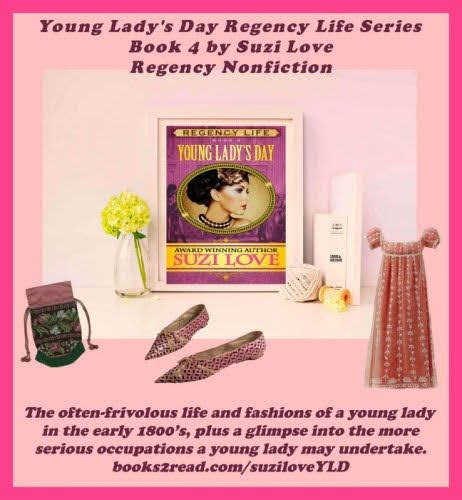
Young Lady’s Day is Book 4 in the Regency Life Series.
This book depicts the often-frivolous life and fashions of a young lady in the early 1800’s, but also gives a glimpse into the more serious occupations a young lady may undertake. Through historic images, historical information, and funny anecdotes, it shows how a young lady fills her day, where she is permitted to go, and who she is allowed spend time with. These light-hearted looks at the longer Regency years are an easy to read overview of what people did and wore, and where they worked and played. There is plenty of information to interest history buffs, and lots of pictures to help readers and writers of historical fiction visualize the people and places from the last years of the 18th Century until Queen Victoria took the throne. https://books2read.com/suziloveYLD