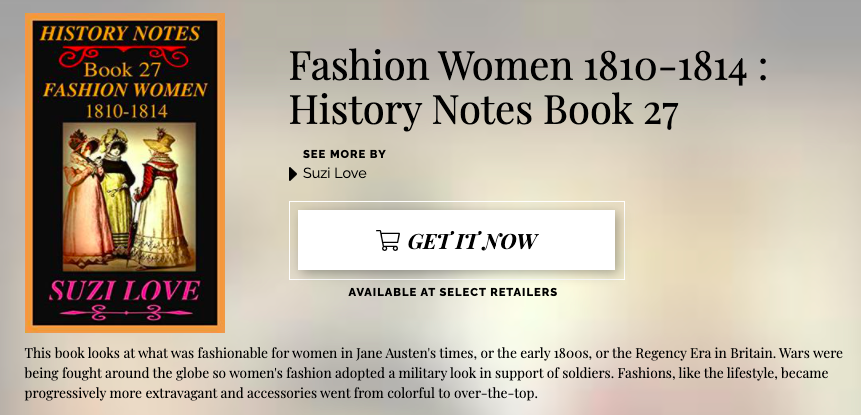
Are you a reader or writer of Regency Romance? Love Jane Austen and the Bridgertons? Want to know more about the mourning, riding, underclothing and other Regency Era women’s fashions in Regency romances? What was fashionable for women in Jane Austen’s times? Mourning, riding, daytime, evening clothing, plus underclothing, corsets and accessories. This book looks at what was fashionable for women in Jane Austen’s times, or the early 1800s, or the Regency Era in Britain. Wars were being fought around the globe so women’s fashion adopted a military look in support of soldiers. Fashions, like the lifestyle, became progressively more extravagant and accessories went from colorful to over-the-top.
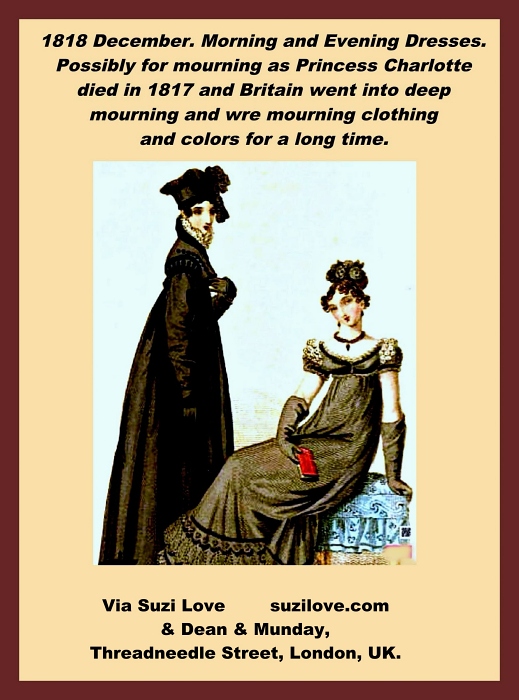
1818 December Morning and Evening Dresses, possibly for mourning as Princess Charlotte died in 1817. Published by Dean and Munday, Threadneedle Street, London, U.K.
Walking Dress is a plain high dress of black bombazine with long sleeves. Skirt trimmed on hem with a broad bias piece of black crape with narrow puffing of black crape. Sleeve hem has three narrow puffings of black crape. Fastens in front and ornamented on the bust with black crape, no collar but a very full mourning ruff of clear muslin. Over this dress is a Spanish coat of fine black Merino, cut tight to the body, short in the waist and trimmed with a row of black buttons on each side of the bust. Black velvet collar is finished round the edge with black crape, long sleeves of an easy fullness and trimmed at the wrist the same as the collar. Very tasteful epaulette is a mixture of black velvet and crape. Skirt is slightly full, trimmed up the fronts and round the hem with a broad band of black velvet, edged on each side by narrow rouleaux of black crape.
Dinner Dress is of black crape over a black sarsnet slip with a gored skirt, trimmed on the hem with black crape flounces, lower very narrow and higher considerably broader and surmounted by another narrow one. They are scalloped and finished at the edge by black satin, narrow rouleau of the same material heads top and bottom flounce. Corsage of black satin cut very low round the bust and waist and bust finished French style with points of black crape. Short full sleeve of black satin with three falls of black crape on the shoulder. Via Lady’s Monthly Museum ~ Dean & Mundy, Threadneedle Street, London, UK.
1818 December Morning and Evening Dresses, possibly for mourning as Princess Charlotte died in 1817. Published by Dean and Munday, Threadneedle Street, London, U.K.
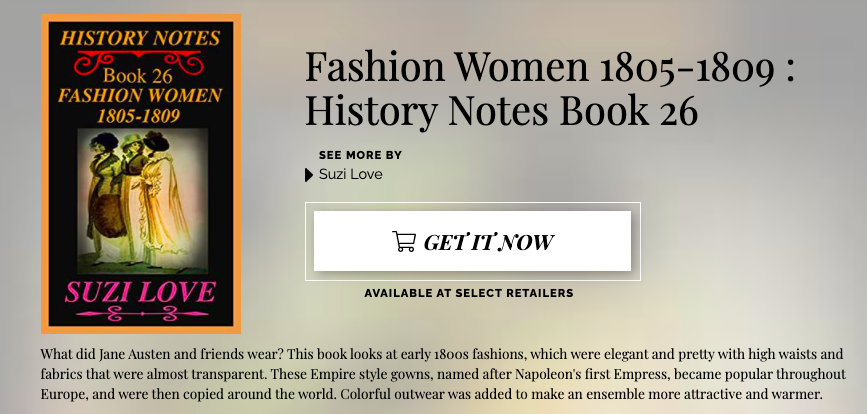
What did Jane Austen and friends wear? Early 1800s fashions were elegant and pretty with high waists and fabrics that were almost transparent. These Empire style gowns, named after Napoleon’s first Empress, became popular throughout Europe, and were then copied around the world. Colorful outwear was added to make an ensemble more attractive and warmer. History Notes Book 26 Fashion Women 1805-1809. https://books2read.com/SuziLoveFashionWomen1805-1809
The Empire waist gown defined women’s fashion during the Regency Era. ‘Empire’ is the name given in France to the period when Napoleon built his French Empire. High-waisted, loose gowns were adopted by the aristocracy as a symbol of turning away from the fussy, elaborate and expensive clothing worn in the 1700s. Jean-Jaques Rousseau advocated copying peasants and returning to a simpler life and more natural fashions. Unrestricting clothing was part of the new Democracy in France and these simpler and flowing fashions were adopted all over Europe, including Britain and despite the continual wars being fought against France during the early 1800s. Not even war stopped fashions from being copied everywhere.
1818 January Fancy Mourning Dishabille. A lady reading a pink book while wearing Dishabille, or morning dress, though as this labeled ‘Fancy’, it was most likely more formal than any normal At-Home morning dress. Dress of crepe with a lavishly decorated hem, worn over a white cambric Spencer, ornamented with fine muslin, embroidered at the edge with black, finished at neck with a triple ruff of muslin, tied in front with black love. Black sarsnet French apron, edged round with a newly invented trimming of black love. Cornette, or hat, of fine muslin, crowned with a garland of black flowers. Black chamois slippers. Fashion Plate via John Belle’s La Belle Assemblée or, Bell’s Court and Fashionable Magazine, London. The magazine’s General Observations on Fashion and Dress tries to explain why the outfit is labeled ‘Fancy’, ‘However little versatility can possibly be attached to the sable garment of sorrow, yet the Print we have presented to our readers representing the home costume of a lady of high fashion, will prove to them how busy Fancy is in her endeavors to throw a changeful hue over the tinct of solid black.’
I can picture Jane Austen and her female friends and family wearing this sort of dress if they were in half-mourning yet wanted to look fashionable. .
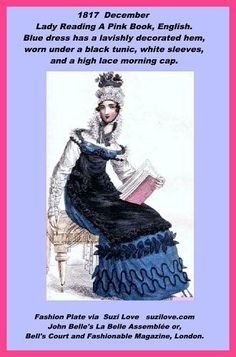
1817 December Lady Reading A Pink Book. Blue dress with a lavishly decorated hem, worn under a black tunic, white sleeves and a high lace morning cap. Fashion Plate via John Belle’s La Belle Assemblée or, Bell’s Court and Fashionable Magazine, London.
1817 December Black Walking Mourning Dress, English. Black bombazine dress with a black crepe hem, with tight bodice wrapping across to the right side, trimmed with a piping of black crape that looks like braiding and finished by rosettes of crape, in the center of each of which is a small jet ornament. Long sleeves trimmed similarly at the wrists, half-sleeve of a new form trimmed with crape, high standing collar displaying a mourning ruff. Claremont bonnet, named because it is the same shape as one worn by the Princess, whose home with her husband, Prince Leopold, was called Claremont. Black crape over black sarsnet and lined with double white crape. Low crown but large front and tastefully finished by black crape with a bunch of crape flowers on one side. Black shamois gloves, and black shoes. “We have again to acknowledge our obligations to the lady who favored us last month; and we understand that the dresses from which our prints this month have been taken were also purchased from Mrs. Bell of St. James’s-street.” Fashion Plate via Rudolph Ackermann’s ‘The Repository of Arts’.
Mrs. Bell ‘invented’ fashion plates and as well as publishing in La Belle assemblee, she also sold them to other magazines. Hence the crossover we often see where the same plate, or a similar version, appears in different magazines.
11811 Half-Mourning Dress, French. Black dress, high white neck ruffle, black hat with white trim and white shoes.
In November, 1810, Princess Amelia, youngest daughter of George III, died. At the end of 1810 full mourning of complete black would have been worn but by the beginning of 1811, half mourning would still have been to respect the loss of a royal family member. Half-mourning allowed touches of silver, grey, mauve and white to be added to a mostly black outfit and would be worn after the period of full mourning was ended, times depending on the relationship to the deceased person. Garments and accessories could either be trimmed with black, jet jewelry worn, black ribbons added, or a layer of black net or gauze added to a dress or hat.
Jane Austen and her family would have worn this type of outfit when mourning a relative or friend. However, as black dresses, black tunics, and black lace shawls were popular throughout the Regency years, it is often hard to decide what was definitely made for mourning and what was simply fashionable wear. Fashion Plate via Journal des Dames et des Modes, or Costume Parisien. https://books2read.com/SuziLoveFashion1810-1814
Definition Half or Slight Mourning: Allowed touches of grey and white to be added to full, or deep, mourning ensembles. Some lustre, or shine, was allowed in fabrics and accessories. After a time, mauve or deep purple could also be worn.
Are you a reader or writer of Regency Romance? Love Jane Austen’s books? Want to know more about the mourning, riding, underclothing and other Regency Era women’s fashions in Regency romances? What was fashionable for women in Jane Austen’s times? Mourning, riding, daytime, evening clothing, plus underclothing, corsets and accessories. This book looks at what was fashionable for women in Jane Austen’s times, or the early 1800s, or the Regency Era in Britain. Wars were being fought around the globe so women’s fashion adopted a military look in support of soldiers. Fashions, like the lifestyle, became progressively more extravagant and accessories went from colorful to over-the-top.
What was fashionable for women in Jane Austen’s times? Mourning, riding, daytime, evening clothing, plus underclothing, corsets and accessories. Wars were being fought so women adopted military looks in support of soldiers. https://books2read.com/SuziLoveFashion1810-1814 History Notes Book 27 Women’s Fashions 1810-1814.
These are the types of outfits worn by Jane Austen and contemporaries in English magazines, where French fashions were obsessively copied despite the two countries being at war for many years. In Jane Austen’s years, she and her contemporaries spent a lot of time walking outdoors. People were encouraged to partake in outdoor pursuits to maintain good health. Fragile slippers were worn for balls and evening events but for walking sturdier shoes were needed, In the early 1800s, these were typically made of leather, had a very small heel, slightly rounded toes and were laced up on the top.
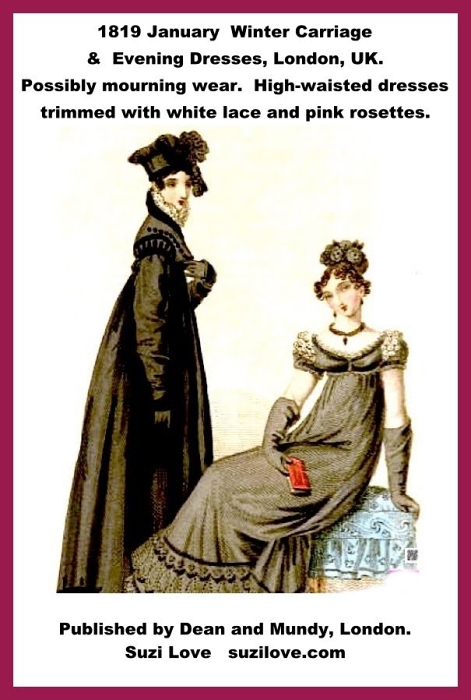
1819 January Two Fashion Plates By Dean and Mundy For Mourning: Winter Carriage and Evening Dresses. High-waisted carriage dress, cuffs edged with white lace and trimmed with gray frog closures, matching plumed hat and shawl. Empire style evening dress with short sleeves and wide neckline trimmed with scallops of white lace, skirt trimmed with white rosettes, evening upswept hairstyle. Fashion Plates Published by Dean and Munday, 1819, London.
Mourning wear was worn in Britain during the regency Era, firstly for Princess Charlotte who died in England on November 6th, 1817, or then for Queen Charlotte, wife of King George III and grandmother of Princess Charlotte, who died on November 17th, 1818. All the fashion magazines featured numerous outfits in black suitable for mourning, followed by many for half mourning in colors of grey, black with touches of white, and later mauve or lavender.
Black was worn for full mourning with various other colors were worn during the months of half mourning, including grey and mauve. However, as black dresses, black tunics, and black lace shawls were popular throughout the Regency years, it is often hard to decide what was definitely made for mourning and what was simply fashionable wear.
After the death of H.R. H. Princess Charlotte on November 7th, 1817, official court mourning was ordered. ‘The ladies to wear black bombazines, plain muslin or long lawn crape hoods, shamoy shoes and gloves, and crape fans. The gentlemen to wear black cloth without buttons on the sleeves or pockets, plain muslin or long lawn cravats and weepers, shamoy shoes and gloves, crape hat bands, and black swords and buckles.’ Two months later, a change of mourning attire was ordered.
1819 January. Winter Carriage and Evening Dresses. High-waisted carriage dress, cuffs edged with white lace and trimmed with gray frog closures, matching plumed hat and shawl. Empire style evening dress with short sleeves and wide neckline trimmed with scallops of white lace, skirt trimmed with white rosettes, evening upswept hairstyle. Mourning wear for Princess Charlotte who died in England in 1817 or for another member of the Royal family. Fashion Plate Published by Dean and Munday, London. 1819 January. Winter Carriage and Evening Dresses, London, U.K. High-waisted carriage dress, trimmed with front closures, matching plumed hat. Empire style evening dress with tiny sleeves and wide neckline trimmed with white lace on sleeves, skirt trimmed with rows of frills. Fashion Plate Published by Dean and Munday, 1819, London. 1819 January Mourning Fashion Plates By Dean and Mundy London: Winter Carriage and Evening Dresses. #Regency #Mourning #Fashion https://books2read.com/SuziLoveFashionWomen1815-1819 Share on XHN_28_D2D_FashionWomen 1815-1819
What did Jane Austen and friends wear? Early 1800s fashions were elegant and pretty with high waists and fabrics that were almost transparent. These Empire style gowns, named after Napoleon’s first Empress, became popular throughout Europe, and were then copied around the world. Colorful outwear was added to make an ensemble more attractive and warmer. History Notes Book 26 Fashion Women 1805-1809. https://books2read.com/SuziLoveFashionWomen1805-1809
The Empire waist gown defined women’s fashion during the Regency Era. ‘Empire’ is the name given in France to the period when Napoleon built his French Empire.
High-waisted, loose gowns were adopted by the aristocracy as a symbol of turning away from the fussy, elaborate and expensive clothing worn in the 1700s. Jean-Jaques Rousseau advocated copying peasants and returning to a simpler life and more natural fashions. Unrestricting clothing was part of the new Democracy in France and these simpler and flowing fashions were adopted all over Europe, including Britain and despite the continual wars being fought against France during the early 1800s. Not even war stopped fashions from being copied everywhere.