19th Century Mid Dance Card or Aide de Memoire. Jeweled and enameled gold dance card with concealed timepiece. Lid with a blue enamel with rose-cut diamonds floral wreath, opening to compartment with watch dial, pencil, and notebook. via Sotheby’s Auctions. sothebys.com
1700 ca. Chess and Backgammon Box, Augsburg. Decorated in violet wood veneer, ebony and ivory. Ivory checkers and chess pieces, hinges and push button lock in gilded brass, two horn goblets, two ivory dice, thirty-none checkers’ pawns stamped both sides with effigies of cities, Munich, Vienna, Nuremberg, Prague, Danzig, of kings and queens, Prussia, England, Scotland, Poland, and various scenes. Via AnticStore.com
1805-1810 ca. India Muslin Dress, English. Slight train, embroidered panel down centre between two lines of drawn-thread work, embroidery of cotton in chikan stitch and knots in scrolls and plume design. Elbow length sleeves with two insertions of embroidery in leaf pattern. via Manchester Art Gallery
Definition Empire Style: Named after the First Empire in France, by 1800 Empire dresses had a very low décolleté, or neckline and a short narrow backed bodice attached to a separate skirt. Skirts started directly under the bust and flowed into the classical relaxed wide styles of Greece and Rome. This style of dress is associated with Jane Austen and her contemporaries as a simple cotton high-waisted dress was worn most days and accessorized according to the importance of the occasion.
1816-1817 ca. Man’s Linen Shirt, American. High collar, ruffles down front opening, fullness from gathered shoulders and sleeves for unrestricted movement. Beautifully created and monogrammed by Elizabeth Wild Hitchings for her husband, Benjamin Hitchings, a sea captain. Wives or servants regularly hand stitched shirts from 1800s-1840s, before sewing machines, but handiwork rarely recorded.
From The Creator: This shirt was created, from the linen fiber to the finished garment, by the donor’s great-grandmother, Elizabeth Wild Hitchings, for her husband Benjamin Hitchings, a sea captain, in 1816. It was common practice for a wife or servant to hand stitch family members’ shirts prior to the mid-19th century, but rarely was such handiwork recorded, making this case rare and intriguing. In addition, its elegant stitching makes it a perfect example of the familial care taken in sewing prior to the common possession and use of the sewing machine. via Metropolitan Museum, N.Y.C., U.S.A. metmuseum.org
Captain Belling cleared his throat and turned to face Lady Melton. “I owe you an apology for not personally seeing to your comfort. I’ve not been at my most amicable recently. Our evacuation plans have changed five times in the past three days, because each messenger has brought worse news about conditions of the roads. Wellesley probably pictured us rounding up a fleet of comfortable carriages to transport the wounded to the coast, after which boats would magically whisk us across the Channel until, within a few days, the wounded would be under the care of a staff of competent physicians. Apparently, the first and largest batches of wounded soldiers managed that scenario and are, I hope, being loaded into the boats as we speak. Word is that the second group ran afoul of deserters on three separate occasions.”
“British or French?”
He shrugged. “Who knows? Men probably went rogue from many forces as soon as the battle turned and we became the winners. Napoleon was so confident of victory that he didn’t plan for retreat. So, retreating regiments were bottlenecked at the bridge at Sambre and soldiers ran away, rather than die during the chaos. Disenchanted soldiers from every country meet, form alliances, and will then kill without compunction, to stay free, or to appease their hunger for food and women. And every day, more will be on the roads.”
When she stiffened, he said, “Don’t worry. Our messengers reported where they’d seen large groups, and we’ll avoid those roads.” She sat still as a statue and listened. “I’d like to get to London without killing anyone else, because I’m tired of the fighting, tired of wars.”
She shuffled a few inches back towards him and laid her hand on his knee. “I’m sorry that I’ve added to your problems.” She looked down at her sleeping son. “Sorry you have two more passengers to worry about.”
“Our main problem is transport. The first groups needed the biggest wagons, so we must make do with inferior vehicles.”
“Daniel and I are used to cramped quarters. We’re grateful for whatever you arrange.”
“Humph. I’m glad to hear that.” When she gave him a puzzled look, he pointed to a mattress set at a right angle to her cot but with their ends almost touching. “I shall now be sleeping there.”
The small noise she made pleased him. She didn’t scream like a virginal girl would if told that a man would be sleeping in such close proximity, but sounded surprised to find that she’d pressed herself up against him.
Her hand flew to her mouth. “Oh, dear. I’ve taken your bed. I’ve forced you to use a mattress on the floor.”
He laughed softly. “Believe me, that’s far better than propping against a tree and trying to snatch an hour’s sleep before battle. Or squeezing between a sea of horses and men so you stay warm and don’t expire from frostbite.”
“How long have you been with Wellesley?”
He leaned forward and rested his arms on his knees. “Too damn long.”
“So you’re pleased to be going home?”
“Pleased? No. Resigned, yes. My friends, my fellow officers, were ordered back to Brussels. I feel guilty that I’m not with them.”
“But surely they will return home soon, now that we’ve defeated Napoleon?”
“We’ve thought the war finished several times before, and I fear this time may prove the same. Nobody can predict what the Corsican will do next.”
She squeezed his thigh. “You’re worn out, Gabe. Things will be better when you’re in London once again.”
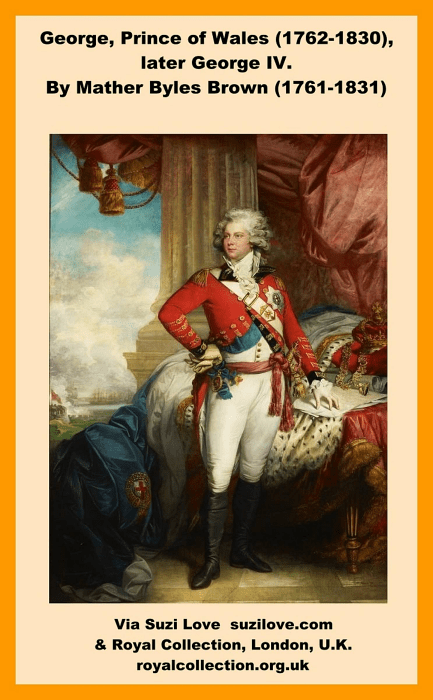
George, Prince of Wales (1762-1830), later George IV. By Mather Byles Brown (1761-1831) via Royal Collection, London, U.K.
The decision to make Prince George the Regent took a lot of political debate. After nearly two and a half months of political wrangling, the British government agreed to grant the title of Prince Regent on George. The Act of Parliament was finally passed by a commission in the House of Lords on February 5th 1811 and the Prince was formally sworn in as Regent at Carlton House the next day. He continued to rule as Regent until 1820 when, on his father’s death, he assumed the title George IV and reigned until his own death in 1830.
The British Regency was the period from 1811-1820. King George III was deemed mad and unfit to rule so his son became his proxy, the Prince Regent, or Prinny to his close friends. This was the situation when Jane Austen was alive. The Regency Era was famous for its beautiful clothing as well as the magnificent buildings erected and furnished in the ‘Regency Style’ under orders from the extravagant Prince Regent.
1826–1829 ca. Pale gold cotton dress with tiny red embroidered flowers, British. Matching embroidered band around wide neckline and wrists, billowing upper sleeves and gathered to tight lower sleeves. via Metropolitan Museum, New York City, U.S.A.
Outback Arrival : A contemporary medical set in an outback Australian hospital. A city nurse follows the doctor she loves to the bush town where he manages his family’s cattle properties, determined to prove her love for him. But can he accept that she is carrying his baby and that those he trusts have lied?
‘No, no, no! Bodies don’t stand up and walk out of hospitals.’
‘I’m real sorry, Nurse Kristie.’ The weather beaten grounds-man shuffled his feet in front of her office desk, distress adding a decade to his sixty something years.‘Looked everˈwhere. Can’t find it.’
‘This can’t be happening, Joey. A corpse cannot just disappear. Somebody must have noticed something.’
‘Sure ain’t sometin´ no normal person’d tuck un’erneath their arm. Walk out with, when visitors go ‘ome.’
Kristie adopted the calm and confident demeanor that had helped her tackle hundreds of emergency room dramas without showing a moment of panic. Casualty nurses joked that no matter how many crazy things you’d dealt with, something stranger was always about to walk in your door. Or in today’s case, walk out of the morgue’s door.
She hauled in a deep breath, while mentally chastising herself for not making more time to attend yoga classes, for Joey’s sake if not her own. She faked a confident smile. ‘We have to find his body, Joey. Quickly. Before the board’s fusspots hear what’s happened. Or we’ll have them arriving, en masse, and breathing down our necks.’
When she’d arrived four weeks earlier, the majority of the board members had welcomed her with open arms. Enticing an experienced nurse away from a city hospital to a remote outback town didn’t happen every day and the town had seen them as heroes saving their stretched outback health system. The few remaining few board members, however, were old-fashioned, staid, and highly suspicious of her motives.
Kristie had learned to be vigilant at work and circumspect when off duty. During her three months’ probation as Director of Nursing, she couldn’t afford any slip ups or she wouldn’t be contracted for a permanent position, no matter how desperate rural towns were to keep medical staff.. Those board members, the ones lacking a sense of humor, would be horrified that a recently deceased member of their small community had mysteriously disappeared from the hospital’s morgue. Although morgue was a loose term for a brick shed which housed a refrigerator, a work bench, and was supposedly cooled by a temperamental air-conditioner. Misplacing a body, without any of her rostered staff noticing, would be classified by the board as her first mistake, a huge mistake.
Writing and Publishing? Tips and Tricks in Self Publishing: Absolute Beginner’s Guide. Information, contacts, and checklists steer you towards professionally produced books. Helps both fiction and non-fiction authors and available in digital and paperback. Co-Authored by two Australians: multi-published Imogene Nix and best-selling and award winning Suzi Love. books2read.com/selfpublishing
1811 January Walking Dress in the English style worn by Jane Austen and her female relations and friends. Pelisse of scarlet Merino cloth, buttoned down front and up arm with small gold buttons, collar and cuffs of purple velvet, empire tippet pointed in back, Scarlet bonnet turned up with velvet, veil through front, scarlet cloth boots trimmed with velvet. Fashion Plate via John Belle’s La Belle Assemblée or, Bell’s Court and Fashionable Magazine, London.Jane Austen and her contemporaries wore long coats like these to keep warm when out and about, visiting, shopping etc. The thin muslin dresses worn in the early 1800s were little protection against European winters.
Definition Merino Wool: Finest quality wool, originating in Spain. During Napoleonic wars, Merino sheep exported to Britain and other parts of Europe. Napoleon supported Merino growth in France. In 1808, after French invaded Spain, King George purchased additional 2000 Merinos for royal flock but Britain too wet for thriving industry. Other countries i.e. Australia, began producing fine quality Merino.
Definition Velvet: Historically made with silk pile on silk backing, or cheaper backing e.g. linen. Velvets were also made from cotton or wool. Today, silk velvet is usually rayon pile on silk backing so you only see the rayon and not the silk.