1805 Breeches, part of the Royal Naval Uniform of surgeon Joshua Horwood , who served as surgeon’s mate in HMS ‘Prince’ at Trafalgar, and was promoted to surgeon in 1807. via Royal Museums Greenwich, London, U.K. collections.rmg.co.uk



1805 Breeches, part of the Royal Naval Uniform of surgeon Joshua Horwood , who served as surgeon’s mate in HMS ‘Prince’ at Trafalgar, and was promoted to surgeon in 1807. via Royal Museums Greenwich, London, U.K. collections.rmg.co.uk
1795-1812 ca. Lord Nelson’s Vice-Admiral Undress Coat. Blue cloth tail coat, double breasted, nine gilt buttons on each lapel., two rows gold lace each sleeve with three buttons between, three buttons below each pocket flap, two buttons on skirt pleats, narrow band of wool cloth and two eyelet holes on shoulders to attach epaulettes, fastened edge to edge with three hooks and eyes, four embroidered stars of Nelson’s orders on left, Order of the Bath, Order of St Ferdinand Merit, Order of Crescent, Order of San Joachim. This is Nelson’s Trafalgar Coat worn by Nelson (1758-1805) at Battle of Trafalgar with bullet hole on left shoulder, close to epaulette. Damage to epaulette and blood stains on tails and left sleeve. National Maritime Museum, Greenwich, London, U.K. www.rmg.co.uk
For most of Jane Austen’s life, Britain was involved in conflicts and wars across the world. The Napoleonic Wars only ended in 1815, just two and a half years before Austen died. During her childhood, Britain was fighting the American Revolutionary War and when she was 14 years old, the French Revolution upset traditional roles of the monarchy, aristocracy and landed gentry in Britain, France and many other European countries.

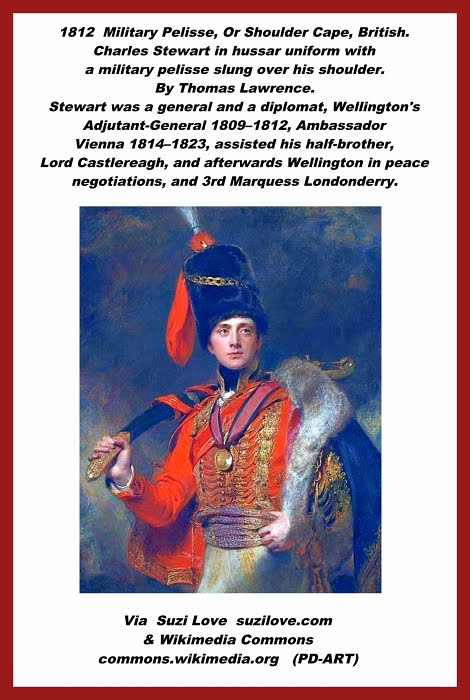
1812 Military Pelisse, Or Shoulder Cape, British. Charles Stewart in hussar uniform with a military pelisse slung over his shoulder. By Thomas Lawrence.
1810-1820 ca. Pantaloons, Probably Military, British. The type of pants worn by men in Jane Austen’s times when wars were being fought all over the world, especially in Europe. Machine-knitted white cotton decorated with cream silk braid on sides and fronts as seen on Hussar uniforms. Cut to fit the leg and button bottom at waist with three buttons. Front fall buttons over five buttoned fly, two horizontal pockets at front below waistband and fob pocket in waistband. Four metal buttons for braces, two front and two back. Cotton ‘puff’ centre back waist and two linen tapes for waist adjustment. via Victoria and Albert Museum, London, UK. collections.vam.ac.uk.
Pair of men’s pantaloon trousers made of machine-knitted white cotton and decorated with cream silk braid applied down the sides and on the fronts. This imitates the hussar uniforms of the period and appeared on fashionable men’s dress. The pantaloons are cut to fit the leg and button at the bottom with three buttons. The pantaloons fasten at the front with front falls buttoning over a five buttoned fly. There are two horizontal pockets at the front below the waistband and a fob pocket in the waistband. There are four metal buttons for braces, two at the front and two at the back. These probably are original. There is a cotton ‘puff’ at the centre back waist and two linen tapes for waist adjustment.
Pantaloons also brought the glamour of military uniform into men’s fashionable dress, especially when teamed with Hessian boots. Uniforms worn by the various armies during the Napoleonic Wars (1793-1815) were often very colourful and lavishly adorned with braid and tassels. It is hardly surprising that some of these attractive trimmings should have infiltrated fashion, particularly when nationalistic feelings ran high. Civilian pantaloons were often ornamented with military-style braid that was applied in a vertical band of topside Russia braiding. They were not, however, generally decorated on the front, which suggests that this pair was for military use. The silk braid is applied in the form of an Austrian knot, which was a popular motif on pantaloons of the light cavalry such as the hussars and light dragoons.


