1880’s Corset, French, silk satin, steel busk, and bone. Women used corsets to get closer to an ‘ideal physical form’. Until the beginning of the 20th century, women’s waists were tightened by corsets. via Kyoto Institute, Japan.
Corsets 1880-1900 History Notes Book 20 This book shows how a fashionable silhouette became of paramount importance and how a well-fitted corset became a fashion essential. As well as a decorative fashion item, tight lacing gave a narrow waist and the desired feminine form under clothing. https://books2read.com/SuziLoveCorsetBook20
1806 Short-Sleeved White Muslin Dress With Train. Bodice and sleeves have ribbon decoration, evening flowered headdress, half parure of necklace and ear bobs, and gorgeous Indian hand-loomed green shawl. Fashion Plate via Journal des Dames et des Modes, or Costume Parisien.
Definition Half Parure: A Parure is a matched set of jewelry, including a necklace, bracelet, earrings, pin etc. A half Parure didn’t include a jewelled headdress, or tiara.
Definition Shawls: The shawl started off in India as a fine wool garment for men that could be worn as a scarf, turban or as a mantle: the word comes from the Persian shäl. Originally imported from the East, European Kashmir shawls were made first in Norwich and Edinburgh in Britain in the late 18th century. Shawls were an essential item in the early 1800s to cover the thin gowns women wore. They were made of muslin, gauze, silk, wool, and velvet, though cashmere shawls were the softest and most prized.
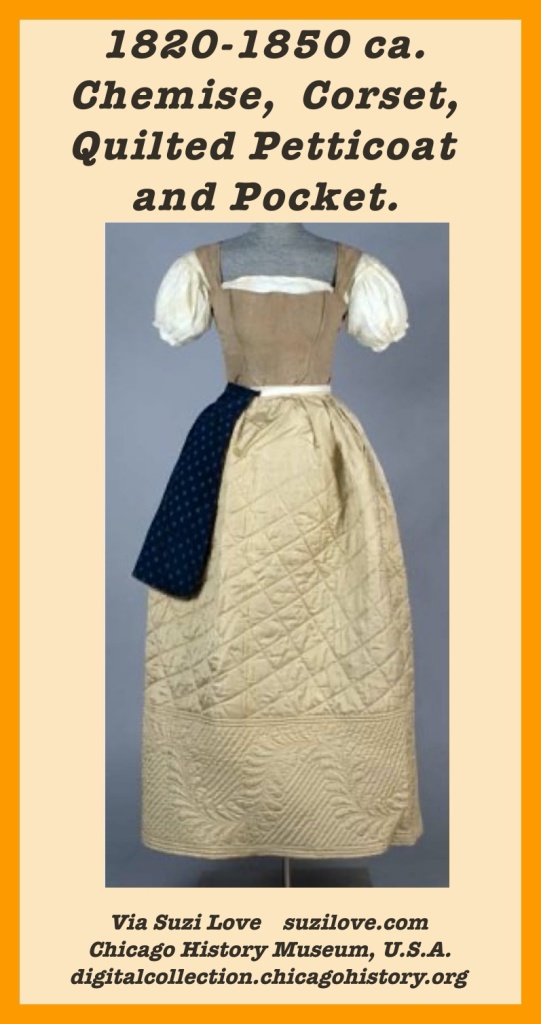
1820-1850 ca. Chemise, Corset, Quilted Petticoat and Pocket. Gift of Mary S. Belden. Corset About 1820-1830 ca. CHS Collection. Pocket About 1820-1840 ca. Chemise About 1839-1850 ca. via Chicago History Museum, U.S.A.
Chemise Or Shift: Sleeveless, mid-calf length garment of white cotton or muslin was worn next to the skin under stays or corset. Called ‘Shift’ from early Georgian (1700-1750) until Late Georgian (1750-1790) to replace ‘Smock’. By 1800, name shift was replaced by ‘Chemise’.
Corset: French term for stays. Structured bust supporting or body shaping foundation garment. Tightened by laces and often with reinforcing e.g. boning, cording and flossing.
From the Curator Victoria and Albert Museum, London: Quilting was a popular form of decoration for a variety of garments including pockets. However, hand-quilting was a time-consuming method of decoration. The increased demand for quilted petticoats, waistcoats and pockets led to the invention of woven quilting.
Love After Waterloo by Suzi Love. Despite Wellington’s victory over Napoleon four days earlier, soldiers, to use the term loosely, still lingered around Waterloo. They and deserters from both sides had joined local famers in picking through the remains of bodies, uniforms, and armory to pilfer anything of value. There’d been nowhere safe to hide her and her son, Daniel, so Lady Melton’s’ brothers had packed what remained of their equipment and taken them, along with a few wounded British soldiers, to the Captain’s quarters, knowing that his orders were to protect whoever remained of French stragglers and deserters.
Anne’s twin brothers hadn’t lingered, because Wellington and what was left of his British troops were marching back towards Brussels and Brendon’s skills as a physician were urgently needed. Benjamin, an aide to Wellington, had stayed to organize the repatriation of their soldiers and the departure of their sister and nephew. Neither twin had understood her reluctance to join Captain Belling and his group and had ignored her pleas to stay with them in Europe, stating firmly that it was time that she and Daniel returned to London.
They hoped that Anne could reopen their townhouse in London and prepare for when they could join her, optimistically within a few weeks. She wasn’t quite so optimistic. Napoleon was an egotist. He wasn’t the type to accept defeat easily, and she imagined he’d already be making plans for a triumphant return in the future, despite the carnage left behind at Waterloo when he and his remaining troops retreated. Her brothers had reported that the plains had been covered with the dead and the dying, both men and horses.
“There is a stubbornness about me that never can bear to be frightened at the will of others. My courage always rises at every attempt to intimidate me.” Jane Austen Pride and Prejudice (1813) #JaneAusten #RegencyEra #Quote https://books2read.com/SuziLoveFashion1810-1814
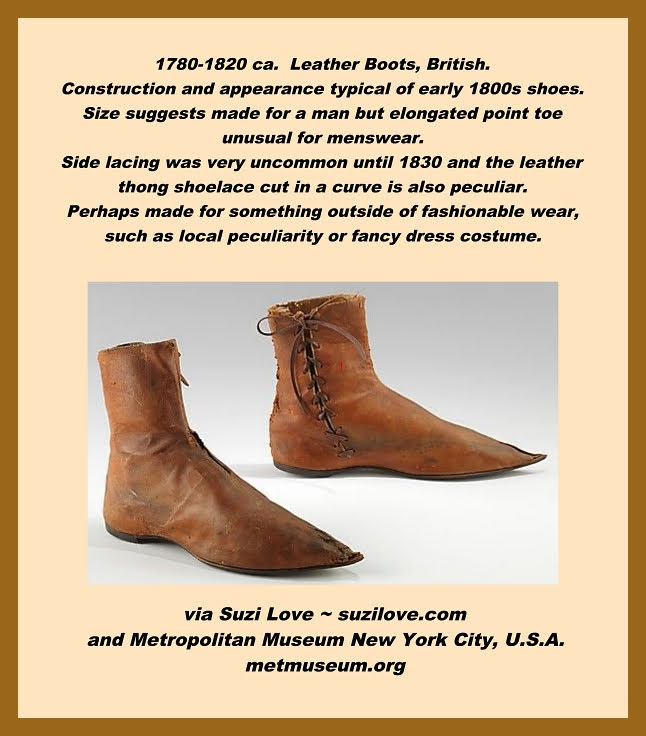
1780-1820 ca. Brown Leather Boots, British. Construction and appearance typical of early 1800s shoes. Size suggests made for a man but elongated point toe unusual for menswear. Side lacing was very uncommon until 1830 and the leather thong shoelace, cut in a curve, is also peculiar. Perhaps made for something outside of fashionable wear, such as local peculiarity or fancy dress costume. via Metropolitan Museum New York City, U.S.A. metmuseum.org
1756-1762 ca. Gold and Enamel Étui, French. Probably by Jean Ducrollay, 1756-62, Paris. via Metropolitan Museum New York City, U.S.A. metmuseum.org
books2read.com/SuziLoveWritingTools
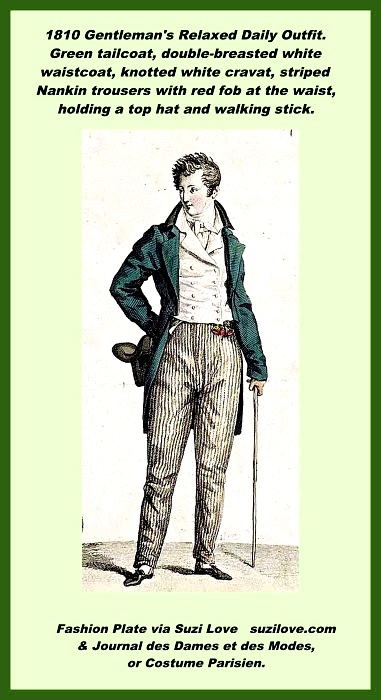
1810 Gentleman’s Relaxed Daily Outfit. Green tailcoat, double-breasted white waistcoat, knotted white cravat, striped Nankin trousers with straps under the foot and red fob at the waist, holding a top hat and a walking stick. Fashion Plate via Journal des Dames et des Modes, or Costume Parisien.
In the early 1800s, men no longer wore complicated styles and extravagant fabrics. Men’s fashion simplified and became more conservative. A well cut tailcoat, vest, pantaloons and an immaculate cravat of beautiful white linen in the style of George Bryan, or Beau, Brummell. Clothes were a status symbol and indicated a man’s social position. These clothing items were the sort worn by Jane Austen’s male family and friends.