↓
 

Suzi Love

Making history fun, one year at a time.

Header_
  • Home
  • Newsletter
  • Pre order form
  • Shop
    • Cart
    • Checkout
    • My account
    • Refund and Returns Policy
  • Blog
  • BOOKS
    • History Events
    • Kelly’s Justice
    • Outback Arrival
    • Irresistible Aristocrats
    • History Notes
    • Scandalous Siblings
    • Love After Waterloo
    • Regency Life Series
  • Privacy Policy
  • EVENTS
Home » Royalty » Page 2 << 1 2 3 4 5 >>

Category Archives: Royalty

Post navigation

← Previous Post
Next Post→

1898 Lilies Of The Valley Imperial Faberge Easter Egg. #EasterEgg #Faberge #Russia

Suzi Love Posted on March 31, 2026 by Suzi LoveMarch 27, 2026

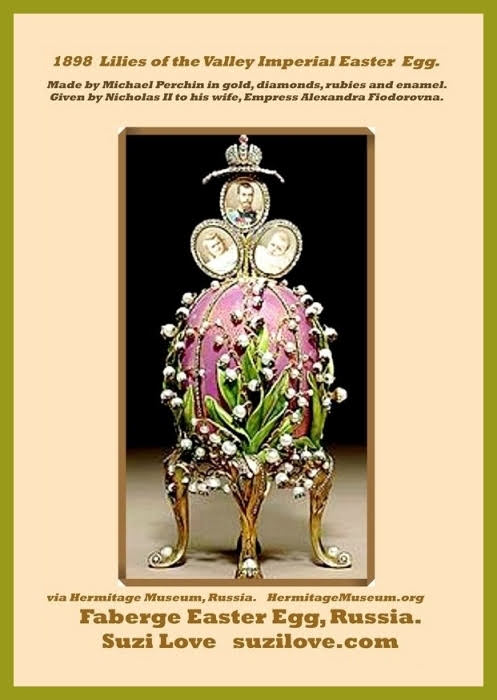
1898 Lilies Of The Valley Imperial Faberge Easter Egg, Russia. An imperial Easter egg presented by Nicholas II to his wife, Empress Alexandra Fiodorovna, for Easter 1898. Gold, diamonds, rubies and pink guilloché enamel with lily-of-the-valley flowers (pearls/diamonds) and contains a hidden portrait. From The Fabergé firm, St Petersburg made by Michael Perchin. Height is 20 cm opened. Via Collection of the Fund ‘The Link of Times’.

The name Faberge is associated with the Russian Imperial family for whom most of the world’s most famous eggs were created. In 1870, Faberge inherited his father’s jewelry business and quickly became known for his brilliant designs. A display of his work and the gold medal he was awarded in Moscow’s Pan-Russian Exhibition of 1882 brought him to the attention of the Russian nobility.

In 1885, Faberge was commissioned by Tsar Alexander III of Russia to create an Easter egg for his wife, the Empress Maria Fedorovna. This became known as The Hen Egg, the first Imperial Faberge Egg, and is made of gold. The Empress was so happy with the gift that Alexander appointed Fabergé a ‘Goldsmith by Special Appointment to the Imperial Crown’ and the following year commissioned another egg. From then on, Faberge was given complete freedom with future Imperial designs which become even more elaborate every year. A famous Fabergé egg is one of sixty eight jeweled eggs made by Fabergé and his assistants for the Russian Tzars and private collectors between 1885 and 1917.

After the Russian Revolution, the House of Faberge was nationalized by the Bolsheviks and the Faberge family fled to Switzerland where Peter Carl Faberge died in 1920. Several of the Faberge Imperial eggs are still missing.

egg_1898_Lilies Of The Valley Imperial Faberge Easter Egg. Made by Michael Perchin. Gold, diamonds, rubies and enamel. 20 cm high opened. Faberge Easter Egg, Russia_Sml

Posted in 1800s, Decorative Item, Easter, Ester In Images, Royalty, Russia, Suzi Love Books, Suzi Love Images, Victorian Era | Tagged Easter, easter egg, Easter in Images, Faberge, Russia, Suzi Love Books, Suzi Love Images, Victorian Era

19th Century Second Half. Paper Mache Easter Egg, Russian. #Easter #EasterEgg #Russia

Suzi Love Posted on March 30, 2026 by Suzi LoveMarch 30, 2026

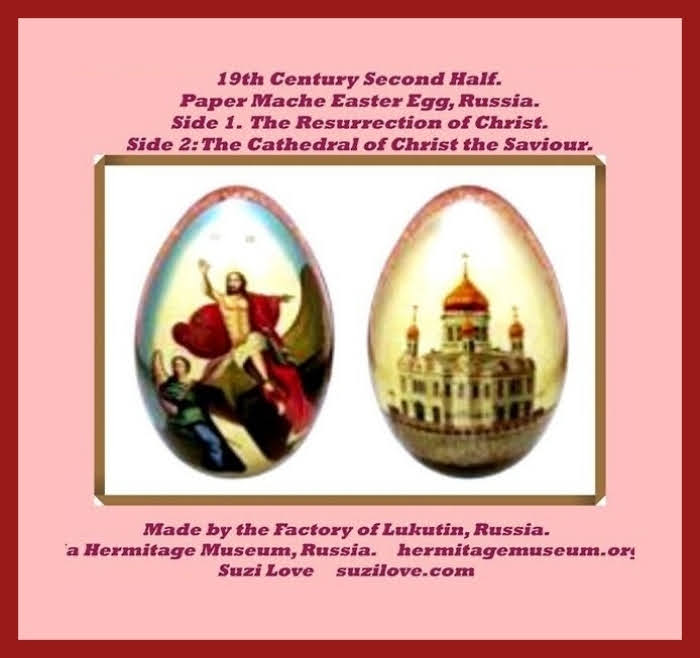
19th Century Second Half. Paper Mache Easter Egg, Russian.#Easter Resurrection of Christ, Cathedral of Christ the Savior. via Hermitage Museum, Russia. hermitagemuseum.org

Posted in 1800s, Easter, Ester In Images, Food and Drink, Royalty, Russia, Victorian Era | Tagged Customs and Traditions, decorative, Easter, easter egg, Easter in Images, Hermitage Museum Russia, Russia, Victorian Era

1885 The Hen Egg, Imperial Faberge Egg, Russia. #easter #EasterEgg #faberge #Russia

Suzi Love Posted on March 29, 2026 by Suzi LoveMarch 29, 2026


1885 The Hen Egg, Imperial Faberge egg, Russia. Gold, rubies and enamel. Height: 6.4 cm. Made by The Fabergé firm, St Petersburg


An imperial Easter egg presented by Alexander III to his wife, Empress Maria Fiodorovna, for Easter 1885. The Hen, was made by Faberge at the behest of Emperor Alexander III for Empress Maria Fedorovna in 1885, possibly to mark the 20th anniversary of their betrothral. It imitates a natural egg and is golden, covered with a white opaque enamel. Inside there is a surprise in the form of a chicken figurine which held in its beak a ruby egg (presently lost). Via The Hermitage Museum, Russia.

egg_1885_First-imperial-hen-egg.-gold-rubies-and-diamonds.-presented-by-tzar-alexander-iii-to-tzarina-maria-fyodorovna.-via-viktor-vekselberg-collection-m
Posted in 1800s, Customs & Manners, Decorative Item, Easter, Ester In Images, Royalty, Russia, Victorian Era | Tagged Easter, easter egg, Easter in Images, Faberge, Hermitage Museum Russia, Russia

1890-1900s Porcelain Easter Egg. Inscription “Christ is risen!”. #easter #easteregg #russia

Suzi Love Posted on March 28, 2026 by Suzi LoveMarch 28, 2026

1890-1900s Porcelain Easter Egg. Inscription “Christ is risen!”. The Kornilov Brothers Factory, St Petersburg. Via Hermitage Museum Faberge Easter Egg, Russia. books2read.com/suziloveEaster

A porcelain Easter egg from the 1890–1900s featuring the inscription “Christ is risen!” was a traditional Russian Orthodox Easter gift. They were produced by both the Kornilov Brothers Factory and the Imperial Porcelain Factory in St. Petersburg. The State Hermitage Museum in St. Petersburg has a large collection of Imperial-era porcelain Easter eggs. These eggs were exchanged, hung on ribbons, or placed on stands during Easter as a symbol of life’s renewal. The words “Christ is Risen!” was a traditional Russian Easter greeting.

 
Posted in 1800s, 1900s, Customs & Manners, Decorative Item, Easter, Edwardian Era, Ester In Images, household, Royalty, Russia, Victorian Era | Tagged Easter, easter egg, Easter in Images, Hermitage Museum Russia, Russia

1900 Friendship, or Hoof, Faberge Egg, Russia. #easter #easteregg #russia #faberge

Suzi Love Posted on March 28, 2026 by Suzi LoveMarch 26, 2026

1900 Friendship, or, Hoof Faberge Egg, Russia. Presented by Tzarina Alexandra to one of her friends. Red gold bowenite, diamonds, rubies and pearls.

egg_1900 Friendship, or, Hoof Faberge Egg (1). Presented by Tzarina Alexandra to one of her friends. Red gold bowenite, diamonds, rubies and pearls. Faberge Easter Egg, Russia

The name Faberge is associated with the Russian Imperial family for whom most of the world’s most famous eggs were created. In 1870, Faberge inherited his father’s jewelry business and quickly became known for his brilliant designs. A display of his work and the gold medal he was awarded in Moscow’s Pan-Russian Exhibition of 1882 brought him to the attention of the Russian nobility.
In 1885, Faberge was commissioned by Tsar Alexander III of Russia to create an Easter egg for his wife, the Empress Maria Fedorovna. This became known as The Hen Egg, the first Imperial Faberge Egg, and is made of gold. The Empress was so happy with the gift that Alexander appointed Fabergé a ‘Goldsmith by Special Appointment to the Imperial Crown’ and the following year commissioned another egg. From then on, Faberge was given complete freedom with future Imperial designs which become even more elaborate every year. A famous Fabergé egg is one of sixty eight jeweled eggs made by Fabergé and his assistants for the Russian Tzars and private collectors between 1885 and 1917.
After the Russian Revolution, the House of Faberge was nationalized by the Bolsheviks and the Faberge family fled to Switzerland where Peter Carl Faberge died in 1920. Several of the Faberge Imperial eggs are still missing.1900  Friendship, or, Hoof #Faberge #Easter Egg. Presented by Tzarina Alexandra to one of her friends. Red gold bowenite, diamonds, rubies and pearls. Faberge Easter Egg, Russia.

Posted in 1900s, Decorative Item, Easter, Edwardian Era, Ester In Images, household, Royalty, Russia | Tagged decorative, Easter, easter egg, Easter in Images, Edwardian Era, household, Russia

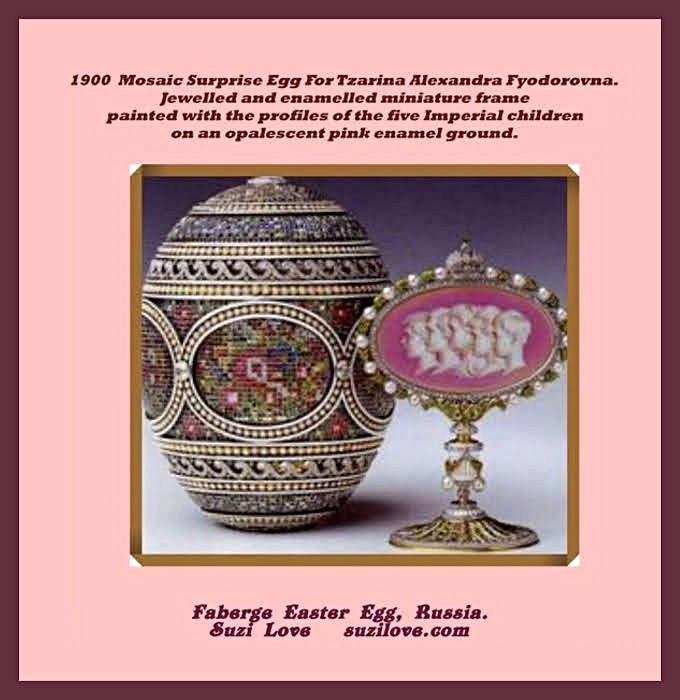
1900 Mosaic Faberge Surprise Egg, Russia. #easter #easteregg #russia

Suzi Love Posted on March 26, 2026 by Suzi LoveMarch 26, 2026

1900 Mosaic Faberge Surprise Egg, Russia. For Tzarina Alexandra Fyodorovna The miniature frame is painted with the profiles of the five Imperial-Russian children on an opalescent pink enamel ground. Faberge Easter Egg, Russia.

egg_1900 Mosaic Faberge Surprise Egg. For Tzarina Alexandra Fyodorovna_Sml

Posted in 1900s, Decorative Item, Easter, Ester In Images, Royalty, Russia | Tagged decorative, Easter, easter egg, Faberge, Hermitage Museum Russia, Royalty, Russia

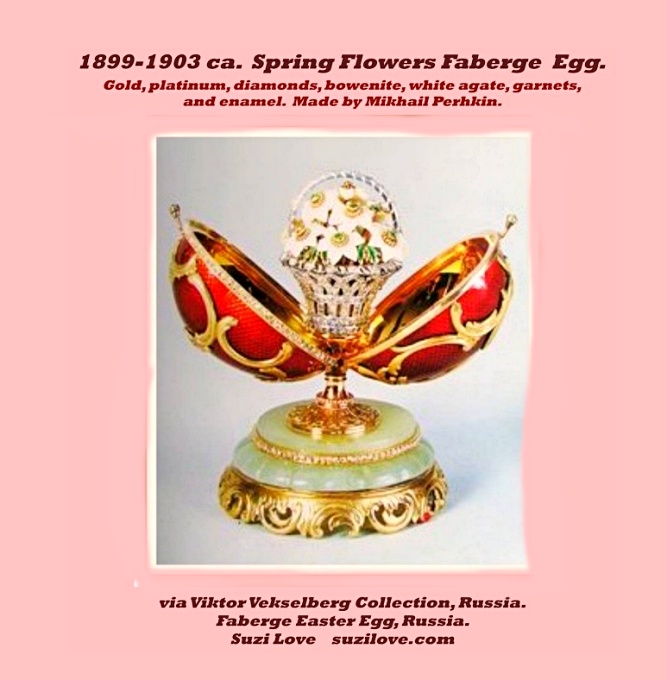
1899-1903 ca. Spring Flowers Imperial Surprise Faberge Easter Egg, Russia. #easter #faberge #russia #easteregg

Suzi Love Posted on March 26, 2026 by Suzi LoveMarch 26, 2026

1899-1903 ca. Spring Flowers Imperial Surprise Faberge Easter Egg. Gold, platinum diamonds, bowenite, white agate, demantoid, garnets, and enamel. By Mikhail Perhkin. Via Viktor Vekselberg Collection in Russia. Faberge Easter Egg, Russia. Faberge Easter Egg, Russia.

egg_1899-1903_SpringFlowers_Faberge Easter Egg, Russia.
Posted in 1900s, Decorative Item, Easter, Ester In Images, household, Royalty, Russia | Tagged decorative, Easter, easter egg, Easter in Images, Faberge, household, Russia

1811-1820 British Regency Era. Jane Austen wrote her books during years when King George III deemed dad and son appointed Prince Regent. #JaneAusten #RegencyEra #London #BritishRoyalty

Suzi Love Posted on March 26, 2026 by Suzi LoveJanuary 25, 2026

1811-1820 Regency Era Overview. The British Regency was the period from 1811-1820. King George III was deemed mad and unfit to rule so his son became his proxy, the Prince Regent, or Prinny to his close friends. This was the era during which Jane Austen wrote her books. Books that are still read and discussed today.

As a period in Britain’s official history, the Regency lasted less than ten years, although scholars apply the term Regency to a much longer period. It began in 1811, when George Ill was declared mad and the Prince of Wales was appointed Regent. It ended in 1820 when the King finally died and the Regent was crowned George IV. However, the Regency was a period in Britain’s history that had an effect on the social and cultural life for four decades, from the start of the French Revolution in 1789 to the passing of Britain’s Great Reform Act in 1832.

The decision to make George IV the Regent took a lot of political debate. After nearly two and a half months of political wrangling, the British government agreed to grant the title of Prince Regent on George. The Act of Parliament was finally passed by a commission in the House of Lords on February 5th 1811 and the Prince was formally sworn in as Regent at Carlton House the next day. He continued to rule as Regent until 1820 when, on his father’s death, he assumed the title George IV and reigned until his own death in 1830.

During the Regency, royalty and upper class ladies and lords, or the Beau Monde, lived elegant and extravagant lives that also allowed excesses and depravity. Britain was united behind exceptional heroes in long wars against France, but internally divided by class distinction and political agitation. The foundations of a modem industrial nation were laid by engineers, inventors and scientists. while Romantic poets and visionary artists dreamt of escape to earlier times and more ideal worlds. From: Queen’s Gallery, London, U.K.

1811-1820 Regency Era Overview.  The British Regency was the period from 1811-1820. King George III was deemed mad and unfit to rule so his son became his proxy, the Prince Regent, or Prinny to his close friends.
RL_1_D2D_Regency Overview RetailerLinks
https://books2read.com/suziloveROver
RL_1_D2D_Regency Overview RetailerLinks https://books2read.com/suziloveROver
Posted in 1800s, 1800s Mens Fashions, England, Google Books, History, Jane Austen, London, Regency Era, Royalty, Suzi Love Images | Tagged British history, King George IV, London, peerage, Prince Regent, Regency Life, Regency London, Regency Royalty

1911 Orange Tree, or, Bay Tree Faberge Imperial Easter Egg. #Easter #EasterEgg #christianity #russia #faberge

Suzi Love Posted on March 25, 2026 by Suzi LoveMarch 25, 2026

1911 Orange Tree, or, Bay Tree Faberge Imperial Easter Egg. Gift to Maria from her son. Automaton nightingale emerges and sings when the correct orange is turned. Gold, jade, diamonds, vitrines, amethysts, rubies, pearls, agates, and bird has feathers. Faberge Easter Egg, Russia.
The name Faberge is associated with the Russian Imperial family for whom most of the world’s most famous eggs were created. In 1870, Faberge inherited his father’s jewelry business and quickly became known for his brilliant designs. A display of his work and the gold medal he was awarded in Moscow’s Pan-Russian Exhibition of 1882 brought him to the attention of the Russian nobility.In 1885, Faberge was commissioned by Tsar Alexander III of Russia to create an Easter egg for his wife, the Empress Maria Fedorovna. This became known as The Hen Egg, the first Imperial Faberge Egg, and is made of gold. The Empress was so happy with the gift that Alexander appointed Fabergé a ‘Goldsmith by Special Appointment to the Imperial Crown’ and the following year commissioned another egg. From then on, Faberge was given complete freedom with future Imperial designs which become even more elaborate every year. A famous Fabergé egg is one of sixty eight jeweled eggs made by Fabergé and his assistants for the Russian Tzars and private collectors between 1885 and 1917.After the Russian Revolution, the House of Faberge was nationalized by the Bolsheviks and the Faberge family fled to Switzerland where Peter Carl Faberge died in 1920. Several of the Faberge Imperial eggs are still missing.

egg_1911_OrangeTreeEasterEgg
Posted in 1900s, Customs & Manners, Decorative Item, Easter, Ester In Images, household, Royalty, Russia, Suzi Love Books | Tagged decorative, Easter, easter egg, Easter in Images, Edwardian Era, Faberge, household, Royalty, Russia

Jane Austen and Bridgerton fan? Love the Regency Era? Do you need more factual and visual information for your historical fiction? #Bridgerton #JaneAusten #GeorgianEra #RegencyEra

Suzi Love Posted on March 12, 2026 by Suzi LoveMarch 7, 2026
  • Do you need more factual and visual information for your historical fiction? Try History Notes Books 1-13. Non-fiction Series: Fashion, music and social manners in the 18th and 19th centuries e.g.
  • books2read.com/suziloveFashWomen1700s
  • books 2read.com/suziloveFashMen1700s
  • books2read.com/SuziLoveTravel
  • books2read.com/SuziLoveChatelaines
  • books2read.com/suziloveMusicViolins
HN_1-28_mantypinglaptop
HN_12_D2D Retailer Buy Link
books2read.com/SuziLoveFashionWomen1800
HN_12 D2D_RetailerBuyLink_HN_12 books2read.com/SuziLoveFashionWomen1800
Posted in 1700s Mens fashion, 1700s Womens Fashion, 1800s Mens Fashions, 1800s women's fashion, Australia, bedroom fashion, Canada, cartoon, Coat or Pelisse Or Redingote, Corset, Customs & Manners, Decorative Item, Dress Or Robe, Edwardian Era, England, Europe, fashion accessories, Food and Drink, Georgian Era, Georgian Fashion, hats, History Notes, household, Jane Austen, medical, military, money, Music, pants, Pastimes, Regency Era, Regency Fashion, Reticule or Bag, riding, Romantic Era, Royalty, Spencer, Suzi Love Books, Suzi Love Images, travel, U.S.A, Victorian Era, Writing Tools | Tagged 1700s Mens Fashion, 1700s Or Georgian Era, 1700s Women's Fashion, 1800s men fashion, 1800s women's fashion, Cartoons, Dress Or Gown, fashion accessories, Fashion Plate, google books, History Notes, Jane Austen, music, Redingote Or Pelisse Or Coat, Regency Fashion, reticule or bag, Shoes, Spencer, Suzi Love Books

Post navigation

← Previous Post
Next Post→

SUBSCRIBE TO SUZI LOVE'S NEWSLETTER.

Recent Posts

  • 1823 Couple In Evening Costumes, French. #RegencyFashion #RomanticEra #HistoricalFashion
  • 1809 Josiah Wedgwood and Thomas Byerley China Showrooms in Jane Austen’s times in York Street, London. #JaneAusten #RegencyEra #London #trade
  • 1876 ‘Queen Bess’ Silk Corset By Worcester Company, American. #VictorianFashion #VictorianEra #Corset #Worcester
  • 18th Century Early.  Silk, Leather, and Linen Mules (shoes), European, and embroidered in Florentine Style. #shoes #georgianfashion #europe
  • Book Hooks: Ironic that Lady Melton and her unborn child had been safer in battle-torn Europe than in England.  #MilitaryRomance #RegencyRomance #BattleofWaterloo

Recent Comments

  1. Jana Richards on Book Hooks: Ironic that Lady Melton and her unborn child had been safer in battle-torn Europe than in England.  #MilitaryRomance #RegencyRomance #BattleofWaterloo
  2. Kayelle Allen on Book Hooks: Ironic that Lady Melton and her unborn child had been safer in battle-torn Europe than in England.  #MilitaryRomance #RegencyRomance #BattleofWaterloo
  3. James DiBenedetto on Book Hooks: Ironic that Lady Melton and her unborn child had been safer in battle-torn Europe than in England.  #MilitaryRomance #RegencyRomance #BattleofWaterloo
  4. Lisabet Sarai on Book Hooks: Ironic that Lady Melton and her unborn child had been safer in battle-torn Europe than in England.  #MilitaryRomance #RegencyRomance #BattleofWaterloo
  5. Suzi Love on Book Hooks: Captain Belling said in a cold voice, “The only thing I don’t know is why the hell you and that child are still near Waterloo.” #MilitaryRomance #RegencyRomance #BattleofWaterloo

Login

  • Log in

Archives

  • August 2026
  • July 2026
  • June 2026
  • May 2026
  • April 2026
  • March 2026
  • February 2026
  • January 2026
  • December 2025
  • November 2025
  • October 2025
  • September 2025
  • August 2025
  • July 2025
  • June 2025
  • May 2025
  • April 2025
  • March 2025
  • February 2025
  • January 2025
  • December 2024
  • November 2024
  • October 2024
  • September 2024
  • August 2024
  • July 2024
  • June 2024
  • May 2024
  • April 2024
  • March 2024
  • February 2024
  • January 2024
  • November 2023
  • October 2023
  • September 2023
  • August 2023
  • July 2023
  • April 2023
  • March 2023
  • June 2022
  • April 2022

Categories

  • 1700s
  • 1700s Mens fashion
  • 1700s Womens Fashion
  • 1800s
  • 1800s Mens Fashions
  • 1800s women's fashion
  • 1900s
  • art
  • Australia
  • Bath
  • bedroom fashion
  • Book Hooks
  • Box Or Container
  • Bridgerton
  • Bus Trips
  • Canada
  • Carriage
  • cartoon
  • Celebrity
  • Chatelaine
  • children
  • Children
  • Christmas
  • Coat or Pelisse Or Redingote
  • Contemporary
  • Corset
  • Couple
  • Customs & Manners
  • dancing
  • December Scandal
  • Decorative Item
  • Dress Or Robe
  • Easter
  • Edwardian Era
  • Embracing Scandal
  • England
  • Ester In Images
  • Europe
  • Events
  • Fashion
  • fashion accessories
  • Food and Drink
  • Four Times A Virgin
  • France
  • furniture
  • Georgian Era
  • Georgian Fashion
  • Google Books
  • Grand Tour
  • Group
  • hats
  • History
  • History Events
  • History Notes
  • History Of Christmases Past
  • household
  • Hygiene
  • Irresistible Aristocrats
  • Jane Austen
  • Keanu Reeves
  • Kellys Justice
  • Legal
  • London
  • Love After Waterloo
  • Loving Lady Katharine
  • medical
  • military
  • money
  • mourning
  • Music
  • Outback Arrival
  • pants
  • Pastimes
  • peerage
  • People
  • Places
  • Pleasure House Ball
  • postal
  • Queensland
  • Quotations
  • Regency Era
  • Regency Fashion
  • Regency Life Series
  • Reticule or Bag
  • riding
  • Romantic Era
  • Royalty
  • Russia
  • Scandalous Siblings Series
  • Scenting Scandal
  • Self Publishing
  • sewing
  • Shirt
  • shoes
  • Shopping
  • South Pacific
  • Spencer
  • sports
  • Suit
  • Sunday Snippet
  • Suzi Love
  • Suzi Love Books
  • Suzi Love Images
  • Suzi Love Writing
  • Swain Cove
  • THe Viscount's Pleasure House
  • travel
  • U.S.A
  • underclothing
  • Vest or Waistcoat
  • Victorian Era
  • Victorian Fashion
  • weapons
  • weddings
  • Writing Tools

1800s men fashion 1800s women's fashion antiques Bridgerton British history Cartoons Corset cravat decorative Dress Or Gown England europe fashion accessories Fashion Plate France Georgian era Georgian Fashion gloves google books Hats And Hair historical romance History Notes household Jane Austen jewelry Journal des Dames et des Modes London Metropolitan Museum NYC pants Redingote Or Pelisse Or Coat Regency Era Regency Fashion Regency London reticule or bag riding Romantic Era sewing shawls Shoes Suzi Love Books Suzi Love Images Tailcoat The Repository Of Arts underclothing Vest or Waistcoat

©2026 - Suzi Love - Weaver Xtreme Theme Privacy Policy
↑