1802 Jane Austen Style Riding Habit, French. Blue riding habit made of castor, worn with a Fichu of white lace to cover her chest and preserve her modesty and carrying a long riding whip. Fashion Plate via Journal des Dames et des Modes, Costume Parisien.
Riding Habit: Early 1800s riding habits still copied men’s riding fashion and usually made by male tailors. They were often a close-fitting jacket worn over a shirt, or with a fichu covering the neck. A skirt with train had either a waistband or straps over the shoulders to keep it in place. Sometimes, habits were made in one piece with the skirt and bodice joined.
Michael Brandon strolled after Cayle St. Martin, the Duke of Sherwyn, when the duke strode to the hallway to greet the latest group of travelers. They’d be, like him, grateful to accept the duke’s hospitality because they’d all become stranded after heavy snowfalls had led to rapidly rising water levels and an impassable local bridge.
He leaned on a wall and watched Mason, the efficient butler at Martin House, ease open the massive front door while three footmen braced their shoulders against the door to stop it blowing fully open. The house had already been full of family members gathered for Christmas, but with the addition of several groups of half-frozen travelers arriving every hour during the afternoon, the house’s walls must be groaning under the excess number of guests needing beds.
Several massive rooms in Martin House had been opened and warmed for the weary travelers who had descended on the duke and his family, but those large fires needed constant feeding with logs of wood. Therefore, Sherwyn couldn’t risk a barrage of snow and sleet blowing inside his house from the courtyard because, in such inclement weather, his footmen might not be able to collect more firewood for another week. Little wonder then that the duke hovered near the front entrance and supervised each subsequent arrival, his charming duchess by his side to add her won welcome.
Michael and his party had been the first to beg assistance from Sherwyn this afternoon, as he’d known that Sherwyn had left London a week earlier and would already be in residence at his country home. There had been a flurry of social events in London over the past two weeks before the Ton left the city and retreated to their country estates to wait out the colder months. Though this extreme weather had caught everyone by surprise.
It was barely mid December and the nearby bridge usually served the locals well through that month and into the New Year. Water levels normally only rose and covered the bridge after the snowstorms of January. Michael and Cayle were long time friends and so he knew Cayle had loathed this house, his family seat, when his father and stepmother had been in residence, but now that Cayle was the duke, and a married man, he had decided to turn this house into a more welcoming family gathering place. Even with the influx of visitors, invited or not, the staff here were jolly and efficient, a rare combination in the serving ranks.
Writing Regency Era Fiction Or Nonfiction? Need more information on Older Gentleman’s Day in early 1800s, or the Bridgerton family or Jane Austen’s Regency Era. A lighthearted overview of an older gentleman’s clothing, social life, and responsibilities in the early 1800s. Take a look at where an older man went, what he wore, and how he managed the family’s finances and his estates. Older Gentleman’s Day Regency Life Series Book 3 books2read.com/suziloveOGD
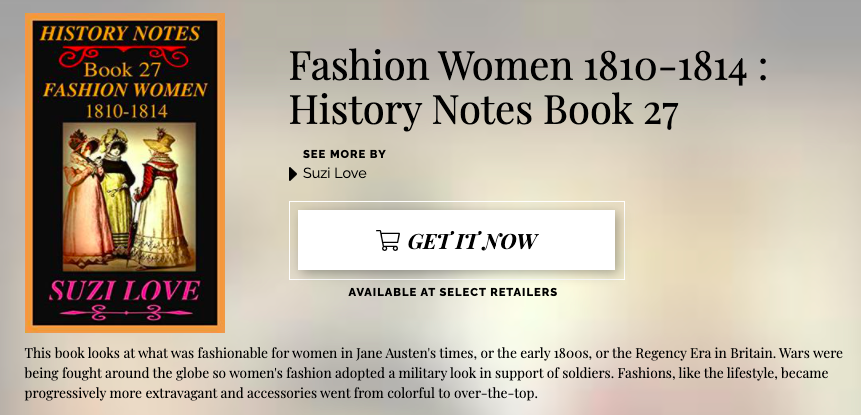
Are you a reader or writer of Regency Romance? Love Jane Austen’s books? Want to know more about the mourning, riding, underclothing and other Regency Era women’s fashions in Regency romances? What was fashionable for women in Jane Austen’s times? Mourning, riding, daytime, evening clothing, plus underclothing, corsets and accessories. This book looks at what was fashionable for women in Jane Austen’s times, or the early 1800s, or the Regency Era in Britain. Wars were being fought around the globe so women’s fashion adopted a military look in support of soldiers. Fashions, like the lifestyle, became progressively more extravagant and accessories went from colorful to over-the-top. https://books2read.com/SuziLoveFashion1810-1814
1811 The Five Positions Of Dancing. An analysis of Country Dancing and all the figures ever used in country dances, etc. By Thomas Wilson, London. The figures show the positions of the Larner and the feet of a finished Dancer during the early 1800s, or the years of the Bridgerton family, or during Jane Austen’s writing years in England. Via British Library, London, UK. www.bl.uk
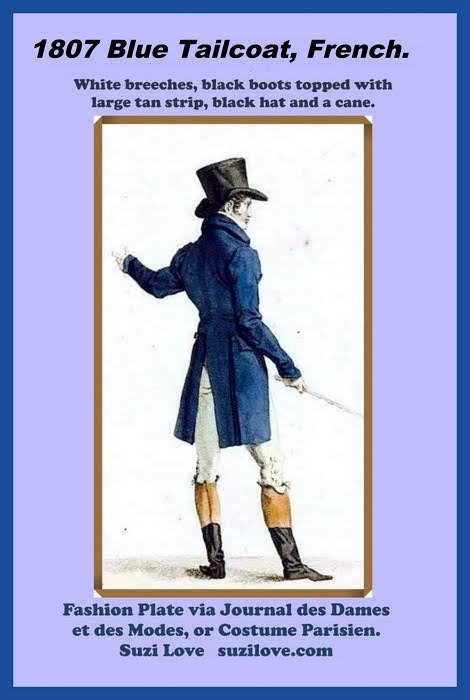
1807 Gentleman’s Blue Tailcoat, French. White breeches, black boots topped with large tan strip, black hat and a cane. Plate via Journal des Dames et des Modes, or Costume Parisien.
French fashions and Georgian and Regency Era fashions from Great Britain were copied around the world. This is what men wore in the times of Jane Austen for city and country life.
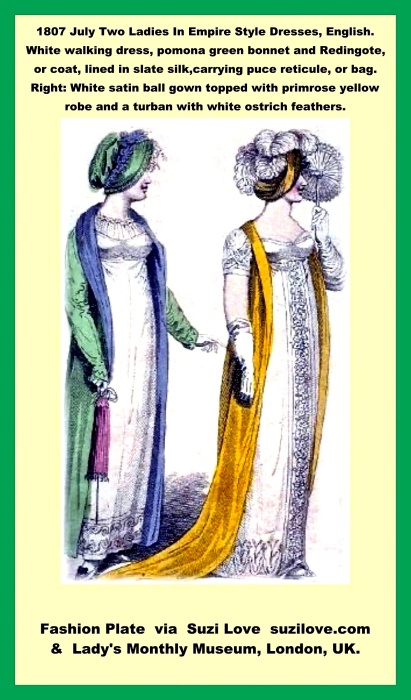
1807 July Two Ladies In Empire Style Dresses, English. White walking dress, Pomona green bonnet and Redingote, or coat, lined in slate silk, carrying puce reticule, or bag. Right: White satin ball gown topped with primrose yellow robe and a turban with white ostrich feathers. Fashion Plate via Lady’s Monthly Museum, London, UK.
Gorgeous Regency Era clothing came in a wide range of styles to suit every season and occasion. Ladies in Jane Austen’s times wore Empire style dresses which were usually of light fabric and floaty in style so accessories were essential to keep women warm.
Definition Reticule Or Ridicule Or Bag or Purse: Often with a drawstring to pull closed and usually made of cloth or covered cardboard and often decorated with beading or embroidery. A reticule, or purse, or handbag, was usually carried by a woman during the Regency period to carry all their daily necessities. Earlier, women used pockets that tied at the waistline and were hidden in the folds of their skirts. Empire style, or early 1800s, high-waisted dresses made it impossible to either sewn in a pocket or to tie on a pocket. So women began carrying small, decorated bags called Reticules, or ridicules, which generally pulled close at the top with a drawstring.
Definition Aigret, aigrette, egret: Plume of feathers or jeweled ornament in shape of feathers worn on head or hats. During the early 19th century., or Jane Austen’s lifetime, the favorite feathers were osprey and heron.
Redingote, or Pelisse, or Walking Dress, or Promenade Dress: Going by many names, this is a coat copied from men’s overcoats but worn by both men and women. Generally, opens down the front, worn for warmth over a dress or coat and breeches, and has a military look with front vertical buttoning or decoration.
1815 Long Blue Overcoat with brown fur trim, white trousers, scarf, top hat and a cane. Fashion Plate via Journal des Dames et des Modes, or Costume Parisien. I can picture Jane Austen’s male friends and family and the Bridgerton men wearing this gorgeous coat when out walking or driving in the park.
1800-1815 ca. Vest, Or Waistcoat, French. Embroidery with spangles and a standing collar. Vests gave a layer of protection from the elements and a fashion arena, as early 1800s coats were either cutaway or designed to be left open in the front. Typical Style of Early 1800s Vest: Standing collar, straight cut, front pockets, heavily embroidered and with tiny spangles to accentuate. via Metropolitan Museum, N.Y.C., U.S.A. metmuseum.org
Typical of a gentleman’s waistcoat, or vest, worn during the early 1800s, or Regency Era, or Jane Austen’s times with a standing collar, straight cut, front pockets, and heavily embroidered with tiny spangles to accentuate.
1820 July 6th View of London Bridge and Custom House with Margate steam yachts, London, U.K. Hand colored By artists and Engravers, P. and D. Colnaghi and Co Ltd and Co (publishers) and R. Havell and Son. via Royal Museums Greenwich. collections.rmg.co.uk