1750 ca. Spanish colonial ‘escritorio’, or writing desk, Columbia. Bone and mother of pearl inlay, hand etched sgraffito and original hand forged iron hinges. Interior has checkerboard drop front and ten compartments, each with original 18th century drawer pulls. Facade over-layed in mother of pearl with hand etched city-scapes, cathedrals, geometric patterns and foliate motifs. Interior has hand carved and gilt wood columns. Via Live Auctions ~ liveauctioneers.com
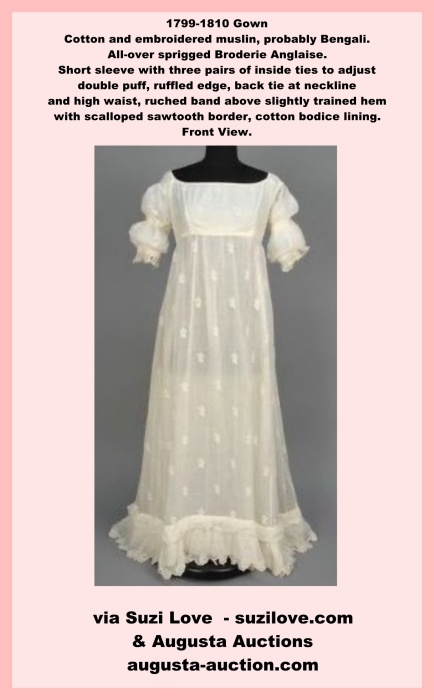
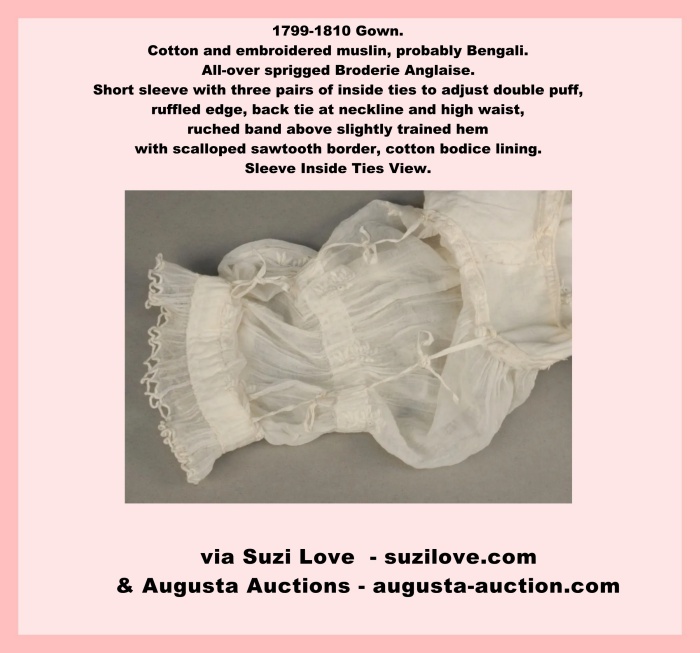
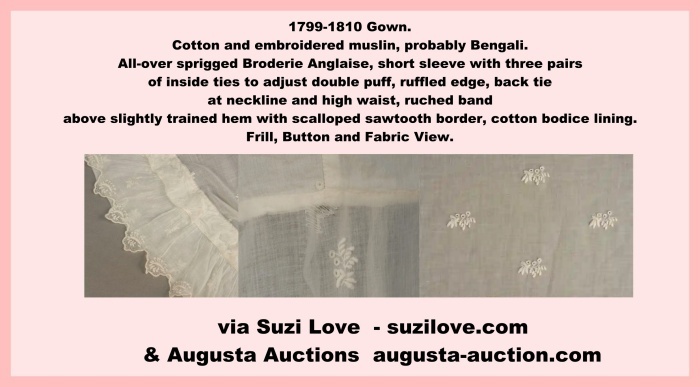
1799-1810 ca. Cotton Muslin Gown, Probably American. White cotton embroidered muslin, probably Bengal, all over sprigged broderie anglaise decoration,short sleeve with three pairs of inside ties to adjust the double-puff, ruffled edge, back tie at neckline and waist, ruched band above the slightly trained hem with scalloped sawtooth border and with cotton bodice lining. via whitakerauction.smugmug.com
These lightweight white cotton dresses were fashionable in Jane Austen’s times, but they were certainly not warm when a lady was out walking or when riding in a carriage. Numerous outer layers could be added for warmth and to brighten and personalize an outfit. These might be an overdress, pelisse or redingote, hat, shawl, gloves, or large fur muff.
The Empire dress which evolved in the late 1790s began as a chemise shift gathered under the breasts and at the neck. Named after the First Empire in France, by 1800 Empire dresses had a very low décolleté, or neckline and a short narrow backed bodice attached to a separate skirt. Skirts started directly under the bust and flowed into the classical relaxed wide styles of Greece and Rome. This style of dress is associated with Jane Austen and her contemporaries as a simple cotton high-waisted dress was worn most days and accessorized according to the importance of the occasion.
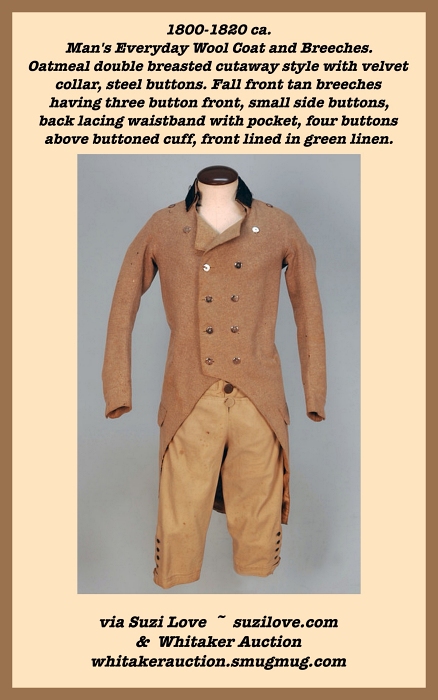
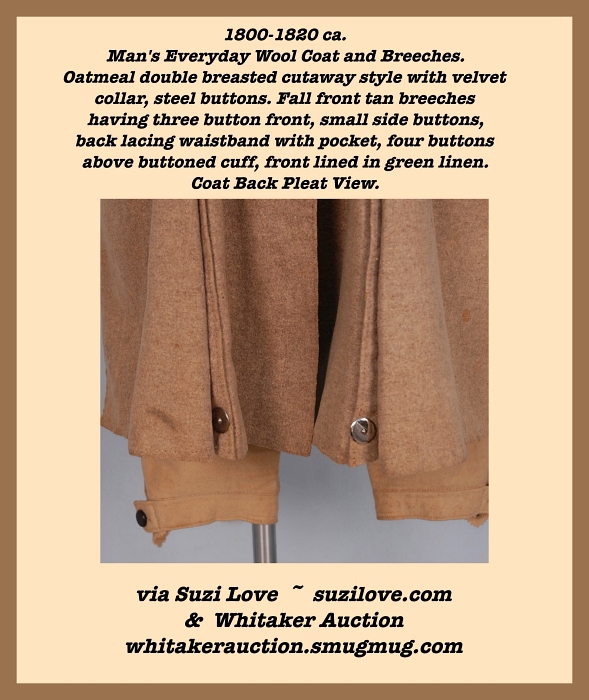
1800-1820 ca. Man’s Everyday Oatmeal Colored Wool Suit With Breeches. Can you picture Jane Austen’s male relatives and friends wearing this? Oatmeal colored double breasted cutaway style coat with velvet collar, steel buttons, rear flap pockets, back vent flanked by stitched down pleats having top and bottom button detail, glazed linen lining. Fall front tan breeches having three button front, small side buttons, back lacing waistband with pocket, four buttons above buttoned cuff, front lined in green linen. via Whitaker Auction whitakerauction.smugmug.com
1836-1840 ca. Floral Print Cotton Dress With Silk Satin Piping, English. Cotton printed in soft pink, red, white, and green floral motif on light brown, edged with green silk satin piping and lined with linen and cotton. Sleeves tightly gathered, loose at elbow, skirt gathered from tight fitting bodice edged with green satin piping. via Victoria and Albert Museum, London, UK. collections.vam.ac.uk.From the Museum: Soft colours and floral patterns are a distinctive feature of many 1830s day dresses. Here, pink, red and white flowers harmonise with the brown ground and green piping. The construction of the sleeves is also interesting as they are tightly gathered at the top and loose around the elbow. This accentuates the slope of the shoulder and the tightness of the wrist.
1797 Elegant Couple Dancing At A Ball. Man: Bottle green tailcoat, yellow knee breeches, white stockings, red vest and black dancing slippers. Lady: White spotted dress with a pale pink overdress open at the front, high belted waist, red and green turban and a parure, or jewelry set. via Fashion Plate via Journal des Dames et des Modes, or Costume Parisien.
1800-1815 ca. Fan of Bone and Silk, French. Jane Austen and her family and friends would have carried this style of fan when attending assemblies, musical evenings and balls. Metropolitan Museum New York City, U.S.A. metmuseum.org
1808 January Trio In Half Dress Walking Ensembles, English. Lady on left wearing a pink dress and green coat and carrying a reticule. Lady on right in a white trained dress, long draping shawl and fitted hat. Gentleman in a blue tailcoat, white vest, extra high white cravat, knee breeches, shoes, and black top hat. Fashion Plate via Le Beau Monde. The sort of outfits ladies and gentlemen in Jane Austen’s times would have worn while out walking, shopping, or going to visit friends.
1813 The Theatre. From Poetical Sketches of Scarborough By Thomas Rowlandson. Aquatint was added by John Bluck and Joseph Stadler. The sketches by Green were made as souvenirs and not intended for publication. Via Suzi Love suzilove.com & Wikimedia Commons commons.wikimedia.org (PD-ART)
18th Century Wool, Leather And Linen Front Lacing Stays. via digitalmuseum.norway
In the early 18th century, stays were basically quilted waistcoats, laced in the front and un-boned and to be worn on informal occasions. Mid century, the role of stays changed. They were then supposed to create a V shaped form and support a woman’s back, so baleen from whales was inserted into the garments and backs became longer.
Eyelet holes were stitched and staggered in spacing, so stays could be spiral laced. Stays were strapless or had straps attached in the back and tied at the front sides. Eyelet holes were stitched and staggered in spacing, so stays could be spiral laced. Later, they began to support the bust, give a fashionable conical shape, and draw shoulders back.
It was around the 1790s that the term corset started to be used as a refined name for stays. The Times of 24 June 1795 stated that: ‘corsettes about six inches long…are now the only defensive paraphernalia of our fashionable belle’.
corset_18th Century Wool, Leather And Linen Front Lacing Stays. via digitalmuseum.norwaycorset_18th Century Wool, Leather And Linen Front Lacing Stays. via digitalmuseum.norwaycorset_18th Century Wool, Leather And Linen Front Lacing Stays. via digitalmuseum.norwaycorset_18th Century Wool, Leather And Linen Front Lacing Stays. via digitalmuseum.norwaycorset_18th Century Wool, Leather And Linen Front Lacing Stays. via digitalmuseum.norwaycorset_18th Century Wool, Leather And Linen Front Lacing Stays. via digitalmuseum.norway18th Century Wool, Leather And Linen Front Lacing Stays. via digitalmuseum.norway #Corset #Europe #Historicalfashion https://books2read.com/SuziLoveCorsetBook15 Share on X
1802 February, 15th. ‘Advantages of Wearing Muslin Dresses.’ during the Regency Era, or Jane Austen’s times. By James Gillray. Fat lady sitting with man and woman at tea table reacts in horror when hot poker from fire falls on her dress. Man sits helplessly while second woman upsets the table. Butler drops plate of muffins and cat scampers away from fire. Painting of Mt. Vesuvius hangs over fireplace. Via Wikimedia Commons commons.wikimedia.org (PD-ART)