19th Century Mother Of Pearl Carnet De Bal Or Dance Card, French. via Ruby Lane Antiques.



19th Century Mother Of Pearl Carnet De Bal Or Dance Card, French. via Ruby Lane Antiques.
1804 Fawn Drap Riding Habit in Jane Austen style. High-waisted dress with a full skirt and train, skirt buttoned at the side, long straight sleeves, velvet snug hat, Fichu around her neck, riding crop, two views of hairstyles. Fashion Plate via Journal des Dames et des Modes, or Costume Parisien.
Male tailors made most women’s riding habits during the Regency years and they were constructed similarly to men’s riding outfits. Generally in two pieces, a jacket and a skirt, and with a shirt with a frilled collar or front opening underneath. The trains of a habit could be caught up for walking, usually with a button and loop, and unhooked and let down so that the skirt flowed over the woman’s legs when she rode side saddle. Due to the numerous wars during the early 1800s, it was seen as patriotic for women to add military style touches to outfits in support of military men. The shoulder and cuff trims resemble the epaulettes and coat trims of a military uniform.

1817 May Pink Evening Dress, English. A white lace dress over a blush-coloured satin slip. The dress is disposed round the bottom of the skirt in festoons, which display a little of the slip; each festoon is ornamented with a bouquet of blue-belles, pinks, and rose-buds. The festoons are surmounted by a rollio of intermingled pink and white saton. We refer to our print for the form of the body, which is novel and tasteful. The sleeve is very short and full; it is finished at the bottom by quillings of blond. The hair is dressed in a plain braid across the face, and a few loose ringlets at the sides. The hind hair forms a tuft, which is concealed by the head-dress, a high wreath of fancy flowers. Pearl necklace. White kid slippers and gloves. Fashion Plate via Rudolph Ackermann’s ‘The Repository of Arts’.


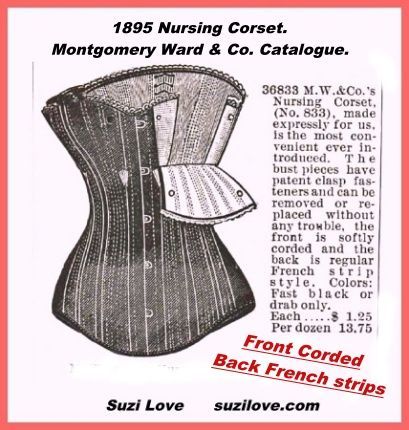
1895 Nursing Corset, French. via Montgomery Ward and co. Catalogue. Boned, soft and pliable busts, French sateen covered strips.
Definition Montgomery Ward: World first American mail order business and later a department store chain that operated between 1872 and 2001.
Corsets 1880-1900 History Notes Book 20 This book shows how a fashionable silhouette became of paramount importance and how a well-fitted corset became a fashion essential. As well as a decorative fashion item, tight lacing gave a narrow waist and the desired feminine form under clothing. https://books2read.com/SuziLoveCorsetBook20

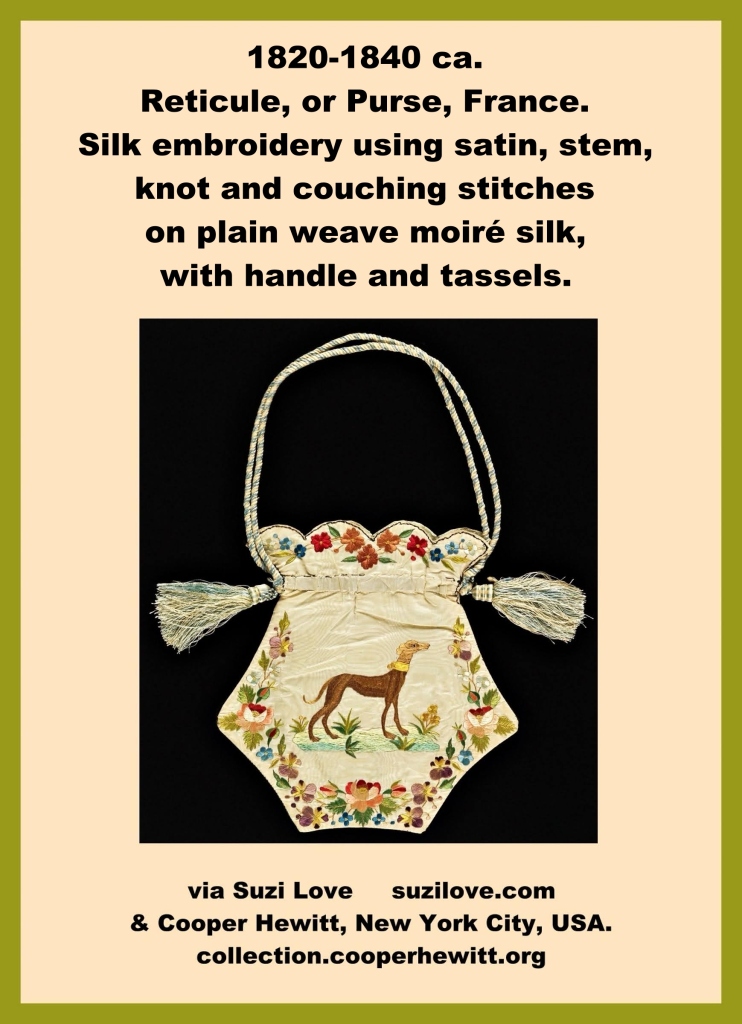
1820-1840 ca. Reticule, Or Purse, France. Bag of plain weave white moiré silk embroidered in colored silks using satin, stem, knot and couching stitches. Shape is five-sided, flat, with a scalloped top. Borders of flower wreaths. Embroidered on one side with a greyhound and with a long-tailed bird on the other. Worked as two separate panels, joined. Lined in pale blue taffeta. Blue and white silk cord. via Cooper Hewitt, New York City, USA. collection.cooperhewitt.org
Definition Reticule: Bag or purse, often with a drawstring to pull closed and usually made of cloth or covered cardboard and often decorated with beading or embroidery. A reticule, or purse, or handbag, was usually carried by a woman during the Regency period to carry all their daily necessities. Earlier, women used pockets that tied at the waistline and were hidden in the folds of their skirts. Empire style, or early 1800s, high-waisted dresses made it impossible to either sewn in a pocket or to tie on a pocket. So women began carrying small, decorated bags called Reticules, or ridicules, which generally pulled close at the top with a drawstring. http://books2read.com/suziloveReticules


19th Century Early. Ladies blue leather boots, Probably British. Side inserts and loops for pulling up. The style of boots the Bridgerton ladies and Jane Austen and her contemporaries would have worn when walking in the countryside. via Metropolitan Museum, NYC, U.S.A. metmuseum.org



1863 Traveler’s Chest, French. Sewing Tools, Ruby Perfume, Aide de Memoire or Notebook, etc. Inside lid with theatre curtains. via Ruby Lane Antiques. rubylane.com


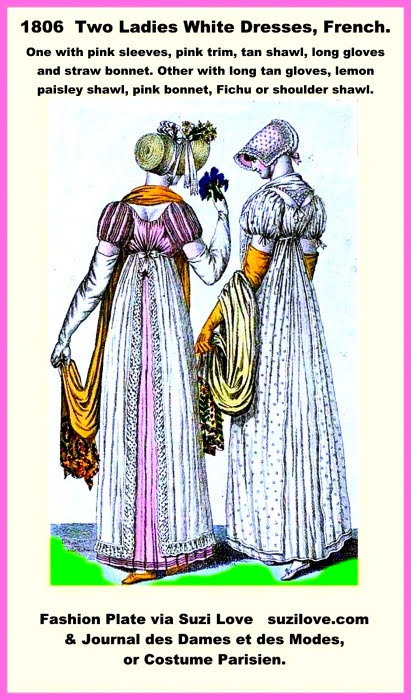
1806 Two Ladies In White Dresses, French. One with pink sleeves, pink trim, tan shawl, long gloves and straw bonnet. Other with long tan gloves, lemon paisley shawl, pink bonnet, Fichu or shoulder shawl. Fashion Plate via Journal des Dames et des Modes, or Costume Parisien. These fashionable ensembles with a variety of fashionable and practical accessories would have been worn by Jane Austen and her family and friends during the day when out walking in the park or visiting village shops. Hats were a necessity to protect fair skin from the sun and scarfs and shawls added color and warmth to an outfit.
Definition Fichu: Draped scarf or shawl worn about shoulders and tied in knot at breast, with ends hanging down loosely. Word, meaning negligee or careless, first used to describe breaking away from stiff collar of the past.

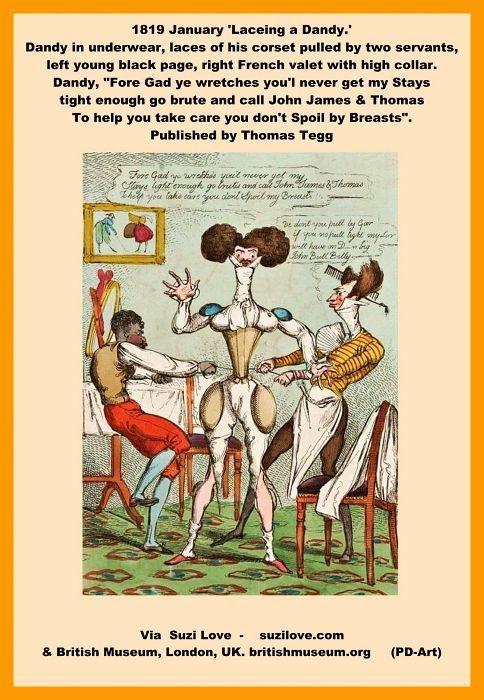
1819 January ‘Laceing a Dandy.’ Dandy in underwear, laces of his corset pulled by two servants, left young black page, right French valet with high collar. Dandy, “Fore Gad ye wretches you’ll never get my Stays tight enough go brute and call John James & Thomas, To help you take care you don’t Spoil by Breasts”. Published by: Thomas Tegg. Hand colored etching. Via British Museum, London, UK. britishmuseum.org (PD-Art)

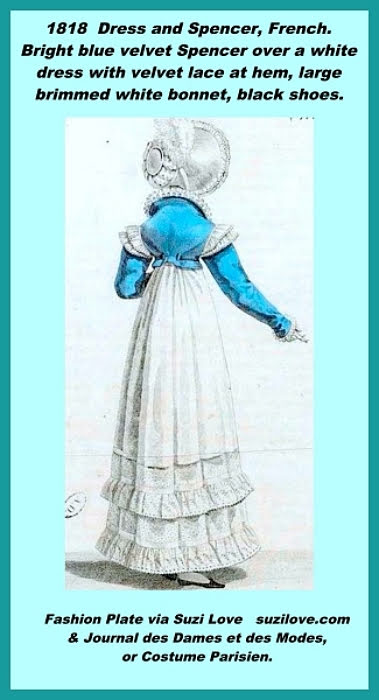
1818 Dress and Spencer, French. Bright blue velvet Spencer over a white dress with velvet lace at hem, large brimmed white bonnet, black shoes. Fashion Plate via Journal des Dames et des Modes, or Costume Parisien.