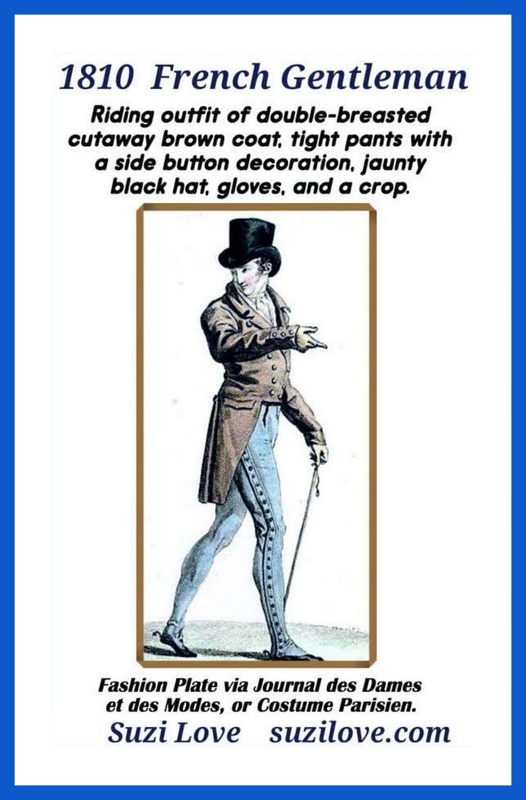
1810 French Gentleman. Riding outfit of double-breasted brown coat, tight pants with a side button decoration, jaunty black hat, gloves, and a crop. Fashion Plate via Journal des Dames et des Modes, or Costume Parisien.
In the early 1800s, men no longer wore complicated styles and extravagant fabrics. Men’s fashion simplified and became more conservative. A well cut tailcoat, vest, pantaloons and an immaculate cravat of beautiful white linen in the style of George Bryan, or Beau, Brummell. Clothes were a status symbol and indicated a man’s social position. These clothing items were the sort worn by Jane Austen’s male family and friends.
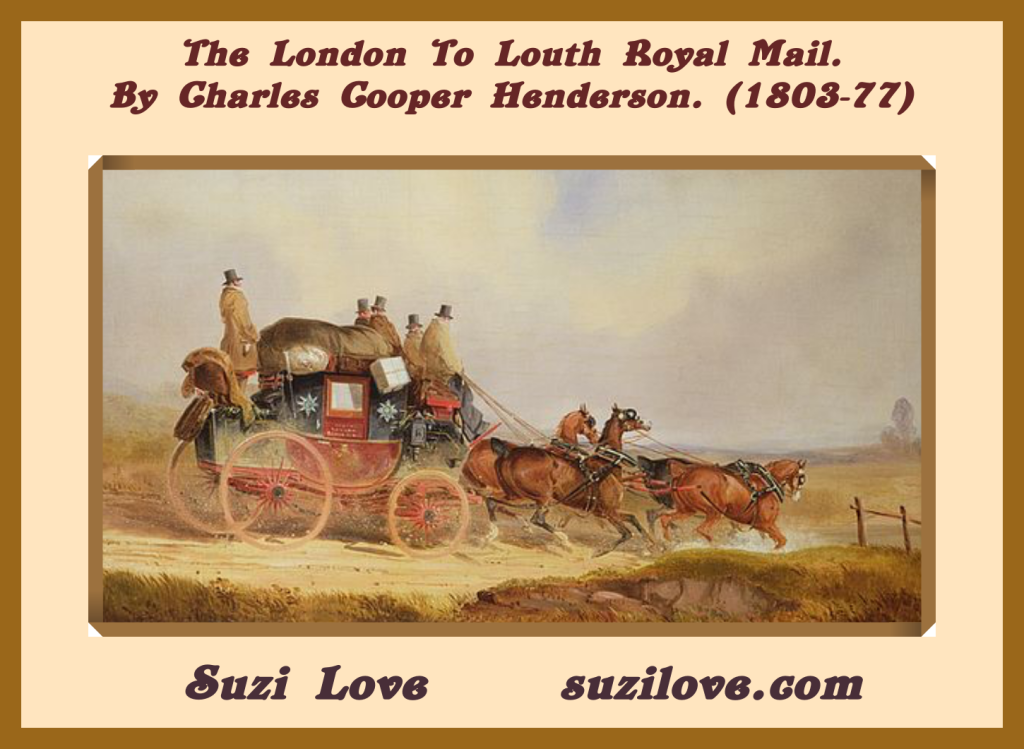
The London To Louth Royal Mail, England, U.K. Print by Charles Cooper Henderson. (1803-1877)
How did Jane Austen and her family? Did they go by stagecoach? The dreadful condition of British roads caused great apprehension to all classes of travelers. Making a journey anywhere in the country was a big undertaking and often a gentleman composed his last will and testament before his departure. Traveling in vehicles was only possible during the day or on the nights with very bright moonlight with few vehicles attempting road travel in winter and any travel on a Sunday was frowned upon. books2read.com/SuziLoveTravel
Description of Stage Coach Travel in England. via 1815 Journal Tour of Great Britain. “The gentlemen coachmen, with half-a dozen great coats about them, immense capes, a large nosegay at the button-hole, high mounted on an elevated seat, with squared elbows, a prodigious whip, beautiful horses, four in hand, drive in a file to Salthill, a place about twenty miles from London, and return, stopping in the way at the several public-houses and gin-shops where stage-coachmen are in the habit of stopping for a dram, and for parcels and passengers on the top of the others as many as seventeen persons. These carriages are not suspended, but rest on steel springs, of a flattened oval shape, less easy than the old mode of leathern braces on springs. Some of these stage coaches carry their baggage below the level of the axletree.”
1809 October Blue Ball Dress, English. A light blue, or grey chemise robe, of gossamer net, imperial crape, worn over white satin, ornamented up the front with French bows and knots of silver. A full melon sleeve, formed of the same material as the dress, and alternate stripes of white satin, finished with bows and knots of silver. A double roll of white satin around the neck by way of a tucker. Hair falling in natural and irregular curls on the forehead, confined in a bow and curled ends, or in plaited braids, at the back of the head with a diamond comb. Diamond bandeau, with necklace, armlets, and drop earrings of the same. Slippers of white satin, with silver clasps, French kid gloves, just escaping the elbow. Fan of carved ivory. Fashion Plate via Rudolph Ackermann’s ‘The Repository of Arts’.
Definition Bandana Or Bandeau: Narrow strip or band worn around head to confine hair. Made of either twisted fabric, length of pearls, flowers, jewels or feathers. From the French word for “strip.
Looking For A Fun Historical Romance? Lady Laura Jamison to the earl: “For the sake of propriety, I was ensuring your garments were intact.” #HistoricalMystery #VictorianRomance #RomCom https://books2read.com/suziloveSS
1800s Typical Meat and Game Meals served during the 1800s. These are the sort of dishes Jane Austen’s family would have eaten on a regular basis. Pig’s Feet and Truffles, Lyons Sausage, Puree of Game and Rice, Pigeon Pie, Brawn, Calf’s Heart, Larks and Potatoes, Lamb Chops and Potatoes, Calf’s Tongue, Scotch Eggs and Forcemeat, Stuffed tomatoes, Hot and Cold Fowl and Jelly, Veal Cutlets and Olives, Veal Cutlets, Filet Of Beef In the Garden, Fillets Of Beef, Lamb Cutlets and Green Peas, Partridges, Garnished Ham, Garnished Tongue, Chicken Fricassée, Chicken Croquettes, Fricandeau Of Veal, Half Calf’s Head, Chartreuse Of Partridge, Timbale Milanese Or Macoroni. From: 1860s Mrs. Beeton’s Book of Household Management. via Google Books (PD-150)
1800s Typical Meat and Game Meal. Pig’s Feet and Truffles, Lyons Sausage, Puree of Game and Rice, Pigeon Pie, Brawn, Calf’s Heart, Larks and Potatoes, Lamb Chops and Potatoes, Calf’s Tongue, Scotch Eggs and Forcemeat, Stuffed tomatoes, Hot and Cold Fowl and Jelly, Veal Cutlets and Olives, Veal Cutlets, Filet Of Beef In the Garden, Fillets Of Beef, Lamb Cutlets and Green Peas, Partridges, Garnished Ham, Garnished Tongue, Chicken Fricasse, Chicken Croquettes, Fricandeau Of Veal, Half Calf’s Head, Chartreuse Of Partridge, Timbale Milanese Or Macoroni. From: 1860s Mrs. Beeton’s Book of Household Management. via Google Books (PD-150)
1800s Typical Meat and Game Meals Served In Households Like Jane Austen’s During The Regency Era. #Food #Regency #BritishHistory #JaneAusten
Almack’s Assembly Rooms often appear in Regency Era romances as they were a well known gathering place for those in the Ton looking for wives or husbands. 1770-1840 . Almack’s or Willis’s Rooms, King Street, St James, London, UK. Almack’s Assembly Rooms, founded by William Almack at No. 26-28, were on the site of the present Almack House. The club was originally a gaming establishment but moved from Pall Mall. The Assembly rooms were on the South side of King Street in St James’s and were opened on February 12, 1765. At the time the subscription was ten guineas for which there was a ball and supper each week for the twelve weeks of the season.
Assemblies were held on Tuesdays and Thursdays, but only four or five times a season. Dates were listed in the paper along with the names of the Patronesses. When Lady Jersey took over Almack’s around 1815, assemblies were changed to Wednesdays. Many aristocrats were reportedly offended by something that happened at Almack’s but Lord Jersey is reported to have refused to duel over any inferred slights because it would have meant he was forever involved in a duel. The other well-known Patronesses were Lady Bathurst and Lady Downshire.
1826 Almack’s Revisited by Charles White.: ‘It was what most correct persons called ‘horrid bad Almack’s’. #RegencyEra #London #BritishHistory1817 April Ladies’ Voucher for all the Wednesday balls at Almack’s in April 1817. via The Huntington Library, San Marino, California, U.S.A.1815 The First Quadrille at Almack’s Assembly Rooms, London. Left to Right: Marquis of Worcester, Lady Jersey, Clanronald MacDonald and Lady Worcester. “It was not until 1815 that Lady Jersey introduced from Paris the favourite quadrille, which has so long remained popular. I recollect the persons who formed the very first quadrille that was ever danced at Almack’s: they were Lady Jersey, Lady Harriett Butler, Lady Susan Ryde, and Miss Montgomery; the men being the Count St Aldegonde, Mr Montgomery, Mr Montague, and Charles Standish.” From The Reminiscences of Captain Gronow 1810-1860.
1765-1840 ca. Almack’s, or Willis’s, Assembly Rooms, South Side Of King Street, St James, London. commons.wikimedia.org
1800s Early Exterior of Almack’s Assembly Rooms, London, UK.
Captain Gronow, an army officer in London around 1814, wrote about the rules of Almack’s in Captain Gronow’s Recollections and Anecdotes, 1864 , but only gives his views on a few years of Almack’s history.
Embracing Scandal Book 1 Scandalous Siblings After Lady Rebecca Jamison, a mathematical genius, saves her family from financial ruin by secretly investing in railway stocks on the London stock exchange, a greedy syndicate, desperate for Becca’s calculations and predictions, murders her friend and threatens the Jamison family, forcing Becca to beg assistance from her childhood friend, Cayle St. Martin. The newly titled Duke of Sherwyn has returned to London after five years on the continent extending his family’s shipping interests. He’s shunned his privileged London life and his father’s unbending attitudes, and becomes committed to employing the spying tactics he learned on the continent to help Becca indict the syndicate – and using his skills as a lover to seduce her into his bed. But how will Cayle be able to convince Becca, a determinedly self-sufficient spinster, that he can be more to her than just a protector? https://books2read.com/suziloveES
Scenting Scandal Book 2 Lady Laura Jamison uses her extraordinary olfactory senses to sniff out her perfect match, a husband who fits all her scientific criteria. But after she evades an assassin’s bullets, twice, while attending her sister’s wedding, she is forced to accept the protection of their family friend, and her nemesis, the Earl of Winchester. Richard evades marriage with someone as beautiful and intelligent as Laura, fearing she’ll uncover his shameful childhood secret. The mismatched pair risks their wealth and reputations racing around London’s seedier areas in a desperate attempt to stop a madwoman before she recruits more criminals and rebuilds her illegal share trading syndicate. When they accept each other’s strengths and weakness, will Laura and Richard also discover a passion neither counted on? https:/books2read.com/suziloveSS
December Scandal Book 3 Michael Brandon travels to introduce the woman he loves to family but is shocked when his missing brother arrives. The Jamisons join the St. Martins at the duke’s country estate but a December snowstorm doubles guest numbers. https:/books2read.com/suziloveDS
Scandalous Siblings Series Books 1-3. The scientifically gifted Jamison siblings beg assistance from the St. Martin clan to battle a greedy railway investment syndicate. https://books2read.com/suziloveES https://books2read.com/suziloveSS https://books2read.com/suziloveDS
1814 Gentleman’s Redingote, or Overcoat, French. Back View of coat with back pleats and metal buttons worn with high topped boots, top hat, and a cane. Fashion Plate via Journal des Dames et des Modes, or Costume Parisien.
Definition Redingote Or Coat: French word developed from English words, riding coat. Long fitted outdoor coat worn over other garments for warmth. Originally made with several capes and trimmed with large buttons. For women, the coat was often cut away in the front or left open to show off the dress underneath. French fashion plates call these coats Redingotes and they were worn by men, women, and children. English fashion plates call the coats a Pelisse, a walking dress, Promenade dress, or Carriage dress.
What did Jane Austen and friends wear? Early 1800s fashions were elegant and pretty with high waists and fabrics that were almost transparent. These Empire style gowns, named after Napoleon’s first Empress, became popular throughout Europe, and were then copied around the world. Colorful outwear was added to make an ensemble more attractive and warmer. History Notes Book 26 Fashion Women 1805-1809. https://books2read.com/SuziLoveFashionWomen1805-1809
The Empire waist gown defined women’s fashion during the Regency Era. ‘Empire’ is the name given in France to the period when Napoleon built his French Empire.
High-waisted, loose gowns were adopted by the aristocracy as a symbol of turning away from the fussy, elaborate and expensive clothing worn in the 1700s. Jean-Jaques Rousseau advocated copying peasants and returning to a simpler life and more natural fashions. Unrestricting clothing was part of the new Democracy in France and these simpler and flowing fashions were adopted all over Europe, including Britain and despite the continual wars being fought against France during the early 1800s. Not even war stopped fashions from being copied everywhere.