1810 ca. Full Dress Jacket, Lothian Yeomanry Cavalry, Britain. The East Lothian Yeomanry Cavalry was raised as a one troop formation at Haddington in May 1797. Five years later a second troop was raised and in 1803 a third and fourth troop. The regiment was reduced to one troop in 1823 and disbanded 15 years later. National Army Museum, London, UK. https://books2read.com/SuziLoveFashionMen1800-1819 In Jane Austen’s time, or the early 1800s, gentlemen were seen in military coats like this often because many Englishmen were involved in the long lasting wars against Napoleon. .
1810 Cotton Waistcoat. Blue black and white woven plaid, narrow double breast with self buttons, buttons create optional lapels, stand collar, hemline pockets, white cotton back with ties and cotton lining. via Whitaker Auction whitakerauction.smugmug.com
Typical of a gentleman’s waistcoat, or vest, worn during the early 1800s, or Regency Era, or Jane Austen’s times with a fancy collar, straight cut, and straight buttoned front.
1840 Group In An Outdoor Setting, French. Two men in top hats. Modes de Longchamps’. Men’s outfits, a woman’s riding habit and a small boy, all tailored by Robin of 21 Rue Saint Marc, Paris. via Le Bon Ton. via Victoria and Albert Museum, London, UK. collections.vam.ac.uk.
1810 Pale Blue Suit For Formal Court Wear, France. Suit with a frilled vest, or waistcoat, white stockings and a bicorn, or two-cornered, hat. Fashion Plate via Journal des Dames et des Modes, or Costume Parisien. The exception to the more relaxed style of early 19th century fashion for men was court dress, which was dictated by the royals in each European country and so retained elements of pomp and ceremony not seen in general dress by men. These outfits remained very formal and therefore little different to court dress of the 18th Century.
A court ensemble meant a coat, often of dark figured velvet although brighter colors could still be seen, breeches, a waistcoat with short skirts, a shirt and elaborately tied cravat, white stockings, and black evening shoes. These court outfits still featured a lot of decoration, such as gold braiding and elaborate embroidery. Court dress was accessorized with jewelry, such as expensive cravat pins and fobs and if the occasion was very formal, a sword was worn at the hip.
1840s Opera Boots, British. Black leather with suede leg and silk bow, hand and machine sewn. via Victoria and Albert Museum, London, UK. collections.vam.ac.uk.
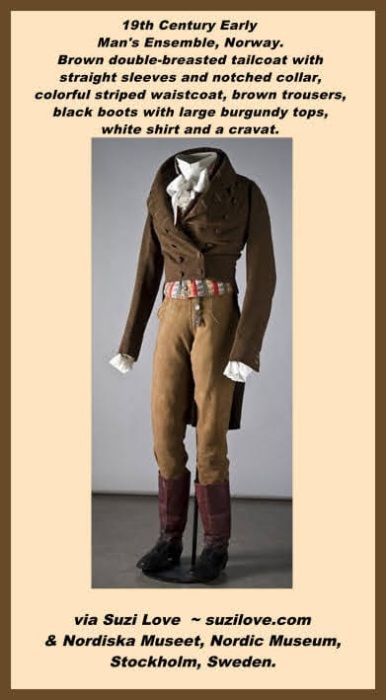
1814 Gentleman’s Ensemble, French. Gentleman in brown tailcoat, white vest, high collared white shirt, knotted white cravat, white pants and white gaiters above black shoes. The style of outfit worn by the men in Jane Austen’s life. Fashion Plate via Journal des Dames et des Modes, or Costume Parisien.
1795-1812 ca. Lord Nelson’s Vice-Admiral Undress Coat. Blue cloth tail coat, double breasted, nine gilt buttons on each lapel., two rows gold lace each sleeve with three buttons between, three buttons below each pocket flap, two buttons on skirt pleats, narrow band of wool cloth and two eyelet holes on shoulders to attach epaulettes, fastened edge to edge with three hooks and eyes, four embroidered stars of Nelson’s orders on left, Order of the Bath, Order of St Ferdinand Merit, Order of Crescent, Order of San Joachim. This is Nelson’s Trafalgar Coat worn by Nelson (1758-1805) at Battle of Trafalgar with bullet hole on left shoulder, close to epaulette. Damage to epaulette and blood stains on tails and left sleeve. National Maritime Museum, Greenwich, London, U.K. www.rmg.co.uk
For most of Jane Austen’s life, Britain was involved in conflicts and wars across the world. The Napoleonic Wars only ended in 1815, just two and a half years before Austen died. During her childhood, Britain was fighting the American Revolutionary War and when she was 14 years old, the French Revolution upset traditional roles of the monarchy, aristocracy and landed gentry in Britain, France and many other European countries.
1806 Silver and silver-gilt vinaigrette, Birmingham, England. Commemorating the Battle of Trafalgar in 1805. Rectangular with a hinged lid and a suspension loop. Gilded, pierced inner cover depicts HMS ‘Victory’ in relief inscribed ‘VICTORY’, ‘TRAFALGAR OCT 21 1805’. Via National Maritime Museum, Greenwich, London, U.K.
Vinaigrettes were used from the late 18th century through the 19th Century to revive a person who had fainted, having the vapors, or to mask unsanitary odors. Small containers, often a silver hinged box, held a tiny sponge dipped in an aromatic substance which had been dissolved in vinegar. The sponge was held beneath a grill or perforated cover so, by a flick of the fingers, the container was opened and the restorative substance held directly beneath a person’s nose. Jane Austen and her family and friends would have been very familiar with the use of vinaigrettes because Regency Era ladies were noted for having the vapors or fainting in hot ballrooms or dramatic situations. Ladies in the Romantic and Victorian Eras would have used them when tightly laced corsets became popular and ladies fainted because they were unable to draw in enough oxygen.
Both men and women used vinaigrettes in the late 1700s when people encountered foul aromas on a daily basis, but by the 1820s vinaigrettes were mainly used by women.These tiny containers were carried in a pocket, a reticule or bag, or suspended from the waist by chains as part of a chatelaine. Their sterling silver interiors were gilded to prevent discoloration from the acetic acid. Birmingham produced 90% of England’s silver vinaigrettes. As gold wasn’t affected by vinegar, craftsmen created some elaborate and decorative boxes on the container’s exteriors.
1800s A Young Lady Riding and Carriage Driving, England. #Riding #Regency #Victorian #Cartoon From: 1860 Mr. Sponge’s Sporting Tour by Robert Smith Surtees. via Google Books (PD-100)
A Lady On The Hunt Riding Side-Saddle. From: 1860 Mr. Sponge’s Sporting Tour by Robert Smith Surtees. via Google Books (PD-100) suzilove.comA bold young man kissing a young lady at the hunt. via 1860 Mr. Sponge’s Sporting Tour By Robert Smith Surtees. via Google Books (PD-150) suzilove.com1860 Rebellious Lady driving and smoking a cigar.via 1860 Mr Sponge’s Sporting Tour by Robert Smith Surtees via Google Books (PD-100)1860 A Day at the Turf. Lady riding side-saddle with gentleman. From- 1860 Mr Sponge’s Sporting Tour by Robert Smith Surtees. via Google Books (PD-100) suzilove.comA lady and a gentleman in a carriage. Lady driving and smoking. via 1860 Mr. Sponge’s Sporting Tour by Robert Smith Surtees. via Google Books (PD-100) suzilove.com
1807 Cotton Linen Shirt, British. Non-regulation shirt worn under uniform. High collar to allow room for a stock, fullness and pleated sleeves enable wearer to fit into tight arms popular in coats. The men in Jane Austen’s life would have worn a shirt like this, especially if they were in the military as many men were during the Napoleonic Wars. via Royal Museums Greenwich collections.rmg.co.uk