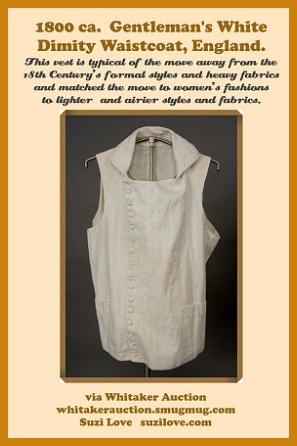
1800 ca. Gentleman’s White Dimity Waistcoat, England. This vest is typical of the move away from the 18th Century’s formal styles and fussy fabrics and matched the move of women’s fashions towards lighter and airier styles and fabrics. via Whitaker Auction whitakerauction.smugmug.com
Jane Austen Men’s Waistcoats: Waistcoats worn at the very beginning of the early 19th century generally had a straight bottom, double-breasted and with wide lapels. Not long after this, waistcoats began to be cut higher up to the waist in front so men during Jane Austen’s lifetime would have worn both styles.
Michael Brandon travels to introduce the woman he loves to family but is shocked when his missing brother, presumed dead for years, arrives at the country estate of the Duke Of Sherwyn where several people are stranded due to a severe snow storm. https://books2read.com/suziloveDS December Scandal, Book 3, Scandalous Siblings.
1805-1820 ca. Combination Shoe and Patten, Or Overshoe. Raises foot off the ground but still elegant enough to be genteel. Very practical but not to everyone’s taste. When Jane Austen and her family and friends went walking in the country, the ground was often very wet due to England’s high rainfall and snowfall so pattens were used to keep shoes and the hems of clothing out of the mud.
Only one of this pair of shoes survives. It effectively combines shoe and patten (overshoe) in one, so raising the foot off the ground but remaining sufficiently elegant to be considered genteel. This type of shoe was very practical but not to everyone’s taste. In 1840 The Shoemaker described it as going out of fashion partly because it looked ‘masculine for the chaster taste of the wearer’. via Victoria and Albert Museum, London, UK. collections.vam.ac.uk
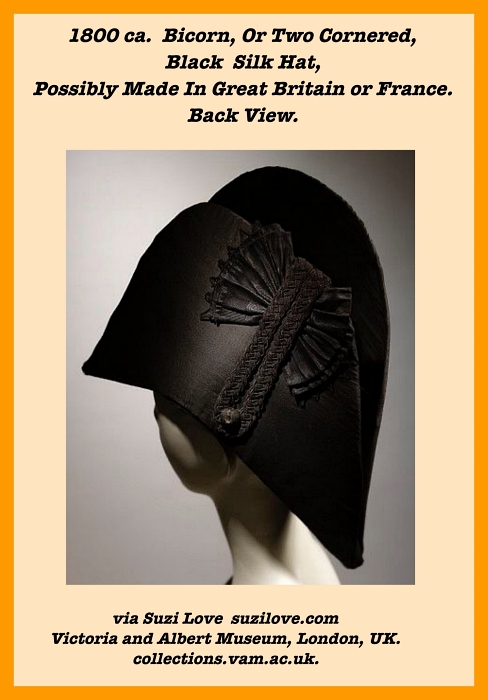
1800 ca. Bicorn, Or Two Cornered, Black Silk Hat, Possibly Made In Great Britain or France. via Victoria and Albert Museum, London, UK. collections.vam.ac.uk. The type of hats worn by the men in Jane Austen’s family around the turn of the century.
Definition: Bicorn Or Bicorne: Two cornered, or pointed, hats often worn by military men because the rain would drain off either side of the hat and away from the body. They could also be easily flattened to carry under arm.
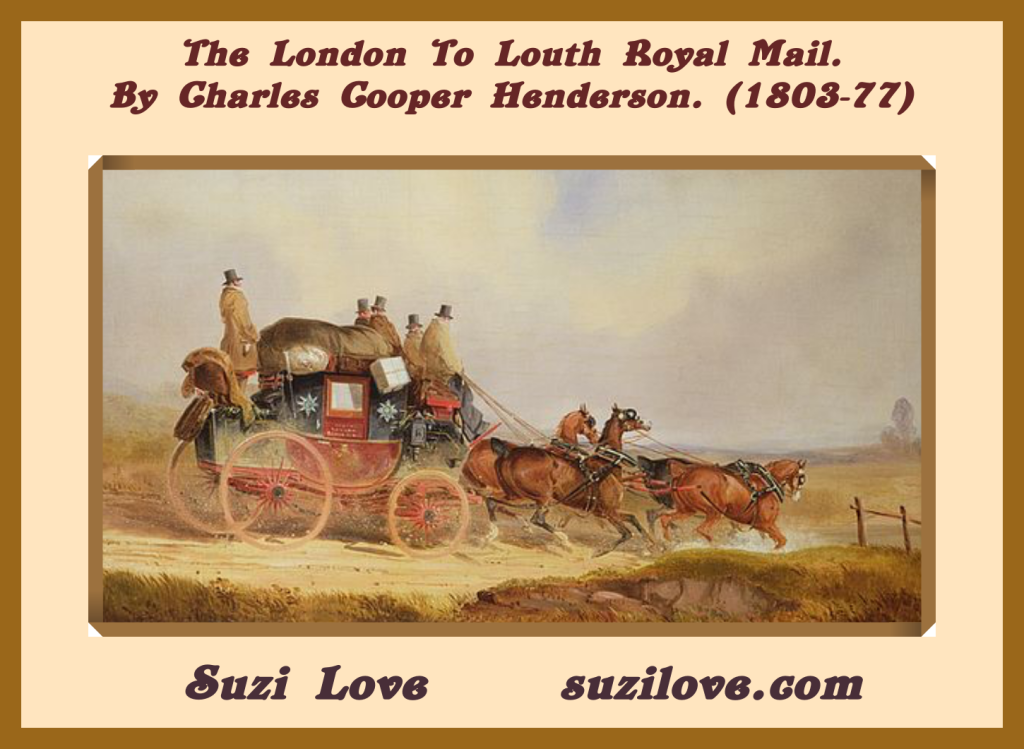
The London To Louth Royal Mail, England, U.K. Print by Charles Cooper Henderson. (1803-1877)
How did Jane Austen and her family? Did they go by stagecoach? The dreadful condition of British roads caused great apprehension to all classes of travelers. Making a journey anywhere in the country was a big undertaking and often a gentleman composed his last will and testament before his departure. Traveling in vehicles was only possible during the day or on the nights with very bright moonlight with few vehicles attempting road travel in winter and any travel on a Sunday was frowned upon. books2read.com/SuziLoveTravel
Description of Stage Coach Travel in England. via 1815 Journal Tour of Great Britain. “The gentlemen coachmen, with half-a dozen great coats about them, immense capes, a large nosegay at the button-hole, high mounted on an elevated seat, with squared elbows, a prodigious whip, beautiful horses, four in hand, drive in a file to Salthill, a place about twenty miles from London, and return, stopping in the way at the several public-houses and gin-shops where stage-coachmen are in the habit of stopping for a dram, and for parcels and passengers on the top of the others as many as seventeen persons. These carriages are not suspended, but rest on steel springs, of a flattened oval shape, less easy than the old mode of leathern braces on springs. Some of these stage coaches carry their baggage below the level of the axletree.”
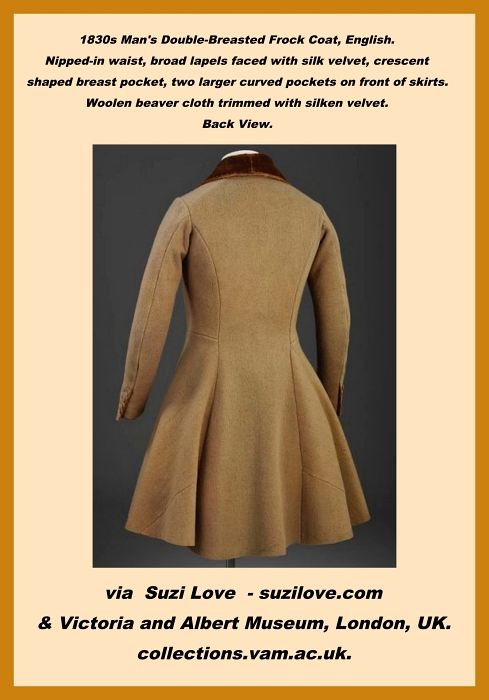
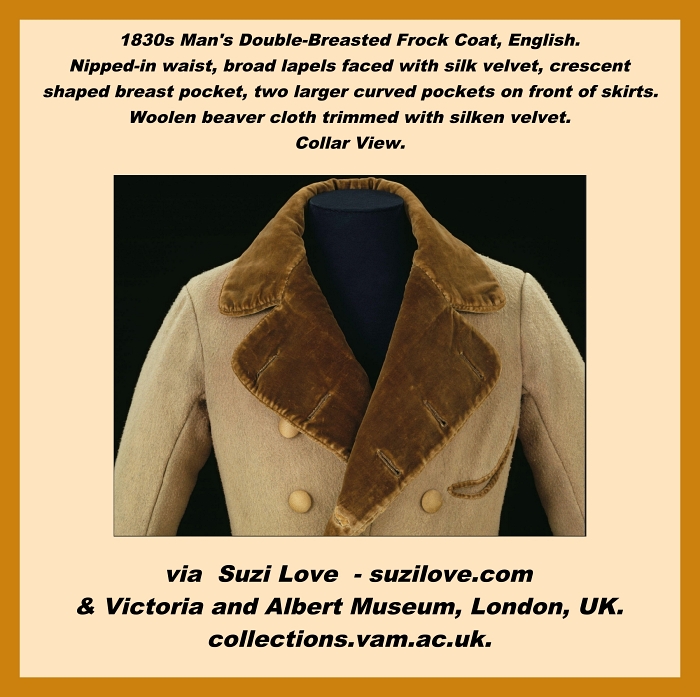
1830s Man’s Double-Breasted Frock Coat, English. Double-breasted frock coat with a nipped-in waist. The broad lapels are faced with silk velvet. This gentleman’s frock coat has a crescent-shaped breast pocket and two larger curved pockets on the front of the skirts. Woolen beaver cloth trimmed with silken velvet.
The waisted frock coat came into fashion in about 1816 and became an enduring style. Typically it had a narrow waist and full skirts hanging vertically in front. The frock coat was worn for everyday purposes such as morning dress, usually with a top hat, cane and trousers. By 1830 frock coats were made in a variety of designs according to taste, fashion or type of activity. This example has an out-breast pocket, a feature which appeared on coats during the 1830s. This coat was given by Messrs Harrods Ltd. Victoria and Albert Museum, London, UK. collections.vam.ac.uk.
1809 Women’s Fashions: Dresses, Shawls, Hats and Jewelry from various fashion magazines. Typical of the outfits worn by Jane Austen and her contemporaries for daytime and evening activities. An Empire style, or high-waisted white cotton dress worn under a Spencer or short jacket, a Redingote, or coat, for warmth and with pretty hats, shawls and shoes.