1802-1812 ca. Dancing Or La Dansomanie Series. Four women being instructed in dancing before a mirror by a master playing a violin. Le Bon Genre Description Plate 12. Via British Museum, London, UK. britishmuseum.org (PD-Art)
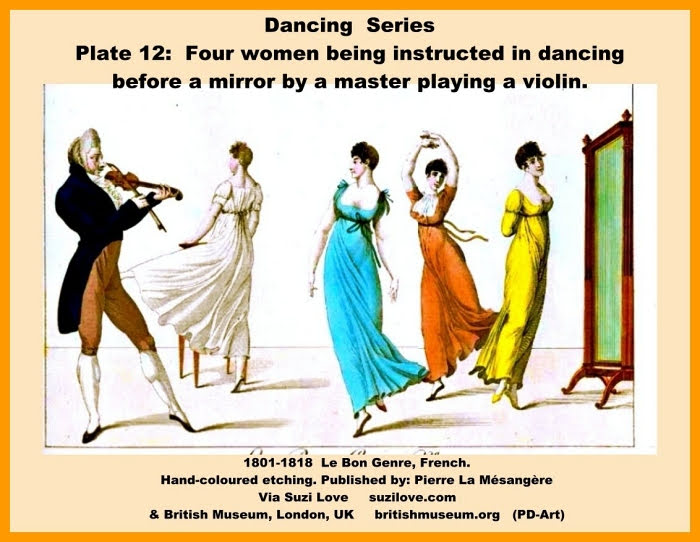


1802-1812 ca. Dancing Or La Dansomanie Series. Four women being instructed in dancing before a mirror by a master playing a violin. Le Bon Genre Description Plate 12. Via British Museum, London, UK. britishmuseum.org (PD-Art)
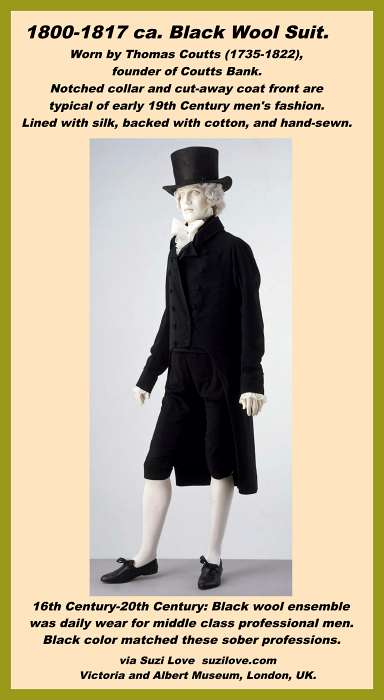
1800-1817 ca. Black Wool Suit, British. An ensemble made from black wool has been the uniform of the middle-class professional – doctor, lawyer, clergyman, academic, merchant, businessmen – since the late 16th century. This tradition continued through the 19th century and well into the 20th. The sombre color of this suit befits the sober profession of its wearer, Thomas Coutts (1735-1822), the founder of Coutts Bank. The notched collar and cut-away front of the coat reflect early-19th-century fashions. via Victoria and Albert Museum, London, UK. collections.vam.ac.uk. https://books2read.com/SuziLoveFashionMen1800-1819
This is the sort of suit that professional men in Jane Austen’s times would have worn, doctors, lawyers and clergymen. https://books2read.com/SuziLoveFashionMen1800-1819

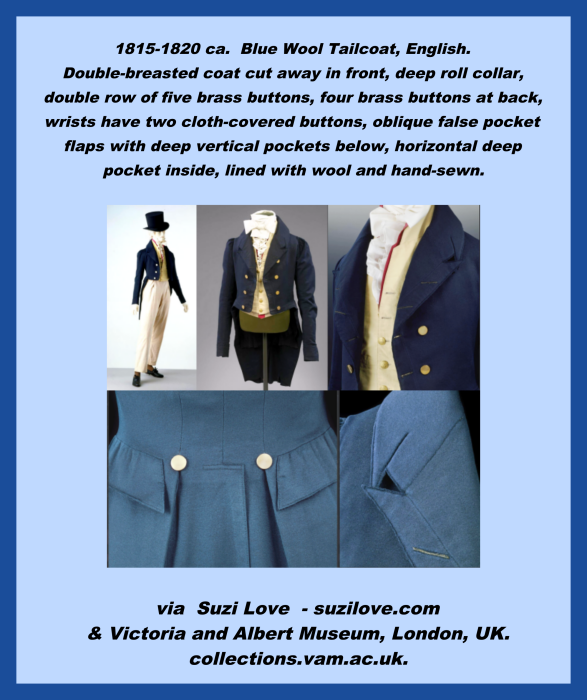
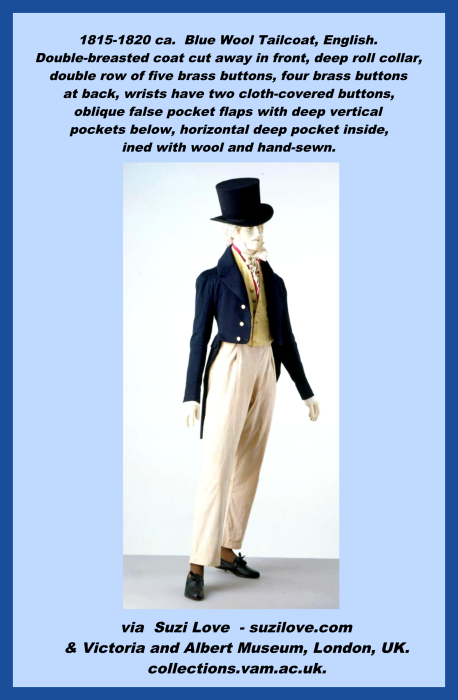
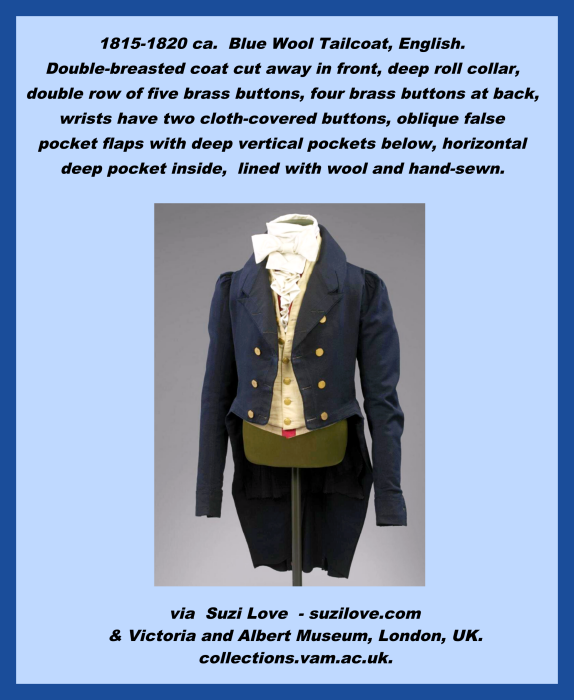
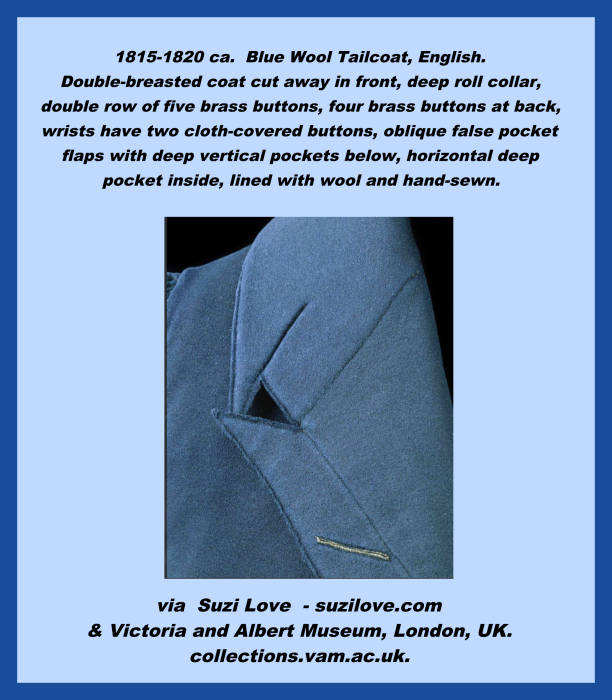
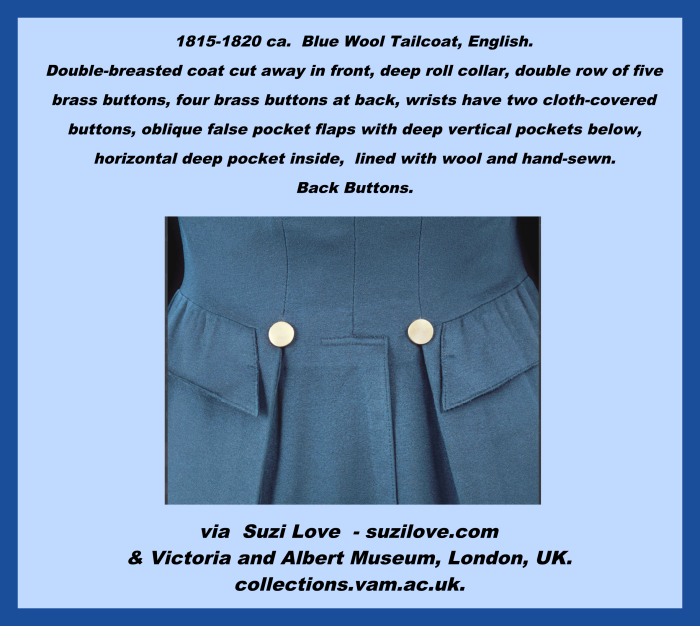
1815-1820 ca. Man’s Blue Wool Tailcoat, English. Chest View. Blue wool, lined with wool, brass buttons, and hand sewn. Double-breasted coat of blue wool, cut away in the front. With a fairly deep roll collar, a double row of five brass buttons, and four further brass buttons at the back. The wrists fasten with two cloth-covered buttons. With oblique false pocket flaps, one on each side, with deep pockets below them entered vertically, and another deep pocket inside entered horizontally. Lined with wool. Hand-sewn. Marks and Inscriptions: ‘Hammond Turner & Sons, Extra Superfine’ (Stamped behind the brass buttons) The cut-away coat remained formal daywear for men until the 1850s. This example has long tight sleeves, puffed at the shoulder, a style typical of the period 1815-1820. The roll collar has an M-shape notch, introduced about 1803, and a waist seam. via Victoria and Albert Museum, London, UK. Given by Lady Osborn.


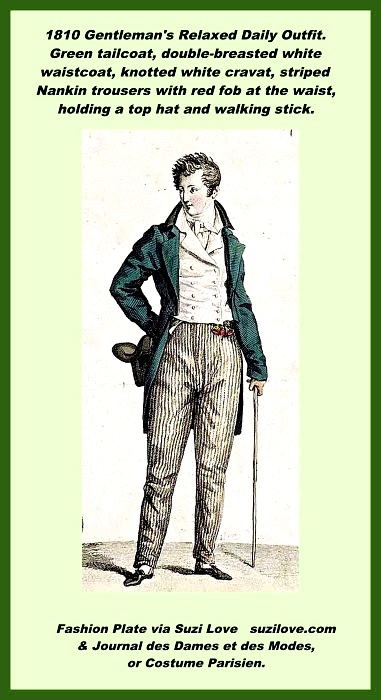
1810 Gentleman’s Relaxed Daily Outfit. Green tailcoat, double-breasted white waistcoat, knotted white cravat, striped Nankin trousers with straps under the foot and red fob at the waist, holding a top hat and a walking stick. Fashion Plate via Journal des Dames et des Modes, or Costume Parisien.
In the early 1800s, men no longer wore complicated styles and extravagant fabrics. Men’s fashion simplified and became more conservative. A well cut tailcoat, vest, pantaloons and an immaculate cravat of beautiful white linen in the style of George Bryan, or Beau, Brummell. Clothes were a status symbol and indicated a man’s social position. These clothing items were the sort worn by Jane Austen’s male family and friends.
1801-1818 ca. ‘Diablo, or devil on two sticks’. Lessons In The Devil Series Plate 55: Man teaching a woman how to play diabolo, or devil on two sticks. via 1801-1818 Le Bon Genre, French. Gentleman in blue tailcoat, high white shirt and cravat, pants and black shoes. Lady in white dress with high frilled neckline, long sleeves and wearing green walking boots. Hand-colored etching. Published by: Pierre La Mésangère. Via British Museum, London, UK britishmuseum.org (PD-Art)
Jane Austen and Games: In Jane Austen’s times, games were a part of daily life. Families played all sorts of games, indoors and outside, to pass the time, especially at house parties or family gatherings.
Diablo, Or Devil On Two Sticks: Double cone type of yo-yo that is twirled, spun, tossed and caught on a string attached to two hand sticks. The toy, or Diablo, is kept spinning by manipulating it back and forth along the string and by tossing into the air. Numerous tricks can be performed e.g. toss, trapeze, cat’s tail and the umbrella.


1808 April Trio of Two Men and a Woman in Full and Half Dress in the Directoire and Empire period, or the Regency Era, or the times of Jane Austen. Two varieties of men’s pants, one knee breeches and stockings and one long pants worn inside high boots. One wearing a Bicorn hat and the other holding a top hat and both with yellow gloves. Woman wearing a pink pelisse, or coat, over a white walking gown with a train and holding a parasol. via Le Beau Monde, or Literary and Fashionable Magazine, London, U.K.


1807 Fashionable French Couple. Man: Blue cutaway coat and yellow breeches. Lady: Lemon and blue dress and bonnet. This is the fashion styles worn by Jane Austen and her family and friends in the early 1800s. Fashion Plate via Journal des Dames et des Modes, or Costume Parisien.https://books2read.com/SuziLoveFashionMen1800-1819

1818 December 11th A dandy fainting or – an exquisite in fits. Scene a private box opera. A dandy lies back fainting in a chair, his limbs rigid, supported by three others while a fourth (left) draws the curtain, cutting off a view of the (distant) stage where a singer is posturing. Via British Museum, London, UK. britishmuseum.org (PD-Art)


1818 September ‘A Nice Gentleman’ By George Cruikshank. A grotesque dandy walks outdoors sucking a cane. Inscribed with names of food, e.g. red carbuncled rose is ‘Currant Jelly’, shallow broad-brimmed hat is ‘Calves Head Jelly’ and ‘Pancake’, cravat which covers neck, cheek and chin is ‘Puff Paste’, loose short trousers are ‘White Sugar Bags’, handkerchief ‘Blow Monge’ and long spurs ‘Gilt Gingerbread’. Via British Museum, London, UK. britishmuseum.org (PD-Art)


1818 ‘The Stamford Dandy or A Modern Peeping Tom’. Lord Stamford rides past a row of houses looking through his
glass at a woman who stands at an open first-floor window. Other women watch him from the two other windows. Dressed as a dandy with red tailcoat, high white collar and cravat, black top hat and wearing loose white trousers. Artist not known. Via British Museum, London, UK. britishmuseum.org (PD-Art)
