1805 Regency Group of Ladies and Gentlemen dressed as Jan Austen and her family and friends would have dressed. Ladies in dresses, bonnets, shawls, gloves, and carrying a reticule, or bag, and a parasol. Gentlemen in tailcoats, overcoats, trousers, vests, cravats, hats, boots and shoes and carrying walking sticks. via Men And Women In Costumes, 1804-1829. The Miriam and Ira D. Wallach Division, The New York Public Library, U.S.A.
1800 Elegant Young French Gentleman. Pulling on his top coat over a long tan coat. Tan gloves, brown hat, brown boots, cane. Fashion Plate via suzilove.com and Journal des Dames et des Modes, or Costume Parisien.
Overcoats: Called many names: Greatcoat, or Carrick, or Garrick, or Coachman’s, or Driving. Or Box Coat. Overcoats were voluminous and covered the other clothing. Usually with many capes, or collars, or pelerines covering the shoulders and with buttons down the front. Popular in the 19th century for riding, driving and travel as they kept the wearer warm and snow and rain off the body. Greatcoat: Overcoat with capes around the shoulders for men. Carrick or Garrick Coat: Other names for a gentleman’s inclement weather coat and worn for driving or travel.
1800 Elegant Young French Gentleman. Pulling on his top coat over a long tan coat. Tan gloves, brown hat, brown boots, cane. Fashion Plate via suzilove.com and Journal des Dames et des Modes, or Costume Parisien. https://books2read.com/SuziLoveFashionMen1800-1819
1806 Waiting For the St. Cloud Coach, Place de la Concorde, Paris. Illustrations by Francis Courboin. via Les Modes de Paris. (PD-Art) This couple is depicted waiting for the coach, which was a passenger vehicle drawn by four horses. The woman is wearing a fashionable hat or “capote” that covers her face. Her dress maintains the empire waist and has very long sleeves that also have a ‘mancheron’ or a gathered sleeve at the shoulders. The man is wearing a ‘habit du gagé’ or a coat with tails, buttoned at the waist. His hat is a ‘haut-de-forme’ or what is commonly known in English as a top hat. He wears tight, short pants tucked into large, riding boots, as was the fashion for men. Illustrations by François Courboin from Octave Uzanne‘s Les Modes de Paris. Variations du goût et de l’esthétique de la femme, 1797-1897, L. Henry May, Paris, 1898, or from the English translation of the same work: Fashion in Paris : the various phases of feminine taste and aesthetics from 1797 to 1897, William Heinemann, London, 1898. Modes de Paris VIa Brown University Library .
1806 Young French Gentleman. Blue tailcoat under a short brown Castorine coat, cream cashmere breeches, white stockings, yellow gloves, black top hat and a cane. Fashion Plate via Journal des Dames et des Modes, or Costume Parisien.
French fashions and Georgian and Regency Era fashions from Great Britain were copied around the world. This is the normal daily outfit for a gentleman in the early 1800s, or in the times of Jane Austen, for daily city and country life. https://books2read.com/SuziLoveFashionMen1800-1819
1805 ca. Leather Breeches, French. Buttoned and adjustable waist and narrow drop down front flap, back waist gusset for ease of movement, fitted cuffs on legs with many buttons to fasten and hold in place. via Metropolitan Museum New York City, U.S.A. metmuseum.org The style of men’s breeches worn by men at the end of the 1700s and early 1800s, or in Jane Austen’ lifetime.
1805 ca. Front Leather Breeches, French. Buttoned and adjustable waist, back waist gusset for ease of movement, front fall flap, two tone fitted cuffs on legs with many buttons to fasten and hold in place on the legs. via Metropolitan Museum New York City, U.S.A. metmuseum.org 1805 ca. Back Leather Breeches, French. Buttoned and adjustable waist, back waist gusset for ease of movement, front fall flap, two tone fitted cuffs on legs with many buttons to fasten and hold in place on the legs. via Metropolitan Museum New York City, U.S.A. metmuseum.org 1805 ca. Waist Fastening Leather Breeches, French. Buttoned and adjustable waist, back waist gusset for ease of movement, front fall flap, two tone fitted cuffs on legs with many buttons to fasten and hold in place on the legs. via Metropolitan Museum New York City, U.S.A. metmuseum.org 1805 ca. Front and Back Leather Breeches, French. Buttoned and adjustable waist, back waist gusset for ease of movement, front fall flap, two tone fitted cuffs on legs with many buttons to fasten and hold in place on the legs. via Metropolitan Museum New York City, U.S.A. metmuseum.org 1805 ca. Cuff Leather Breeches, French. Buttoned and adjustable waist, back waist gusset for ease of movement, front fall flap, two tone fitted cuffs on legs with many buttons to fasten and hold in place on the legs. via Metropolitan Museum New York City, U.S.A. metmuseum.org https://books2read.com/SuziLoveFashionMen1800-1819
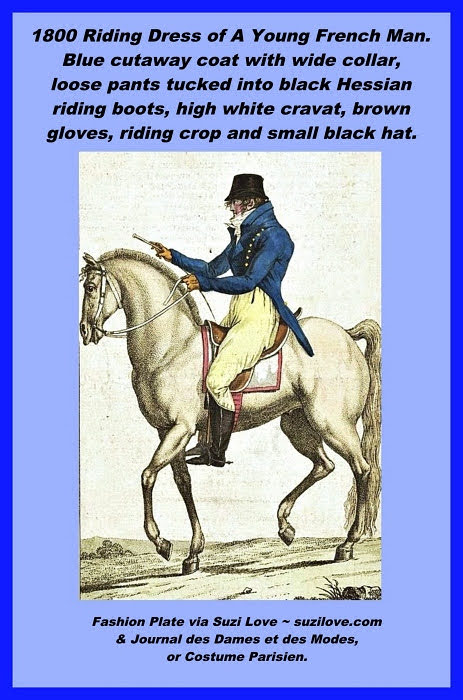
1800 Riding Dress of A Young French Man. Blue cutaway coat with wide collar, loose pants tucked into high black riding boots, high white cravat, brown gloves, riding crop and a very small black hat. Fashion Plate via Journal des Dames et des Modes, or Costume Parisien.
1800 Riding Dress of A Young FrenchMan. Blue cutaway coat with wide collar pants tucked into high black riding boots high white cravat gloves riding crop. Fashion Plate via Journal des Dames et des Modes, or Costume Parisien. https://books2read.com/SuziLoveFashionMen1800-1819
1804-1829 ca. Two Gentlemen and A Lady, Italian. Dressed as ladies and gentlemen would be in the times of the Bridgerton family and Jane Austen and friends. Gentleman in a caped overcoat with black top hat and red umbrella. Lady in walking costume of lavender cape over red dress, red shawl, white bonnet and black walking shoes. Gentleman in blue opera cloak with red lining, black top hat and black shoes. Men And Women In Costumes, 1804-1829 The Miriam and Ira D. Wallach Division, The New York Public Library. nypl.org The sort of fashionable outfit and items worn or carried by Jane Austen and her contemporaries when out walking. Outfits were always heavily accessorized with coats, shawls, hats and parasols.
1804-1829 ca. Two Gentlemen and A Lady, Italian. Gentleman in a caped overcoat with black top hat and red umbrella. Lady in walking costume of lavender cape over red dress, red shawl, white bonnet and black walking shoes. https://books2read.com/SuziLoveFashionMen1800-1819
19th Century Early Cotton Trousers, British. Buttons at waist, drop down front flap with buttons and cut with excess material to allow easy movement. via Metropolitan Museum New York City, U.S.A. metmuseum.org.
Trousers: In the early 19th century, trousers were sewn with a flap in front called a fall front and was held in place by two or three buttons. Trousers were held up by tight-fitting waists which were adjusted by gusset ties in back of the waist. Seats were baggy to allow a man to rise comfortably from a sitting position.
19th Century Early Cotton Trousers, British. Buttons at waist, drop down front flap with buttons. and cut with excess material to allow easy movement. via Metropolitan Museum New York City, U.S.A. metmuseum.org https://books2read.com/SuziLoveFashionMen1800-1819
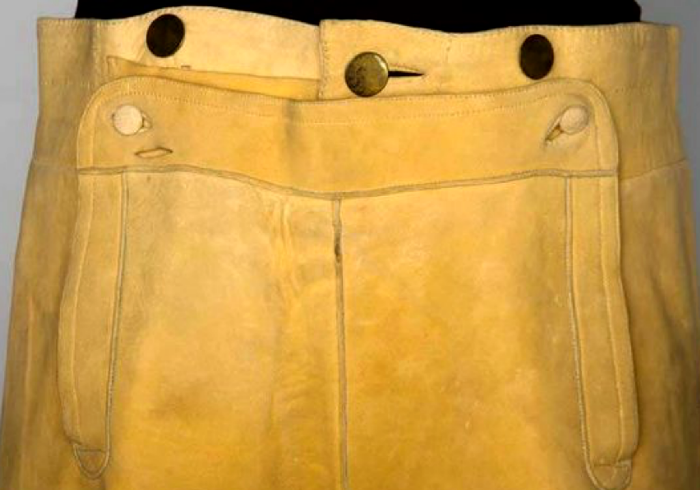
1790 British Consul’s Tan Leather Pants, Boston. Tan buckskin, fall front, brass and self covered buttons, breeches have leather ties at waist and at leg hems. via Augusta Auction ~ augusta-auction.com
1790 Closed Front Flap. 1790 Open Front Flap. 1790 Side View. 1790 Back Waist View. 1790 Front Waist View. RL_2_D2D_RetailerBuyLink_RL_2
https://books2read.com/suziloveYGD
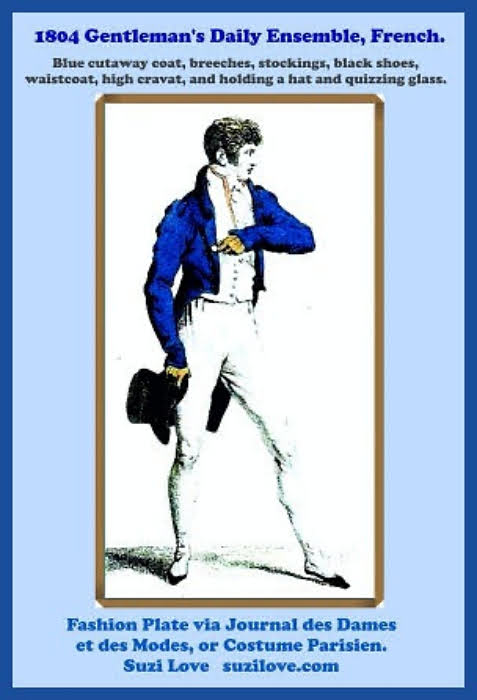
1804 Men’s Fashions In The Time Of Jane Austen. From the finish of the 18th century until 1820, men’s fashions in European and European-influenced countries moved away from the formal wear of brocades, lace, wigs and powder to more informal and relaxed styles. Focus was on undress rather than formal dress. Typical menswear in the early 1800s included a tailcoat, a vest or waistcoat, either breeches, pants, or the newer trousers, stockings, shoes or boots, all worn with an overcoat and hat. This basic ensemble was accessorized with some form of neckcloth or cravat, gloves, walking stick, cane or riding crop, handkerchief, fobs, watch and perhaps a quizzing glass or eye glass.
In 1806, the Journal des Dames et des Modes stated, ‘The informal outfit for a young man includes a coat of similar style, snug pantaloons which are probably knitted, and a striped waistcoat.’
Skirted coats were replaced with short-fronted, or cutaway, tailcoats worn over fitted waistcoats and plain, white linen shirts. Knee breeches were gradually replaced by tight-fitting pantaloons and later trousers, decorative shoes with buckles were replaced with a variety of boot styles, and fussy and ruffled neckwear gave way to intricately tied, white linen neck cloths. A Regency Era, or early 1800s, gentleman was outfitted in more practical fabrics, such as wool, cotton and buckskin rather than the fussy brocades and silks of the late 1700s.