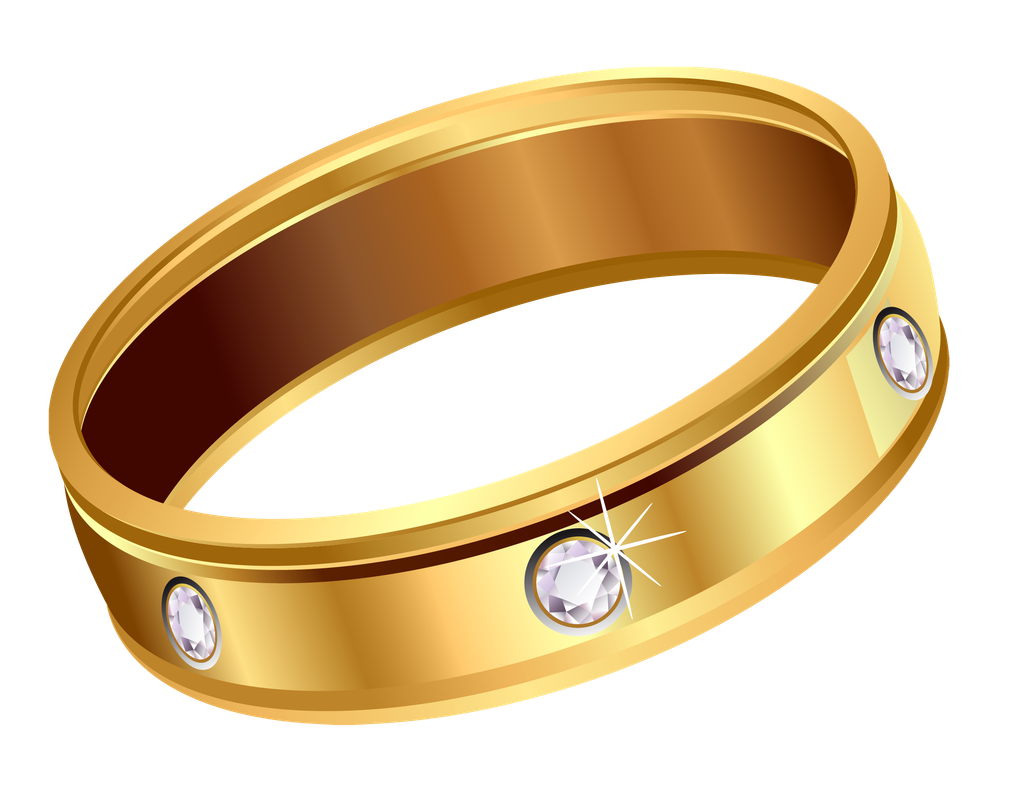
Wedding ring customs that originated in long ago history.
Betrothal ring – An old Roman custom confirming that the marriage contract would be carried out. It was the first part of a dowry given, and it meant the woman was no longer for sale as the first part of the monetary settlement had been paid.
Wedding ring – many primitive peoples who believed in magic used a rope around the waist or the hand and feet, and later a ring, to symbolise that the bride was captured and spoken for, and also to ward off any evil spirits hovering around the bride and ensure marital bliss.
The ring hand– a symbol of the humiliating tradition of the man as the master – the right hand of the family – and the woman being the slave . The right hand stood for power and authority while the left hand expressed submission and serfdom.
The ring finger – Ancient Greek and Roman anatomists believed a vein or nerve led from the heart to the third finger – the healing finger – so they romantically linked this finger to the heart. There are also some more practical reasons the third finger continues to be used. It’s the most prominent for displaying a ring, and it cannot be extended to its full length on its own and usually remains slightly bent, preventing the ring slipping off.
So next time you look at a wedding ring, you can think back to how it came to be on someone’s left third finger,
Rituals of courting and marriage from ‘How Did it Begin’ by R. Brasch first published in 1965. In the word ‘Wedlock’, the lock isn’t a lock and chain but the Anglo-Saxon for gift, as wed means a promise. Wedlock pledged the gift of the happiness of a man and a woman. Nearly all courtship rituals can be traced back to early practises designed to ensure the fertility of a union. Kissing is thought to have started because primitive man believed exhaled air had magic power.
Signing an X for a kiss began in the Middle Ages when people were illiterate and used an X to sign and would then kiss the parchment to affirm their sincerity, like kissing the Bible to take an oath. The word ‘Spooning’ to describe courting came for the custom of young men in Wales to carve an elaborate spoon to give as a love token to the girl of their choice in the place of an engagement ring. Leap year proposals by women to men were a rare chance for women to correct an unjust state of affairs, just as the extra day in a leap year was a topsy-turvy day, a leapt over day in other years. In a time when there was a surplus of women, it was a chance of ensuring they were not left on the shelf.
A sedan chair is a portable enclosed chair for a single passenger. It was generally carried by two “chairmen” holding poles attached to either side of the chair. Sedan chairs were fashionable in England and Europe during the 17th, 18th and early 19th centuries and were an important part of the social life of the times. They were very useful for negotiating crowded, unsafe, narrow, winding and often filthy streets and were particularly used by “invalids, ladies and party goers”. Sedan chairs had the advantage of being able to be carried up and down stairs and could deliver the passenger from inside their own home to inside their destination without having to step outside.
1784 Sedan Chair. ‘The return from a masquerade. A morning scene.’ A young lady dressed as shepherdess with staff slumps in a sedan chair. Asleep or drunk her head and shoulders hang outside window. Two porters smile and dwarf chimney sweep carries a mask.’ By Robert Dighton and Cari.
1784 Sedan Chair. ‘The return from a masquerade. A morning scene.’ A young lady dressed as shepherdess with staff slumps in a sedan chair. Asleep or drunk her head and shoulders hang outside window. Two porters smile and dwarf chimney sweep carries a mask.’ By Robert Dighton and Cari.
The 19th century English author, Elizabeth Gaskell, described the use and function of the sedan perfectly in her novel “Wives and Daughters” when she reminisced how the Browning sisters chose to be transported to a ball by sedan chair, which ‘came into the parlor, and got full of the warm air, and nipped you up, and carried you tight and cosy into another warm room, where you could walk out without having to show your legs by going up steps, or down steps.’
The Bath Chair was invented in Bath, England, in the mid 18th Century to transport the wealthy and the sick around the city. It could be steered by the passenger and rivaled and then outdid the Sedan Chair as only one chairman was needed to operate it. The last Bath Chairman retired in 1949.
Typical 1700s, or Eighteenth Century Sedan Chair. Portable enclosed chair for single passenger usually carried by two chairmen holding poles attached to either side of chair. Fashionable during 17th, 18th and early 19th centuries when needed to negotiate crowded, unsafe, narrow, and dirty streets. Used by invalids, ladies and party goers. The sedan chair comprises a small kiosk with a curved timber roof which is covered with leather and studded with brass nails. The front and side panels are painted in green with floral decorations of cherubs and flowers. The back panel is of plain timber. Access to the chair was via a hinged door at the front. Inside, the chair is upholstered in silk and features padded upholstered arm rests. The windows have raw silk curtains which are gathered with tassels. The present brackets and poles are reproductions made in 1986 prior to display in the Transport exhibition. The total length of the new poles are 80 inches. The sedan chair door lock features the initials “V.F.” and a set of crossed keys with the wording “PARIS” and the number “34”. Via Powerhouse Museum, Sydney, Australia.
Typical 1700s, or Eighteenth Century Sedan Chair. Portable enclosed chair for single passenger usually carried by two chairmen holding poles attached to either side of chair. Fashionable during 17th, 18th and early 19th centuries when needed to negotiate crowded, unsafe, narrow, and dirty streets. Used by invalids, ladies and party goers. The sedan chair comprises a small kiosk with a curved timber roof which is covered with leather and studded with brass nails. The front and side panels are painted in green with floral decorations of cherubs and flowers. The back panel is of plain timber. Access to the chair was via a hinged door at the front. Inside, the chair is upholstered in silk and features padded upholstered arm rests. The windows have raw silk curtains which are gathered with tassels. The present brackets and poles are reproductions made in 1986 prior to display in the Transport exhibition. The total length of the new poles are 80 inches. The sedan chair door lock features the initials “V.F.” and a set of crossed keys with the wording “PARIS” and the number “34”. Via Powerhouse Museum, Sydney, Australia.
The longest journey recorded in a sedan chair was made by Princess Amelia, youngest daughter of King George III, who in 1728 was carried by 8 chairmen working in reliefs from London to Bath, a distance of 172 kms (107 miles). This sedan chair door lock features the initials “V.F.” and a set of crossed keys with the wording “PARIS” and the number “34”.
HN_10_D2D_RetailerBuyLink_ History Notes Book 10 books2read.com/SuziLoveTravel
Almack’s Assembly Rooms often appear in Regency Era romances as they were a well known gathering place for those in the Ton looking for wives or husbands. 1770-1840 . Almack’s or Willis’s Rooms, King Street, St James, London, UK. Almack’s Assembly Rooms, founded by William Almack at No. 26-28, were on the site of the present Almack House. The club was originally a gaming establishment but moved from Pall Mall. The Assembly rooms were on the South side of King Street in St James’s and were opened on February 12, 1765. At the time the subscription was ten guineas for which there was a ball and supper each week for the twelve weeks of the season.
Assemblies were held on Tuesdays and Thursdays, but only four or five times a season. Dates were listed in the paper along with the names of the Patronesses. When Lady Jersey took over Almack’s around 1815, assemblies were changed to Wednesdays. Many aristocrats were reportedly offended by something that happened at Almack’s but Lord Jersey is reported to have refused to duel over any inferred slights because it would have meant he was forever involved in a duel. The other well-known Patronesses were Lady Bathurst and Lady Downshire.
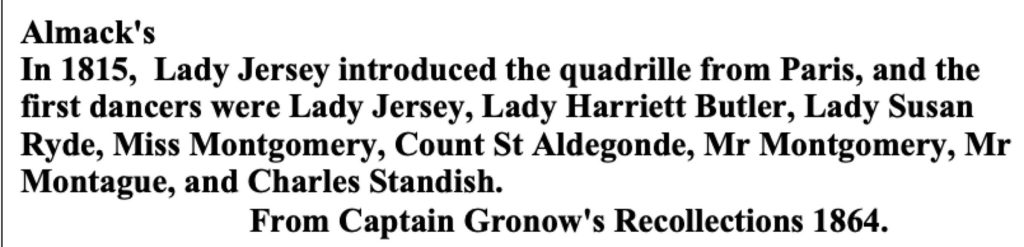
1826 Almack’s Revisited by Charles White.: ‘It was what most correct persons called ‘horrid bad Almack’s’. #RegencyEra #London #BritishHistory1817 April Ladies’ Voucher for all the Wednesday balls at Almack’s in April 1817. via The Huntington Library, San Marino, California, U.S.A.1815 The First Quadrille at Almack’s Assembly Rooms, London. Left to Right: Marquis of Worcester, Lady Jersey, Clanronald MacDonald and Lady Worcester. “It was not until 1815 that Lady Jersey introduced from Paris the favourite quadrille, which has so long remained popular. I recollect the persons who formed the very first quadrille that was ever danced at Almack’s: they were Lady Jersey, Lady Harriett Butler, Lady Susan Ryde, and Miss Montgomery; the men being the Count St Aldegonde, Mr Montgomery, Mr Montague, and Charles Standish.” From The Reminiscences of Captain Gronow 1810-1860.
1765-1840 ca. Almack’s, or Willis’s, Assembly Rooms, South Side Of King Street, St James, London. commons.wikimedia.org
1800s Early Exterior of Almack’s Assembly Rooms, London, UK.
Captain Gronow, an army officer in London around 1814, wrote about the rules of Almack’s in Captain Gronow’s Recollections and Anecdotes, 1864 , but only gives his views on a few years of Almack’s history.
In 1814, the dances were Scotch reels and the old English country-dance; and the orchestra, being from Edinburgh, was conducted by the then celebrated Neil Gow. From Captain Gronow’s Recollections 1864.Screenshot
1800s Almack’s Assembly Rooms, London, and Regency Vouchers in Jane Austen and Bridgerton years. #JaneAusten #Bridgerton #regencyera #almacks #london books2read.com:suziloveYLD
The Assembly Rooms in Bath, UK. One of my favorite places to visit.
Bath had two assembly rooms in the lower part of the town but they weren’t large enough for the rapidly increasing population so on the 30th September, 1771, New Rooms were opened on the north east of the Circus, between Bennett and Alfred Streets. These Upper Rooms were designed by the architect, John Wood, and were in a better part of town so they became much more fashionable. They were called the New, or Upper Rooms, to distinguish them from the older Assembly Rooms in the lower part of the town.
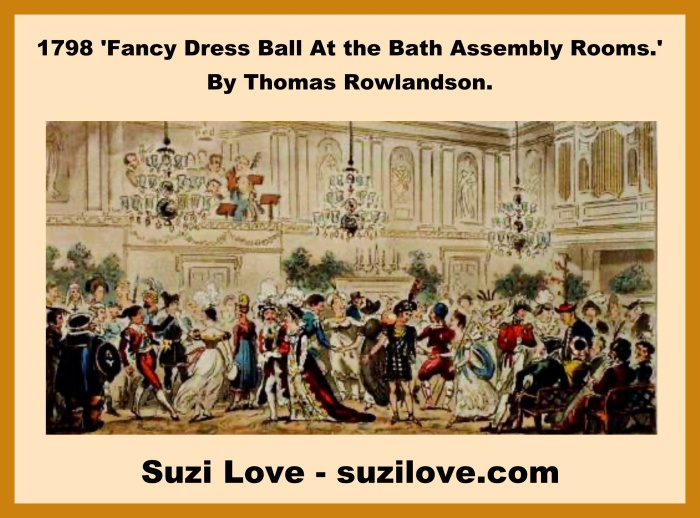
They were a set of public rooms purpose-built for the 18th century form of entertainment called an ‘assembly‘, where a large number of people came together to dance, drink tea, play cards, listen to music, or parade around the rooms and talk and flirt. The four rooms are the Ball Room, the Tea Room or Concert Room, the Octagon Room, and a Card Room. The Upper Rooms held two balls a week, a dress ball on Monday evenings and a fancy ball on Thursdays during the Bath season which was from October to early June. These balls were so popular they attracted between 800 and 1,200 guests at a time.
John Wood raised the money for the New Rooms by a “tontine” subscription, which was like a lottery. By April 1769, £14,000 was raised amongst 53 people. When a subscriber died, their shares were added to the holdings of the other subscribers, which meant that the last surviving subscriber inherited everything.
The exterior of the Upper Assembly Room looks typically Georgian, but the interior is very grand and the high ceilings gave good ventilation on crowded ball nights and windows set at a high level prevented outsiders from looking in. Two long rectangular rooms flank the entrance hall and are linked by an octagonal room at the far end to form a U-shape.
1798 Fancy Dress Ball at the Bath Assembly Rooms.’
By Thomas Rowlandson.Interior of Assembly Rooms, Bath.Entrance to Assembly Rooms,
Now Fashion Museum.
Bath, U.K.Entrance to Assembly Rooms,
Now Fashion Museum.
Bath, U.K.1805 Interior of Concert Room, Bath. By John Claude Nattes
‘Bath Illustrated by a Series of Views.’
Via Suzi Love – suzilove.com
& Wikimedia Commons commons.wikimedia.org1799 Richard Nash Esq. Master of Ceremonies, Assembly Rooms, Bath From- 1799 The New Bath Guide Printed by R. Cruttwell.1771 The New Assembly Rooms Opened,
Between Bennet and Alfred streets,
Bath, U.K.
via Suzi Love – suzilove.com
& 1835 The Historical and Local New Bath Guide
Published By C. Duffield.
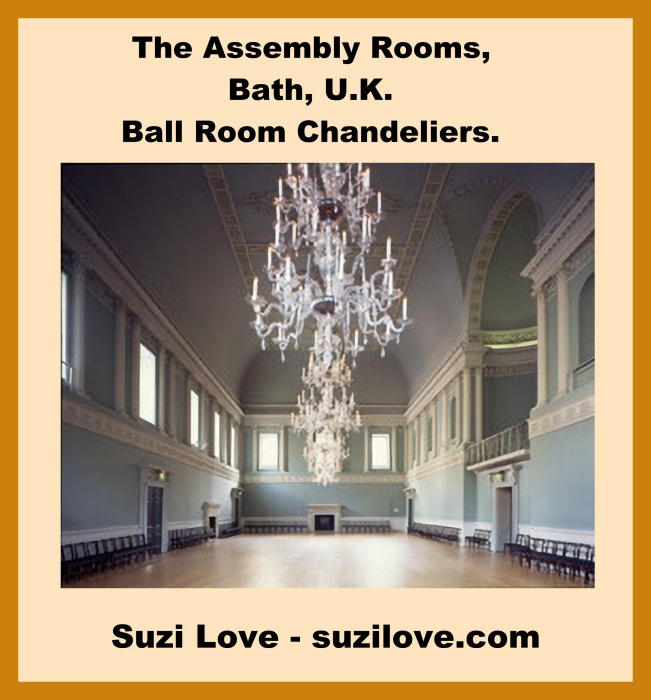
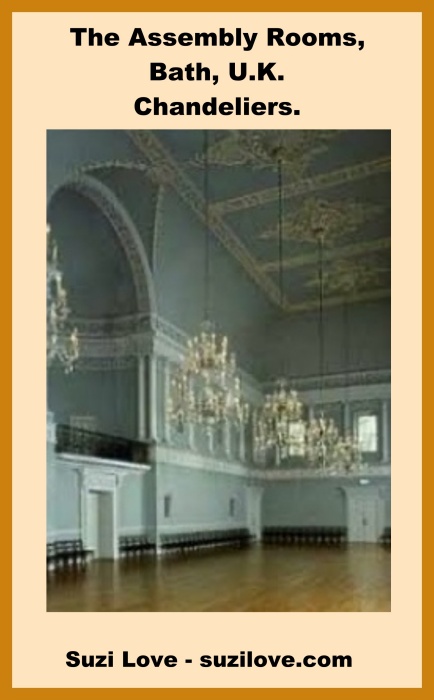
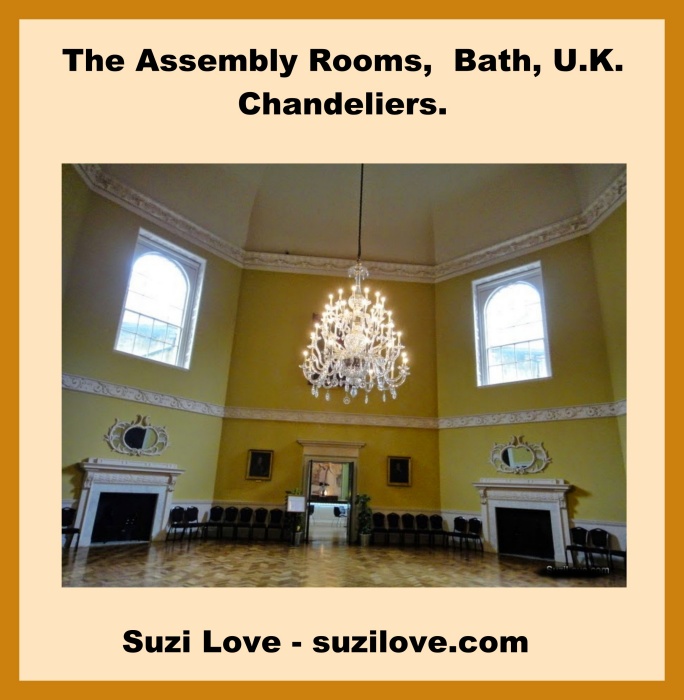
The Assembly Rooms are lit by a set of nine chandeliers, made for the building in 1771. Jonathan Collett of London originally provided a set of five chandeliers for the Ball Room when it opened in September 1771. Shortly afterwards the arm of one of the chandeliers fell off – narrowly missing the artist, Thomas Gainsborough, who lived nearby at the time. The Ball Room chandeliers were taken down and a new set was ordered from William Parker of London. Parker had already supplied three chandeliers for the Tea Room. It was agreed that Jonathan Collett should salvage the rejected set of Ball Room chandeliers and make one large chandelier to hang in the Octagon Room. The chandeliers in the three rooms had an average height of eight feet and they were made of Whitefriars crystal from the Whitefriars Glassworks in London and were originally lit by candles. The Ball Room and Tea Room chandeliers each had 40 lights and the Octagon chandelier had 48 lights.
During the 19th century, they were fitted for gas and were later converted to electric light. At the start of the Second World War, the chandeliers were put into storage and escaped destruction when the Assembly Rooms were bombed in 1942. During the extensive refurbishment of the building in 1988-1991, the chandeliers were restored by R. Wilkinson & Sons of London. The Bath Season ran from October to June. As the Season spanned the winter months and many activities took place in the evening it was essential to provide good artificial lighting.
The ball room is the largest of the three main rooms and is over 105 feet long and 42 feet wide and 42 feet high. It runs the whole length of the north side of the building and covers two storeys. The paint is called Ballroom Blue and was first created by David Mlinaric in the 1970s from an original colour swatch. “It is a stroke of luck that the colour sample of blue paint is still attached to the 1770s minute book of the Assembly Rooms Furnishing Committee.” said Lucy Powell, Assistant Archivist at Bath Record Office, “The building was bombed in 1942 so traces of the paint would never have survived otherwise.” From: Fashion Museum, Bath.
On the other side, the tea room is 70 feet long and 27 feet wide and all the rooms had huge chandeliers to give light. In 1777, a card room was added to the Octagonal Room. Before the Card Room was added, the Octagon Room became famous for card playing, the favorite leisure activity from the Georgian Era through to the Regency, as the Upper Rooms were open for card games every day except Sunday. The Octagon Room is dominated by Gainsborough’s portrait of the first Master of Ceremonies at the Upper Rooms, Captain William Wade. Bath’s most famous Master of Ceremonies, Richard “Beau” Nash, never knew this building as he died in 1761.
Bath_Octagon Room, The Assembly Rooms, Bath, U.K. Chandeliers. The Assembly Rooms,
Bath, U.K.
Ball Room Chandeliers. The Assembly Rooms,
Bath, U.K.
Chandeliers. The Assembly Rooms,
Bath, U.K.
Chandeliers. The Assembly Rooms,
Bath, U.K.
Chandeliers. The Assembly Rooms,
Bath, U.K.
Chandeliers. The Assembly Rooms,
Bath, U.K.
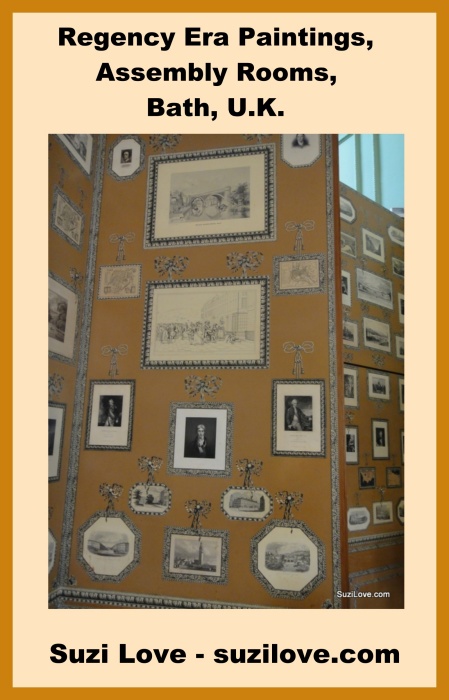
Chandeliers. Regency Era Paintings,
Assembly Rooms,
Bath, U.K.Regency Era Paintings,
Assembly Rooms,
Bath, U.K.Regency Era Paintings,
Assembly Rooms,
Bath, U.K.Regency Era Paintings,
Assembly Rooms,
Bath, U.K.
The tea room was used for refreshments, with tea generally served weak and black or perhaps with arrack and lemon, and on Wednesday nights during the Season concerts were held there. Fashionable visitors to Bath could also hold breakfasts there for their friends.
Many famous people visited the Assembly Rooms in the 18th and 19th centuries. Jane Austen and Charles Dickens both mention the Assembly Rooms in their novels and the diarist, Francis Kilvert, described a reception there in 1873. Subscription concerts were popular and many well-known musicians also visited, the most distinguished being Joseph Haydn, Johann Strauss the Elder, and Franz Liszt.
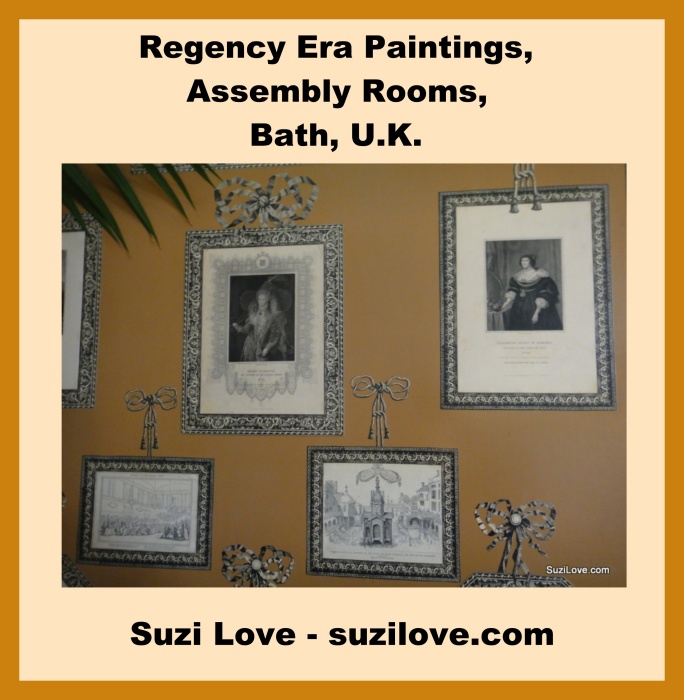
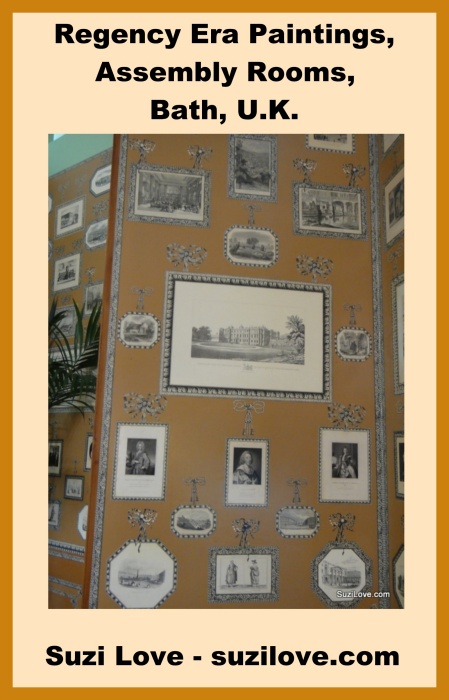
Today, the Octagon Room, the Tea Room, and the Cloak room Landings all showcase beautiful paintings and prints as the Upper Rooms were given to the National Trust in 1931. You can see paintings by Thomas Gainsborough and John Simmons as well as an Original ticket to the Thirteenth Dress Ball at the Assembly Rooms, 24 January 1803.
Since 1963, the Upper Assembly Rooms have also housed the amazing Fashion Museum. The building is owned by the National Trust and is leased by Bath & North East Somerset Council.
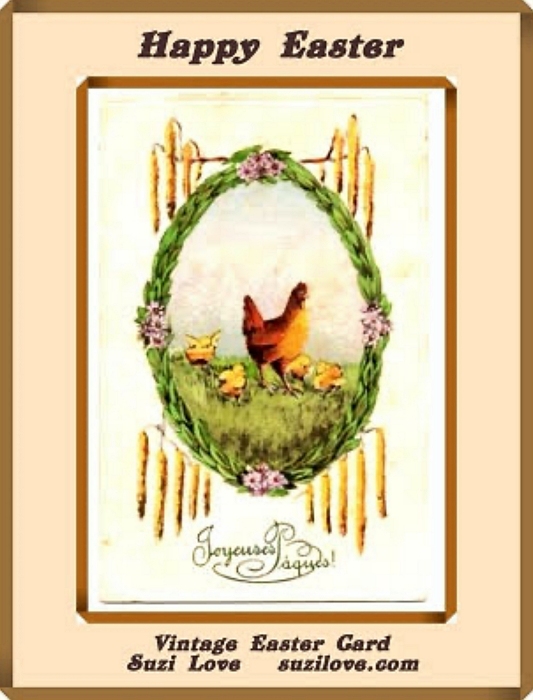
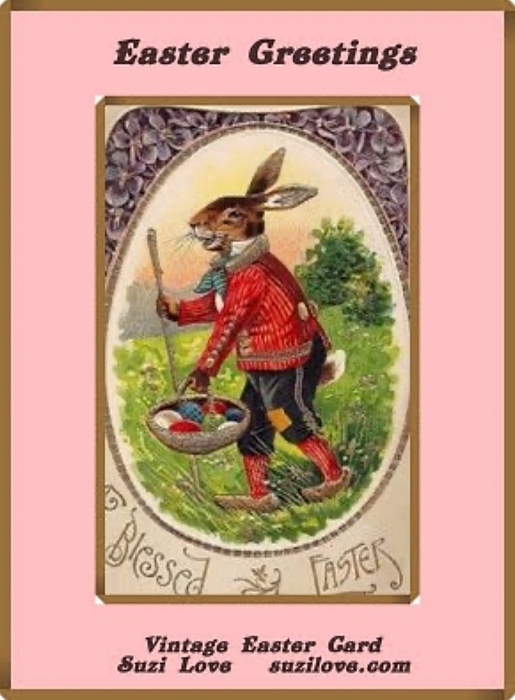
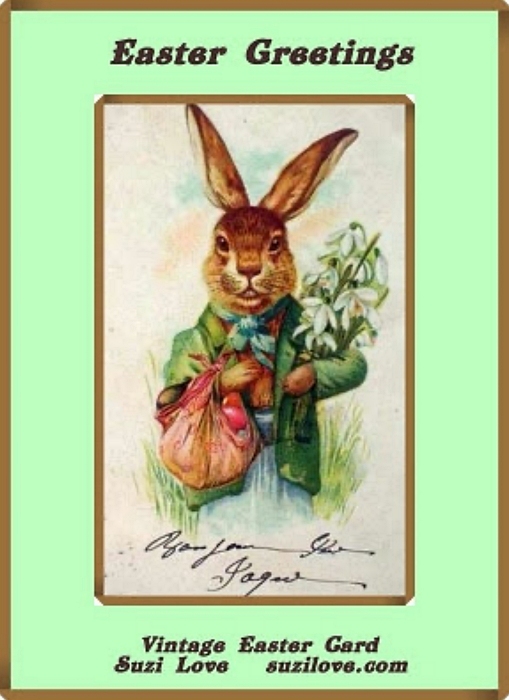
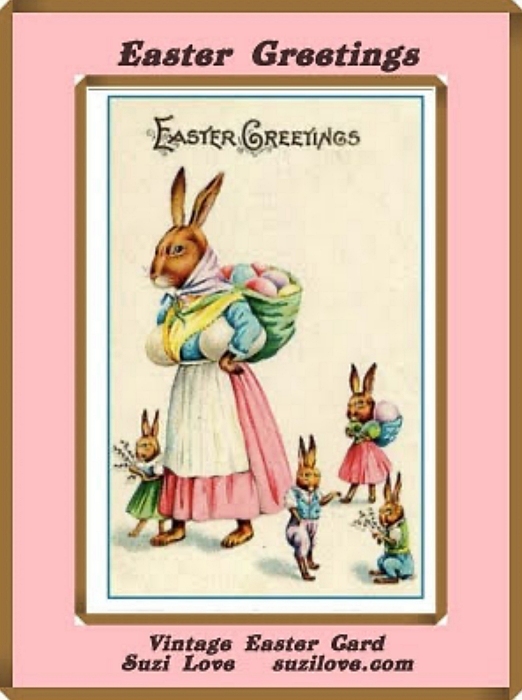
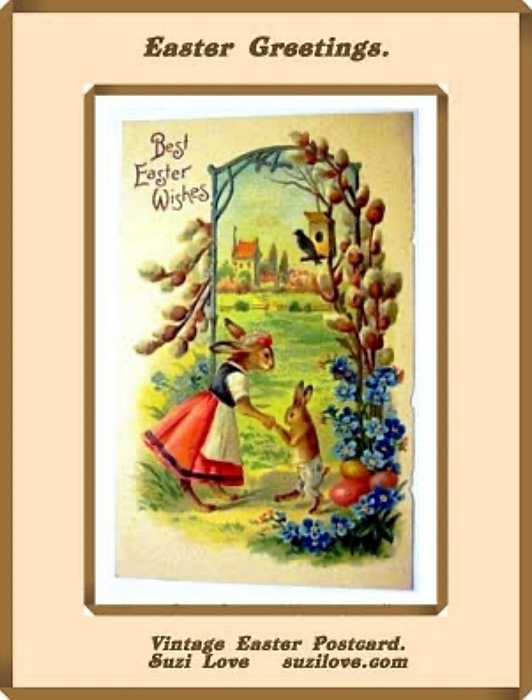
Ordinary people began to celebrate Easter by sending postcards as gifts. At first, mainly religious pictures appeared on postcards. Then postcards images became more about real life and people. In the early 1900s, postcards became more fanciful and pretty for young children. Religious images were gradually replaced by images that children could understand and relate to about Easter.
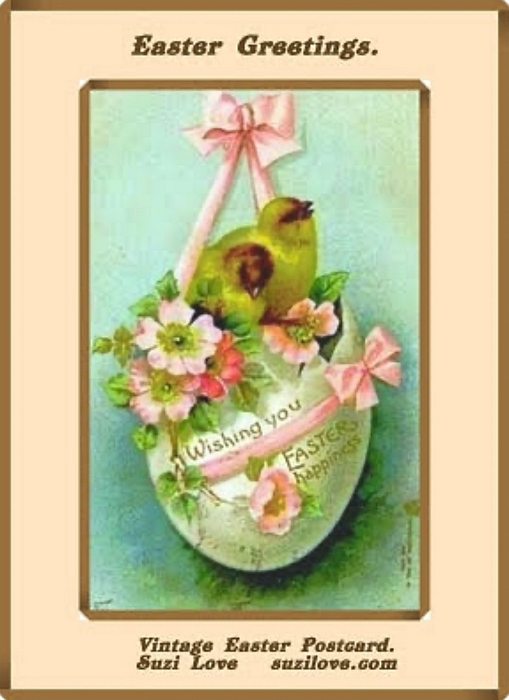
Postcards then concentrated on images of chickens and eggs, symbolic of birth and rebirth such as chickens emerging from cracked shells as Christ emerged from the tomb. Children were then added to the images so cards became for something for the whole family. Children with chickens and eggs became very popular on postcards. Bunny rabbits became associated with Easter and children could relate to these as it fitted with their idea of the Easter bunny.
Ellen Clapsaddle (1865 – 1934). An American illustrator from the late 19th and early 20th centuries and recognized as the most prolific postcard and greeting card artist of her time. Her greatest success was single-faced cards that could be kept as souvenirs or mailed as postcards. These cards were highly prized particularly during the peak of the golden age of souvenir postcards from 1898 to 1915. She is credited with over 1000 designs in post cards and souvenir cards. Cards in the mid 1900s were created to send personal Easter messages to loved ones such as mothers and fathers, grandparents, aunts and uncles and siblings. Artists from around the world began creating beautiful cards to share at Easter.
Jenny Eugenia Nyström (1854 – 1946) was a Swedish painter and illustrator who illustrated Easter postcards for, and about, children and happy ideas, especially European subjects.Jenny Nystrom (1884-1946)
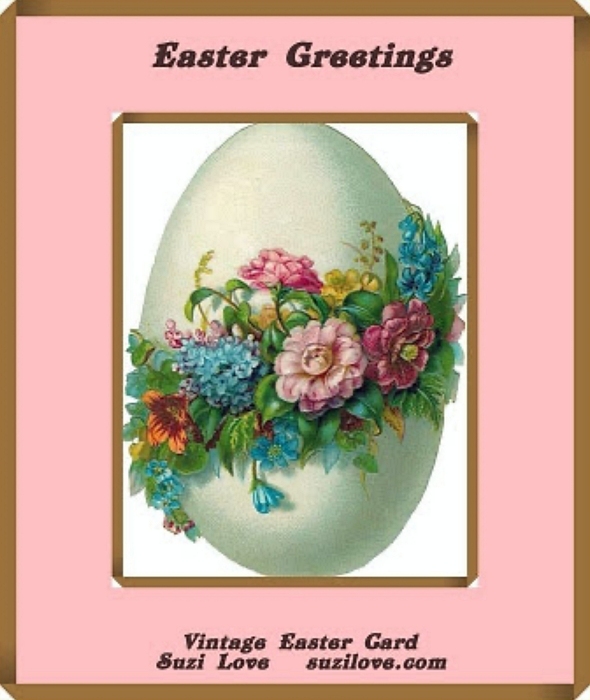
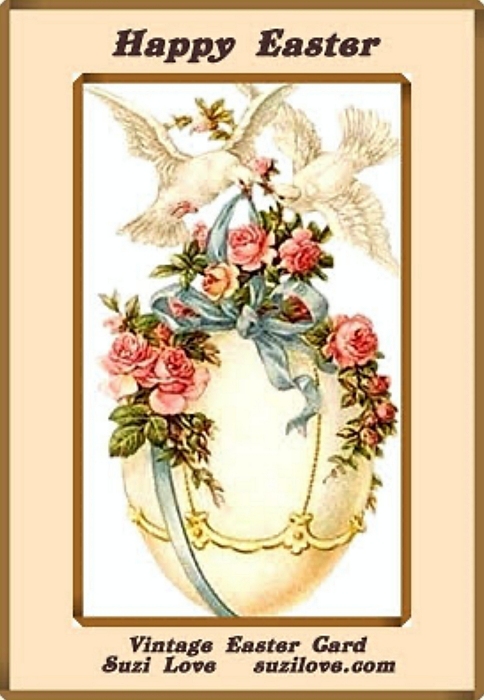
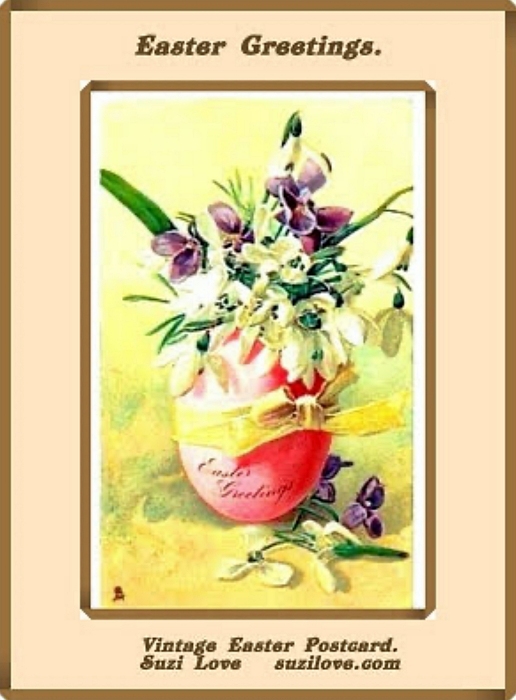
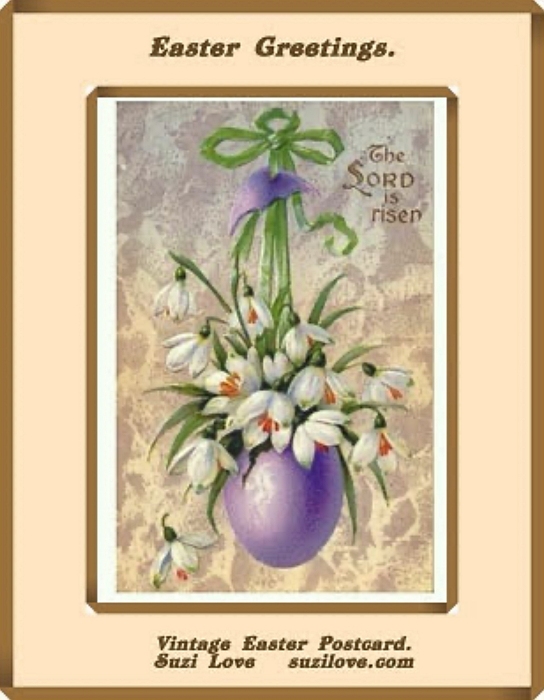
Egg With Flowers. Easter Greetings.
Suzi Love – suzilove.comEgg With Flowers. Easter Greetings.
Suzi Love – suzilove.comEgg With Flowers. Easter Greetings.
Suzi Love – suzilove.comEgg With Flowers. Easter Greetings.
Suzi Love – suzilove.comEgg With Flowers. Easter Greetings.
Suzi Love – suzilove.comEgg With Flowers. Easter Greetings.
Suzi Love – suzilove.comEgg With Flowers. Easter Greetings.
Suzi Love – suzilove.comEgg With Flowers. Easter Greetings.
Suzi Love – suzilove.com
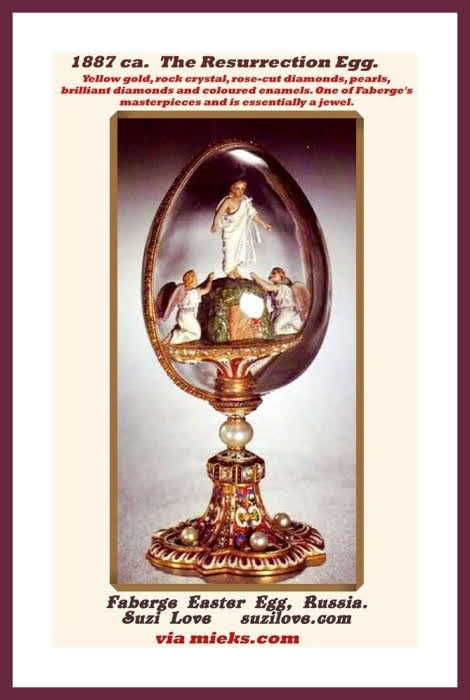
1887 Resurrection Imperial Faberge Egg. Yellow gold, rock crystal, rose-cut-diamonds, pearls, brilliant diamonds and various colored enamels. One of Faberge’s masterpieces and is essentially a jewel.
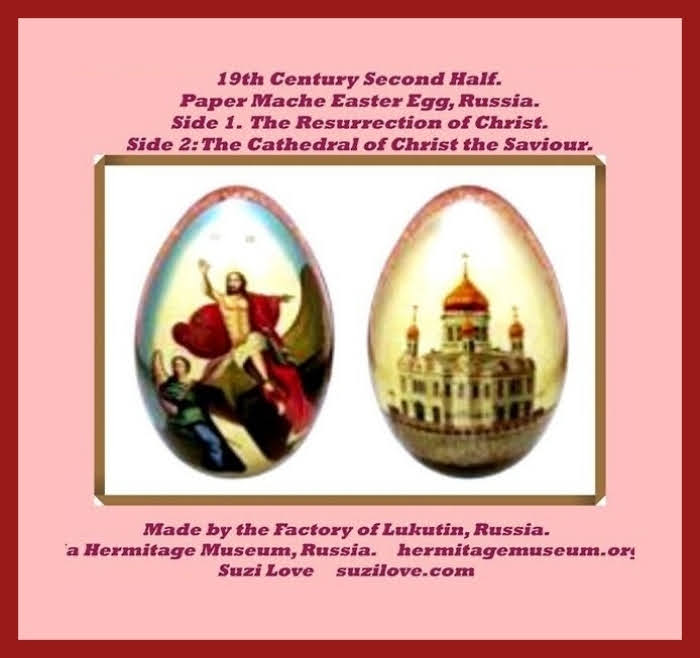
19th Century Second Half. Paper Mache Easter Egg, Russian.#Easter Resurrection of Christ, Cathedral of Christ the Savior. via Hermitage Museum, Russia. hermitagemuseum.org
1916 Steel Military Surprise Faberge Easter Egg, Russia. Gift from Nicholas II to his wife Tzaritsa Alexandra Fyodorovna. Surprise is a miniature painting on an easel of the Tzarin planning with his generals in field. Faberge Easter Egg, Russia.
The name Faberge is associated with the Russian Imperial family for whom most of the world’s most famous eggs were created. In 1870, Faberge inherited his father’s jewelry business and quickly became known for his brilliant designs. A display of his work and the gold medal he was awarded in Moscow’s Pan-Russian Exhibition of 1882 brought him to the attention of the Russian nobility. In 1885, Faberge was commissioned by Tsar Alexander III of Russia to create an Easter egg for his wife, the Empress Maria Fedorovna. This became known as The Hen Egg, the first Imperial Faberge Egg, and is made of gold. The Empress was so happy with the gift that Alexander appointed Fabergé a ‘Goldsmith by Special Appointment to the Imperial Crown’ and the following year commissioned another egg. From then on, Faberge was given complete freedom with future Imperial designs which become even more elaborate every year. A famous Fabergé egg is one of sixty eight jeweled eggs made by Fabergé and his assistants for the Russian Tzars and private collectors between 1885 and 1917. After the Russian Revolution, the House of Faberge was nationalized by the Bolsheviks and the Faberge family fled to Switzerland where Peter Carl Faberge died in 1920. Several of the Faberge Imperial eggs are still missing.
1826 Cartoon: A squeeze at Carlton Palace in Bridgerton and Jane Austen times. From Regency Social Life. #JaneAusten #Bridgerton #Cartoon #England https://books2read.com/suziloveYGD