1660-1700 ca. Green Velvet Gaming Purse, Probably French. Trimmed with Copper-Gilt Thread, probably French. This purse was designed especially for gaming, or gambling, and would have held money, or counters, and is of a different design to other 17th-century purses. The base is a flat circle and the sides are gathered on a drawstring to stop money or gaming counters from spilling out, and to hide how much a gambler had in the purse. The bag’s plain look was probably a deliberate move to fool other gamblers into thinking the owner had little money.The purse is quite plain, with no embroidery and only a twist of copper gilt thread, gilt being a cheap substitute for gold or silver thread.
Playing and betting on card games was a socially acceptable pastime for the wealthy in the late 17th century. Along with dancing, riding and the theatre, it was an amusement for those classes that did not have to work. A gentleman or lady who did not participate in games such as ‘Quadrille’ and ‘Basset’ would have been considered ‘low-bred and hardly fit for conversation’ according to ‘The Compleat Gamester’, published in 1674. Victoria and Albert Museum, London, UK.
1660-1700-ca. Gaming Purse, probably French. Green velvet trimmed with copper gilt thread. Gaming or gambling with cards popular as a 17th Century Pastime and any gentleman or lady. D2D_RetailerBuyLink_HN_3 http://books2read.com/suziloveReticules
1806 Young French Gentleman. Brown Castorine Coat Over Blue Tailcoat, French. White cashmere breeches, white stockings, yellow gloves, black hat and a cane. Fashion Plate via Journal des Dames et des Modes, or Costume Parisien.
French fashions and Georgian and Regency Era fashions from Great Britain were copied around the world. This is the normal daily outfit for a gentleman in the early 1800s, or in the times of Jane Austen, for daily city and country life.
Le Beau Monde magazine made suggestions for men’s fashion in November 1806.
“The neckcloth should, by no means, be too greatly puffed out; but should be neatly united in front with a large unspread bow. Dark bottle green coats will be as generally worn this season, as those of brown colours were last winter.
“For morning dress frock coats will be prevalent: those of an olive hue, with a black velvet collar, will be the most universal. Fancied waistcoats of all manufactures may be worn with this kind of coat; but fashion ordains the invariable use of dark blue or light-coloured kerseymere pantaloons, and half-boots. The boots must rise somewhat higher in the leg than has recently been the custom, and the toes of them should be formed into a perfect semi-cirlce.
“Full dress coats will likewise be made of dark green cloth, double-breasted, and will possess the similar ornament of a black velvet collar. Single-breasted white waistcoats, and light-coloured kerseymere breeches will be in much estimation. Either flesh-coloured or now-white silk stockings fashion now considered as elegant.
“The hair, for morning dress, should be cut à la Titus; for full dress, it should be powdered. Buckles for the shoes are employed in full dress; but ribbands are allowed in afternoon or dinner dress.”
1800 Un salon, or public Room, at Frascati, Paris. This plate depicts a group of people at Frascati’s. The man in the foreground is plainly dressed in dark colors while pastels are favored by the women. From: Illustrations by Francois Courboin from Octave Uzanne’s Les Modes de Paris. (PD-Art) Although this is in Paris, there were similar places in England where Jane Austen and her contemporaries would meet to eat, drink and play games.
Frascati’s was a cafe in Paris, described by the text as “‘A stream of human beauty’, as the expression of the period has it, was still to be seen flowing through the galleries of Greek and Roman antiquities, spreading through the porticos, into the saloons, and smaller chambers, pouring and winding along the garden alleys, and disappearing at last into the kiosks where it was lost to sight. The great mirror at the end of the garden reflected, as in a wonderful prismatic vision, the surging crowd of veiled or turbaned heads of ever-changing couples, each whispering and fondly clasped. While farther off seated at tables in the open air, thirsty nymphs called for creams and tutti frutti and all the various iced compounds then so eagerly consumed.”
1800 Un Salon, or Public Room, at Frascati, Paris. Frascati’s was a popular cafe in Paris where people walked through the galleries of Greek and Roman antiquities, past the porticos, into saloons and smaller chambers, winding along the garden alleys and disappearing into kiosks. The man wears darker clothing while the women are in colorful dresses. via Suzi Love ~ suzilove.com
& Illustrations by François Courboin, French librarian (1865-1926)
From Octave Uzanne’s ‘Les Modes de Paris, or Fashion in Paris,’ the various phases of feminine taste and aesthetics from 1797 to 1897.
(PD-Art) via Brown University Library, U.S.A.
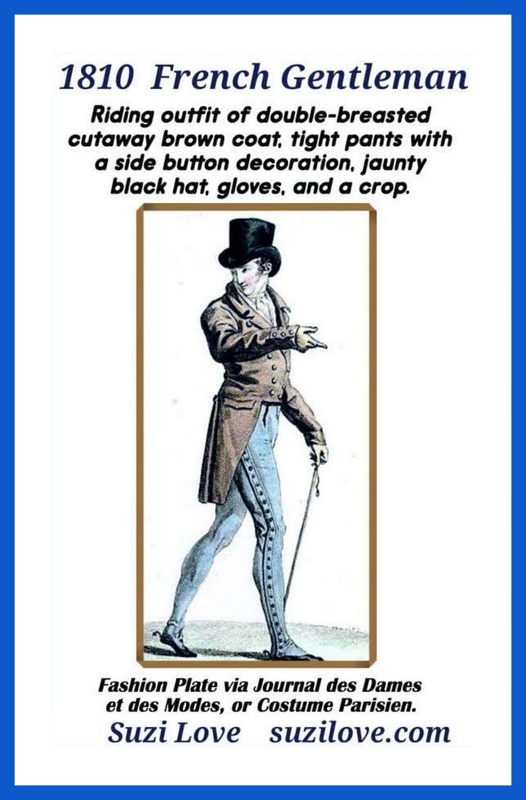
From the finish of the 18th century until 1820, men’s fashions in European and European-influenced countries moved away from the formal wear of brocades, lace, wigs and powder to more informal and relaxed styles. Focus was on undress rather than formal dress. Typical menswear in the early 1800s included a tailcoat, a vest or waistcoat, either breeches, pants, or the newer trousers, stockings, shoes or boots, all worn with an overcoat and hat. This basic ensemble was accessorized with some form of neckcloth or cravat, gloves, walking stick, cane or riding crop, handkerchief, fobs, watch and perhaps a quizzing glass or eye glass.
Skirted coats were replaced with short-fronted, or cutaway, tailcoats worn over fitted waistcoats and plain, white linen shirts. Knee breeches were gradually replaced by tight-fitting pantaloons and later trousers, decorative shoes with buckles were replaced with a variety of boot styles, and fussy and ruffled neckwear gave way to intricately tied, white linen neck cloths. A Regency Era, or early 1800s, gentleman was outfitted in more practical fabrics, such as wool, cotton and buckskin rather than the fussy brocades and silks of the late 1700s.
1800s French Palais Royal Sewing Box and Twelve Mother of Pearl Enamel Tools. This is the style of sewing box Jane Austen and her family would have used in the early 1800s, or Regency years. via via suzilove.com and 1st Dibs Auctions 1stdibs.com
Definition: Palais Royal: Name of an area around the Royal Palace in Paris, France, that specialized in making small and exquisite works of art during the 18th and 19th centuries. Palais Royal sewing tools were elaborate and usually feature mother-of-pearl, often intricately carved or engraved. During the 19th century, workboxes were often works of art with engravings, carvings, mother-of-pearl, and elaborate gilt metal mounts. Most popular were scissors with steel blades and gilt mounts, thimbles and needle cases which were often shaped like animals or other natural forms. Workmanship was exceptional and the tools almost too fragile to use.
1800s French Palais Royal Sewing Box and Twelve Mother of Pearl Enamel Tools. via via suzilove.com and 1st Dibs Auctions 1stdibs.comHN_11_D2D_Craftsmen created containers of precious metals, leather, silks, and decorated them with jewels to make exquisite and expensive items as well as practical carrying cases. books2read.com/suziloveBoxesCases
1811 Lady’s Redingote, or Pelisse, or Walking Dress, French. Blue Levantine walking dress, with pale blue hat of Drap. Fashion Plate via Journal des Modes et des Dames, or Costume Parisienne.
The term, Redingote, was used more in France and other parts of Europe and Pelisse or Walking Dress was used more in England.While the terms Redingote and Pelisse are often used interchangeably, the Redingote usually features a close fitted top and flares out at the hemline with a more tailored or military look than a Pelisse. Redingotes or Pelisses were needed to cover the flimsy dresses made of lightweight fabrics of the Regency years to provide warmth and some protection from windy conditions when gowns might lift and cause modesty issues.In Europe, a Redingote was a coat or robe like garment worn both indoors and out, indoors left open to reveal a dress while the outdoor version was made of heavier materials and of darker colors than the type worn indoors. The name comes from the term ‘riding coat.’
Definition Drap: Made of wool, shiny and velvety after treatment, hair uniformly laid in the direction of the cut, thick and resistant. Used for coats.
Definition Levantine: Stout silk cloth in twill weave. First made in the Levant, a large area in the Eastern Mediterranean region of Western Asia.
1808 Gorgeous Women’s Fashion In The Times Of Jane Austen. Fashion plates from Journal des Dames et des Modes or Costume Parisien. Dresses, coats or Redingotes, Spencers in purple and red, shawls, fichu or shoulder cape, shoes, hats and headdresses, gloves, and Reticules or bags. https://books2read.com/SuziLoveFashionWomen1805-1809
1808 High-Waisted White Dress, French. White Fichu over the shoulders, pale blue shoes, pink striped hat.1808 White Dress With Purple Spencer, French. 1800 White Dress, French. Black ribbon criss-crossing the back bodice. 1808 White Dress With Train Under A Red Spencer, French. Pointed shawl bodice and long sleeves.1808 Negligee Or At-Home Dress, French. Orange redingote, or coat, white shawl, blue gloves and shoes.1808 Lady in a white At-Home dress and cap sitting at her dressing table, French. Fashion Women 1805-1809 History Notes Book 26
What did Jane Austen and friends wear? This book looks at early 1800s fashions, which were elegant and pretty with high waists and fabrics that were almost transparent. These Empire style gowns, named after Napoleon’s first Empress, became popular throughout Europe, and were then copied around the world. Colorful outwear was added to make an ensemble more attractive and warmer.
https://books2read.com/SuziLoveFashionWomen1805-1809
1807 Gentleman’s Half Dress, French. Green cutaway tailcoat, white vest, white frilled shirt with very high white cravat, white breeches with red fob at waist, white stockings, black shoes, black top hat and carrying a cane. Fashion Plate via Journal des Dames et des Modes, or Costume Parisien.
French fashions and Georgian and Regency Era fashions from Great Britain were copied around the world. This is the normal daily outfit for a gentleman in the early 1800s, or in the times of Jane Austen, for daily city and country life. https://books2read.com/SuziLoveFashionMen1800-1819
1807 Gentleman’s Half Dress, French. Green cutaway tailcoat, white vest, white frilled shirt with very high white cravat, white breeches with red fob at waist, white stockings, black shoes, black top hat and carrying a cane. Fashion Plate via Journal des Dames et des Modes, or Costume Parisien.
1800 ca. Heptagonal Bag, French. Old rose moiré silk panels on steel cockade frame. Cut steel rosettes at rivets. Steel turn-key closure. White ribbon on steel rings. White silk lining. Credit: The Elizabeth Day McCormick Collection via Museum of Fine Arts, Boston, U.S.A. mfa.org
Reticule Or Bag: As the silhouette of dresses became more form fitting and fabrics lighter and more transparent, pockets could no longer be hidden in the folds of skirts or underwear. Something else was needed to hold a lady’s essentials. Small purses, like men’s money pouches, were used by women to carry money for gambling, sewing necessities, and women’s daily requirements such as combs. A bag or purse, often with a drawstring to pull closed and usually made of cloth or covered cardboard and often decorated with beading or embroidery was called a reticule, or ridicule. They came in a variety of shapes, sizes, and materials. Jane Austen and her contemporaries would have purchased or hand made reticules, or bags, for each other for gifts and carried them with them whenever they went out.
1800 ca. Heptagonal Bag, French. Old rose moiré silk panels on steel cockade frame. Cut steel rosettes at rivets. Steel turn-key closure. White ribbon on steel rings. White silk lining. Credit: The Elizabeth Day McCormick Collection via Museum of Fine Arts, Boston, U.S.A. mfa.orgHN_12 D2D_RetailerBuyLink_HN_12 books2read.com/SuziLoveFashionWomen1800
1814 Long Dark Green Coat, Or Redingote, French. Horizontal front pockets, high white cravat, black top hat and high black boots. Fashion Plate via Journal des Dames et des Modes, or Costume Parisien.
Definition Redingote Or Coat: French word developed from English words, riding coat. Long fitted outdoor coat worn over other garments for warmth. Originally made with several capes and trimmed with large buttons. For women, the coat was often cut away in the front or left open to show off the dress underneath. French fashion plates call these coats Redingotes and they were worn by men, women, and children. English fashion plates call the coats a Pelisse, a walking dress, Promenade dress, or Carriage dress.
1814 Long Dark Green Coat, French. Horizontal front pockets, high white cravat, black top hat and high black boots. Fashion Plate via Journal des Dames et des Modes, or Costume Parisien.23_d2d_fashionmen1800-1819
https://books2read.com/SuziLoveFashionMen1800-1819