1823 Couple In Walking Dress, French, as worn in Europe and England in the Regency Era. Redingote, or Coat, with matching hat, neck frill of Gros de Nice lace. Gentleman in tailcoat, short length brown trousers, yellow vest, high white cravat, top hat and black shoes. via Modes Françaises L’Indiscret, France.
What did an older lady do in the Bridgerton family’s and Jane Austen’s times, or the early 1800s. An easy to read overview of what an older lady did, wore, and how she lived in the early 19th Century. Information for history buffs and pictures for readers and writers of historical fiction. Older Lady’s Day, Regency Life Series, Book 5, by Suzi Love. books2read.com/suziloveOLD
Through historic images, historical information, and funny anecdotes, it shows how an older lady in Jane Austen’s times fills her day, where she goes, and with whom she spends her time. This light-hearted look at the longer Regency years is an easy to read overview of what people did and wore, and where they worked and played. There is plenty of information to interest history buffs, and lots of pictures to help readers and writers of historical fiction visualize the people and places from the last years of the 18th Century until Queen Victoria took the throne.
1815 Arundel Fete Dress and Baronial Helmet, English. White dress with purple bodice and hem with matching shawl and plumed headdress. Skirt of white crape over white satin, a double row of novel and elegant trimmings on the bottom, two falls of the crape, set on full, are edged with silk. Body comes high on each side of the bosom and is shaped so as to display the neck and shoulders, and both body and sleeves are formed and trimmed in the most exquisitely tasteful manner. A superb cord and tassels confines the waist and ties in front. The Baronial Helmet is striking and made of white sarsnet or satin and white lace and superbly ornamented with feathers. Jewelry set, or Grand Parure, of necklace, bracelets. ear-rings, and small French locket of pearl. White kid slippers and gloves. Full Dress for evening would most likely be a dress of silk or satin, perhaps with a transparent overlay of netting, tulle etc., embellished with taffeta, ruffles and ribbons, and with a full range of accessories including a Grand Parure of tiara and other matching jewelry. https://books2read.com/SuziLoveFashionWomen1815-1819
La Belle Assemblee: Fashion Plate via John Belle’s La Belle Assemblée or, Bell’s Court and Fashionable Magazine, London. Many of the fashion plates seen in La Belle Assemblée and The Repository of Arts were designed by Mrs. Bell who had her dressmaking showroom in Bedford Square, London, and was related to John Bell who published La Belle Assemblée. It seems that she designed for at least two fashion magazines and so there is a cross-over of designs in different magazines.
Grand Parure: A Parure is a matched set of jewelry, including a necklace, bracelet, earrings, pin etc. and a Grand Parure often includes a tiara or other headdress.
Fashion Women 1815-1819 History Notes Book 28 https://books2read.com/SuziLoveFashionWomen1815-1819
Regency Life Series: Images, information, funny anecdotes give overview of Jane Austen’s and Bridgerton times. #bridgerton #RegencyEra #JaneAusten #BritishHistory https://books2read.com/suziloveROver
Are you a Bridgerton fan? Love Jane Austen? Love history? Take a look at a Young Gentleman’s Day in early 1800s. Young Gentleman’s Day Regency Life Series Books 2 by Suzi Love. Easy to read books on what a young gentleman did, wore, and lived during the early 1800s, or the Regency Era when King George 3rd was mad and his son, Prince George, was the Regent in Britain. #Regency #JaneAusten #amwriting books2read.com/suziloveYGD
What did an older lady do and wear in the Regency Era? Information & pictures for readers and writers of early 1800s history, nonfiction and fiction. books2read.com/suziloveOLD
The older lady’s day usually started with her toilette in her bedroom, where her maid helped her dress for the day and styled her hair. After that, she would join her family downstairs for breakfast unless she preferred a tray with either tea or hot chocolate in her bedroom as she prepared for her busy day. Her day would be made up of speaking with the housekeeper and the cook about the week’s menus, assuring that the servants were all available that day and no one was ill, and checking the list of foods needed. She would also enquire if the laundry was up to date and that they had enough good linen to make up all the beds before extended family members and guests arrived. If she was in the country and hosting a weekend house party, she would assign rooms to the guests on her lists and query that all was in readiness for their arrival.
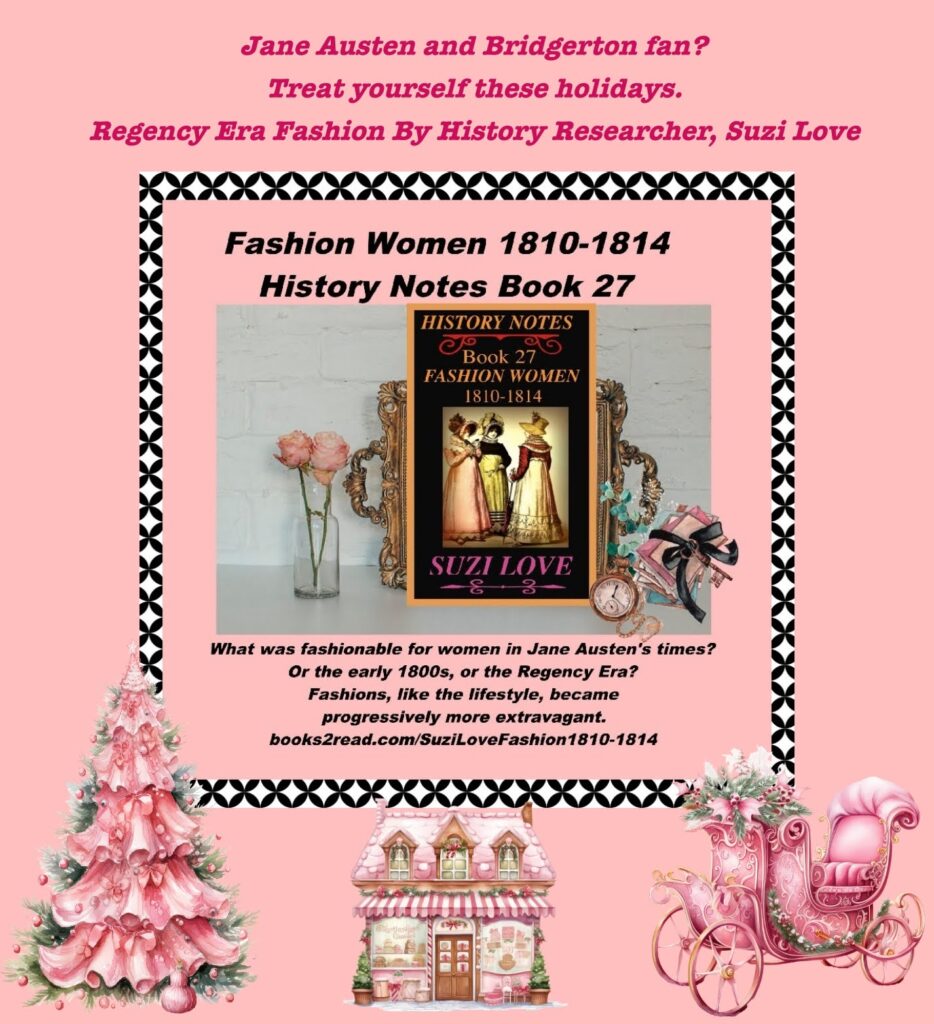
What was fashionable for women in Jane Austen’s times? Mourning, riding, daytime, evening clothing, plus underclothing, corsets and accessories. Fashion Women 1810-1814 History Notes Book 27 This book looks at what was fashionable for women in Jane Austen’s times, or the early 1800s, or the Regency Era in Britain. Wars were being fought around the globe so women’s fashion adopted a military look in support of soldiers. Fashions, like the lifestyle, became progressively more extravagant and accessories went from colorful to over-the-top. https://books2read.com/SuziLoveFashion1810-1814
The Lady’s Magazine said of the basis of women’s fashion that was popular for the first twenty years of the 1800s, ‘White is still the prevailing color for robes. For morning dresses, linen gowns, in large diamonds or squares, are fashionable. Indian muslins, plain or embroidered, are preferred to Florence and satins. The designs of embroidery for shawls are of infinite variety. Long gloves, which reach above the elbow, are not yet laid aside. Medallions are hung around the neck from crossed chains and some of these medallions are shaped like the bags, called ridicules. These reticules are of the lozenge or hexagon shape, with a small tassel at each angle. Reticules, or ridicules, are in lozenge or hexagon shapes with a small tassel at each angle. In capotes, or hats, and ribbands, the violet and dark green prevail over jonquil. Bracelets in hair, pear-shaped ear-rings, medallions on square plates, saltiers of colored stones, are still in fashion.’
1809 September Mother and Daughter Mild Mourning Dresses, English. “Our plate will be found to represent a lady and her infant in slight mourning habits: the former composed of black gossamer net, or imperial gauze, worn over a white satin slip. A half train. A round frock front, and short French sleeves, each edged with a rich Vandyke lace. A cestus, or belt, of white satin edged with gold bullion and finished in front with a rich cord and cone tassels, suspended from topaz studs. Pearl necklace and bracelets, with topaz snaps. Hair in the eastern style, with a Spartan diadem, and comb of topaz or gold. Circassian scarf of grey Spanish silk with a Tuscan border in black embroidery, tassels to correspond, confined on one shoulder with a topaz broach. Shoes of grey satin, with clasps of jet, or rosettes of black bugles. White gloves of French kid; and fan of black crape, with gold spangled devices. ‘In deep mourning, this robe should be formed of black crape, and worn over black sarsnet. The ornaments and trimmings of every description must be of bugles or jet. The shoes of queen’s silk. The scarf, black crape or imperial silk, spotted and bordered with bugles. Jet tassels and broach. The child’s dress is a simple frock of black crape muslin, tucked small, and worn over a cambric skirt. A plain net-lace tucker, and cap to match. Grey kid slippers, with black clasps.’ Fashion Plate via Rudolph Ackermann’s ‘The Repository’ of Arts.
Because many men across Europe were fighting in wars during these years, women often had a reason to dress in black. The loss of numerous family members and friends meant that black was a mainstay in any lady’s wardrobe. Black dresses, hats, capes, shoes, gloves, fans and jewelry would have been essentials, with touches of white, grey or purple being added for times of half mourning. Early publications of Rudolph Ackermann’s ‘The Repository of Arts’ had many fashion plates that included children, but the plate below with a child in ’slight’ mourning dress is very unusual. With this fashion plate is a description of how this ’slight’ mourning could be adapted for deep mourning.
Fabrics for deep mourning would be flat, rather than shiny, hats would be black with little embellishment, and jewelry would be subdued. Slight mourning allowed the white dress trimming, white gloves and these grey satin shoes.
Definition Van Dyke: V-shaped lace and trims named after a 17th Century Flemish painter, Sir Anthony Van Dyck, known for painting V-shaped lace collars and scalloped edges on sitters.
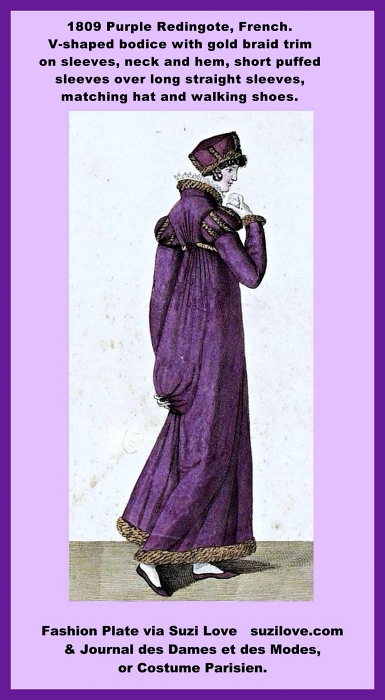
1809 Purple Redingote, Or Coat, French. V-shaped bodice with gold braid trim on sleeves, neck and hem, short puffed sleeves over long straight sleeves, matching hat and walking shoes. Fashion Plate via Journal des Dames et des Modes, or Costume Parisien.
Definition Redingote Or Pelisse: Long fitted outdoor coat worn over other garments for warmth. French word developed from English words, riding coat. Redingotes or Pelisses were needed to cover the flimsy dresses made of lightweight fabrics of the Regency years to provide warmth and some protection from windy conditions when gowns might lift and cause modesty issues. Jane Austen and her contemporaries often walked to places and so would have needed the warmth of a Pelisse or coat in the cold British winters.
Fashion Women 1805-1809 History Notes Book 26 What did Jane Austen and friends wear? https://books2read.com/SuziLoveFashionWomen1805-1809
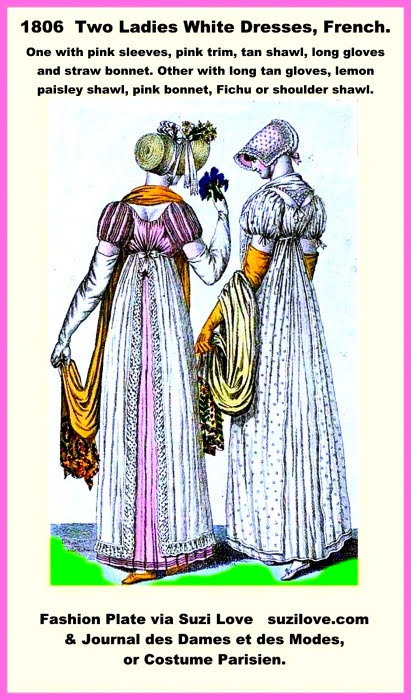
1806 Two Ladies In White Dresses, French. One with pink sleeves, pink trim, tan shawl, long gloves and straw bonnet. Other with long tan gloves, lemon paisley shawl, pink bonnet, Fichu or shoulder shawl. Fashion Plate via Journal des Dames et des Modes, or Costume Parisien. These fashionable ensembles with a variety of fashionable and practical accessories would have been worn by Jane Austen and her family and friends during the day when out walking in the park or visiting village shops. Hats were a necessity to protect fair skin from the sun and scarfs and shawls added color and warmth to an outfit.
Definition Fichu: Draped scarf or shawl worn about shoulders and tied in knot at breast, with ends hanging down loosely. Word, meaning negligee or careless, first used to describe breaking away from stiff collar of the past.
Fashion Women 1805-1809 History Notes Book 26 What did Jane Austen and friends wear? https://books2read.com/SuziLoveFashionWomen1805-1809