1900s Early Gorgeous Faberge Egg Pendants Made In Russia. 2.
The name Faberge is associated with the Russian Imperial family for whom most of the world’s most famous eggs were created. In 1870, Faberge inherited his father’s jewelry business and quickly became known for his brilliant designs. A display of his work and the gold medal he was awarded in Moscow’s Pan-Russian Exhibition of 1882 brought him to the attention of the Russian nobility.
In 1885, Faberge was commissioned by Tsar Alexander III of Russia to create an Easter egg for his wife, the Empress Maria Fedorovna. This became known as The Hen Egg, the first Imperial Faberge Egg, and is made of gold. The Empress was so happy with the gift that Alexander appointed Fabergé a ‘Goldsmith by Special Appointment to the Imperial Crown’ and the following year commissioned another egg. From then on, Faberge was given complete freedom with future Imperial designs which become even more elaborate every year. A famous Fabergé egg is one of sixty eight jeweled eggs made by Fabergé and his assistants for the Russian Tzars and private collectors between 1885 and 1917.
After the Russian Revolution, the House of Faberge was nationalized by the Bolsheviks and the Faberge family fled to Switzerland where Peter Carl Faberge died in 1920. Several of the Faberge Imperial eggs are still missing.
Keep Calm and Read my Scandalous Siblings Series Books 1-3. The scientifically gifted Jamison siblings beg assistance from the St. Martin clan to battle a greedy railway investment syndicate. https://books2read.com/suziloveES
Embracing Scandal By Suzi Love Book 1 Scandalous Siblings. Lady Rebecca Jamison saves her family from financial ruin by investing in railways, but when a greedy syndicate murders her friend, Becca is forced to beg assistance from Cayle St. Martin, the new Duke of Sherwyn. https://books2read.com/suziloveES
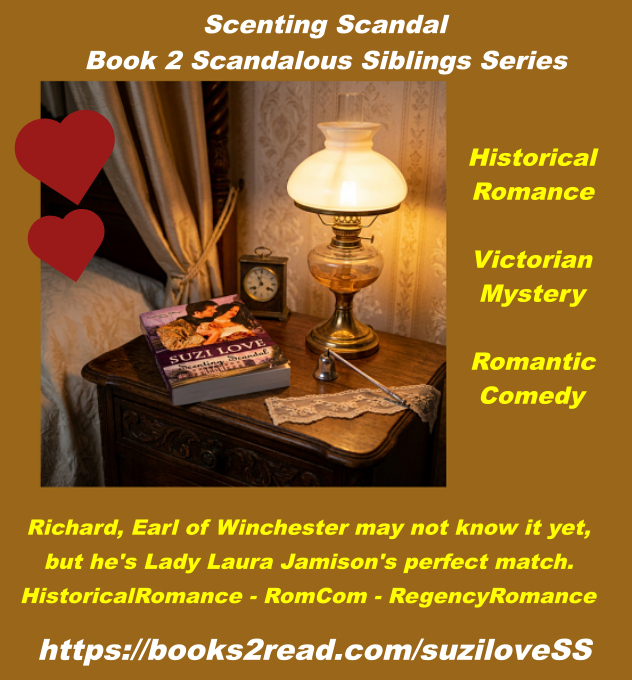
Scenting Scandal Book 2 Scandalous Siblings Series. Lady Laura Jamison uses her extraordinary olfactory senses to sniff out her perfect match, but after she evades an assassin’s bullets, twice, she is forced to accept the protection of their family friend, and her nemesis, Richard St. Martin, the Earl of Winchester. https://books2read.com/suziloveSS
The Jamisons join the St. Martins at the duke’s country estate but a December snowstorm doubles guest numbers. #Holidays #FamilySaga #HistoricalRomance https://books2read.com/suziloveDS
1930-1939 ca. Louis Vuitton Wardrobe Trunk. Monogrammed coat hangers, leather handle.1930-19391930-1939 ca. Louis Vuitton Steamer Trunk.18th Century Late – 19th Century Early. Hide covered, two tier traveling chest or box. Via Bonham’s Auctions.17th Century Iron Trunk With Locking Mechanism. 1900s Early Bags and Suitcases.
1st Dibs Auctions. 1859 ca. Packing Case or Trunk By Louis Vuitton, French. Iron trim, wooden slats, brass studs and locks.17th – 20th Centuries Luggage For Travel. #RegencyEra #VictorianEra #EdwardianEra books2read.com/SuziLoveTravel Share on XHN_10_D2D_RetailerBuyLink_ History Notes Book 10 books2read.com/SuziLoveTravel
1916 Steel Military Surprise Faberge Easter Egg, Russia. Gift from Nicholas II to his wife Tzaritsa Alexandra Fyodorovna. Surprise is a miniature painting on an easel of the Tzarin planning with his generals in field. Faberge Easter Egg, Russia.
The name Faberge is associated with the Russian Imperial family for whom most of the world’s most famous eggs were created. In 1870, Faberge inherited his father’s jewelry business and quickly became known for his brilliant designs. A display of his work and the gold medal he was awarded in Moscow’s Pan-Russian Exhibition of 1882 brought him to the attention of the Russian nobility. In 1885, Faberge was commissioned by Tsar Alexander III of Russia to create an Easter egg for his wife, the Empress Maria Fedorovna. This became known as The Hen Egg, the first Imperial Faberge Egg, and is made of gold. The Empress was so happy with the gift that Alexander appointed Fabergé a ‘Goldsmith by Special Appointment to the Imperial Crown’ and the following year commissioned another egg. From then on, Faberge was given complete freedom with future Imperial designs which become even more elaborate every year. A famous Fabergé egg is one of sixty eight jeweled eggs made by Fabergé and his assistants for the Russian Tzars and private collectors between 1885 and 1917. After the Russian Revolution, the House of Faberge was nationalized by the Bolsheviks and the Faberge family fled to Switzerland where Peter Carl Faberge died in 1920. Several of the Faberge Imperial eggs are still missing.
The name Faberge is associated with the Russian Imperial family for whom most of the world’s most famous eggs were created. In 1870, Faberge inherited his father’s jewelry business and quickly became known for his brilliant designs. A display of his work and the gold medal he was awarded in Moscow’s Pan-Russian Exhibition of 1882 brought him to the attention of the Russian nobility.
In 1885, Faberge was commissioned by Tsar Alexander III of Russia to create an Easter egg for his wife, the Empress Maria Fedorovna. This became known as The Hen Egg, the first Imperial Faberge Egg, and is made of gold. The Empress was so happy with the gift that Alexander appointed Fabergé a ‘Goldsmith by Special Appointment to the Imperial Crown’ and the following year commissioned another egg. From then on, Faberge was given complete freedom with future Imperial designs which become even more elaborate every year. A famous Fabergé egg is one of sixty eight jeweled eggs made by Fabergé and his assistants for the Russian Tzars and private collectors between 1885 and 1917.
After the Russian Revolution, the House of Faberge was nationalized by the Bolsheviks and the Faberge family fled to Switzerland where Peter Carl Faberge died in 1920. Several of the Faberge Imperial eggs are still missing.
1900 Cockerel Faberge Easter Egg, or, Cuckoo Clock Egg was given by Tsar Nicholas II to Empress Maria Feodoronova. Mechanism on top rear enables its bird to come out and move. The egg is part of the Viktor Vekselberg Collection, owned by The Link of Times Foundation, and housed in the Fabergé Museum in Saint Petersburg, Russia. Faberge Easter Egg, Russia.
Embracing Scandal Book 1, Scandalous Siblings Series. Lady Rebecca Jamison sneaks into the house of the Duke of St. Martin to beg his assistance to combat a rogue and murderous group of railway investors.
Lady Rebecca Jamison told The Duke of St. Martin. ‘We utilize Foster and Braithwaite as our stock trading agents and invest through them using the minimum identification on any documents.”
“Impressive. I heard that Foster and Braithwaite’s business grew twelve fold in the last few years by riding on railway stocks.”
“Hence, our problem. Their profits, our profits, became legendary. People speculated about the mysterious names on share certificates.” At his puzzled look she added, “Simple enough. We draw up letters. Ladies sign with their initials and family name, nothing more, so no one realizes the investors aren’t men. Or rather, no one did before.”
“And now?”
“Two weeks ago, some members of the outer circle approached my brother, Michael. They believe him to be personally responsible for our own change in fortune.”
“How big a change in fortune?”
“Oh, nothing too major.” She waved a hand in a vague manner and hoped her face didn’t flush. “Modest successes. Dividend rates in excess of six percent in some situations.”
His eyebrows shot upwards. “Six percent! Nobody I do business with calls that modest. No wonder they wish to obliterate all reference to your family, and your Society.”
“Yes, if only we’d been able to keep our good fortune a secret. We take the uttermost care with our clandestine activities, as we value our privacy and our reputations.”
The Duke raised a brow and pointed at his clock. “Oh, yes. Great care with your reputation!”
She chose to ignore him. “Michael laughed it off. Refused to join their so-called group of friends who dabbled in investing. So they raised the stakes. If he refuses to hand over m … his calculations for all the new railway share ventures opening, within the next two weeks, they vowed to destroy the members of his family. One by one, until he gives in.”
“Ah, now I understand. That’s why they’re keeping you alive. They’re waiting to acquire the records. They assume as eldest, and involved in a charitable society, you hold the most knowledge of…” When he mumbled, she stiffened. Did he guess? “Of Michael’s future stock predictions. Then, when they have all they require, they’ll kill all–”
“Yes, yes, I know. They’ll dispense with us regardless.”
She lifted her chin a notch. “But I can resolve this situation. Given a little more time, plus a little assistance from you.”
“Ah! Back to the crux of the matter. What you require from me.”
1897 The Imperial Coronation Egg With A Surprise.Made By Mikhail Pushkin. Presented by Emperor Nicholas II to his wife Empress Alexandra Feodorovna as memento of entry to Moscow on May 26th, the day of the Coronation, in Uspensky Cathedral. Gold embellished with translucent yellow guilloché enamel.
Many Russian Easters were celebrated with Imperial monogramed eggs as the royals were very involved with both the religious celebrations of Easter and the family traditions. Fabergé eggs were jeweled eggs created by Peter Carl Fabergé and his company in Russia from 1885 to 1917. The most famous of the eggs are the ones made for the Russian Tsars, Alexander III and Nicholas II, as Easter gifts for their wives and mothers, often called the ‘Imperial’ Fabergé eggs. The House of Fabergé made about 50 eggs and 43 have survived. Another two were planned for Easter 1918, but because of the Russian Revolution were not delivered. After the Revolution, the Fabergé family left Russia and the Fabergé trademark has been sold several times since then. Several companies have sold Easter egg merchandise using the Fabergé name. The trademark is now owned by Fabergé Limited, which makes egg-themed jewelry.
As some of my historical romance books are set in a house in Grosvenor Square, its history fascinates me. How about you? Do you love the history associated with Grosvenor Square? The Jamison family in Embracing Scandal and Scenting Scandal live in Grosvenor Square.
Grosvenor Square - Pronounced ˈɡrovna’, is a large garden square in the exclusive Mayfair district and the centrepiece of the Mayfair property of the Duke of Westminster and takes its name from their surname, “Grosvenor”.
In 1710, Sir Richard Grosvenor obtained a licence to develop Grosvenor Square and the surrounding streets and development started around 1721. Grosvenor Square became one of the most fashionable residential addresses in London from its construction until the Second World War, with numerous leading members of the aristocracy in residence. The early houses had five or seven bays, basement, three main stories, and an attic. Colen Campbell produced a design for a palatial east side to the square featuring thirty Corinthian columns but this was not carried out and in the end most of the houses were built to individual designs. There were mews behind all four sides. Many houses were rebuilt later and acquired an extra storey. Number 23 (later 26) was rebuilt in 1773–74 for the 11th Earl of Derby by Robert Adam and shows how grandeur of effect and sophisticated planning might be achieved on a confined site. It was demolished and rebuilt again in the 1860s.
1761 – Sir Richard Grosvenor, the 7th Baronet, was created Baron Grosvenor of Eaton in the County of Chester
1784 – Became Viscount Belgrave and Earl Grosvenor under George III.
1831- At coronation of William IV, Robert Grosvenor, the 2nd Earl Grosvenor, became Marquess of Westminster
1874 – Queen Victoria created the title Duke of Westminster and bestowed it upon Hugh Grosvenor, 3rd Marquess of Westminster.
Current title holder is Gerald Grosvenor, 6th Duke of Westminster and his seat is at Eaton Hall, Cheshire The Dukedom and Marquessate are in the Peerage of the United Kingdom The rest are in the Peerage of Great Britain. The courtesy title of the eldest son and heir to the Duke is Earl Grosvenor.
Nearly all of the older houses were demolished during the 20th century and replaced with blocks of flats in a neo-Georgian style, hotels and embassies. The central garden was originally reserved for the occupants of the houses but is now a public park managed by The Royal Parks. Grosvenor Square. Grosvenor Square has been the traditional home of the official American presence in London since John Adams established the first American mission to the Court of St. James’s in 1785. Adams lived, from 1785 to 1788, in the house which still stands on the corner of Brook and Duke Streets. During World War II, Eisenhower established a military headquarters at 20 Grosvenor Square, and during this time the square was nicknamed “Eisenhower Platz”.
The former American Embassy of 1938–1960 on the square was purchased by the Canadian government and renamed Macdonald House. In 1960, a modern USA Embassy was built on the western side of Grosvenor Square and caused controversy in the mainly Georgian and neo-Georgian area. In 2008, the United States Government chose a site for a new embassy in the Nine Elms area, south of the River Thames with with relocation completed by 2016 or 2017. In October, 2009, English Heritage granted Grade II listed status to the building which means new owners will not be allowed to change the facade.
Grosvenor Square in Literature In Little Dorrit by Charles Dickens the Barnacles are said to live at “four Mews Street Grosvenor” which “was not absolutely Grosvenor Square itself but it was very near it”. Caroline Bingley makes a comment regarding the local dance in Pride and Prejudice ”We are a long way from Grosvenor Square, are we not, Mr Darcy”. It appears in the title of several novels including The Lonely Lady of Grosvenor Square by Mrs. Henry De La Pasture (1907) and The House in Grosvenor Square by Linore Rose Burkard (2009) In Oscar Wilde’s play Lady Windermere’s Fan, the Duchess of Berwick says, “I think on the whole that Grosvenor Square would be a more healthy place to reside in. There are lots of vulgar people live in Grosvenor Square, but at any rate there are no horrid kangaroos crawling about.”
Scenting Scandal: Lady Laura Jamison: “For the sake of propriety, I was ensuring your garments were intact.” #HistoricalMystery #VictorianRomance #RomCom https://books2read.com/suziloveSS
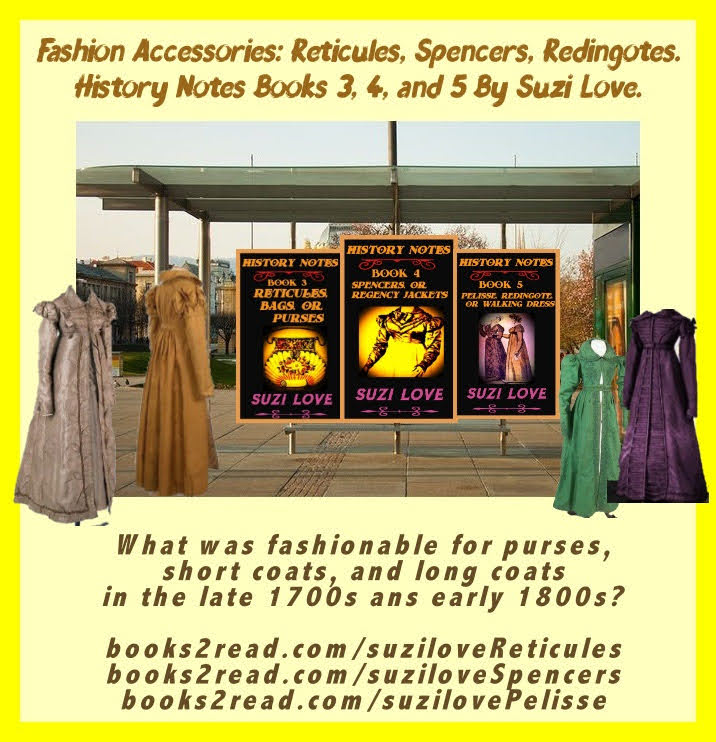
Fashion Must Haves In Jane Austen’s Times: Reticules, Spencers, Redingotes. History Notes Series Books 3, 4, and 5.
Reticule Or Bag: Purse, often with a drawstring to pull closed and usually made of cloth or covered cardboard and often decorated with beading or embroidery. Carried by a woman during the Regency period to carry all their daily necessities. in the place of pockets.
Spencer: Short jacket, cropped at the waist, worn over a dress, or gown. Delicate and regency dresses provided so little protection from the cold, so over garments were essential for warmth, modesty and good health.
Pelisse Or redingote Or Walking Dress: Coat worn over clothing of both sexes for warmth and protection from the elements.