1818 Redingote, Or Overcoat, French. Blue tailcoat, red waistcoat, straight blue trousers, black boots, knotted kerchief and black top hat. Fashion Plate via Journal des Dames et des Modes, or Costume Parisien.
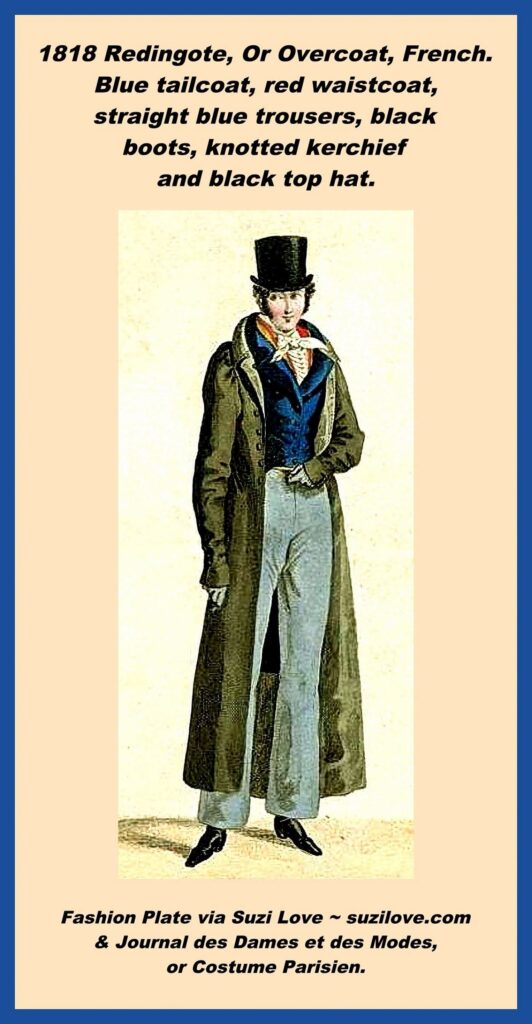


1818 Redingote, Or Overcoat, French. Blue tailcoat, red waistcoat, straight blue trousers, black boots, knotted kerchief and black top hat. Fashion Plate via Journal des Dames et des Modes, or Costume Parisien.
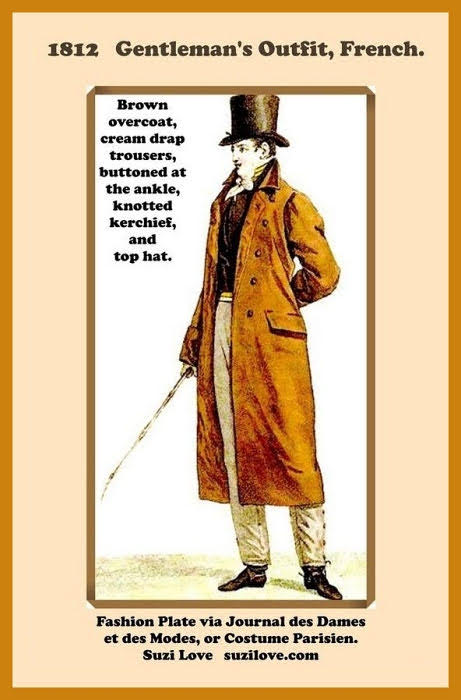
1812 Gentleman’s Outfit, French. Brown overcoat, or Redingote, with front pockets, cream Drap trousers buttoned at the ankle, knotted kerchief, top hat and holding a cane. Fashion Plate via suzilove.com and Journal des Dames et des Modes, or Costume Parisien. By 1812, men no longer wore complicated styles and extravagant fabrics. Men’s fashions had simplified and these practical and relaxed clothing items were the sort worn by Jane Austen’s male family and friends when out and about in town or on their daily excursions.
Definition Redingote Or Coat: French word developed from English words, riding coat. Long fitted outdoor coat worn over other garments for warmth. Originally made with several capes and trimmed with large buttons. French fashion plates call these coats Redingotes and they were worn by men, women, and children. English fashion plates call the coats a Pelisse, a Walking Dress, Promenade dress, or Carriage dress. Definition Drap: French equivalent for the English word cloth or stuff and generally applied to fabrics of wool or silk.
1818 September 18th Le Palais Royal de Paris, Or ‘A Peep at the French Monstrosities’.
By George Cruikshank. Two English tourists, both dressed as dandies, walk arm-in-arm under the arcade of the Palais Royal, interested in the promenading courtesans. Two Frenchmen make more direct overtures to two women. Their dress is rather similar to that of the Englishmen, but the latter wear bell-shaped top-hats, while the Frenchmen have flower-pot shaped hats. An officer wearing a large cocked hat addresses a girl, and a man, said by Reid to be Irish, jovially accosts another. Some of the women are in evening-dress, others in street costume. Behind are iron railings between the supports of the roof; on one of these is the inscription ‘Caveau des Sauvages’. Published by: George Humphrey. via British Museum.


1818 May ‘Beau’s of 1818’ By George Cruikshank. Two Dandies shake hands while third watches. All wearing bell-shaped top-hats, extra high collars, short waists, long spurs and yellow gloves. One with moustache wears wide and short white trousers, one wears top-boots and riding-breeches and has monocle in his eye and third has very full trousers gathered above ankle. These are the sort of outfits that the Bridgerton men and Jane Austen’s male contemporaries would have worn. Hand colored etching. Via British Museum, London, UK. britishmuseum.org (PD-Art)

1801 Young Man’s Daily Outfit, French. Blue cutaway coat with extra high collar, brown knee breeches, chin high white cravat, an all-over curly hairstyle and a round-hat with a wide brim and a low crown which is flat on the top. The hats only decoration is a narrow ribbon and buckle. Fashion Plate via Journal des Dames et des Modes, or Costume Parisien. https://books2read.com/SuziLoveFashionMen1800-1819

1808 Gentleman’s Ensemble, French. Drap Redingote or coat, black hessian boots with heart shaped front, black top hat. Fashion Plate via suzilove.com and Journal des Dames et des Modes, or Costume Parisien. Typical gentleman’s outdoor ensemble as worn by men in Jane Austen’s time, or the Regency Era. https://books2read.com/SuziLoveFashionMen1800-1819
Hessian Boots: Named after German mercenaries who fought alongside British. Soft, highly polished calfskin, knee high, heart-shaped top and decorated with tassel. Boot shaped like stirrup so rider could insert feet into stirrups and be kept securely in place. Tassels were designed to wear with breeches and didn’t suit tight fitting new trousers that dandies like Beau Brummell wore in 1800s so Hessians replaced by other boots e.g. Wellington.

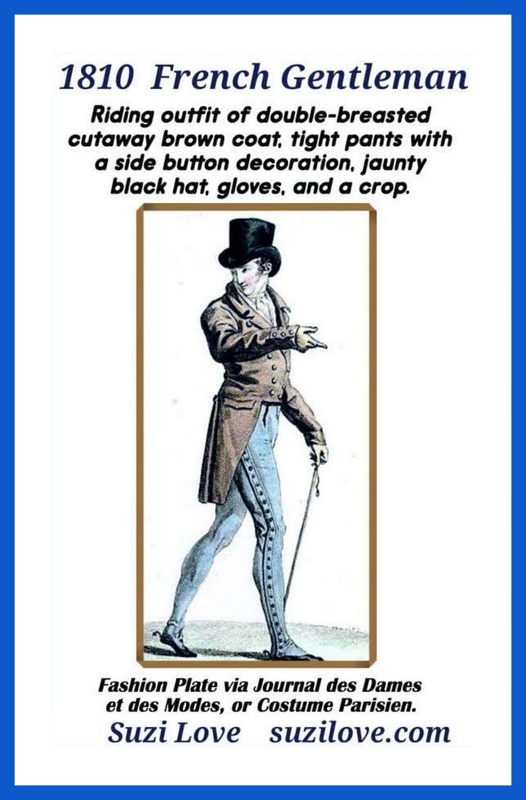
1810 French Gentleman. Riding outfit of double-breasted brown coat, tight pants with a side button decoration, jaunty black hat, gloves, and a crop. As Worn by Gentleman in the Bridgerton and Jane Austen Families. Fashion Plate via Journal des Dames et des Modes, or Costume Parisien.
Pantaloons: When tailcoats lengthened, breeches extended below the knees to accommodate the longer tails and were gradually replaced with slimmer fitting, longer pants, or pantaloons, that ended at the ankle. Pantaloons were close-fitting and sometimes buttoned all the way down the leg. To make them hug the leg tighter, knitted fabrics were used, or fabrics like nankin and kerseymere were cut on the bias.
In the early 1800s, men no longer wore complicated styles and extravagant fabrics. Men’s fashion simplified and became more conservative. A well cut tailcoat, vest, pantaloons and an immaculate cravat of beautiful white linen in the style of George Bryan, or Beau, Brummell. Clothes were a status symbol and indicated a man’s social position. These clothing items were the sort worn by Jane Austen’s male family and friends.
1812 Tailcoat of Blue Drap, French. White Nankin trousers with ankle openings, knotted white cravat, short hair with sideburns, black shoes, holding a black hat and walking stick. Fashion Plate via Journal des Dames et des Modes, Costume Parisien. By 1812, men no longer wore complicated styles and extravagant fabrics. Men’s fashion simplified and became more conservative. A well cut tailcoat, vest, pantaloons and a cravat, either elaborately tied or simply knotted. Clothes were a status symbol and indicated a man’s social position. These clothing items were the sort worn by Jane Austen’s male family and friends on a daily basis.
Definition Drap: French equivalent for the English word cloth or stuff and generally applied to fabrics of wool or silk.
Definition Nankeen Or Nankin: Durable, buff colored cloth, made of Chinese cotton which is naturally brownish yellow. Originally brought from Nanking.

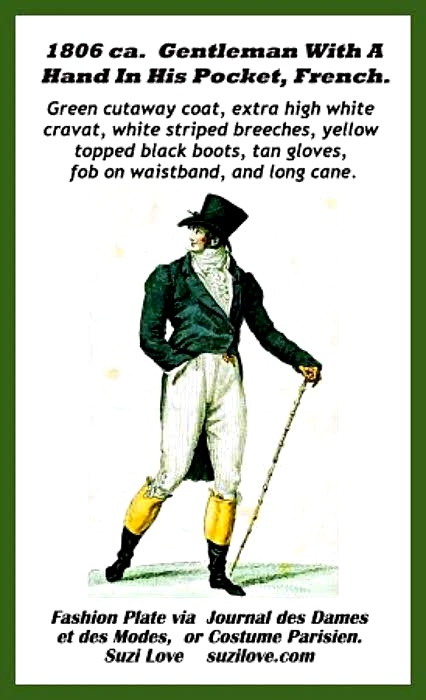
1806 Gentleman With A Hand In His Pocket, French. Green cutaway coat, extra high white cravat, white striped breeches, yellow topped black boots, tan gloves, fob on the waistband, and long cane. Typical Gentleman’s outfit as worn by men to daytime activities, such as escorting his female family members to the shops in Bond Street,London,or for walking in the park in Jane Austen’s times. Fashion Plate via Journal des Dames et des Modes, or Costume Parisien.
1815 French Couple. Lady in evening dress with scooped neckline on low-cut pink bodice, floral headpiece and long white gloves. Gentleman in brown tailcoat and stirrup trousers, vest, and casual necktie. Fashion Plate via Journal des Dames et des Modes, or Costume Parisien.
The sort of fashionable outfits and items worn or carried by Jane Austen and her contemporaries when out in public. Ladies outfits for evening were accessorized with gloves, headdresses and jewelry and often dresses were of this shorter length for dancing. Gentlemen were always heavily accessorized as well with the essential of gloves, coats, waistcoats and neatly tied cravats. For more about the fashions of 1815, take a look at History Notes Books 23 and 28 men’s and women’s regency Era fashions.
Fashion Women 1815-1819 History Notes Book 28 What did Jane Austen wear? What was fashionable for women at the end of the Regency Era in Britain and the reconstruction in Europe after the wars. Book 28 for 1815-1819 in History Notes Includes fashions for mourning, riding, dresses, hats, shoes, reticules or bags, underclothing, accessories.
Fashion Men 1800-1819 History Notes Book 23 What was fashionable for men in early 1800s, or Jane Austen’s time, or Regency Era? Suits, hats, shoes, underclothing, fashion accessories, military and bedroom fashions. French fashions and Georgian and Regency Era fashions from Great Britain were copied around the world.

