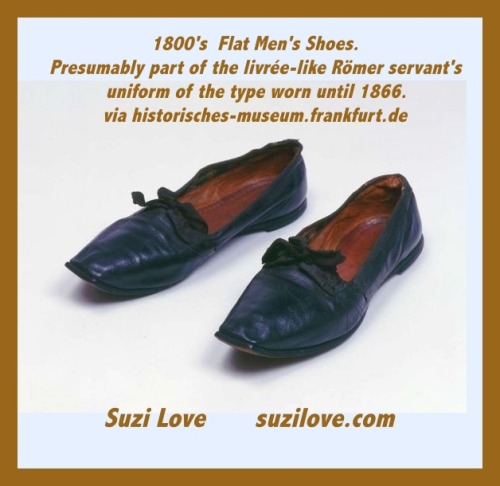
1800’s Flat men’s shoes, presumably part of the livrée-like Römer servant’s uniform of the type worn until 1866. via historisches-museum.frankfurt.de



I'm an Australian author of contemporary and historical romances, plus history non-fiction. My books range from sexy to erotic, late 1700s to the mid 1800s, and with a dash of Australia thrown into the mix. My heroes and heroines challenge tradition and my stories often expose the seamier levels of life. I now live in a sunny part of Australia after spending many years in developing countries in the South Pacific. My greatest loves are traveling, anywhere and everywhere, meeting crazy characters, and visiting the Australian outback. I hope my books bring history alive and you have fun adventuring with my roguish heroes and feisty heroines.
1800’s Flat men’s shoes, presumably part of the livrée-like Römer servant’s uniform of the type worn until 1866. via historisches-museum.frankfurt.de
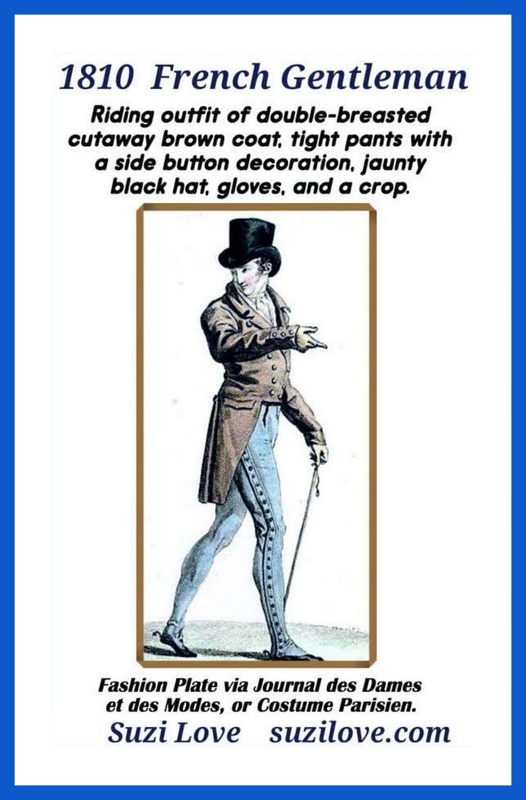
1810 French Gentleman. Riding outfit of double-breasted brown coat, tight pants with a side button decoration, jaunty black hat, gloves, and a crop. Fashion Plate via Journal des Dames et des Modes, or Costume Parisien.
In the early 1800s, men no longer wore complicated styles and extravagant fabrics. Men’s fashion simplified and became more conservative. A well cut tailcoat, vest, pantaloons and an immaculate cravat of beautiful white linen in the style of George Bryan, or Beau, Brummell. Clothes were a status symbol and indicated a man’s social position. These clothing items were the sort worn by Jane Austen’s male family and friends.


Looking For A Fun Historical Romance? Lady Laura Jamison to the earl: “For the sake of propriety, I was ensuring your garments were intact.” #HistoricalMystery #VictorianRomance #RomCom https://books2read.com/suziloveSS
Continue reading →Almack’s Assembly Rooms often appear in Regency Era romances as they were a well known gathering place for those in the Ton looking for wives or husbands. 1770-1840 . Almack’s or Willis’s Rooms, King Street, St James, London, UK. Almack’s Assembly Rooms, founded by William Almack at No. 26-28, were on the site of the present Almack House. The club was originally a gaming establishment but moved from Pall Mall. The Assembly rooms were on the South side of King Street in St James’s and were opened on February 12, 1765. At the time the subscription was ten guineas for which there was a ball and supper each week for the twelve weeks of the season.
Assemblies were held on Tuesdays and Thursdays, but only four or five times a season. Dates were listed in the paper along with the names of the Patronesses. When Lady Jersey took over Almack’s around 1815, assemblies were changed to Wednesdays. Many aristocrats were reportedly offended by something that happened at Almack’s but Lord Jersey is reported to have refused to duel over any inferred slights because it would have meant he was forever involved in a duel. The other well-known Patronesses were Lady Bathurst and Lady Downshire.


1765-1840 ca. Almack’s, or Willis’s, Assembly Rooms, South Side Of King Street, St James, London. commons.wikimedia.org

1800s Early Exterior of Almack’s Assembly Rooms, London, UK.
Captain Gronow, an army officer in London around 1814, wrote about the rules of Almack’s in Captain Gronow’s Recollections and Anecdotes, 1864 , but only gives his views on a few years of Almack’s history.


Embracing Scandal Book 1 Scandalous Siblings After Lady Rebecca Jamison, a mathematical genius, saves her family from financial ruin by secretly investing in railway stocks on the London stock exchange, a greedy syndicate, desperate for Becca’s calculations and predictions, murders her friend and threatens the Jamison family, forcing Becca to beg assistance from her childhood friend, Cayle St. Martin. The newly titled Duke of Sherwyn has returned to London after five years on the continent extending his family’s shipping interests. He’s shunned his privileged London life and his father’s unbending attitudes, and becomes committed to employing the spying tactics he learned on the continent to help Becca indict the syndicate – and using his skills as a lover to seduce her into his bed. But how will Cayle be able to convince Becca, a determinedly self-sufficient spinster, that he can be more to her than just a protector? https://books2read.com/suziloveES
Scenting Scandal Book 2 Lady Laura Jamison uses her extraordinary olfactory senses to sniff out her perfect match, a husband who fits all her scientific criteria. But after she evades an assassin’s bullets, twice, while attending her sister’s wedding, she is forced to accept the protection of their family friend, and her nemesis, the Earl of Winchester. Richard evades marriage with someone as beautiful and intelligent as Laura, fearing she’ll uncover his shameful childhood secret. The mismatched pair risks their wealth and reputations racing around London’s seedier areas in a desperate attempt to stop a madwoman before she recruits more criminals and rebuilds her illegal share trading syndicate. When they accept each other’s strengths and weakness, will Laura and Richard also discover a passion neither counted on? https:/books2read.com/suziloveSS
December Scandal Book 3 Michael Brandon travels to introduce the woman he loves to family but is shocked when his missing brother arrives. The Jamisons join the St. Martins at the duke’s country estate but a December snowstorm doubles guest numbers. https:/books2read.com/suziloveDS

Scandalous Siblings Series Books 1-3 Historical romance with science, history and mystery. #histrom #Regencyromance. #mystery #VictorianRomance #ReadARegency https://books2read.com/suziloveDS Share on X

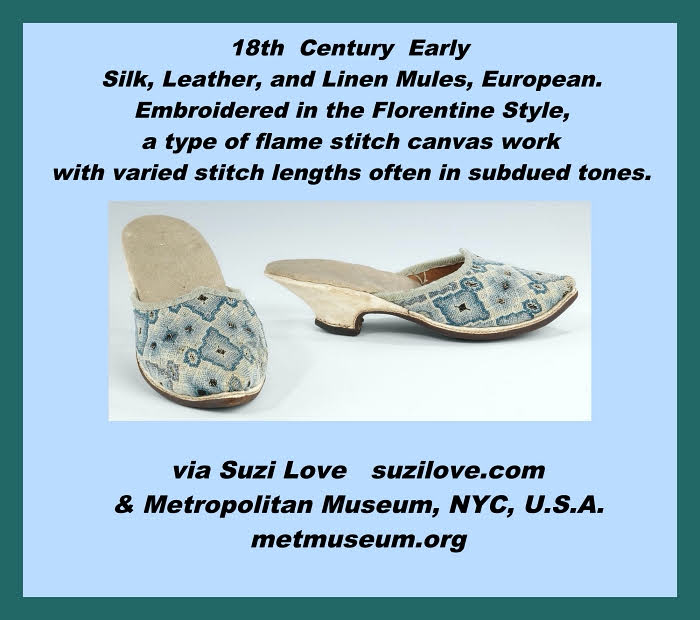
18th Century Early. Silk, Leather, and Linen Mules, European. Embroidered in the Florentine Style, a type of flame stitch canvas work with varied stitch lengths often in subdued tones. via Metropolitan Museum, NYC, U.S.A.

1809 Wedgwood and Byerley showrooms for Wedgewood china, York Street, London, UK. Plate via Rudolph Ackermann’s Repository of Arts. The premises of master potter Josiah Wedgwood in York Street, St James’ Square, London, U.K. Wedgwood china was known for its high quality, beautiful glazes and Wedgwood trademark printed on the back of each item. The London show-room was managed by Thomas Byerley, who also held a quarter share of the business. From 1790 to 1810 the firm was known as Wedgwood and Byerley.

After the French Revolution, the fussy styles previously affordable only by the very wealthy were replaced with ideas of simplicity in dress, behavior, and decorating. The neoclassic style was adopted and carried through the Napoleonic War years, partly because of Napoleon Bonaparte’s love of anything Greco-Roman. The Empire silhouette copied the chiton worn by the Greeks and Romans. The chiton was a tubular garment draped from the shoulders and sometimes belted beneath the bust and this style of garment was completely different to the rectangular panniered skirts of the 18th century.
1802 Mother and Child, French. Mother wears a long green cape over a loose and flowing white dress. The child wears a similarly flowing pink dress. Both wear fitted hats. Fashion Plate via Journal des Modes et des Dames, or Costume Parisienne. suzilove.com
The Empire style of clothing began as children’s wear made from fine white cotton. Women adopted the same fabrics in England and turned them into light and airy tubular dressed with skirts gathered under the bust and often with more fullness at the back to allow women to walk and move freely.
1807 Empire style, or high-waisted, white walking dress, French. Worn with a red draping shawl and long white gloves. Fashion Plate via Journal des Modes et des Dames, or Costume Parisienne. suzilove.com
Empire style dresses were high waisted and were worn almost exclusively by women from 1800 until around 1820.
In the 1820’s, waists began to drop from under the bust and skirts went from tubular to bell shaped by flattening the front and adding fullness at the centre back.
By the 1830s, waists were almost back down to their natural waistline and they stayed at a woman’s natural waist as skirts widened even more until they became the conical hoop skirts of the later 19th century.
During the Empire years in France, fine Indian muslin was manufactured and embroidered in India and then exported to Europe and America. French women wore the finest and most sheer cottons and dresses became more an more daring as bodices were cut lower and lower and gowns became transparent.
1805-1815 ca. Three Women’s Empire Style Dresses. landeskunde-online.de suzilove.com
Naturally, English women copied this French trend. Some supposedly ‘damped down’ the skirts of their gowns with water to make them even more see through, and therefor even more enticing to the gentlemen. As the Prince Regent, George IV, was a known connoisseur of women, the boldest of ladies wanted to catch his eye, and perhaps become of one of his mistresses.
1805-1810 ca. Lemon Dress, Regency style, Light and Floaty Dress. via Manchester Galleries manchestergalleries.org suzilove.com
This trend to sheer fabrics, which would have been freezing in winter in England or Europe, also led to the creation of other fashion items that women needed to stay warm.
Long draping shawls were worn over these sheer Empire style gowns, as were Spencers and Pelisses, or Redingotes. Tunics were often added to give gowns an appearance of decency, especially from the back.
1802 White Dress, French. Long burgundy shawl, white lace cap and yellow gloves. Fashion Plate via Journal des Dames et des Modes, or Costume Parisien.https://books2read.com/SuziLoveFashionWomen1801-1804
The type of dress worn across Europe in the early 1800s. This sort of high-waisted dress would have been worn by Jane Austen and her contemporaries in England. The Empire waist gown defined women’s fashion during the Regency Era. ‘Empire’ is the name given in France to the period when Napoleon built his French Empire. High-waisted, loose gowns were adopted by the aristocracy as a symbol of turning away from the fussy, elaborate and expensive clothing worn in the 1700s.