1816 Blue Riding Habit, French. High-waisted blue riding dress with a train, the long full skirt being necessary to cover a lady’s legs and preserve her modesty when riding side saddle. These riding habits were usually designed by men and were in two pieces, a jacket and a skirt, worn over a shirt. A military style bodice decoration, high pointed collar and a knotted pink dotted cravat worn underneath that imitate male styles, or even Dandy fashion. Sleeves are very long as was the trend in French riding habits. Yellow gloves and a masculine style beaver hat. This print was designed by Horace Vernet and engraved by Pierre Baquoy. Fashion Plate via Journal des Dames et des Modes, or Costume Parisien. Although, there are very similar riding habit fashion plates in other magazines.
The type of outfit Jane Austen and her friends would have worn if they went horse riding. https://books2read.com/SuziLoveFashionWomen1815-1819
1817 Pink Morning Walking Dress, French. High-waisted,high frilled neckline, long straight sleeves, triple layer of frills above the hem, bonnet with plumes, or feathers to decorate, and tied under the chin with pink ribbon, pink shoes and gloves. Most likely has white muslin dress with the white neck frill underneath the dress. Fashion Plate via Journal des Dames et des Modes, or Costume Parisien.
Definition Morning Walking Dress: Worn out shopping, walking in a city park or the country estate. Presentable and warm, more fashionable than Morning Dress but not overly accessorized.
1817 Pink Morning Dress, French. High-waisted,high frilled neckline, long straight sleeves, triple layer of frills above the hem, bonnet tied under the chin with pink ribbon, pink shoes. Fashion Plate via Journal des Dames et des Modes, or Costume Parisien.
This book shows how corsets changed to fit well under clothing, give maximum support and comfort. Corsets pushed up breasts and showed off the bust line beneath a square-cut and low-cut neckline as in the early 1800s, or Regency years. Jane Austen and her female and friends wore these corsets. Corsets or stays worn during the early 1800s, or Jane Austen’s lifetime. https://books2read.com/SuziLoveCorsetBook17
This book shows how body wraps, stays, and corsets were worn to create a variety of fashionable silhouettes through past centuries. Corsets flattened breasts and accentuated rounded hips or pushed up breasts and showed off the bust line depending on the fashions of the time and the desired silhouette. Includes corsets through the Georgian, Regency, Victorian and Edwardian Eras and Jane Austen’s lifetime. Overview of corsets through history, including the Georgian, Regency, Victorian and Edwardian Eras and Jane Austen’s lifetime. History Notes Book 14.
1817-1820 ca. Spencer, or Jacket, English. The sort of jacket worn by Jane Austen and friends over their loose Empire style dresses. Green silk Spencer, brown satin puffs, silk cord on deep V collar and sleeves. With the rise of fashionable waistlines in women’s dresses after around 1800, women’s outerwear followed suit. This jacket with very short bodice and long sleeves was known as a Spencer and was named after the male coat. via Museum of London, UK. museumoflondon.org.uk
Description Spencer: Short jackets worn for warmth over the high-waisted Empire style gowns that were popular after the French Revolution, where there was a shift away from opulence and decadence to simpler fashion. This jacket with very short bodice and long sleeves was known as a Spencer and was named after the male coat made famous by the Earl Spencer and said to have originated in accident to Lord Spencer in hunting when coat tails torn off and a cropped jacket was invented. The dresses in the early 1800s therefore became looser, lighter, and flowing and women became cold due to their very low cut and short bodices. Short fitted jackets that went easily over the dresses and provided extra modesty and some warmth. As Europe and many other parts of the world were deep in wars in the late 1700s and early 1800s, men in uniform were found everywhere. In support of these military men, fashions leaned towards military style shoulder paddings, shoulder embellishments, loops, buttons, and braids.
1817-1820 ca. Spencer, English. With the rise of fashionable waistlines in women’s dresses after around 1800, women’s outerwear followed suit. This jacket with very short bodice and long sleeves was known as a spencer. via Museum Of London. 1817-1820 ca. Spencer, English. Back View. Green silk, brown satin puffs, silk cord on deep V collar and sleeves.
With the rise of fashionable waistlines in women’s dresses after around 1800, women’s outerwear followed suit.
This jacket with very short bodice and long sleeves
was known as a spencer and was named after the male coat.
via Museum of London, UK. museumoflondon.org.uk suzilove.com1817-1820 ca. Jane Austen and Bridgerton Style Green Silk Spencer, Or Jacket, English. #Bridgerton #RegencyFashion #BritishFashion #JaneAusten https://books2read.com/SuziLoveFashionWomen1815-1819 Share on XHN_28_D2D_FashionWomen 1815-1819
1819 January Red Redingote, French. Merino wool coat over a white dress with a high lace collar, matched with a black velour, or velvet, hat lined with white satin. Military style shoulder pads and front buttons. It was fashionable at the time to wear military inspired clothing to show support of all the men fighting in wars across the world. The type of outfit young Regency Era ladies would have worn if they were out shopping on Bond Street, walking in a park, or taking a carriage ride through Hyde Park. Fashion Plate via Journal des Dames et des Modes, or Costume Parisien.
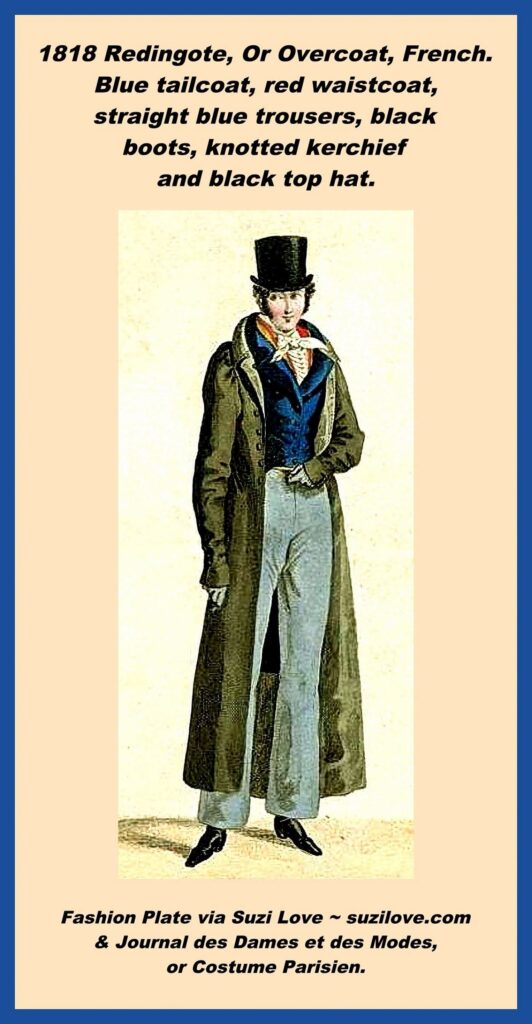
Definition Redingote Or Pelisse Or Walking Dress Or Coat: French word developed from English words, riding coat. Long fitted outdoor coat worn over other garments for warmth. Often left open at the front to show off the dress underneath. Sometimes cut away in front. Originally made with several capes and trimmed with large buttons. French fashion plates call these coats Redingotes and they are designed for women, men and children. English fashion plates call them a Pelisse, a walking dress, Promenade dress, or Carriage dress.
1819 January Red Redingote, French. Also called a Pelisse or Walking Dress in England. Merino wool coat over a white dress with a high lace collar, matched with a black velour, or velvet, hat lined with white satin. Fashion Plate via suzilove.com and Journal des Dames et des Modes, or Costume Parisien.
1819 Red Merino Wool Redingote Or Coat With Matching Bonnet. #Regency #Fashion #FashionPlate #French https://www.books2read.com/SuziLoveFashionWomen1815-1819
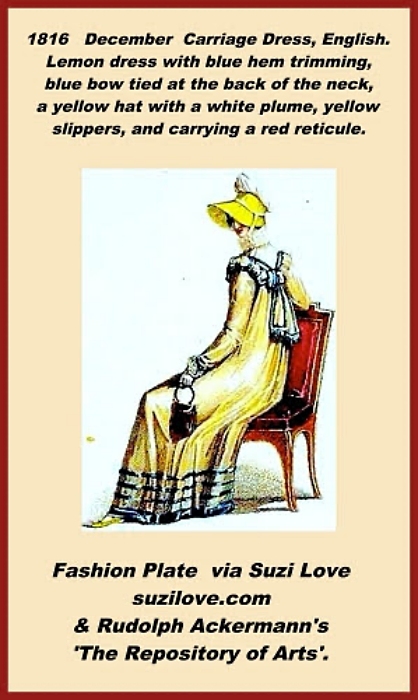
1817 December Black Walking Mourning Dress, English. Black bombazine dress with a black crepe hem, with tight bodice wrapping across to the right side, trimmed with a piping of black crape that looks like braiding and finished by rosettes of crape, in the center of each of which is a small jet ornament. Long sleeves trimmed similarly at the wrists, half-sleeve of a new form trimmed with crape, high standing collar displaying a mourning ruff. Claremont bonnet, named because it is the same shape as one worn by the Princess, whose home with her husband, Prince Leopold, was called Claremont. Black crape over black sarsnet and lined with double white crape. Low crown but large front and tastefully finished by black crape with a bunch of crape flowers on one side. Black shamois gloves, and black shoes. “We have again to acknowledge our obligations to the lady who favored us last month; and we understand that the dresses from which our prints this month have been taken were also purchased from Mrs. Bell of St. James’s-street.” Fashion Plate via Rudolph Ackermann’s ‘The Repository of Arts’.
Mrs. Bell ‘invented’ fashion plates and as well as publishing in La Belle assemblee, she also sold them to other magazines. Hence the crossover we often see where the same plate, or a similar version, appears in different magazines.
1815-1820 ca. Blue Wool Tailcoat As Worn By Bridgerton Gentlemen and the Men In Jane Austen’s Life.
1815-1820 ca. Man’s Blue Wool Tailcoat, English. Chest View. Blue wool, lined with wool, brass buttons, and hand sewn. Double-breasted coat of blue wool, cut away in the front. With a fairly deep roll collar, a double row of five brass buttons, and four further brass buttons at the back. The wrists fasten with two cloth-covered buttons. With oblique false pocket flaps, one on each side, with deep pockets below them entered vertically, and another deep pocket inside entered horizontally. Lined with wool. Hand-sewn. Marks and Inscriptions: ‘Hammond Turner & Sons, Extra Superfine’ (Stamped behind the brass buttons) The cut-away coat remained formal daywear for men until the 1850s. This example has long tight sleeves, puffed at the shoulder, a style typical of the period 1815-1820. The roll collar has an M-shape notch, introduced about 1803, and a waist seam. via Victoria and Albert Museum, London, UK. Given by Lady Osborn.
From the finish of the 18th century until 1820, men’s fashions in European and European-influenced countries moved away from the formal wear of brocades, lace, wigs and powder to more informal and relaxed styles. Focus was on undress rather than formal dress. Typical menswear in the early 1800s included a tailcoat, a vest or waistcoat, either breeches, pants, or the newer trousers, stockings, shoes or boots, all worn with an overcoat and hat. This basic ensemble was accessorized with some form of neckcloth or cravat, gloves, walking stick, cane or riding crop, handkerchief, fobs, watch and perhaps a quizzing glass or eye glass.
Skirted coats were replaced with short-fronted, or cutaway, tailcoats worn over fitted waistcoats and plain, white linen shirts. Knee breeches were gradually replaced by tight-fitting pantaloons and later trousers, decorative shoes with buckles were replaced with a variety of boot styles, and fussy and ruffled neckwear gave way to intricately tied, white linen neck cloths. A Regency Era, or early 1800s, gentleman was outfitted in more practical fabrics, such as wool, cotton and buckskin rather than the fussy brocades and silks of the late 1700s.
1800-1820 ca. Small Pieces Of Drawing Room Furniture as would have been used in houses where Jane Austen lived. Side tables, book tables, chest and foot stool. Collage by Suzi Love.
1800-1820 ca. Small Pieces Of Drawing Room Furniture. Side tables, book tables, chest and foot stool.
1800-1820 ca. Small Pieces Of Drawing Room Furniture As Jane Austen Would Have Used. #Regency #Furniture #BritishHistory
Policing in the 17th and 18th centuries – one unarmed able-bodied citizen in each parish a man was appointed or elected annually to serve for a year unpaid as parish constable.
Worked in co-operation with the local Justices in observing laws and maintaining order.
In towns, responsibility for the maintenance of order was conferred on the guilds
Later conferred on other specified groups of citizens
These supplied bodies of paid men, known as The Watch
The Watch guarded the gates and patrolled the streets at night
Huge social and economic changes and increases in town populations meant parish constables and Watch systems couldn’t cope.
In 1812, 1818 and 1822, Parliamentary committees investigated crime and policing.
Impotence of the law-enforcement machinery was a serious menace
Conditions became intolerable and led to the formation of the New Police
The Metropolitan Police
Established by an Act of Parliament in 1829 by Sir Robert Peel
Peel appointed 2 Commissioners
Appointed 895 Constables, 88 Sergeants, 20 Inspectors and 8 Superintendents.
Superseded the local Watch in the London area but the City of London was not covered.
Numbers increased
Grew to include the Greater London area (excluding the City of London)
Included parts of the Home Counties and all Royal Naval Dock Yards throughout the country.
First officer was given the warrant number ‘1’
Today the service is reaching near to a quarter million
The warrant number is unique to the officer
Different from the shoulder number which changes as the officer moves stations. Scotland Yard
Colonel Charles Rowan and Richard Mayne organized and designed the New Police
The two Commissioners occupied a private house at 4, Whitehall Place
The back opened on to a courtyard and used as a police station
This address led to the headquarters of the Metropolitan Police being known as Scotland Yard.
Sir Robert Peel, 2nd Baronet, (5 February 1788 – 2 July 1850) British Conservative statesman who served twice as Prime Minister of the United Kingdom, Chancellor of the Exchequer, and Home Secretary. Regarded as the father of modern British policing as he founded the Metropolitan Police Service.
Other Police organizations
Some older police establishments remained outside control of the Metropolitan Police Office
The Bow Street Patrols, mounted and foot, commonly called the Bow Street runners.
Police Office constables attached to the offices of, and under the control of, the Magistrates.
The Marine or River Police.
By 1839 all these establishments had been absorbed by the Metropolitan Police Force.
The City of London Police was set up in 1839 and is an independent force to this day.