“Ah! there is nothing like staying at home for real comfort. Nobody can be more devoted to home than I am.” Jane Austen — Emma (1815)
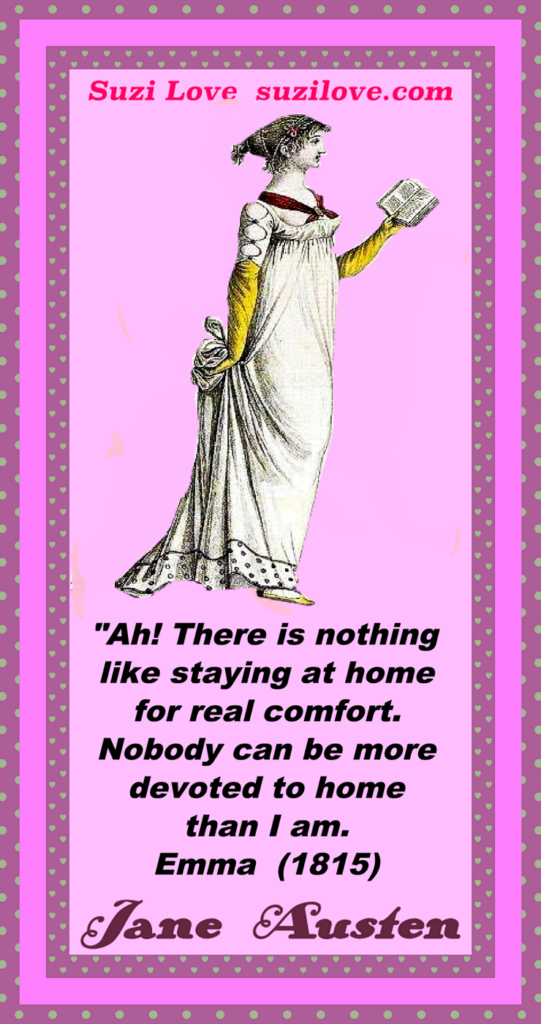


“Ah! there is nothing like staying at home for real comfort. Nobody can be more devoted to home than I am.” Jane Austen — Emma (1815)
1806 Silver and silver-gilt vinaigrette, Birmingham, England. Commemorating the Battle of Trafalgar in 1805. Rectangular with a hinged lid and a suspension loop. Gilded, pierced inner cover depicts HMS ‘Victory’ in relief inscribed ‘VICTORY’, ‘TRAFALGAR OCT 21 1805’. Via National Maritime Museum, Greenwich, London, U.K.
Vinaigrettes were used from the late 18th century through the 19th Century to revive a person who had fainted, having the vapors, or to mask unsanitary odors. Small containers, often a silver hinged box, held a tiny sponge dipped in an aromatic substance which had been dissolved in vinegar. The sponge was held beneath a grill or perforated cover so, by a flick of the fingers, the container was opened and the restorative substance held directly beneath a person’s nose. Jane Austen and her family and friends would have been very familiar with the use of vinaigrettes because Regency Era ladies were noted for having the vapors or fainting in hot ballrooms or dramatic situations. Ladies in the Romantic and Victorian Eras would have used them when tightly laced corsets became popular and ladies fainted because they were unable to draw in enough oxygen.
Both men and women used vinaigrettes in the late 1700s when people encountered foul aromas on a daily basis, but by the 1820s vinaigrettes were mainly used by women.These tiny containers were carried in a pocket, a reticule or bag, or suspended from the waist by chains as part of a chatelaine. Their sterling silver interiors were gilded to prevent discoloration from the acetic acid. Birmingham produced 90% of England’s silver vinaigrettes. As gold wasn’t affected by vinegar, craftsmen created some elaborate and decorative boxes on the container’s exteriors.


1818 High-waisted Promenade Dress, English. White dress with multiple layers of lace from hem upwards. Narrow striped scarf of bright colors, large brimmed hat decorated with flowers and a pink parasol. Fashion Plate via John Belle’s La Belle Assemblée or, Bell’s Court and Fashionable Magazine, London.
Definition Empire Style Dress: High-waisted white gown defined women’s fashion during the Regency Era. ‘Empire’ is the name given to the period when Napoleon Bonaparte built his French Empire. High-waisted, loose gowns were adopted by the aristocracy as a symbol of turning away from the fussy, elaborate and expensive clothing worn in the 1700s.

1812 October Autumnal Carriage Or Morning Costume, English. Loose white jaconet muslin dress, high in the neck, with double frills of deep vandyke lace that fall over the Spencer. Blue satin Spencer ornamented with silver cord and buttons ‘en militaire’ and held at the throat with a cord and tassels, a quartered foundling cap of lace tied under the chin with a full band and decorated with an autumnal flower. Grey kid shoes, lemon gloves and a ridicule, or bag, of purple velvet. Fashion Plate via Rudolph Ackermann’s ‘The Repository of Arts’.
Dress – Morning: Worn either at home, out shopping, or for walking in the park or country. Presentable but not overly accessorized.
Spencer: Short body-hugging jacket worn for warmth &modesty. Said to have originated in accident to Lord Spencer in hunting when coattails torn off.


1811 Evening Dress, French. Red cashmere dress over white under shirt with short puffed sleeves, carrying a white shawl, long white gloves, earrings and white evening shoes. Fashion Plate via Journal des Dames et des Modes, or Costume Parisien. Though this is a French fashion plate, the outfit is typical of the dresses worn by Jane Austen and her contemporaries. An Empire style, or high-waisted, dress with a white underdress and for warmth there is an extra layer with the shawl.
Definition Cashmere: Soft, fine wool, historically used for costly dress fabric, usually in twill weave. Originally made of yarn handspun from the wool of Cashmere goats but later from other soft wools. Used for dresses, infants’ coats.

1816 January Blue Carriage Dress, English. High neck but no collar, front is fitted but back has slight fullness and very short bodice. Puffed roll to decorate the hem, trimmed in bias cut blue satin, long sleeves finished at wrists with satin, gloves of white kid and ‘sandals’ or shoes of blue kid leather. Head-dress à la mode de Paris is an unusual cap of white lace and decorated with two rolls of ribbon. “We are indebted to the tasteful fancy of Mrs. Bean, of Albemarle Street, for both our dresses this month.” Fashion Plate via Rudolph Ackermann’s ‘The Repository of Arts’.
Jane Austen and her contemporaries would have worn this style of outdoor, or carriage ensemble with a coat over a dress. These outdoor dresses were labelled a variety of names. In England, this might also have been called a Walking Or Promenade dress, or Pelisse. In Europe, it would be called a Redingote.
Definition: Pelisse, Walking Dress, Carriage dress, Promenade Dress, Redingote. Long, fitted coat sometimes cut away in front to show off the dress underneath. Originally made for men with several capes and trimmed with large buttons, they were adapted to add an additional, and warmer, layer to the typical white muslin dresses worn in the early 1800s. Those light weight dresses were good in summer but not suited to harsh winters. Over the carriage dress, a shawl could be added as well as a muff to give a warm and comfortable outfit for traveling by carriage.

1860 Corset, American. Cotton, metal, and bone. Manufacturer: Langdon Batcheller and Company, A1851-1860 ca. Blue Ribbed Silk Corset, English. Front and Back. Front hooks and back lacing. via Museum of London, UK. museumoflondon.org.uk

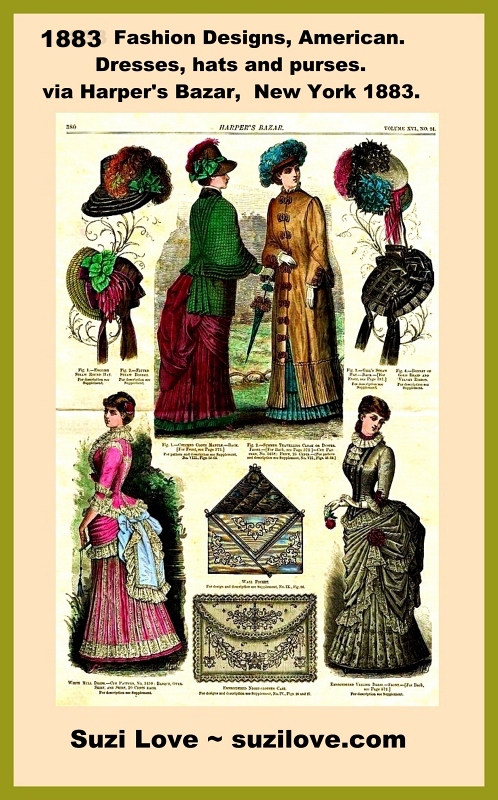
1883 Fashion Designs, American. Dresses hats and purses. Harper’s Bazar, New York City.

1800s A Young Lady Riding and Carriage Driving, England. #Riding #Regency #Victorian #Cartoon From: 1860 Mr. Sponge’s Sporting Tour by Robert Smith Surtees. via Google Books (PD-100)


1807 Cotton Linen Shirt, British. Non-regulation shirt worn under uniform. High collar to allow room for a stock, fullness and pleated sleeves enable wearer to fit into tight arms popular in coats. The men in Jane Austen’s life would have worn a shirt like this, especially if they were in the military as many men were during the Napoleonic Wars. via Royal Museums Greenwich collections.rmg.co.uk


