1810 Couple In Walking Dress, French. Lady in a jade green Redingote, or coat, with paisley skirt, worn over a white dress with sleeves caught up, and hat tied under her chin. Man in a brown tailcoat, tight white pants that button down the sides, black hat and shoes and carrying a walking stick. Fashion Plate via Journal des Dames et des Modes, or Costume Parisien.
The sort of outfits a lady and gentleman in Jane Austen’s times would have worn while out walking, shopping, or going to visit friends.
Pelisse, or Walking Dress, or Redingote. The Fashion Dictionary description of a Redingote is (réd’ing-göt; red ing gote). Pronounced: red ing gote Woman’s long, fitted coat often cut Princess style and worn open in front to show off the dress underneath. Sometimes cut away in front. Originally made for men with several capes and trimmed with large buttons. French word developed from English words, riding coat. reefer. Single- or double-breasted, fitted, tailored, over-all coat usually made from sturdy fabric but in the British Regency Era a Pelisse was often made from a lighter fabric, such as cotton.
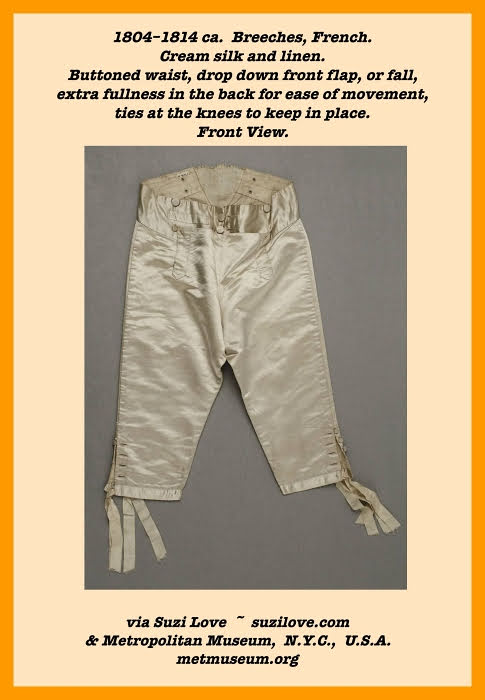
1804-1814 ca. Breeches, French. Cream silk and linen. Buttoned waist, drop down front flap, or fall, extra fullness in the back for ease of movement, ties at the knees to keep in place. via Metropolitan Museum, N.Y.C., U.S.A. metmuseum.org
Definition Pants – Breeches: Men’s close-fitting pants that fastened just below the knees or above the ankles with buttons, drawstrings, or buckles. They had a horizontal front flap called a ‘fall’ which unbuttoned to drop down. Some falls were narrow and some wide. Breeches were worn with stockings. In Jane Austen’s times, or the Regency Era, breeches were worn tighter to show off a gentleman’s manly physique, often leaving nothing to the imagination.
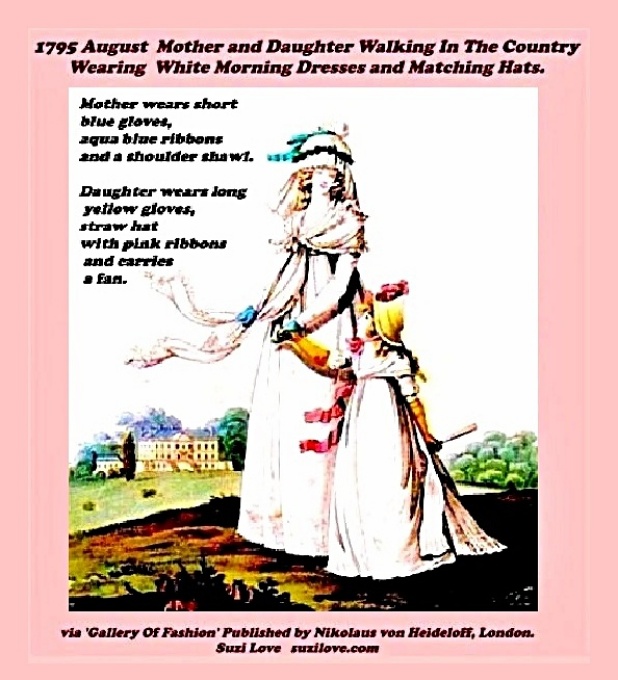
1795 August Mother and Daughter walking in the country wearing white morning dresses and matching hats. Mother wears short blue gloves, aqua blue ribbons and a shoulder shawl, or fichu. Daughter wears long yellow gloves, a straw hat with pink ribbons and carries a fan. via Nikolaus Heideloff’s Gallery of Fashion.
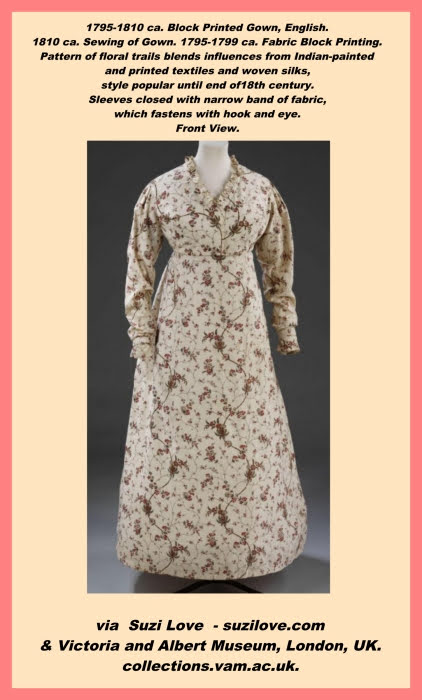
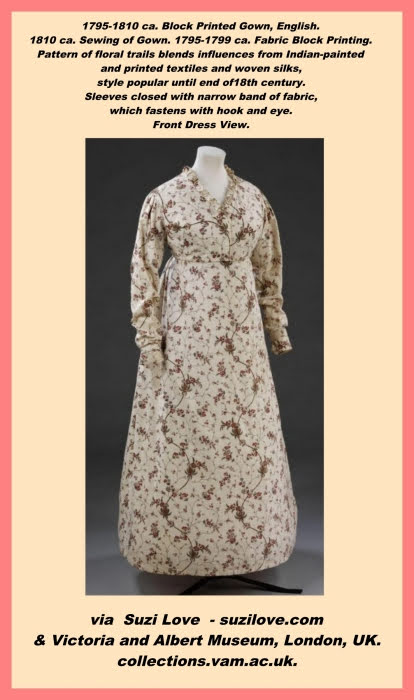
1795-1810 ca. Roller Printed Dress, English. Empire style, high-waisted, roller printed dress with skirt gathered at the back to create a full skirt and with simple V-necked bodice and long sleeves. Sleeves are closed with a narrow band of fabric which fastens with a hook and eye. via Victoria and Albert Museum, London, UK. 1810 ca. Sewing of Gown. 1795-1799 ca. Fabric Block Printing. Pattern of floral trails blends influences from Indian-painted and printed textiles, and woven silks, a style which remained popular until the end of18th century.
The pattern of floral trails seen on the printed fabric of this gown exhibits a blend of influences from Indian-painted and printed textiles, and woven silks, a style which remained popular until the end of the 18th century. The sleeves of this gown are closed with a narrow band of fabric, which fastens with a hook and eye.
The dress is styled with a high-waisted , fitted bodice, which fastens centrally. The neck, which is trimmed with a 1″ frill of matching material, is rounded a the back and V-shaped at the front. The bodice is lined with white cotton which extends 1/3 of the way down the full length tapered sleeves. A trimming decorations is attached to the wrist of the right sleeve (made from the same material and lined with white cotton), which fastens with a metal hook and eye at the hip. The skirt has an ‘apron’ style front with fastening tapes attached to either side, in addition to this there are vertical pocket slits situated at either side of the skirt measuring 11″. The front and rear sides of the skirt are constructed from one width of fabric – 39.5″ wide. The waistline at the back of the skirt is gathered a the centre and is constructed from two pieces of material measuring 46″ wide.
The cotton has blue threads in the selvedges denoting English origin, and is block printed in a polychrome palette with pencilled blue on a white ground. The design consists of an all-over pattern of delicate floral trails of carnations, pinks an other stylised flowers interspersed by vertical arborescent meanders bearing exotic fruits and stylised flowers. The pattern repeat measures 10.5″ by 10″.
1815 ca. Tailcoat, Probably British. Black wool, silk cotton and wood. Double-breasted, cutaway at the front waist, notched collar, straight sleeves, pleat falling from the back waist. via Metropolitan Museum, N.Y.C., U.S.A. As Worn By the Men in the Families of Jane Austen and the Bridgertons. #Regency #JaneAusten #Fashion #BritishHistory
Tailcoat: A Regency Era, or early 1800s, gentleman was outfitted in more practical fabrics, such as wool, cotton and buckskin rather than the fussy brocades and silks of the late 1700s. The men in Jane Austen’s life would have worn a black tailcoat like this for everyday wear. https://books2read.com/SuziLoveFashionMen1800-1819
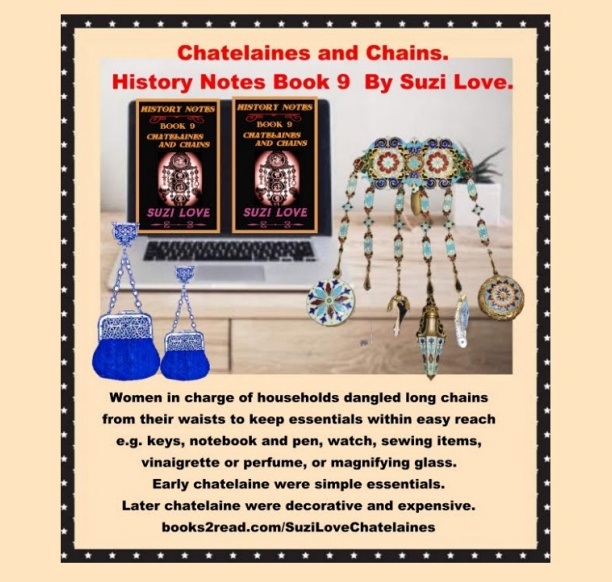
Chatelaines and Chains History Notes Book 9 By Suzi Love. What do you know about Chatelaines and Chains worn in Jane Austen’s and Bridgerton times? Women in charge of households carried important items with them. History Notes Book 9 Chatelaines and Chains. books2read.com/SuziLoveChatelaines
Personal Necessities, keys, or chatelaines was a set of useful items hung from waist by decorative chain. Chatelaines and Chains. History Notes Book 9 By Suzi Love. Women in charge of households dangled long chains from their waists to keep essentials within easy reach e.g. keys, notebook and pen, watch, sewing items, vinaigrette or perfume, or magnifying glass. Early chatelaine were simple essentials. Later chatelaine were decorative and expensive. http://books2read.com/SuziLoveChatelaines
Definition Chatelaine: The word Chatelaine is French and means the keeper of the keys. Chatelaine” derives from the Latin word for castle. In Medieval times, the chatelaine was in charge of the day-to-day running of the castle. Women in charge of households dangled long chains from their waists to keep essentials within easy reach e.g. keys, notebook and pen, watch, sewing items, vinaigrette or perfume, or magnifying glass. Early chatelaine were simple essentials. Later chatelaine were decorative and expensive.books2read.com/SuziLoveChatelaines
What did a chatelaine do? Most important task was keeper of the keys. Also ordered supplies, did bookkeeping, supervised servants, taught castle children, and organized guests.
Jane Austen’s and the Bridgerton ladies personal necessities, keys, or chatelaines was a set of useful items hung from waist by decorative chain. Chatelaines and Chains. History Notes Book 9 By Suzi Love. Women in charge of households dangled long chains from their waists to keep essentials within easy reach e.g. keys, notebook and pen, watch, sewing items, vinaigrette or perfume, or magnifying glass. Early chatelaine were simple essentials. Later chatelaine were decorative and expensive. http://books2read.com/SuziLoveChatelaines
Definition Chatelaine: The word Chatelaine is French and means the keeper of the keys. Chatelaine” derives from the Latin word for castle. In Medieval times, the chatelaine was in charge of the day-to-day running of the castle. Women in charge of households dangled long chains from their waists to keep essentials within easy reach e.g. keys, notebook and pen, watch, sewing items, vinaigrette or perfume, or magnifying glass. Early chatelaine were simple essentials. Later chatelaine were decorative and expensive.books2read.com/SuziLoveChatelaines
What did a chatelaine do? Most important task was keeper of the keys. Also ordered supplies, did bookkeeping, supervised servants, taught castle children, and organized guests.
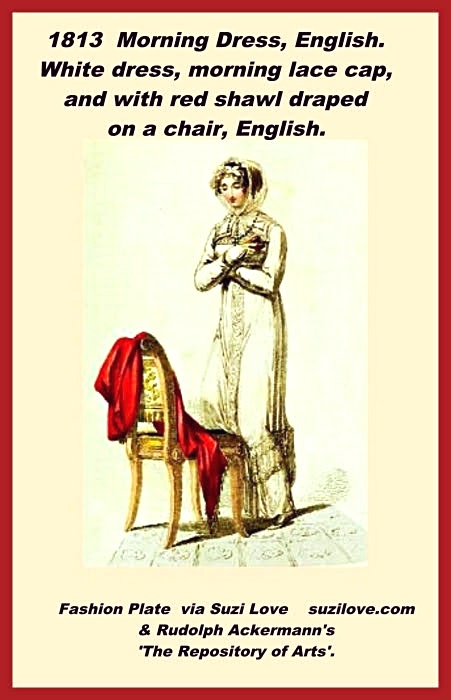
1813 October Morning Dress, English. Jane Austen and her family and friends would have worn this style of relaxed dress and cap. White At-Home dress with morning lace cap and a red shawl. Plain cambric underdress, three-quartered muslin or Chinese silk robe trimmed round the bottom and up the front with Indian border, or needle-work, and finished with a deep flounce of lace. Convent hood and pelerine of white net lace, confined under the chin with a silk cord and tassel. Hair in irregular curls with a fancy flower in the front. Short rosary and cross, plus bracelets, of coquilla beads. Buff or lemon kid slippers and pale tan gloves. Fashion Plate via Rudolph Ackermann’s ‘The Repository of Arts’.
This is a typical outfit worn at home in the morning in the house, to be seen only by family or close friends. A lady might wear this while writing having breakfast, writing letters, or reading. Called by the various names of Undress, to At-Home dress, or Morning dress, it is the most relaxed ensemble a lady will wear all day. The sort of outfit Jane Austen would have worn when writing her books.
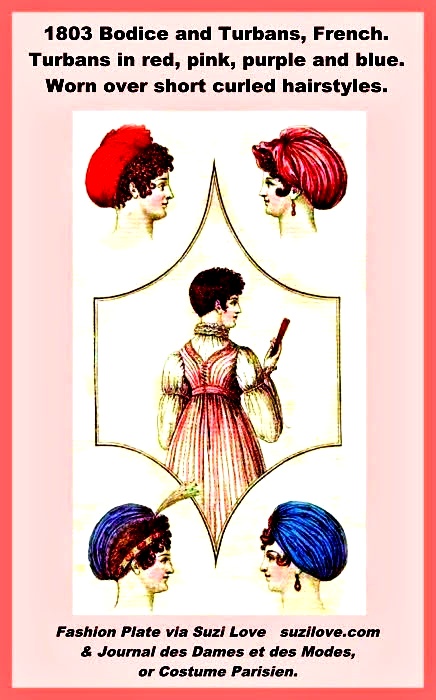
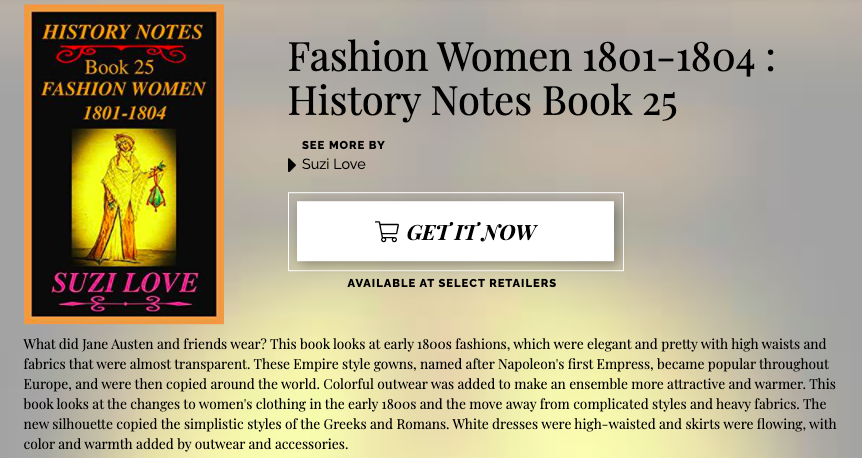
1803 Bodice and Turbans, French. Turbans in red pink purple and blue. Worn over short curled hairstyles. Fashion Plate via Journal des Dames et des Modes, or Costume Parisien.) https://books2read.com/SuziLoveFashionWomen1801-1804
Definition Turban: Early 19th-century etiquette required a lady’s head to be covered at all times, even with evening dress. In Jane’s Austen’s world, a lady wore some sort of hat or bonnet during the day when out and about, a cap during the night to keep her hair in place and for relaxed morning dress e.g. for breakfast, and for evenings either a small hat or turban. From 1800 to 1820, hats came in every shape, color, and size. Turbans, jockey caps, and straw bonnets were decorated with flowers, ribbons, lace, and feathers. Turbans, especially decorated with feathers were popular.
What did Jane Austen and friends wear? Early 1800s fashions were elegant and pretty with high waists and fabrics that were almost transparent. These Empire style gowns, named after Napoleon’s first Empress, became popular throughout Europe, and were then copied around the world. Colorful outwear was added to make an ensemble more attractive and warmer. History Notes Book 26 Fashion Women 1805-1809. https://books2read.com/SuziLoveFashionWomen1805-1809
The Empire waist gown defined women’s fashion during the Regency Era. ‘Empire’ is the name given in France to the period when Napoleon built his French Empire. High-waisted, loose gowns were adopted by the aristocracy as a symbol of turning away from the fussy, elaborate and expensive clothing worn in the 1700s. Jean-Jaques Rousseau advocated copying peasants and returning to a simpler life and more natural fashions. Unrestricting clothing was part of the new Democracy in France and these simpler and flowing fashions were adopted all over Europe, including Britain and despite the continual wars being fought against France during the early 1800s. Not even war stopped fashions from being copied everywhere.