1800s French Palais Royal Sewing Box and Twelve Mother of Pearl Enamel Tools. This is the style of sewing box Jane Austen and her family would have used in the early 1800s, or Regency years. via via suzilove.com and 1st Dibs Auctions 1stdibs.com
Definition: Palais Royal: Name of an area around the Royal Palace in Paris, France, that specialized in making small and exquisite works of art during the 18th and 19th centuries. Palais Royal sewing tools were elaborate and usually feature mother-of-pearl, often intricately carved or engraved. During the 19th century, workboxes were often works of art with engravings, carvings, mother-of-pearl, and elaborate gilt metal mounts. Most popular were scissors with steel blades and gilt mounts, thimbles and needle cases which were often shaped like animals or other natural forms. Workmanship was exceptional and the tools almost too fragile to use.
1775-1777 ca. Snuffbox With Medallion, Russian. Made by Johann Baltasar Gass St Petersburg, Russia. Gold, silver, cut diamonds; chased, engraved and pounced. via liveinternet.ru
1775-1777 ca. Snuffbox With Medallion, Russian. Made by Johann Baltasar Gass St Petersburg, Russia. Gold, silver, cut diamonds; chased, engraved and pounced. via liveinternet.ru
18th Century Snuff Boxes. Not only were boxes made to serve a purpose, but decorative boxes of all types were prized, especially in the 18th Century when everything decorative and extravagant was in vogue and taking a pinch of snuff was fashionable. Snuff is made from ground or pulverized tobacco leaves and is sniffed from a pinch of snuff placed on the back of the hand. Flavorings were added to the tobacco to give a fast hit of nicotine and a lasting scent. Snuff began in the Americas and was used in Europe by the 17th Century.
Snuff became popular from the mid 1600s to the mid 1800s and was more popular than smoking. Inhaling snuff, or snuffing, was first seen by a European missionary in 1493 in Christopher Columbus’s new world within Haiti’s indigenous Taino. Until then, tobacco had been unknown to Europeans, but its use spread quickly throughout Europe during the 1500s. By the second half of the 17th century, ornate boxes started being produced to keep the precious powder dry and an entire industry making accessories blossomed around the fashion of taking snuff. Noblemen, and some women, carried extravagantly decorated snuff boxes with them at all times and would offer a pinch of their own particular blend to friends and family. Therefore, these boxes were always on display and so it became a competition to see who could have the most bejeweled or expensive box possible.
1808 Fashionable English Couple, Dressed As In Jane Austen’s times. Lady in a white dress with pointed hem decorations, fitted white hat tied under her chin with yellow ribbon, yellow shawl and pink slippers. Gentleman in formal dress of blue tailcoat, black knee breeches, white stockings, black shoes, black bicorn hat, curly hair style and sideburns and a sword. Interestingly, this is English style fashions from a French magazine. Fashion Plate via Journal des Dames et des Modes, or Costume Parisien.
1808 Fashionable English Couple. Lady in a white dress with pointed hem decorations, fitted white hat tied under her chin with yellow ribbon, yellow shawl and pink slippers. Gentleman in formal dress of blue tailcoat, black knee breeches, white stockings, black shoes, black bicorn hat, curly hair style and side burns and a sword. Fashion Plate via Journal des Dames et des Modes, or Costume Parisien.1808 Fashionable English Couple Dressed As In Jane Austen's times. #RegencyFashion #JaneAusten #HistoricalFashion https://books2read.com/SuziLoveFashionWomen1805-1809 Share on X Fashion Women 1805-1809 History Notes Book 26 What did Jane Austen and friends wear? https://books2read.com/SuziLoveFashionWomen1805-1809
“I remember who you are, Lady Melton,” Captain Belling said in a cold voice, barely glancing over his shoulder at them. “The only thing I don’t know is why the hell you and that child are still anywhere near Waterloo, when all women were ordered to evacuate a week ago.”
“That child has a name, Captain. His name is Daniel, or if you are a stickler for formality, Viscount Melton.”The captain turned and frowned down at her son, who stared back at him with blatant curiosity and a small amount of animosity, as forthright as any young and intelligent child. Even at his young age, Daniel was a shrewd judge of character, and had been instructed by his uncles to be careful about trusting strangers. When the Captain turned back to the tattered maps spread over his makeshift desk, Anne ignored his unspoken dismissal and used the time to observe the infuriating man without having his condemning gaze fixed on her, as it had been a week earlier at the Duke and Duchess of Richmond’s extravagant Brussels ball. If she and Daniel were to travel with his group of wounded soldiers, Anne wanted to learn as much as possible about their leader. Her son’s survival depended on her being well informed and prepared for any eventuality.
Dust filtered down through a gaping hole in the high roof and settled in the Captain’s hair, turning it a darker brown than his normal golden yellow, though a bucketful of dust wouldn’t make any difference to the state of his stained uniform. His left pants’ leg had been sliced open to the knee, the two sides pinned clear of the large bandage winding down most of his leg, while a spindly wooden crutch was propped against the table.
His large physique had attracted her even before their dance at the ball, though his striking physical attributes didn’t compensate for his belligerent attitude, or for his obvious displeasure at encountering her both in Brussels and near the battlefield. Still, the Captain had undoubtedly scowled in a similar fashion at many women he’d met either in Brussels or at Waterloo, as she’d heard him spout his narrow-minded view at the ball to his fellow officers. The Captain believed that in the vicinity of battles only men should be allowed. Not women, and especially not ladies.
Early 1800s Typical Regency Couple in a Curricle. The sort of vehicle Jane Austen and her contemporaries would have driven in. Young men loved them and occasionally women drove them.
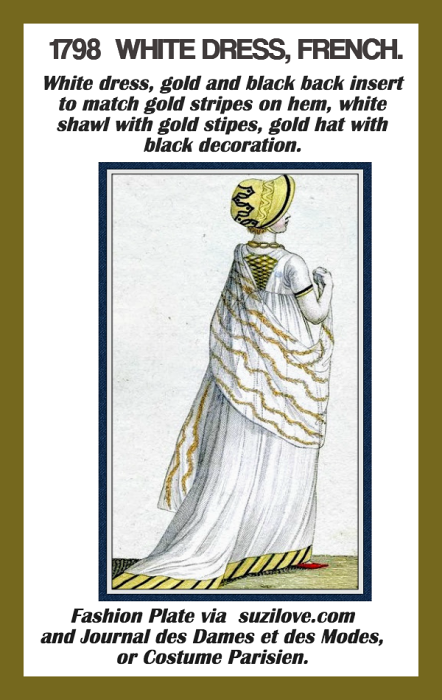
1798 White Dress, French. Gold and black back insert to match gold stripes on the hem, white shawl with gold stripes, gold hat with black decoration. Via Journal des Dames et des Modes or Costume Parisien.
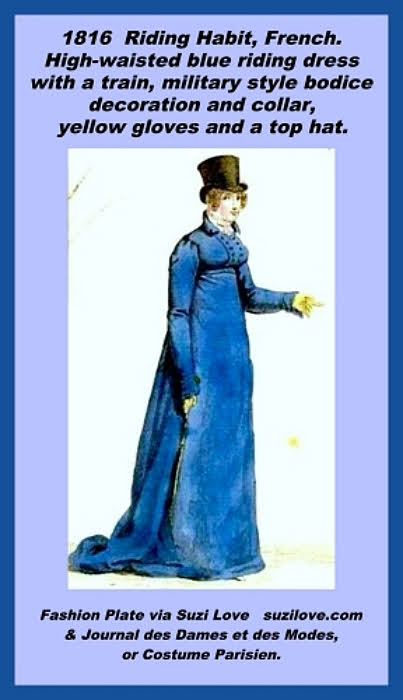
1816 Blue Riding Habit, French. High-waisted blue riding dress with a train, the long full skirt being necessary to cover a lady’s legs and preserve her modesty when riding side saddle. These riding habits were usually designed by men and were in two pieces, a jacket and a skirt, worn over a shirt. A military style bodice decoration, high pointed collar and a knotted pink dotted cravat worn underneath that imitate male styles, or even Dandy fashion. Sleeves are very long as was the trend in French riding habits. Yellow gloves and a masculine style beaver hat. This print was designed by Horace Vernet and engraved by Pierre Baquoy. Fashion Plate via Journal des Dames et des Modes, or Costume Parisien. Although, there are very similar riding habit fashion plates in other magazines.
The type of outfit Jane Austen and her friends would have worn if they went horse riding. https://books2read.com/SuziLoveFashionWomen1815-1819
1817 Pink Morning Walking Dress, French. High-waisted,high frilled neckline, long straight sleeves, triple layer of frills above the hem, bonnet with plumes, or feathers to decorate, and tied under the chin with pink ribbon, pink shoes and gloves. Most likely has white muslin dress with the white neck frill underneath the dress. Fashion Plate via Journal des Dames et des Modes, or Costume Parisien.
Definition Morning Walking Dress: Worn out shopping, walking in a city park or the country estate. Presentable and warm, more fashionable than Morning Dress but not overly accessorized.
1817 Pink Morning Dress, French. High-waisted,high frilled neckline, long straight sleeves, triple layer of frills above the hem, bonnet tied under the chin with pink ribbon, pink shoes. Fashion Plate via Journal des Dames et des Modes, or Costume Parisien.
1819 Pale Blue Redingote, Pelisse or Walking Dress, French. Blue redingote with pink bow showing off gorgeous neck frills and bonnet of castor decorated with tassels. The type of outfit young Regency Era ladies would have worn if they were out shopping on Bond Street, walking in a park, or taking a carriage ride through Hyde Park. Fashion Plate via Journal des Dames et des Modes, or Costume Parisien.
Definition Redingote Or Pelisse Or Walking Dress Or Coat: French word developed from English words, riding coat. Long fitted outdoor coat worn over other garments for warmth. Often left open at the front to show off the dress underneath. Sometimes cut away in front. Originally made with several capes and trimmed with large buttons. French fashion plates call these coats Redingotes and they are designed for women, men and children. English fashion plates call them a Pelisse, a walking dress, Promenade dress, or Carriage dress.