↓
 

Suzi Love

Making history fun, one year at a time.

Header_
  • Home
  • Newsletter
  • Pre order form
  • Shop
    • Cart
    • Checkout
    • My account
    • Refund and Returns Policy
  • Blog
  • BOOKS
    • History Events
    • Kelly’s Justice
    • Irresistible Aristocrats
    • History Notes
    • Scandalous Siblings
    • Love After Waterloo
    • Regency Life Series
  • Privacy Policy
  • EVENTS
Home » Europe » Page 15 << 1 2 … 13 14 15 16 17 … 46 47 >>

Category Archives: Europe

Post navigation

← Previous Post
Next Post→

Christmas: Lord Of Misrule #Christmas #holidays #Traditions #Customs

Suzi Love Posted on December 16, 2025 by Suzi LoveDecember 15, 2025

The Lord of Misrule was generally a peasant, or sub-deacon, and the revelries followed the Pagan tradition of Saturnalia and was a time of drunkenness and wild partying. The Church’s festival with a Boy Bishop, the leader of children’s festivities in choir schools, was similar, but was abolished by Henry VIII in 1541, restored by the Catholic Queen Mary, but again abolished by Protestant Elizabeth I. On the Continent, the Council of Basle suppressed it in 1431 but the custom was revived in some places from time to time, even as late as the eighteenth century. After the death of Edward VI in 1553, the English court stopped appointing a Lord of Misrule.

From A Survey of London by John Stow: Reprinted from the text of 1603.

‘…in the feaste of Christmas, there was in the kings house, wheresoeuer he was lodged, a Lord of Misrule, or Maister of merry disports, and the like had yee in the house of euery noble man, of honor, or good worshippe, were he spirituall or temporall.’

During the late medieval and early Tudor periods in England, Lord of Misrule, also called Abbot Of Misrule, or King Of Misrule, was appointed to manage the Christmas festivities held at court, in the houses of great noblemen, in the law schools of the Inns of Court, and in many of the colleges at the universities of Cambridge and Oxford.

His reign lasted anywhere from 12 days to 3 months and his role was to direct the masques, processions, plays, and feasts. Although this was mostly a British custom, in ancient Rome from the 17th to 23rd of December, a Lord of Misrule took on the guise of Saturn for the feast of Saturnalia and the ordinary rules were changed so that masters became slaves and the offices of state were held by slaves. The Lord of Misrule presided and could command anyone to do anything. Our contemporary Christmas holidays seem to have originated from this idea of festive holidays.

The custom began in December 1551 when the Duke of Somerset, Edward VI’s uncle Edward Seymour, was in the Tower of London awaiting execution. He sent a note to the Master of Revels to appoint George Ferrers as Lord of Misrule. Ferrers was a courtier and poet who later contributed to A Mirror for Magistrates, described by Scott Lucas as a “compendium of tragic monologues” by a series of historical personages.

Scotland had the Abbot of Unreason (suppressed in 1555) as their equivalent to the Lord of Misrule and scholars believe both ideas came from the “king” or “bishop” who presided over the earlier Feast of Fools.

Xmas_Lord Of Misrule
Christmas: Lord Of Misrule Custom #Christmas #holidays #Traditions #Customs. books2read.com/suziloveHOCP Share on X
Posted in Australia, Canada, Christmas, Customs & Manners, England, Europe, History Of Christmases Past, Suzi Love Images, U.S.A | Tagged Christmas, Customs and Traditions, History Of Christmases Past, pastimes

Christmas: Bring In The Boar’s Head. #Christmas #holidays #customs #BritishHistory #RegencyEra

Suzi Love Posted on December 15, 2025 by Suzi LoveDecember 15, 2025

The Boar’s head At Christmas.

Christmas in the Olden Time by Walter Scott. 

Then was brought in the lusty brawn

By old blue-coated serving man;

Then the grim boar’s head frowned on high,

Crested with bays and rosemary.

Well can the green-garbed ranger tell

How, when and where the monster fell;

What dogs before his death he tore,

And all the baitings of the boar.

The wassal round, in good brown bowls,

Garnished with ribbons, blithely trowls.

There the huge sirloin reeked: hard by

Plum-porridge stood, and Christmas pye;

Nor failed old Scotland to produce,

At such high-tide, her savory goose.

Because wild boar was the most feared animal, serving it at a meal represented the victory of good over evil. During the 17th century, wild boar became extinct in Britain so a pig’s head was used instead. The head was often presented on a decorated platter with an apple in its mouth and carried in by bearers in a dramatic manner. The tradition of serving ham for Christmas lunch or dinner probably came from the idea of serving boar’s head or roasted boar joints to guests at Christmas.

To say nothing of the roast beef and plum-pudding, Christmas pies, furmity, and snap-dragons, the Yule-log and the mistletoe have not finally abdicated, while the boar’s head, decorated with rosemary or prickly holly, maintains its place at the English Christmas dinner, and is still served up in great state at the royal Christmas table. At Oxford, U.K., the boar’s head was carried in by the strongest of the guardsmen, singing a Christmas carol, and preceded by a forester, a huntsman, and a couple of pages dressed in silk and carrying the mustard which was regarded as a great luxury and  an infallible digester.

Xmas_Boar's Head
Xmas_Boar's Head
Xmas_Boar's Head

The following celebrated carol of the Boar’s Head is found in the book of  ‘Christmasse Carolles’ published in 1521 by Wynkyn de Warde: 

The boar’s head in bande bring I,     

With garlandes gay and rosemary,

I pray you all synge merely,

Qui estis in convivio.

“The bore’s head, I understande,

Is the chefe servyce in this lande.

Loke wherever it be fande,

Servite cum cantico.

“Be gladde, lordes, both more and lasse,

For this bath ordayned our stewarde,

To chere you all this Christmasse,

The bore’s head with mustarde.”

At Oxford, U.K., the boar’s head was carried in by the strongest of the guardsmen, singing a Christmas carol, and preceded by a forester, a huntsman, and a couple of pages dressed in silk and carrying the mustard which was regarded as a great luxury and  an infallible digester. A similar custom appears to have prevailed in Genoa in the times of the Dorias when a boar decorated with branches of laurel and accompanied by trumpeters was annually presented to the Doria family by the Abbot of San Antonio at Pré at midday on the 24th of December.

Christmas: Bring In The Boar's Head. #Christmas #holidays #customs #BritishHistory #RegencyEra https://books2read.com/suziloveHOCP Share on X

Posted in 1700s, 1800s, Christmas, Customs & Manners, England, Europe, Food and Drink, Georgian Era, Regency Era, Romantic Era, Suzi Love Images, Victorian Era | Tagged Christmas, Customs and Traditions, europe, Food, Great Britain, household, Suzi Love Images

Christmas: Mistletoe and its long history. #Christmas #Holidays #Customs #BritishHistory

Suzi Love Posted on December 14, 2025 by Suzi LoveDecember 14, 2025

Another Christmas Tradition is kisisng under the Mistletoe. So have fun this Christmas and find someone to kiss. The problem in hotter climates is to find the Mistletoe, of course. Darn!

Mistletoe was used by Druid priests 200 years before the birth of Christ in their winter celebrations. They revered the plant since it had no roots yet remained green during the cold months of winter. The ancient Celtics believed mistletoe to have magical healing powers and used it as an antidote for poison, infertility, and to ward of evil spirits. The plant was also seen as a symbol of peace, and it is said that among Romans, enemies who met under mistletoe would lay down their weapons and embrace.

Scandanavians associated the plant with Frigga, their goddess of love, and it may be from this that we derive the custom of kissing under the mistletoe. Those who kissed under the mistletoe had the promise of happiness and good luck in the following year. Mistletoe was associated with Christmas as both a decoration under which lovers kiss, as well as a protection from witches and demons. Sounds romantic, although mistletoe is actually a parasitic plant that grows on other trees or plants and comes in many varieties.  

In Britain, mistletoe was mainly found in the western and southwestern parts, so the custom wasn’t even followed in all parts of England. But where the mistletoe custom was followed, it was hung in doorways and the greenery was watched by young gentlemen in hopes of catching a pretty girl to kiss, usually on the cheek.      

Traditionally, a man was allowed to kiss a woman who was standing underneath mistletoe and bad luck would befall any woman who refused. In some places, it was the custom to pick a berry for each kiss and when all the berries were gone, no more kisses could be taken.

Xmas_Mistletoe
Xmas_Mistletoe
Xmas_Mistletoe
cropped to image, recto, unframed
Xmas_Mistletoe
Xmas_Mistletoe
Christmas: Mistletoe and its long history. #Christmas #Holidays #Customs #BritishHistory https://books2read.com/suziloveHOCP Share on X
Posted in 1700s, 1800s, Australia, Christmas, Customs & Manners, dancing, England, Europe, Georgian Era, History Of Christmases Past, household, Regency Era, Romantic Era, Suzi Love Images, U.S.A, Victorian Era | Tagged British history, Christmas, Customs and Traditions, dancing, europe, Georgian era, History Of Christmases Past, Regency Era

Christmas: Twelve Days Of Christmas and Twelfth Night.

Suzi Love Posted on December 13, 2025 by Suzi LoveDecember 11, 2025

Twelve Days of Christmas

Days and nights used to be counted separately, so the important night was often the night before rather than the night of, which is why some parts of the world celebrate Christmas on Christmas Eve. Therefore, the twelve days of Christmas actually begin on the eve of December 25th, the first night, and end on January 6th, which is Epiphany. The day of December 26 is the first day and the eve of December 26 the second night.

The famous Twelfth Night is the eve of Epiphany and the twelfth day is Epiphany itself. During these twelve days, traditional roles were relaxed or turned upside down so that masters waited on their servants, men were allowed to dress as women and women as men. These crazy antics can also be seen in modern Christmas pantomimes in which authority is mocked, women play male leads and the leading older female character is played by a man.

Twelfth Night

The Twelfth Night festival marked the onset of the winter solstice, the point in late December when the sun, whose daily arc had reached its lowest and darkest. 

Twelfth Night is the eve before the twelfth day of Christmas or the Epiphany celebration, which commemorates the adoration of the Magi before the infant Jesus and marks the final night of the Christmas season. Twelve Nights,” which extended from the 25th of December to the 6th of January. The Twelve Nights were religiously observed by numerous feasts, and were regarded by the ancient Germans as among the holiest and most solemn of their festivals.

In Tudor England, the Twelfth Night marked the end of a winter festival that started on All Hallows Eve. A King or Lord of Misrule would be appointed to run the Christmas festivities, and the Twelfth Night was the end of his period of rule. Shakespeare’s play, Twelfth Night, or What You Will, was originally written to be performed as a Twelfth Night entertainment. After Twelfth Night, the Carnival season starts and lasts until Mardi Gras. In some places, Twelfth Night celebrations include food traditions such as the king cake or tortell.

In the Bavarian and Styrian Alps the Twelve Nights are called “Rumor Nights,” on account of their visions of ghosts and hobgoblins, when priests and prudent housewives, with prayer and invocation, holy-water and burning incense, fumigate dwelling and outhouse, and sprinkle their cattle with salt. Hence these nights were also called “Fumigating Nights.” As an additional protection against “witches’ feet” and “devils’ paws,” the initials of the holy magicians were formerly inscribed upon the door-posts. On the dreaded Twelfth-night, when Frau Holle, or Berchta, issues with her fearful train from her wild mountain home, where she dwells among the dead, she is generally preceded by the faithful Eckhart, an old man with a long beard and a white wand, who warns every one of her terrible approach.

Xmas_Twelth Night
Xmas_Twelth Night
Xmas_Twelth Night
Christmas: Twelve Days Of Christmas and Twelfth Night. https://books2read.com/suziloveHOCP Share on X
Posted in Christmas, Customs & Manners, England, Europe, Food and Drink, History, household, Suzi Love Images | Tagged British history, Christmas, Customs and Traditions, drinks, Food, household, Suzi Love Images

Christmas: Wassail Bowl History #Christmas #holidays #Traditions #Customs

Suzi Love Posted on December 12, 2025 by Suzi LoveDecember 11, 2025

Christmas: Wassail Bowl History #Christmas #holidays #Traditions #Customs

The term wasseling refers to the jovial revelry and carousing that went on in historic England when all classes of society would gather around a common banquet-table and the wassail bowl and indulge in the most unrestrained joviality and merriment around.

Wassail Bowl: Most great houses had a wassel-bowl, or cup, frequently of massy silver. Toasts were “Drine heil,” or “Was hail,” from which the howl derives its name but were replaced around the nineteenth century by “Come, here’s to you,” or “I’ll pledge you.” Now, we toast with the simplified version of ‘Here’s to you’. As the hour of twelve approached, carol-singers would prepare and bell-ringers would place themselves at their post to usher in the morning of the Nativity with lots of rejoicing and with bands of music parading the towns.

In some parishes in the West of England, carol-singers adjourn to the church to sing in Christmas-day, a remnant probably of popery, as in Catholic countries there were frequently church-services held at this time. In the 16th century, Tusser prescribed for Christmas: good drink, a good fire in the hall, brawn, pudding, and mustard withall, capon, or turkey, cheese, apples, nuts, and jolly carols. In rich houses, a wassail cup would be filled with rich wine, sweet and spicy, and with roasted apples bobbing on the surface. In poorer houses, the cup would hold ale with nutmeg, sugar, ginger, and roasted crab apples.

Xmas_wassail
Xmas_wassail
Christmas: Wassail Bowl History #Christmas #holidays #Traditions #Customs https://books2read.com/suziloveHOCP Share on X
Posted in 1700s, 1800s, Christmas, Customs & Manners, England, Europe, Food and Drink | Tagged British history, Christmas, Customs and Traditions, drinks, europe, google books, History Of Christmases Past, pastimes

Christmas Greenery: Holly, Ivy and Evergreen Boughs. #Christmas #Holidays #customs #Europe

Suzi Love avatarPosted on December 12, 2025 by Suzi LoveDecember 11, 2025

Christmas Greenery: Holly, Ivy and Evergreen Boughs. #Christmas #Holidays #customs #Europe https://books2read.com/suziloveHOCP

Continue reading →
Posted in Australia, Canada, Christmas, Customs & Manners, Edwardian Era, England, Europe, Georgian Era, History, household, Regency Era, Romantic Era, South Pacific, Suzi Love Images, U.S.A, Victorian Era | Tagged Christmas, Customs and Traditions, History Events, History Of Christmases Past, household

Christmas: Christmas Card History #Christmas #holidays #Traditions #Customs #VictorianEra

Suzi Love Posted on December 11, 2025 by Suzi LoveDecember 11, 2025

Sending Christmas Cards.

At the end of the winter term, schoolmasters would set their pupils to work on Christmas Pieces, samplers of writing on superior paper with engraved borders, to show parents how they had progressed during the year. By about 1820, the engraved borders were enhanced with color and the children’s pieces became more decorative.

However, the custom of sending cards at Christmas was started in the United Kingdom in 1843 by Sir Henry Cole. Postage had been standardized three years earlier and Cole was a civil servant who had played a key role in initiating Uniform Penny Post. He wanted ordinary people to become more interested in the new ‘Public Post Office’. With his artist friend John Horsley, they designed the first card which was issued from a periodical, Felix Summerley’s Home Treasury, and were sold for 1 shilling each.

The card was lithographed, hand-colored, had three panels and was in a rustic frame of carved wood and ivy. The outer two panels showed people caring for the hungry and the naked. The centre panel showed a family of three generations having Christmas dinner, although the temperate classes strongly objected to the idea of a child being given a glass of wine with dinner.

Xmas_Christmas Card

New railways carried more post, and a lot faster, than a horse and carriage so the Post Office offered a Penny stamp. Cards became even more popular when they could be posted in an unsealed envelope for one halfpenny. Christmas cards became truly popular when printing improved and cards could be produced in large numbers, around 1860. By the early 1900s, the custom had spread over Europe and especially in Germany.

Early cards usually pictured Nativity scenes, but in the late Victorian times, robins and snow-scenes became popular because the postmen wore red uniforms and were nicknamed ‘Robin Postmen’. Snow-scenes were also popular because they were a reminder of the very bad winter of 1836.

Snow scenes reflected the snowy and often harsh northern hemisphere winters when opening and reading Christmas cards was an enjoyable family experience.  In 1860, Charles Goodall & Son, a British publisher of visiting cards, began mass producing cards to be used for visits during the Christmas period. These Christmas and New Year’s visiting cards were decorated with simple designs such as a twig of holly or flowers.

Sales of cards grew and designs and sizes changed. The first cards were meant to appeal to the masses and encourage them to send large numbers by post, so rather than focus on religious images, they showed sentimental or humorous images of family and children, fanciful designs of flowers, fairies, or reminders of the approach of spring. Religious themes of nativity scenes, children looking at the manger, or angels and candles remain popular to the modern day.

Cards could be shaped like bells, a fan, a crescent, a circle, or a diamond and were folding, decorated with jewels, iridescent, embossed, and carried either simple Christmas and New Year greetings or had verses and carols written in them. The next year, Mr W.C.T. Dobson produced a sketch symbolizing the ‘Spirit of Christmas’ which sold many more than the previous thousand and the novelty caught on.

Many artists became famous for their annual illustrations that became postcards and cards.  Printing technology became more advanced in the age of industrialisation and the price of card production dropped. With the introduction of the halfpenny postage rate, the Christmas card industry industry increased until in 1880 11.5 million cards were produced.

Xmas_Christmas Card
Xmas_Christmas Card
Xmas_Christmas Card
Xmas_Christmas Card
Xmas_Christmas Card
Xmas_Christmas Card
Xmas_Christmas Card
Xmas_Christmas Card
Xmas_Christmas Card
Christmas Card History #Christmas #holidays #Traditions #Customs #VictorianEra https://books2read.com/suziloveHOCP Share on X
Posted in 1800s, Australia, Canada, Christmas, Customs & Manners, England, Europe, household, Pastimes, Suzi Love Images, U.S.A, Victorian Era | Tagged British history, British Postal Museum, Christmas, Customs and Traditions, europe, History Of Christmases Past, postal, Victoria and Albert Museum, Victorian Era

Christmas: How did they celebrate Christmas in Bridgerton and Jane Austen times? #Christmas #Christianity #Bridgerton #JaneAusten #holidays

Suzi Love Posted on December 10, 2025 by Suzi LoveDecember 9, 2025

How did they celebrate Christmas in Bridgerton and Jane Austen times? Historical information about the traditions of Christmas through the centuries, including the religious aspects, decorations, games, food and plays. History Of Christmases Past has lots of information and images about Christmas through the centuries, including religious aspects, decorations, games, food and plays. Historic images show how some traditions have changed while many have remained the same through the centuries. books2read.com/suziloveHOCP

How did they celebrate Christmas in Bridgerton and Jane Austen times? Historical information about the traditions of Christmas through the centuries, including the religious aspects, decorations, games, food and plays. #holidays #Christmas #Christianity #Bridgerton #JaneAusten http://books2read.com/suziloveHOCP
How did they celebrate Christmas in Bridgerton and Jane Austen times? Historical information about the traditions of Christmas. #holidays #Christmas #Christianity #Bridgerton #JaneAusten http://books2read.com/suziloveHOCP Share on X


Posted in 1700s, 1800s, 1900s, Australia, Bridgerton, Canada, Christmas, Customs & Manners, Edwardian Era, England, Europe, Events, Food and Drink, Georgian Era, History Of Christmases Past, household, Jane Austen, Music, Regency Era, Romantic Era, Royalty, South Pacific, Suzi Love Books, Suzi Love Images, U.S.A, Victorian Era | Tagged Book 1, Bridgerton, British history, Christmas, Customs and Traditions, drinks, Edwardian Era, Food, Georgian era, History Events, History Of Christmases Past, household, Jane Austen, music, Queen Victoria, Regency Era, Regency Royalty, Suzi Love Books, Victorian Era

Christmas: Typical Christmas Food Eaten By the Bridgerton and Jane Austen Families. #Christmas #Food #JaneAusten #Bridgerton

Suzi Love Posted on December 9, 2025 by Suzi LoveDecember 9, 2025

Christmas: Typical Christmas Food Eaten By the Bridgerton and Jane Austen Families. #Christmas #Food #JaneAusten #Bridgerton

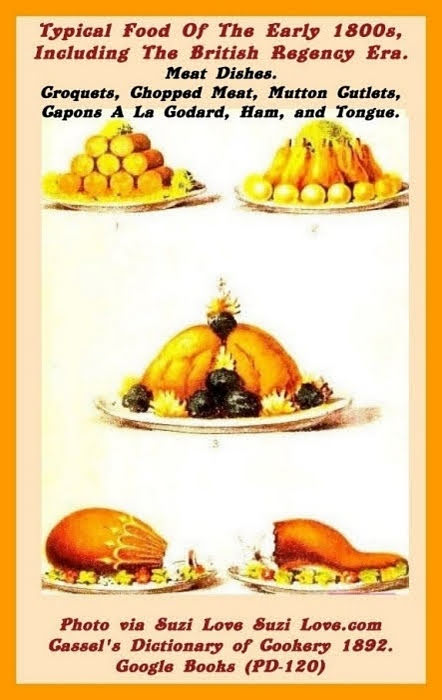
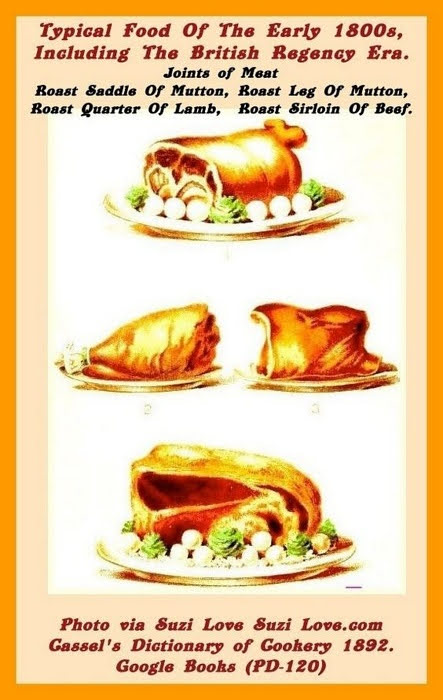
On the Christmas menu was generally mince pies and perhaps a goose or a piece of beef, depending on the family’s wealth and status. Mince pies were not made of fruit mince as we do now, but of offal or meat such as bullock’s tongue cooked with spices, orange peel, and wine and then used to fill pastry cases.

Another Christmas specialty was a Yorkshire Christmas pie which would be filled with turkey, goose, a hen, or perhaps woodcocks, partridge, or pigeons. And after the main courses, came the Plum Pudding, mixed on Stir-Up Sunday according to each family’s recipe and then boiled in a cloth.

Xmas_food_1800s_Typicalchristmasdesserts_1892cassells
Xmas_food_1800s_TypicalPies-and-Puddings_MrsBeeton
Food_1800s_Typical Food of the Early 1800s Including the British Regency Era. Meat Dishes- Croquettes, chopped meat, mutton cutlets, capons A la Godard, Ham and Tongue. 1892 Cassell_Sml
Food_1800s_Typical Food of the Early 1800s. Including the Regency Era. Joints Of Meat_Sml
food_1800s_Typical Historical Christmas Meal. Boars Head, Wassail Bowl, Punch Bowl, Roast Swan, Punch Jelly, Lamb_s Wool, and Truffles. Plate via Cassell_s Dictionary of Cookery_Sml
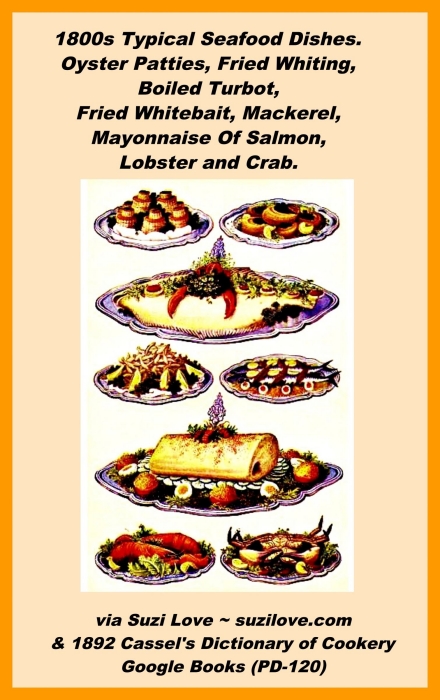
Food_1800s_TypicalFishDishes_OysterPattties_FriedWhiting_BoiledTurbot_friedWhitebait_Mackera=el_MayonaiseOfsalmon_Lobster_Crab_From1892Cassells
food_1800s_TypicalGame and Poultry (1). Snipe On Toast, Larks On Toast, Roast Pheasant, Roast Pigeons, Roast Fowl, Roast Goose, Roast Duck, Boiled Fowl, Roast Turkey_1860s_Mrs. Beeton_Sml
Food_1800s_TypicalJoints_SirloinofBeef, Boiled Beef, Leg Of Mutton, Roast Ribs Of Beef. From- 1861 Mrs. Beeton_Sml
Christmas: Typical Christmas Food Eaten By the Bridgerton and Jane Austen Families. #Christmas #Food #JaneAusten #Bridgerton https://books2read.com/suziloveHOCP Share on X
Posted in 1700s, 1800s, Australia, Bridgerton, Canada, Christmas, Customs & Manners, England, Europe, Food and Drink, Georgian Era, History, History Of Christmases Past, household, Jane Austen, Regency Era, Romantic Era, Suzi Love Images, U.S.A, Victorian Era | Tagged Bridgerton, British history, Christmas, europe, Food, google books, History Of Christmases Past, household, Jane Austen, Suzi Love Images

Christmas: Mince Pies #Christmas #holidays #Food #Traditions #Customs

Suzi Love Posted on December 9, 2025 by Suzi LoveDecember 8, 2025

Christmas Mince Pies.   

‘The following is a valued receipt that has been handed down in a Cornish family for many generations,
and the hand-writing of the receipt book will vouch for its antiquity.
‘A pound of beef-suet chopped fine;
a pound of raisins do. stoned.
A pound of currants cleaned dry.
A pound of apples chopped fine.
Two or three eggs.
Allspice beat very fine, and sugar to your taste.
A little salt, and as much brandy and wine as you like.
An ancient Cornish custom at Christmas.”
A small piece of citron in each pie is an improvement.’
From: 1833 Christmas Carols, Ancient and Modern by William Sandys.

Mince meat pies, or Christmas or Twelfth Night pies, were always part of Christmas feasts. Originally the mince pies were oblong or oval but in the 1600’s, the pies became circular, although were quite large and could weigh up to 20 lbs. In London, they could be brought out on Lord Mayor’s Day which was the 9th of November.

Timeline of Mince Pies via Minced Pie Club.

  • In the 13th century, crusaders returned from the Middle Eastern with recipes containing meat, fruit and spices mixed together, which helped preserve meat without having to smoke, dry or salt.
  • 1413 King Henry served a mincemeat pie at his coronation.
  • 1588 Good Hous-Wiues Treasurie by Edward Allde: meats were still cut up to be eaten with a spoon and combined with fruits and heavy spices. His recipe for Minst Pye had practically the same ingredients as modern mince pies.
  • 1657 Mince Pies were banned during the reign of Oliver Cromwell, along with other Christian traditions that were classed as gluttony.
  • 1659 Oliver Cromwell’s Puritan influence spread to the American British Colonies and many towns banned mincemeat pies at Christmas time.
  • When pies were reintroduced in Britain, they were a lot smaller and could be served individually to guests and were named Wayfarer pies.
  • 1832 Bill of Fare: no less than one hundred and eleven dishes of mince pies included.
Xmas_Christmas: Mince Pies
  • More Minced Pie Trivia
  • When the monarchy was restored in 1660, the law regarding Minced Pies was disregarded but apparently never repealed so Mince pies are still, supposedly, illegal.
  • Pastry crusts sink in the middle and are thought to resemble Jesus’ manger so sometimes a small pastry doll was put in the middle and these were called crib pies.
  • Pies could last up to two months in cold weather.
  • Recipes varied by region, but usually included beef, poultry and other meats, suet, sugar, raisins or currants, spices, orange and lemon peel, eggs, apples and brandy.
  • Minced-meat was only supposed to be stirred clockwise, otherwise the stirrer would have bad luck in the coming year. bring bad luck for the coming year.
  • Filling included cinnamon, cloves and nutmeg to represent the gifts of the Magi to the infant Jesus and the star shaped pastry on top represents the star of Bethlehem.
  • If you ate minced pie every day of the twelve days of Christmas you were supposed to have twelve months of happiness, especially if the pies were baked by the dozen and offered by friends.
Christmas: Mince Pies #Christmas #holidays #Food #Traditions #Customs https://books2read.com/suziloveHOCP Share on X
Posted in 1700s, 1800s, 1900s, Christmas, Customs & Manners, Edwardian Era, England, Europe, Food and Drink, Georgian Era, History Of Christmases Past, household, Regency Era, Romantic Era, Suzi Love Books, Victorian Era | Tagged British history, Christmas, Customs and Traditions, England, europe, Food, History Of Christmases Past

Post navigation

← Previous Post
Next Post→

SUBSCRIBE TO SUZI LOVE'S NEWSLETTER.

Recent Posts

  • 1802 Bridgerton and Jane Austen Style Dress Bodices and Two Cute Bonnets. #Bridgertons#Regency #Hats #JaneAusten
  • Love After Waterloo: There’d been nowhere safe to hide a lady and her son at Waterloo. #HistoricalEroticRomance #MilitaryRomance #Waterloo #RegencyRomance #ReadARegency
  • “There is a stubbornness about me that never can bear to be frightened at the will of others. My courage always rises at every attempt to intimidate me.” Jane Austen Pride and Prejudice (1813) #JaneAusten #RegencyEra #Quote
  • 1780-1820 ca. Brown Leather Boots, British, As Worn In Bridgerton and Jane Austen Times. #Bridgerton #JaneAusten #GeorgianEra #RegencyEra #Shoes
  • 1756-1762 ca. Gold and Enamel Étui, French. #GeorgianEra #France #Antiques #WritingToools

Recent Comments

  1. Suzi Love on Book Hooks: Earl of Winchester has no time for mad scientist Lady Jamison yet when he’s with her, desire explodes. #HistoricalMystery #RomCom #VictorianRomance #RegencyRomance
  2. Suzi Love on Book Hooks: Earl of Winchester has no time for mad scientist Lady Jamison yet when he’s with her, desire explodes. #HistoricalMystery #RomCom #VictorianRomance #RegencyRomance
  3. Maggie Blackbird on Book Hooks: Earl of Winchester has no time for mad scientist Lady Jamison yet when he’s with her, desire explodes. #HistoricalMystery #RomCom #VictorianRomance #RegencyRomance
  4. Suzi Love on Book Hooks: Earl of Winchester has no time for mad scientist Lady Jamison yet when he’s with her, desire explodes. #HistoricalMystery #RomCom #VictorianRomance #RegencyRomance
  5. Jana Richards on Book Hooks: Earl of Winchester has no time for mad scientist Lady Jamison yet when he’s with her, desire explodes. #HistoricalMystery #RomCom #VictorianRomance #RegencyRomance

Login

  • Log in

Archives

  • April 2026
  • March 2026
  • February 2026
  • January 2026
  • December 2025
  • November 2025
  • October 2025
  • September 2025
  • August 2025
  • July 2025
  • June 2025
  • May 2025
  • April 2025
  • March 2025
  • February 2025
  • January 2025
  • December 2024
  • November 2024
  • October 2024
  • September 2024
  • August 2024
  • July 2024
  • June 2024
  • May 2024
  • April 2024
  • March 2024
  • February 2024
  • January 2024
  • November 2023
  • October 2023
  • September 2023
  • August 2023
  • July 2023
  • June 2023
  • April 2023
  • March 2023
  • February 2023
  • June 2022
  • April 2022
  • March 2022

Categories

  • 1700s
  • 1700s Mens fashion
  • 1700s Womens Fashion
  • 1800s
  • 1800s Mens Fashions
  • 1800s women's fashion
  • 1900s
  • art
  • Australia
  • Bath
  • bedroom fashion
  • Book Hooks
  • Box Or Container
  • Bridgerton
  • Bus Trips
  • Canada
  • Carriage
  • cartoon
  • Celebrity
  • Chatelaine
  • children
  • Children
  • Christmas
  • Coat or Pelisse Or Redingote
  • Contemporary
  • Corset
  • Couple
  • Customs & Manners
  • dancing
  • December Scandal
  • Decorative Item
  • Dress Or Robe
  • Easter
  • Edwardian Era
  • Embracing Scandal
  • England
  • Ester In Images
  • Europe
  • Events
  • Fashion
  • fashion accessories
  • Food and Drink
  • Four Times A Virgin
  • France
  • furniture
  • Georgian Era
  • Georgian Fashion
  • Google Books
  • Grand Tour
  • Group
  • hats
  • History
  • History Events
  • History Notes
  • History Of Christmases Past
  • household
  • Hygiene
  • Irresistible Aristocrats
  • Jane Austen
  • Keanu Reeves
  • Kellys Justice
  • Legal
  • London
  • Love After Waterloo
  • Loving Lady Katharine
  • medical
  • military
  • money
  • mourning
  • Music
  • Outback Arrival
  • pants
  • Pastimes
  • peerage
  • People
  • Petunia and Pearl Diver
  • Places
  • Pleasure House Ball
  • postal
  • Queensland
  • Quotations
  • Regency Era
  • Regency Fashion
  • Regency Life Series
  • Reticule or Bag
  • riding
  • Romantic Era
  • Royalty
  • Russia
  • Scandalous Siblings Series
  • Scenting Scandal
  • Self Publishing
  • sewing
  • Shirt
  • shoes
  • South Pacific
  • Spencer
  • sports
  • Suit
  • Sunday Snippet
  • Suzi Love
  • Suzi Love Books
  • Suzi Love Images
  • Suzi Love Writing
  • Swain Cove
  • THe Viscount's Pleasure House
  • travel
  • U.S.A
  • underclothing
  • Vest or Waistcoat
  • Victorian Era
  • Victorian Fashion
  • weapons
  • weddings
  • Writing Tools

1800s men fashion 1800s women's fashion antiques Bridgerton British history Cartoons Corset cravat decorative Dress Or Gown England europe fashion accessories Fashion Plate France Georgian era Georgian Fashion gloves google books Hats And Hair historical romance History Notes household Jane Austen jewelry Journal des Dames et des Modes London Metropolitan Museum NYC pants Redingote Or Pelisse Or Coat Regency Era Regency Fashion Regency London reticule or bag riding sewing shawls Shoes Suzi Love Books Suzi Love Images Tailcoat The Repository Of Arts underclothing Vest or Waistcoat Writing Tools

©2026 - Suzi Love - Weaver Xtreme Theme Privacy Policy
↑