1789-1790 ca. Man’s Red Riding Coat, England or France. Wool plain weave, full finish, with metallic-thread embroidery, tan breeches, black riding boots and crop. Credit: (M.2007.211.46) via Los Angeles County Museum of Art, California, USA. collections.lacma.org
1789-1790 Man’s Red Riding Coat, England or France. Wool plain weave, full finish, with metallic-thread embroidery Credit: (M.2007.211.46) via Los Angeles County Museum of Art, California, USA. collections.lacma.org suzilove.comHN_2_D2D_Fashion Men 1700s
books2read.com/suziloveFashMen1700
1800 Outfit Of A Young Man With Grey Cutaway Coat, French. Grey cutaway coat, red vest or waistcoat, high white cravat, yellow breeches with red fob at waist, yellow gloves, black boots with tassels, hat and walking stick. Fashion Plate via Journal des Dames et des Modes, or Costume Parisien.
In the early years of the 19th century, men’s fashions changed dramatically. Coats were cut higher in the front and finished in long tails at the back. Waist length square-cut waistcoats were displayed beneath tailcoats. The lining of the shoulders and upper chest of the coat was sometimes quilted to improve the fit and some dandies wore boned corsets to give them a small waist. Trousers became increasingly fashionable in the first quarter of the 19th century as men gradually adopted long trousers rather than knee breeches. At first long length pants were only worn for day and informal dress and breeches were still required for court dress, but by the 1820s trousers were accepted as evening wear.
Typical menswear in the early 1800s included a tailcoat, a vest or waistcoat, either breeches, pants, or the newer trousers, stockings, shoes or boots, all worn with an overcoat and hat. This basic ensemble was accessorized with some form of neckcloth or cravat, gloves, walking stick, cane or riding crop, handkerchief, fobs, watch and perhaps a quizzing glass or eye glass. The tan hat from the late 18th century was worn and developed into the top hat which was worn for day and formal dress throughout the 19th century. Hair was carefully styled into a windswept look or worn short and curled.
1830 ca. Quilted Buff Canvas Corset, English. Quilted canvas, wood, boning, and brass. Self lined, quilted with back stitch.
Front fastening, shoulder straps, and brass eyelets for back. The wide centre front busk may be of wood and these stays are boned from the waist through the centre of the bust gussets, with three bones at each side and on each side of the back lacing. The rest is quilted, the top is over a cord foundation, and there are gussets at the hips. Eyelets in the back and strap lacing are of brass and machine inserted. On the left of the centre busk at hip level, is a tape stretched so that it ties horizontally. The top and straps are bound with tape. Self lined, quilted in back stitch, the waist is herringboned, and the bases of the bust and hip gores are button-holed. via Victoria and Albert Museum, London, UK. collections.vam.ac.uk
19th Century Early Reticule, Or Bag, New England, England or U.S.A. Septagonal, or four sided, with embroidery and silk tassels. White satin embroidered with polychrome silks, silver threads, silver sequins. On front, in center of wreath of roses tied with blue bow, is written VALUE THE TRIFLE. On back, in similar wreath, is FRIENDSHIP. On sides are floral motifs, one of sweetpeas and the other of pansies. On all sides a border of silver threads in chain motif entwined with curling brown vine. Primarily worked in satin stitch. Thirteen silk tassels attached. White ribbon ties. via Museum of Fine Arts, Boston, U.S.A. mfa.org
Definition Reticule Or Ridicule Or Bag or Purse: Often with a drawstring to pull closed and usually made of cloth or covered cardboard and often decorated with beading or embroidery. A reticule, or purse, or handbag, was usually carried by a woman during the Regency period to carry all their daily necessities. Earlier, women used pockets that tied at the waistline and were hidden in the folds of their skirts. Empire style, or early 1800s, high-waisted dresses made it impossible to either sewn in a pocket or to tie on a pocket. So women began carrying small, decorated bags called Reticules, or ridicules, which generally pulled close at the top with a drawstring.
1800 ca. Brown Silk Trousers, French. Though these pants are French, the men in Jane Austen’s life would have worn similar trousers. Drop down front flap, or ‘fall’, buttoned waist front and back, extra fabric in the back for ease of movement and ties at calves to hold in place. via Metropolitan Museum, N.Y.C., U.S.A.
1800 ca. Brown Silk Trousers, extra fabric in the back for ease of movement. 1800 ca. Brown Silk Trousers, French. Drop down front flap, or ‘fall’, buttoned waist front and back. 1800 ca. Brown Silk Trousers, French. Drop down front flap, or ‘fall’, buttoned waist front and back. 1800 ca. Brown Silk Trousers, French. Drop down front flap, or ‘fall’, buttoned waist front and back, extra fabric in the back for ease of movement and ties at calves to hold in place. HN_23_D2D_Fashion Men 1800-1819
1801 Typical Gentleman’s Suit, French. Normal outfit worn by men in the times of Jane Austen, or the Regency Era, or the early 1800s. Blue tailcoat with brass buttons, taupe breeches tied beneath the knees, white stockings, black dress shoes, black hat, gloves and cane. Fashion Plate via Journal des Dames et des Modes, or Costume Parisien.
Typical menswear in the early 1800s included a tailcoat, a vest or waistcoat, either breeches, pants, or the newer trousers, stockings, shoes or boots, all worn with an overcoat and hat. This basic ensemble was accessorized with some form of neckcloth or cravat, gloves, a walking stick, cane or riding crop, handkerchief, fobs, a watch and perhaps a quizzing glass or eye glass.
HN_23_D2D_Fashion Men 1800-1819 History Notes Book 23
https://books2read.com/SuziLoveFashionMen1800-1819
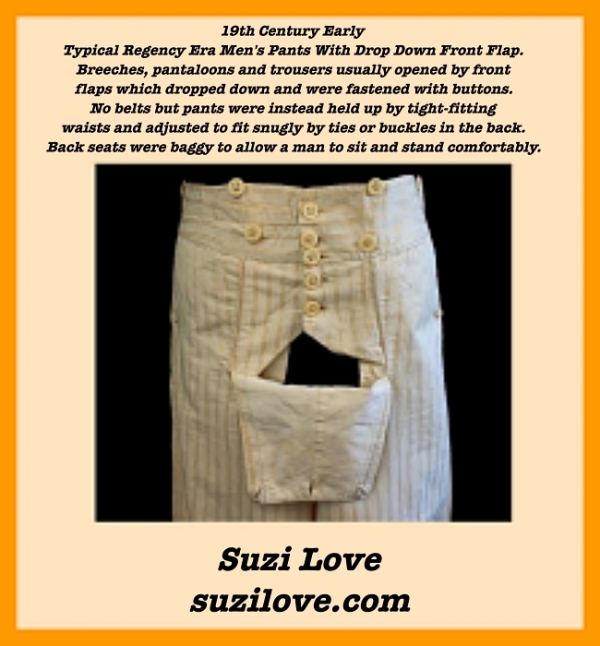
19th Century Early Typical Regency Era Men’s Pants With Drop Down Front Flap. Breeches, pantaloons and trousers usually opened by front flaps which dropped down and were fastened with buttons. No belts but pants were instead held up by tight-fitting waists and adjusted to fit snugly by ties or buckles in the back. Back seats were baggy to allow a man to sit and stand comfortably. Typical of a gentleman’s pants worn during the early 1800s, or the Regency Era, or Jane Austen’s times. They have a front flap, or fall, a back waist tie and buttons and ties to secure the breeches below the knee.
1810 ca. Pineapple Dress, French. High-waisted, Empire style dress with embroidered pineapple motifs, short wide neckline, puffed sleeves and long train. via Palais Galliera, Musée de la Mode de la Ville de Paris.
1808 Gentleman’s Ensemble, French. Drap Redingote or coat, black hessian boots with heart shaped front, black top hat. Fashion Plate via suzilove.com and Journal des Dames et des Modes, or Costume Parisien. Typical gentleman’s outdoor ensemble as worn by men in Jane Austen’s time, or the Regency Era. https://books2read.com/SuziLoveFashionMen1800-1819
Hessian Boots: Named after German mercenaries who fought alongside British. Soft, highly polished calfskin, knee high, heart-shaped top and decorated with tassel. Boot shaped like stirrup so rider could insert feet into stirrups and be kept securely in place. Tassels were designed to wear with breeches and didn’t suit tight fitting new trousers that dandies like Beau Brummell wore in 1800s so Hessians replaced by other boots e.g. Wellington.
1808 Gentleman’s Ensemble, French. Drap Redingote or coat, black hessian boots with heart shaped front, black top hat. Fashion Plate via suzilove.com and Journal des Dames et des Modes, or Costume Parisien. https://books2read.com/SuziLoveFashionMen1800-1819
1819 Pink Redingote, French. Also called a Walking Dress or Pelisse in England. Vertical front has pink satin bows, high white collar, matching pink satin hat and pink slippers. Short puffed sleeves over long straight, as was the fashion in 1819 across Europe. The type of outfit young Regency Era ladies would have worn if they were out shopping on Bond Street, walking in a park, or taking a carriage ride through Hyde Park. Fashion Plate via Journal des Dames et des Modes, or Costume Parisien. https://books2read.com/SuziLoveFashionWomen1815-1819
Definition Redingote Or Pelisse Or Walking Dress Or Coat: French word developed from English words, riding coat. Long fitted outdoor coat worn over other garments for warmth. Often left open at the front to show off the dress underneath. Sometimes cut away in front. Originally made with several capes and trimmed with large buttons. French fashion plates call these coats Redingotes and they are designed for women, men and children. English fashion plates call them a Pelisse, a walking dress, Promenade dress, or Carriage dress.
1819 Pink Redingote, French. Also called a Walking Dress or Pelisse in England. Vertical front has pink satin bows, high white collar, matching pink satin hat and pink slippers.Fashion Plate via Journal des Dames et des Modes, or Costume Parisien.