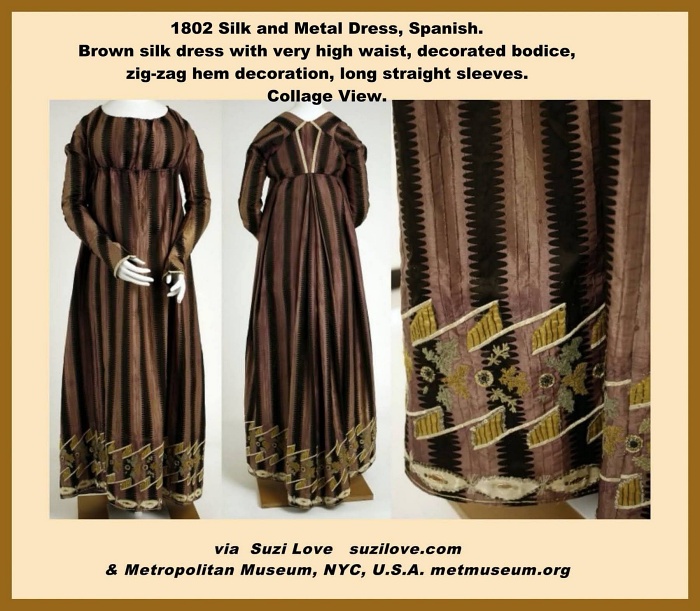
1802 Silk and Metal Dress, Spanish. Brown silk dress with very high waist, decorated bodice, zig-zag hem decoration, long straight sleeves. I can picture Jane Austen and her female friends and family wearing this sort of dress to a dinner party or musical evening. via Metropolitan Museum, NYC, U.S.A. metmuseum.org
1802 Silk and Metal Dress, Spanish. 1802 Silk and Metal Dress, Spanish. Front View. 1802 Silk and Metal Dress, Spanish. Back View. 1802 Silk and Metal Dress, Spanish. Fabric View. HN_25_D2D_fashwomen1801-1804 https://books2read.com/SuziLoveFashionWomen1801-1804
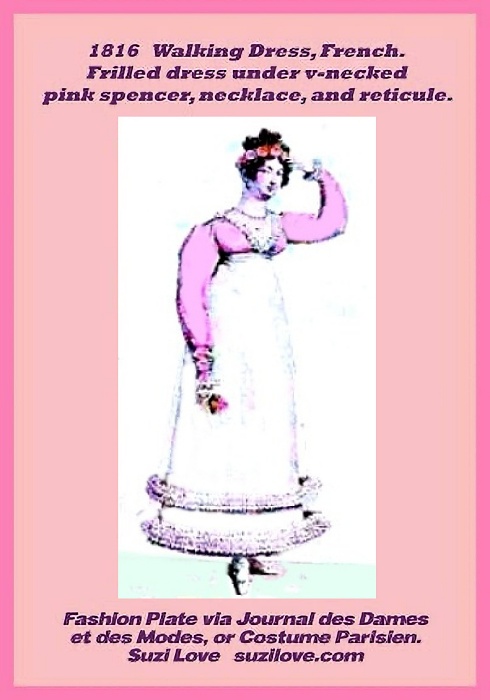
1816 White Walking Dress of short length and double row of frills at the hem. With pretty pink V-necked Spencer and carrying a reticule, walking shoes and floral wreath in her hair. Fashion Plate via Journal des Dames et des Modes, or Costume Parisien. Jane Austen and her contemporaries often walked to places and so would have needed the warmth of a Spencer over her dress in the cold British winters. https://books2read.com/SuziLoveFashionWomen1815-1819
Definition Spencer: Short jacket, cropped at the waist, worn over a dress, or gown. These close-fitting, tight sleeved, waist length jackets were modeled on a gentleman’s riding coat, but without tails. Delicate and regency dresses provided so little protection from the cold, so over garments were essential for warmth, modesty and good health.
Definition Ridicule, Reticule, Indispensable, or Handbag: From the late 1700s, pockets could no longer be sewn into gowns, as skirts fell from just under the bust and were full and flowing. Instead, women began carrying small bags, known at first as ridicules and later as reticules, to keep necessary items on their person e.g. handkerchiefs, coins, vinaigrettes, calling cards, glasses etc.
Definition Empire Style Dress: Named after the First Empire in France. Empire dresses had a low neckline and skirts started directly under the bust and flowed into the classical relaxed wide styles of Greece and Rome. This style of dress is associated with Jane Austen and her contemporaries as a high-waisted dress was worn most days. Cotton, silk or taffeta were the popular fabrics. Only the very wealthy could afford white dress in this style as the cottons were imported from India and had to be carefully cleaned, usually by a lady’s maid.
Fashion Women 1815-1819 History Notes Book 28 https://books2read.com/SuziLoveFashionWomen1815-1819
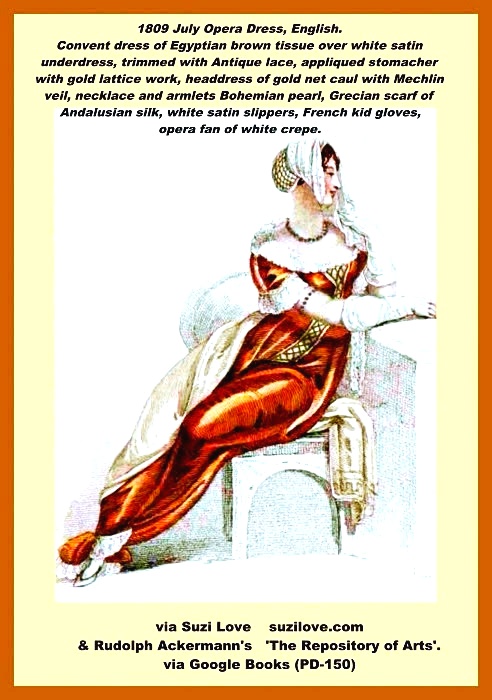
1809 July Opera Dress. I can picture aristocratic women wearing this sort of gorgeous outfit to the opera or an evening event.
Round convent robe of Egyptian brown tissue worn over white satin underdress, ornamented at feet, bosom and sleeves with broad Antique lace, out on full, and narrowing in front, white satin appliqued stomacher embellished with gold lattice work and continued in a straight line down to the hem. Headdress is a gold net caul, enclosing the hair at the back and finished in front with a Mechlin veil displaying the hair on the forehead and falling over the left shoulder. Necklace and armlets are a single row of Bohemian pearl with topaz or diamond snaps. Grecian scarf of rich Andalusian silk, contrasted with the robe and wrought at the ends in a deep Tuscan border of gold or colored silks. White satin slippers, trimmed with brown foil or gold, French kid gloves, opera fan of white crepe with a border of jessamine. Fashion Plate via Rudolph Ackermann’s ‘The Repository of Arts’.
Fashion Women 1805-1809 History Notes Book 26 What did Jane Austen and friends wear? https://books2read.com/SuziLoveFashionWomen1805-1809
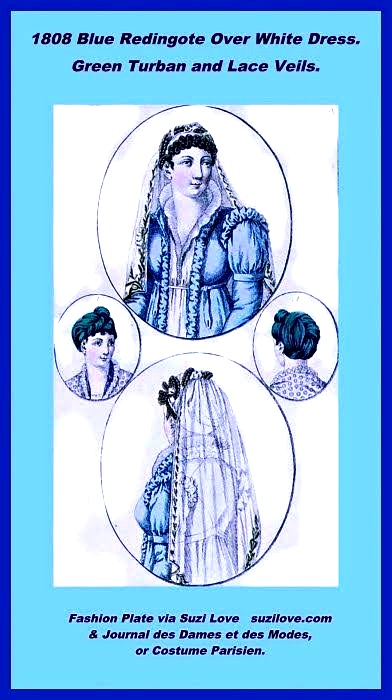
1808 Jane Austen Style Blue Redingote Over A White Dress. Green turban and lace veils. Bodice. Fashion Plate via Journal des Dames et des Modes, or Costume Parisien.
French fashions like this were copied by English magazines so these styles of hats would have been worn by Jane Austen and her contemporaries.
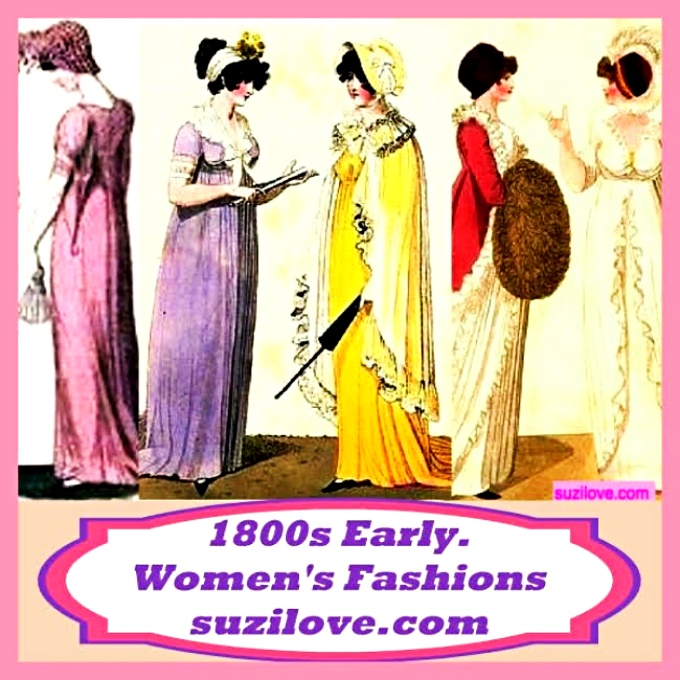
1800s Early Women’s Fashions Collage . Typical of the outfits worn by Jane Austen and her contemporaries for daytime and evening activities. An Empire style, or high-waisted white cotton dress worn under a Spencer or short jacket, a Redingote, or coat, for warmth and with pretty hats, shawls and shoes.Women’s Fashions By Suzi Love. High-waisted dresses, hats, muff, parasol, cape, reticule or bag and shoes.
Regency Era women’s fashions are elegant, pretty, and sometimes afford a gentleman a tiny glimpse of a well-turned ankle. Though to me, that sounds more like the lady has sprained her ankle rather than her ankle looking fashionably slim. High-waisted, or Empire style, white gowns defined women’s fashion during the Regency Era. ‘Empire’ is the name given to the period when Napoleon Bonaparte built his French Empire. High-waisted, loose gowns were adopted by the aristocracy as a symbol of turning away from the fussy, elaborate and expensive clothing worn in the 1700s.
Dress fabrics were thinner, sometimes almost transparent, which meant outerwear needed to be thicker and more practical. A coat, called a Redingote in France, a Pelisse in England, and a Walking Dress or Carriage Dress in Rudolph Ackermann’s fashion plates, became a necessity to keep out the chilling cold. Half cloaks, cloche or close-fitting hats, and accessories such as oversized fur muffs were very popular.
1800s Early Women’s Fashions By Suzi Love. HN_25_D2D_fashwomen1801-1804 https://books2read.com/SuziLoveFashionWomen1801-1804
1810 Couple In Walking Dress, French. Lady in a jade green Redingote, or coat, with paisley skirt, worn over a white dress with sleeves caught up, and hat tied under her chin. Man in a brown tailcoat, tight white pants that button down the sides, black hat and shoes and carrying a walking stick. Fashion Plate via Journal des Dames et des Modes, or Costume Parisien.
The sort of outfits a lady and gentleman in Jane Austen’s times would have worn while out walking, shopping, or going to visit friends.
Pelisse, or Walking Dress, or Redingote. The Fashion Dictionary description of a Redingote is (réd’ing-göt; red ing gote). Pronounced: red ing gote Woman’s long, fitted coat often cut Princess style and worn open in front to show off the dress underneath. Sometimes cut away in front. Originally made for men with several capes and trimmed with large buttons. French word developed from English words, riding coat. reefer. Single- or double-breasted, fitted, tailored, over-all coat usually made from sturdy fabric but in the British Regency Era a Pelisse was often made from a lighter fabric, such as cotton.
HN_23_D2D_Fashion Men 1800-1819 History Notes Book 23
https://books2read.com/SuziLoveFashionMen1800-1819
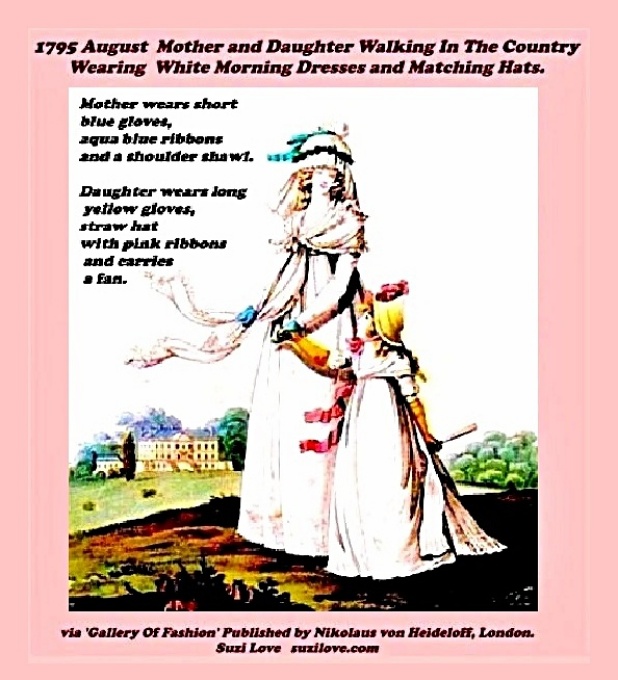
1795 August Mother and Daughter walking in the country wearing white morning dresses and matching hats. Mother wears short blue gloves, aqua blue ribbons and a shoulder shawl, or fichu. Daughter wears long yellow gloves, a straw hat with pink ribbons and carries a fan. via Nikolaus Heideloff’s Gallery of Fashion.
HN_1 Fashion Women Late 1700s History Notes Book 1 by Suzi Love.
What was fashionable for women in the late 1700s? Extravagant colors and fabrics and outrageous styles were all seen in these flamboyant fashions.
books2read.com/suziloveFashWomen1700s
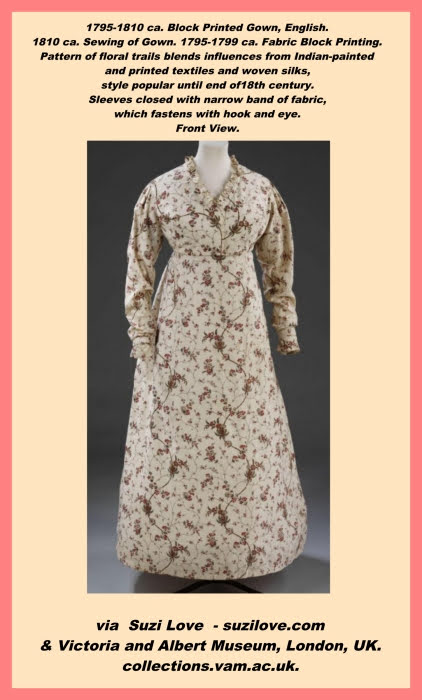
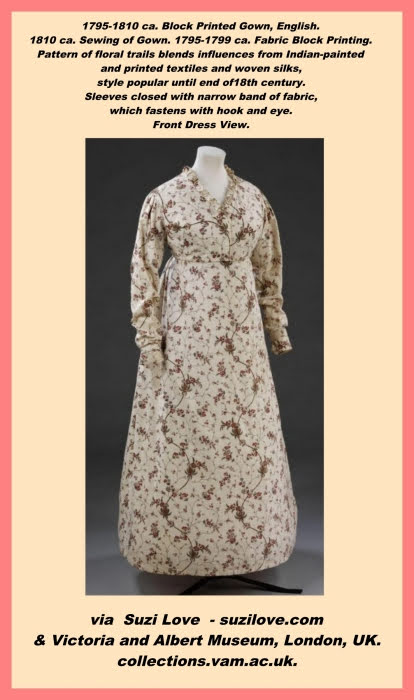
1795-1810 ca. Roller Printed Dress, English. Empire style, high-waisted, roller printed dress with skirt gathered at the back to create a full skirt and with simple V-necked bodice and long sleeves. Sleeves are closed with a narrow band of fabric which fastens with a hook and eye. via Victoria and Albert Museum, London, UK. 1810 ca. Sewing of Gown. 1795-1799 ca. Fabric Block Printing. Pattern of floral trails blends influences from Indian-painted and printed textiles, and woven silks, a style which remained popular until the end of18th century.
The pattern of floral trails seen on the printed fabric of this gown exhibits a blend of influences from Indian-painted and printed textiles, and woven silks, a style which remained popular until the end of the 18th century. The sleeves of this gown are closed with a narrow band of fabric, which fastens with a hook and eye.
The dress is styled with a high-waisted , fitted bodice, which fastens centrally. The neck, which is trimmed with a 1″ frill of matching material, is rounded a the back and V-shaped at the front. The bodice is lined with white cotton which extends 1/3 of the way down the full length tapered sleeves. A trimming decorations is attached to the wrist of the right sleeve (made from the same material and lined with white cotton), which fastens with a metal hook and eye at the hip. The skirt has an ‘apron’ style front with fastening tapes attached to either side, in addition to this there are vertical pocket slits situated at either side of the skirt measuring 11″. The front and rear sides of the skirt are constructed from one width of fabric – 39.5″ wide. The waistline at the back of the skirt is gathered a the centre and is constructed from two pieces of material measuring 46″ wide.
The cotton has blue threads in the selvedges denoting English origin, and is block printed in a polychrome palette with pencilled blue on a white ground. The design consists of an all-over pattern of delicate floral trails of carnations, pinks an other stylised flowers interspersed by vertical arborescent meanders bearing exotic fruits and stylised flowers. The pattern repeat measures 10.5″ by 10″.
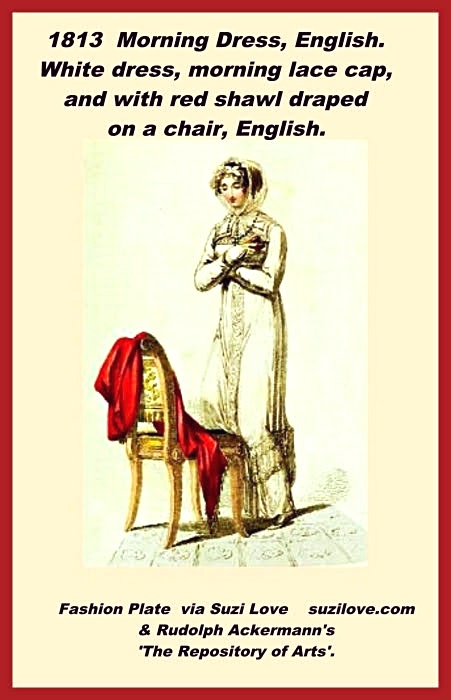
1813 October Morning Dress, English. Jane Austen and her family and friends would have worn this style of relaxed dress and cap. White At-Home dress with morning lace cap and a red shawl. Plain cambric underdress, three-quartered muslin or Chinese silk robe trimmed round the bottom and up the front with Indian border, or needle-work, and finished with a deep flounce of lace. Convent hood and pelerine of white net lace, confined under the chin with a silk cord and tassel. Hair in irregular curls with a fancy flower in the front. Short rosary and cross, plus bracelets, of coquilla beads. Buff or lemon kid slippers and pale tan gloves. Fashion Plate via Rudolph Ackermann’s ‘The Repository of Arts’.
This is a typical outfit worn at home in the morning in the house, to be seen only by family or close friends. A lady might wear this while writing having breakfast, writing letters, or reading. Called by the various names of Undress, to At-Home dress, or Morning dress, it is the most relaxed ensemble a lady will wear all day. The sort of outfit Jane Austen would have worn when writing her books.
1812 Red Dress, French. High-waisted red Merino wool dress with short puffed sleeves, high Chako hat with a plume long white gloves and white shoes. Fashion Plate via Journal des Dames et des Modes, or Costume Parisien.HN_27_D2D_fashwomen1810-1814
https://books2read.com/SuziLoveFashion1810-1814
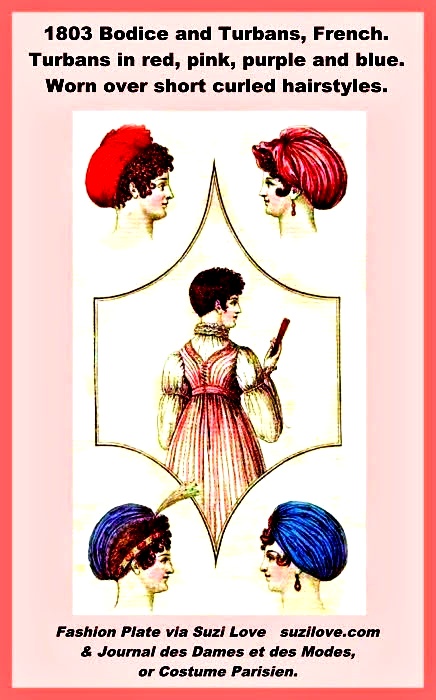
1803 Bodice and Turbans, French. Turbans in red pink purple and blue. Worn over short curled hairstyles. Fashion Plate via Journal des Dames et des Modes, or Costume Parisien.) https://books2read.com/SuziLoveFashionWomen1801-1804
Definition Turban: Early 19th-century etiquette required a lady’s head to be covered at all times, even with evening dress. In Jane’s Austen’s world, a lady wore some sort of hat or bonnet during the day when out and about, a cap during the night to keep her hair in place and for relaxed morning dress e.g. for breakfast, and for evenings either a small hat or turban. From 1800 to 1820, hats came in every shape, color, and size. Turbans, jockey caps, and straw bonnets were decorated with flowers, ribbons, lace, and feathers. Turbans, especially decorated with feathers were popular.