1806 Short Sleeved White Muslin Dress With Train, French. Bodice and sleeves have ribbon decoration, evening flowered headdress, half parure of necklace and ear bobs, and gorgeous Indian hand loomed green shawl. Fashion Plate via Journal des Dames et des Modes, or Costume Parisien. https://books2read.com/SuziLoveFashionWomen1805-1809
Definition Jewelry – Parure: Matched set of jewelry, including a necklace, bracelet, earrings, pin etc. Half Parure had no headpiece.
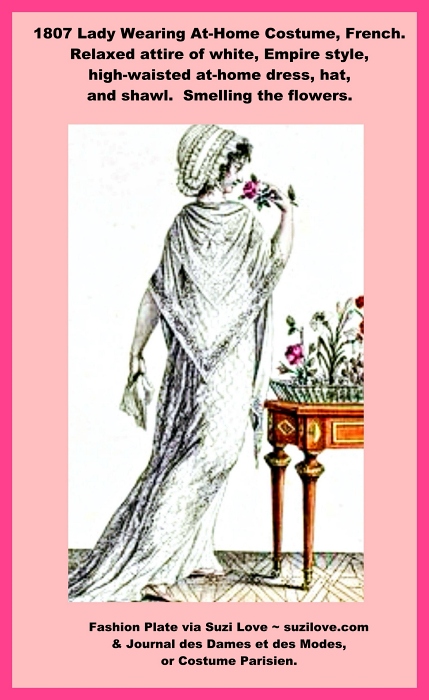
Definition Shawls: The shawl started off in India as a fine wool garment for men that could be worn as a scarf, turban or as a mantle: the word comes from the Persian shäl. Originally imported from the East, European Kashmir shawls were made first in Norwich and Edinburgh in Britain in the late 18th century. Shawls were an essential item in the early 1800s to cover the thin gowns women wore. They were made of muslin, gauze, silk, wool, and velvet, though cashmere shawls were the softest and most prized.
1816 October Half-Dress. A gown of lilac sarsnet, cut low round the bust, which is trimmed with pink ribbon, disposed so as to form a wreath; the shape of the back is marked by hands of pink, and a large bow, in the French style, ornaments the middle of it at bottom. The back is full; a plain light front forms the shape in a most becoming manner. Long full sleeve, composed of clear muslin, trimmed at the wrist with a single row of lace, and finished by a pink bow. Fichu to correspond, very full trimmed round the throat with lace. The bottom of the skirt is edged with pink, and trimmed with a single flounce of blond lace, set on very full, and surmounted by a wreath of French roses. Cornette composed of tulle, finished by a quilling of blond round the face, and fastened by a pink bow under the chin; a bow to correspond ornaments it on the forehead, and a bunch of flowers is placed very far back on the head. The style of this cornette, though French, is so simply elegant and becoming, that we have not for some time seen any half-dress cap to equal it. Plain gold ornaments. White kid gloves, and white kid slippers with pink rosettes. Fashion Plate via Rudolph Ackermann’s ‘The Repository of Arts’.
Definition Half Dress: Between undress and full dress, respectable outfit without an excess of formal accessories and might be worn either day or evening. Could include Afternoon Dress, such as Afternoon Walking Dress and even Evening Dress if not a very formal evening occasion, such as a theatre attendance or dinner engagement.
Definition Empire Style: Named after the First Empire in France, by 1800 Empire dresses had a very low décolleté, or neckline and a short narrow backed bodice attached to a separate skirt. Skirts started directly under the bust and flowed into the classical relaxed wide styles of Greece and Rome. This style of dress is associated with Jane Austen and her contemporaries as a simple cotton high-waisted dress was worn most days and accessorized according to the importance of the occasion.
1816 October Half-Dress. A gown of lilac sarsnet, cut low round the bust, which is trimmed with pink ribbon, disposed so as to form a wreath. Fashion Women 1815-1819 History Notes Book 28 https://books2read.com/SuziLoveFashionWomen1815-1819
1812 Tailcoat of Blue Drap, French. White Nankin trousers with ankle openings, knotted white cravat, short hair with sideburns, black shoes, holding a black hat and walking stick. Fashion Plate via Journal des Dames et des Modes, Costume Parisien.
In the early 1800s, men no longer wore complicated styles and extravagant fabrics. Men’s fashion simplified and became more conservative. A well-cut tailcoat, vest, pantaloons and an immaculate cravat of beautiful white linen in the style of George Bryan, or Beau, Brummell. Clothes were a status symbol and indicated a man’s social position. These clothing items were the sort worn by the Bridgerton family and Jane Austen’s male family and friends.
Definition Drap: French equivalent for the English word cloth or stuff and generally applied to fabrics of wool or silk.
Definition Nankeen Or Nankin: Durable, buff colored cloth, made of Chinese cotton which is naturally brownish yellow. Originally brought from Nanking.
HN_23_D2D_Fashion Men 1800-1819 History Notes Book 23
https://books2read.com/SuziLoveFashionMen1800-1819
1805-1815 ca. Bonnet. Olive brown stiffened, peaked brim, and lined with ivory satin to protect pale skin from sun in Bridgerton and Jane Austen style.
Regency bonnets were made in a wide variety of shapes and sizes, and with elaborate decorations. This was a practical way of offsetting the minimalism popular in Regency Era fashions. During the early 1800s, most young ladies, and some older ones, wore white dresses in the relaxed styles of ancient Greece. This neoclassical movement saw women wearing Empire style, or high-waisted, gowns that were either straight sheaths or flowed from under the bust. The stiffened brim shielded the lady’s face from harmful sun rays, because it was considered essential for an upper class lady to have a pale white skin. The crown of this bonnet is lined with stiffened ivory linen and the brim is lined with ivory satin. For more about this gorgeous bonnet, see Vintage Textile :- vintagetextile.com
Fashion Women 1805-1809 History Notes Book 26 What did Jane Austen and friends wear? https://books2read.com/SuziLoveFashionWomen1805-1809
1807 Lady Wearing At-Home Costume, French. Relaxed attire of white, Empire style, high-waisted at-home dress, hat, and shawl. Smelling the flowers. Jane Austen and her family and friends would have worn this style of dress. Fashion Plate via Journal des Dames et des Modes, or Costume Parisien.
Typical outfit worn at home in the morning when at home and to be seen only by family or close friends. A lady might wear this while writing having breakfast, writing letters, or reading. Called by the various names of Undress, to At-Home dress, or Morning dress, it is the most relaxed ensemble a lady will wear all day.
Fashion Women 1805-1809 History Notes Book 26 What did Jane Austen and friends wear? https://books2read.com/SuziLoveFashionWomen1805-1809
1800 ca. Tan Corduroy Breeches. Drop down front flap, or ‘fall’, with two buttons, three silver metal buttons at the waistband, watch pocket, corner pockets with buttons, pieced back with waist tie, saggy back with extra fabric to allow for easier movement when riding or sitting, four buttons and silk ties at knee. via Whitaker Auction whitakerauction.smugmug.com. Typical of a gentleman’s breeches worn during the early 1800s, or the Regency Era, or Jane Austen’s times. They have a front flap, or fall, which unbuttons and drops down and a back waist tie to adjust the waist size and there are buttons and ties to secure the breeches below the knee. https://books2read.com/SuziLoveFashionMen1800-1819
1800 ca. Tan Corduroy Breeches. Drop down front flap, or ‘fall’, with two buttons, three silver metal buttons at the waistband, watch pocket.
1800 ca. Tan Corduroy Breeches. saggy back with extra fabric to allow for easier movement when riding or sitting.
1800 ca. Tan Corduroy Breeches. Drop down front flap, or ‘fall’
1800 ca. Tan Corduroy Breeches. four buttons and silk ties at knee.
1800 ca. Tan Corduroy Breeches. four buttons and silk ties at knee.
1809 White Walking Dress, French. Green cashmere shawl, green shoes and close-fitting hat. This is a fashionable ensemble as would have been worn by Jane Austen and her family and friends. Walking dress such as this would have been worn when out shopping, walking in a park or the country estate. This sort of outfit needed to be presentable and warm, but not overly accessorized. Fashion Plate via Journal des Dames et des Modes, or Costume Parisien.
1809 White Walking Dress, French. Green paisley shawl, green shoes and close-fitting hat. Fashion Plate via Journal des Dames et des Modes, or Costume Parisien. Fashion Women 1805-1809 History Notes Book 26 What did Jane Austen and friends wear? https://books2read.com/SuziLoveFashionWomen1805-1809
1785–1800 ca. Cotton Breeches, American or European. Man’s cotton breeches, drop down, or fall, front opening, button fastening at the waist, extra material in the back allows more movement for riding etc., and buttons secure the leg openings so they can be fitted to wear with boots for riding. via Metropolitan Museum, NYC, U.S.A. These are the sort of pants that the men Jane Austen knew would have worn for riding or in the country.
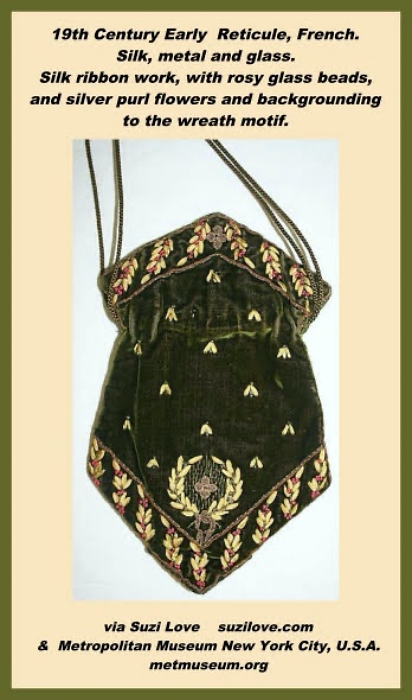
19th cent. Early. Reticule, or Bag, of silk, metal and glass, French, as carried in Jane Austen’s times. Silk ribbon work, with rosy glass beads, and silver purl flowers and backgrounding to the wreath motif. via Metropolitan Museum, N.Y.C., U.S.A. metmuseum.org
Definition Reticule: Bag or purse, often with a drawstring to pull closed and usually made of cloth or covered cardboard and often decorated with beading or embroidery. A reticule, or purse, or handbag, was usually carried by a woman during the Regency period to carry all their daily necessities. Earlier, women used pockets that tied at the waistline and were hidden in the folds of their skirts. Empire style, or early 1800s, high-waisted dresses made it impossible to either sewn in a pocket or to tie on a pocket. So women began carrying small, decorated bags called Reticules, or ridicules, which generally pulled close at the top with a drawstring.
19th Century. Early. Reticule. Silk, metal and glass. French. Silk ribbon work, with rosy glass beads, and silver purl flowers and backgrounding to the wreath motif. via Metropolitan Museum New York City, U.S.A. metmuseum.orgHN _3_D2D_RetailerBuyLink_HN_3
1800 ca. Tan Corduroy Breeches. Drop down front flap, or ‘fall’, with two buttons, three silver metal buttons at the waistband, watch pocket, corner pockets with buttons, pieced back with waist tie, saggy back with extra fabric to allow for easier movement when riding or sitting, four buttons and silk ties at knee. via Whitaker Auction whitakerauction.smugmug.com. https://books2read.com/SuziLoveFashionMen1800-1819.
Typical of a gentleman’s breeches worn during the early 1800s, or the Regency Era, or Jane Austen’s times. They have a front flap, or fall, which unbuttons and drops down and a back waist tie to adjust the waist size and there are buttons and ties to secure the breeches below the knee.
1800 ca. Tan Corduroy Breeches. Drop down front flap, or ‘fall’, with two buttons, three silver metal buttons at the waistband, watch pocket.1800 ca. Tan Corduroy Breeches. saggy back with extra fabric to allow for easier movement when riding or sitting.1800 ca. Tan Corduroy Breeches. Drop down front flap, or ‘fall’1800 ca. Tan Corduroy Breeches. four buttons and silk ties at knee. 1800 ca. Tan Corduroy Breeches. four buttons and silk ties at knee. https://books2read.com/SuziLoveFashionMen1800-1819