1820 ca. Brown Silk Pelisse, Or Coat, British. Worn over a light weight dress for warmth. Silk, lined with blue silk satin and cotton, hand-sewn. Front opening with concealed buttons and loops, wide stiffened collar, elaborate piping with thin rolls of fabric, skirt cut A-line shape and hem padded to accentuate shape, fairly high waistline with attached gored skirt and gathered panel at back. Long sleeves with short puffed over-sleeves. Green shawl, parasol, matching bonnet. via Victoria and Albert Museum, London, UK. collections.vam.ac.uk.
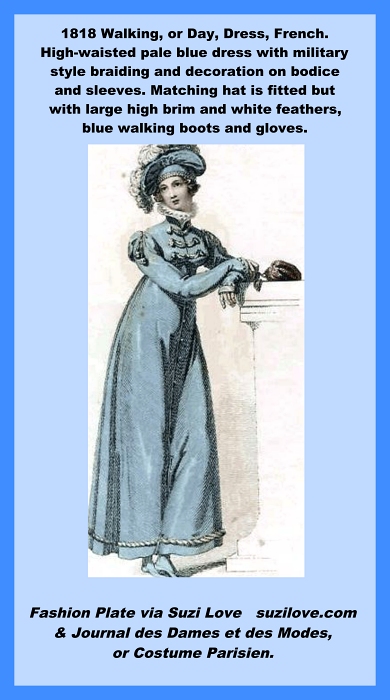
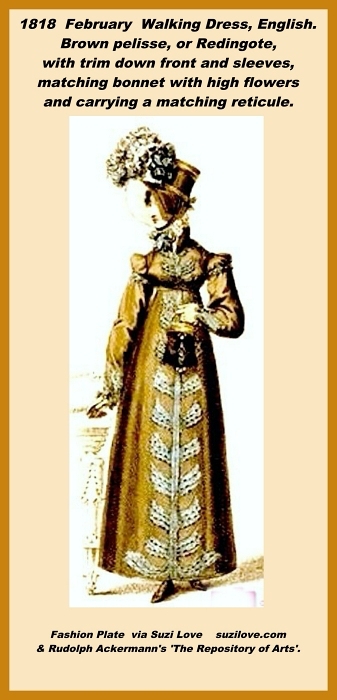
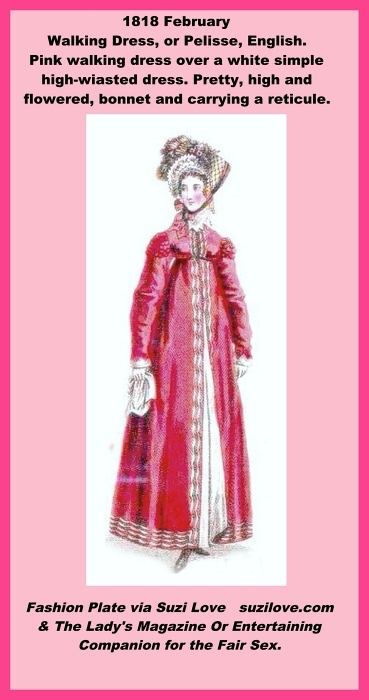
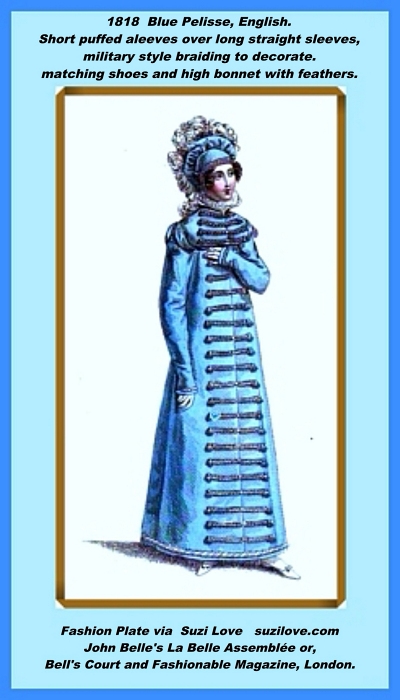
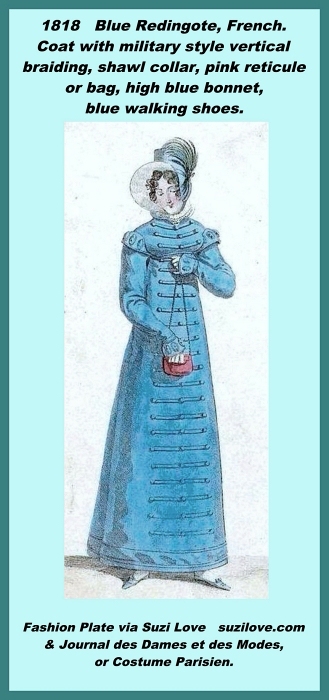
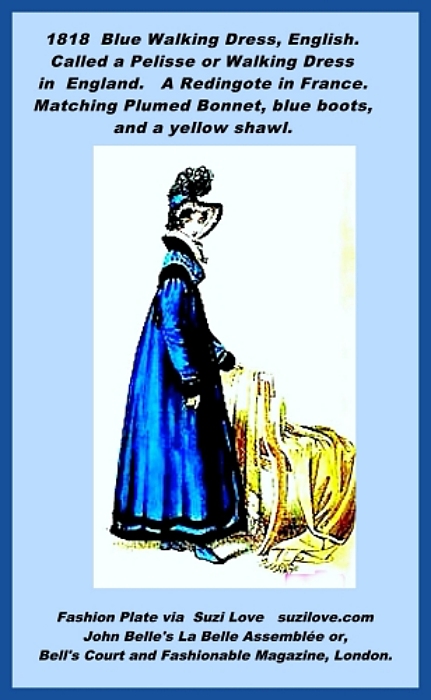
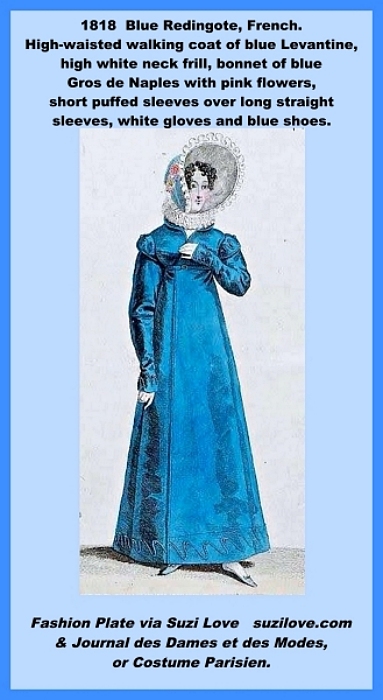
Definition Redingote Or Pelisse Or Walking Dress Or Coat: French word developed from English words, riding coat. Long fitted outdoor coat worn over other garments for warmth. Often left open at the front to show off the dress underneath. Sometimes cut away in front. Originally made with several capes and trimmed with large buttons. French fashion plates call these coats Redingotes and they are designed for women, men and children. English fashion plates call them a Pelisse, a walking dress, Promenade dress, or Carriage dress.
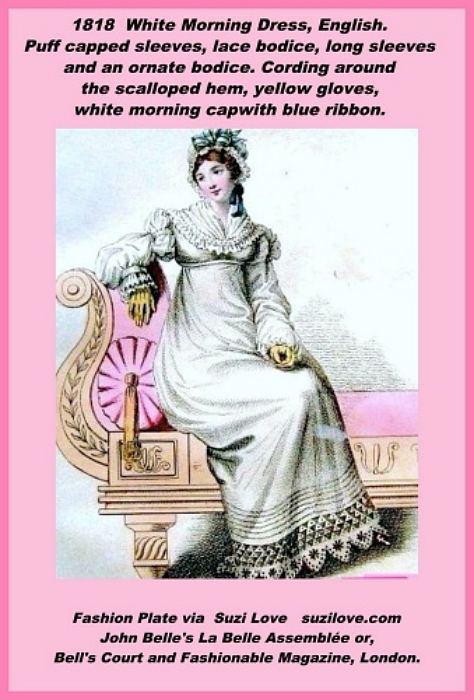
1818 Empire style, or high-waisted white morning dress, English. Puffed capped sleeves, lace shawl like neckline, ornate bodice cording around a scalloped hem, small white hat with blue flowers, and yellow gloves. Fashion Plate via John Belle’s ‘La Belle Assemblee’, London.
Definition Morning or At-Home Dress: Worn at home for reading, painting, sewing or for walking locally or while residing in the country. To be seen by family and close friends.
Definition Empire Style Dress: High-waisted white gown defined women’s fashion during the Regency Era. ‘Empire’ is the name given to the period when Napoleon Bonaparte built his French Empire. High-waisted, loose gowns were adopted by the aristocracy as a symbol of turning away from the fussy, elaborate and expensive clothing worn in the 1700s.
Definition Morning Cap Or Cornette: Muslin or other lightweight material, worn to cover hair during at-home pursuits such as reading, playing music, or sketching, tied under chin and sometimes worn under a bonnet.
1800-1805 ca. Pink Silk Bonnet, French. Similar to hats worn in England by Jane Austen and friends. Silk net, silk satin ribbon, and silk flowers. via Museum of Fine Arts, Boston, U.S.A. mfa.org
19th Century Mid-Late Five Desk Seals. L-R Carnelian seal with silver mounts set with colored stones; malachite urn seal: gilt-bronze seal with winged cherub heads: Silver-gilt seal eagle, Silver-gilt seal as eagle’s leg below a blue glass ball. via Sotheby’s Auctions. sothebys.com
In the Bridgerton family, or Jane Austen’s household, and during the Regency Era, sealing wax was not only impressed onto the back of a letter with a seal to protect against tampering, but also to identify the sender of the letter. People, especially aristocrats, kept personal and family seals to be used for many different purposes e.g. A letter to a government official would be sealed with an aristocrat’s crest or title. Personal seals for identification have been since early civilizations. The rubber stamps and embossers we use today serve the same purpose, identifying the sender.
Definition: Wax Seals: Pressed onto a letter or envelope to show that a document is unopened or to verify the sender’s identity. A signet ring or was seal is pressed into a dollop of hot wax to seal a letter or envelope closed.
Do you need more factual and visual information for your historical fiction? History of fashion, music, peerage and customs in 18th and 19th centuries. Non-fiction series full of gorgeous pictures and engraved fashion plates. A visual history of fashion, music, peerage, social manners and customs from late 1700s to late 1800s, or 18th and 19th centuries.
1807 Fashionable French Couple. Man: Blue cutaway coat and yellow breeches. Lady: Lemon and blue dress and bonnet. This is the fashion styles worn by Jane Austen and her family and friends in the early 1800s. Fashion Plate via Journal des Dames et des Modes, or Costume Parisien.https://books2read.com/SuziLoveFashionMen1800-1819
1807 Fashionable French Couple. Man: Blue cutaway coat and yellow breeches. Lady: Lemon and blue dress and bonnet. Fashion Plate via Suzi Love ~ suzilove.com & Journal des Dames et des Modes, or Costume Parisien.
ance”As the Duke of Sherwyn, you’ve entree into the best houses and social events.”
After a scowl towards the ceiling, he muttered, “Thanks to my stepmother, I’m forced into it. But what does my recent social popularity have to do with your current predicament?”
“In daylight, with other ladies, I can stroll about the streets. Visit shops, sometimes slip unnoticed into the twice-weekly stock auctions at the Hall of Commerce in Threadneedle Street. And I’ve already searched the desks of many of the mere misters and lesser peers of the lower orders of the consortium, as their houses aren’t guarded like fortresses.”
“Do you mean to say you entered these men’s homes and rifled their papers?”
“Well yes, but–”
“Are you mad?”
“I risked little, because those sort of houses cannot afford a footman guarding every passageway. Especially not on occasions such as those I attended, where every footman is needed to fetch drinks for belligerent guests. Slipping into those libraries was child’s play.” She sighed. “What I cannot do is visit the homes of the highest ranking peers to scour their correspondence for any that bears the special seal of the consortium. Nor secure enough privacy to copy any incriminating letters I may find. Someone always hovers, and watches, at those type of houses.”
He paced before her like a restless panther, an angry scowl pulling his face taut. His fine looks had always turned heads, but this brooding beast carried a lethal combination of strength and menacing masculinity. She shivered. His newly acquired arrogance of bearing enhanced, rather than detracted from, his magnetism, although this time, she knew to avoid his magnetic pull.
“You intend searching the houses of every peer in the city who is making money from stock shares?”
“No, no, not all of them. We’ve done a lot of research–”
“We?”
“My family have become quite adept at research. We’ve narrowed our search to gentlemen known to invest in railway expansions in a large way. Our final list is of those we consider to be involved in the inner, and most secret, tier of the syndicate. It contains eighteen names, the majority of whom are high-ranking peers.
“Bloody hell, Becca.” He ground the expletive out through clenched teeth. “You’re out of your depth. I’ve been involved in similar commercial groups. They’ll stop at nothing for the sake of money.”
“Nevertheless, we need certain details you may overhear at clubs about certain gentlemen having sudden windfalls. Or things gleaned at certain balls and soirees.
“Unbelievable.” Both hands went up in the air. “That’s certainly as clear as muddy water.”
“Clear or not, I’m asking you to trust me. To help me.”
She held out both hands, palms up, and hoped he wouldn’t notice their tremors. “With your assistance, I can verify more names. Collect proof of each one’s involvement and hand it over to Scotland Yard. Time is of the essence, as we’ve now less than two weeks.”
She watched him absorb, assess, decide. In under a minute, he guided her to his desk and seated her before it.
“Make a start. List the names of every man you suspect to be a member.” He placed writing materials before her. “Then list those you consider inner tier, and include their ranking.”
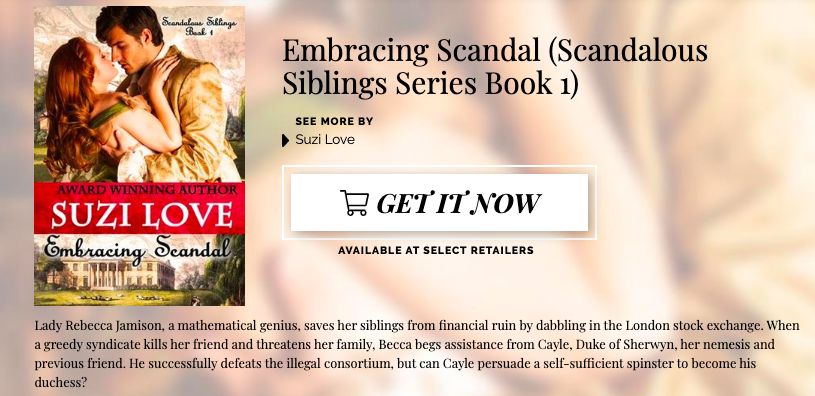
Lady Jamison saves family from financial ruin by railway investing but when her friend is murdered, Becca begs assistance from new Duke of Sherwyn. https://books2read.com/suziloveES
ES_ Embracing Scandal Book 1 Scandalous Siblings Series D2D_ES_ https://books2read.com/suziloveES
1818 Women’s outdoor fashions In the times of Jane Austen. Pelisses or coats or Redingotes, with matching hats, shoes, goves, reticules or bage, plus other accessories as displayed in various fashion magazines. Definition Redingote Or Coat Or Pelisse: Long fitted outdoor coat worn over other garments for warmth. French word developed from English words, riding coat. French fashion plates call these coats a Redingote and English plates call them a Pelisse, Or Walking Dress, or Carriage Costume.
. Fashion Women 1815-1819 History Notes Book 28 https://books2read.com/SuziLoveFashionWomen1815-1819
1805-1815 ca. Empire Style, High-Waisted Dress, American. Typical style of dress worn in the time of Jane Austen. Long sleeves under short sleeves, square neckline, back fastening. Via Five Colleges and Historic Deerfield Museum Consortium. museums.fivecolleges.edu
Definition Empire Style Dress: High-waisted white gown defined women’s fashion during the Regency Era. ‘Empire’ is the name given to the period when Napoleon Bonaparte built his French Empire. High-waisted, loose gowns were adopted by the aristocracy as a symbol of turning away from the fussy, elaborate and expensive clothing worn in the 1700s.
Fashion Women 1805-1809 History Notes Book 26
What did Jane Austen and friends wear? This book looks at early 1800s fashions, which were elegant and pretty with high waists and fabrics that were almost transparent. These Empire style gowns, named after Napoleon’s first Empress, became popular throughout Europe, and were then copied around the world. Colorful outwear was added to make an ensemble more attractive and warmer.
https://books2read.com/SuziLoveFashionWomen1805-1809
1818 December 11th A dandy fainting or – an exquisite in fits. Scene a private box opera. A dandy lies back fainting in a chair, his limbs rigid, supported by three others while a fourth (left) draws the curtain, cutting off a view of the (distant) stage where a singer is posturing. Via British Museum, London, UK. britishmuseum.org (PD-Art)