1820-1850 ca. Cotton and Beadwork Reticule Or Bag, Dutch. Couple on shore, man in boat, house and windmill behind, musicians, dancers, onlookers. Yellow metallic frame and green braided silk cord. Beadwork on cotton foundation. Polychrome design: couple on shore, man in boat, house and windmill behind (obv.); musicians, dancers, onlookers (rev.); acanthus motif at base. Yellow metallic frame with dotted design, stud closure, green braided silk cord. Ecru silk lining. via Museum of Fine Arts, Boston, U.S.A. mfa.org
Definition Reticule Or Bag or Purse: Often with a drawstring to pull closed and usually made of cloth or covered cardboard and often decorated with beading or embroidery. A reticule, or purse, or handbag, was usually carried by a woman during the Regency period to carry all their daily necessities. Earlier, women used pockets that tied at the waistline and were hidden in the folds of their skirts. Empire style, or early 1800s, high-waisted dresses made it impossible to either sewn in a pocket or to tie on a pocket. So women began carrying small, decorated bags called Reticules, or ridicules, which generally pulled close at the top with a drawstring.
19th Century Inkwell and Tomb of the Scipios Grand Tour Souvenir, Italian. The type of Grand Tour souvenir collected by travelers in Jane Austen and Bridgerton Times.
Siena marble with ink wells and pen holder. Lid removes to reveal pair of ink wells and pen holder. Scipios were a family of Roman war heroes and generals. Tomb of Scipios erected around 150 B.C.E and copied many times. 18th-19th Centuries, tomb models were favorites of Grand Tour souvenir hunters. The sort of exotic item a gentleman in Jane Austen’s times might send back to England during his Grand Tour of Europe and Asia. via 1st Dibs Auctions 1stdibs.com
18th Century Mid. Nécessaire, London, England. Wood, shagreen, silk, tortoiseshell with gold mounts, steel. Includes: pen knife, beard trimmer, scissors, bottles, paper cutter, 6 razors, hone, strop. via Metropolitan Museum New York City, U.S.A. metmuseum.org
Definition Shagreen: A type of rawhide, or rough untanned skin, originally made from the back of a horse or a wild donkey. In the 18th century, the skin of a shark or stingray also began to be called shagreen.
1800 ca. Ormolu Ink Stand with Lid, French. Ormolu ink stand in the shape of a globe surrounded by three rams head pen supports with animal legs and hoofs on a tripartite base. The top is removable revealing a silvered compartment with containers for sand and ink. via 1st Dibs Auctions 1stdibs.com
Definition Ormolu: Gold colored alloy of copper, zinc, and tin used in decoration and for making ornaments. Ormolu is used in mounts i.e ornaments on borders, edges, and as angle guards) for furniture, especially 18th-century furniture, and for other decorative purposes. Its gold colour may be heightened by immersion in dilute sulfuric acid or by burnishing.
1830 ca. Rosewood and Inlaid Brass Inkstand, England. Each side has cut-glass inkwells with brass inlaid tops and pen trays, so ideal for a partners desk. via 1st Dibs Auctions 1stdibs.com
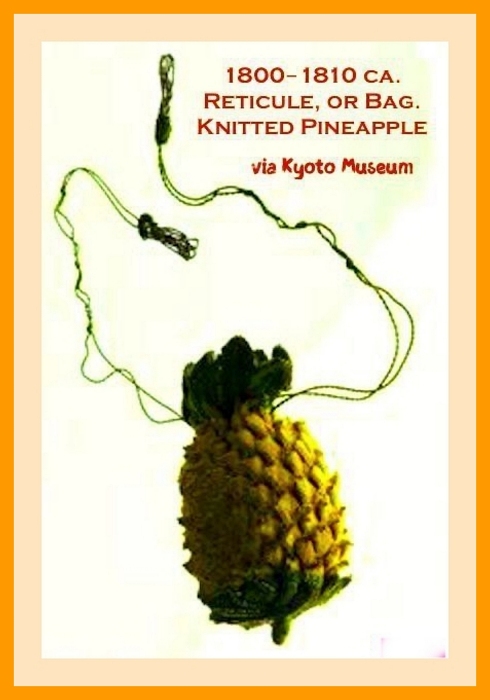
1800-1810 ca. Pineapple Reticule, or Bag. A knitted pineapple with long strings. In Jane Austen’s times, pineapples were a luxury imported item that most people in Great Britain had never seen, let alone tasted. When more pineapples were imported from hotter countries, or English gardeners started to grow some, pineapples became a much desired novelty and an exotic experience. Pineapple motifs appeared on dresses, furniture, household goods etc. Knitting pineapple reticules was part of this obsession with pineapples. via Kyoto Museum, Japan.
Definition Ridicule, Reticule, Indispensable, or Handbag: From the late 1700s, pockets could no longer be sewn into gowns, as skirts fell from just under the bust and were full and flowing. Instead, women began carrying small bags, known at first as ridicules and later as reticules, to keep necessary items on their person e.g. handkerchiefs, coins, vinaigrettes, calling cards, glasses etc. http://books2read.com/suziloveReticules
1800-1810 ca. Reticule, or Bag. A knitted pineapple with long strings. via Kyoto Museum, Japan.
In the early nineteenth century, reticules started to look like future handbags as they were often made from rigid card or molded mâché or card into a variety of shapes. Early bags were circular and with a drawstring but as women wanted their reticules to look individual they could be made with two halves and a hinged metal closure or with concertina sides. Materials varied from silk, cotton and string and shapes were round, hexagonal or lozenge shapes with shell shaped bags becoming very popular during the Regency and Romantic Eras.
1800s magazines were written for well bred women who could read, so they gave plenty of ideas for how ladies could make and embellish reticules for their own use and as pretty gifts. Needlework was highly encouraged as a pastime for a lady so bags were frequently embroidered or decorated with beading. By the 1820s, reticules became more like our modern handbags using soft leather gathered at the top or hard leather with a rigid fastener and metal chain for carrying.
A portrait from 1810-1814 of Rudolph Ackermann, shop owner and founder of ‘The Repository Of Arts’ magazine, The Strand, London. via National Portrait Gallery, London. Plus, an image of Ackermann’s premises in 1809. His ‘Repository of Arts, Literature, Fashion, Manufactures, etc.’ was published from 1809 to 1829 with images of Regency London, Regency furnishings and grand homes as well as beautiful fashion prints and descriptions every month. Ackermann originally supplied artists, amateur and professional, with supplies for watercolor painting. In 1799, he began manufacturing and selling his own watercolor paint blocks which were supplied by other colourmen, although at least three colors were his own mixture – Ackermann’s Green, White and Yellow. From 1817, his eldest son Rudolph Ackermann junior was responsible for the watercolor manufacturing. Ackermann also trained as a carriage designer. He began publishing prints and colour-plate books like ‘The Microcosm of London’ and ‘Doctor Syntax’ in the early 1800s.
The Repository of Arts was one the most popular magazines in Jane Austen’s time as it displayed everything ladies wanted to learn e.g. history, important country seats and houses in England, music, current events such as theatre plays, plus fashion plates and embroidery patterns. Ackermann’s shop in The Strand, London, was one of the fashionable places to shop during the Regency Era. The Repository also included poetry, travel reports, society reports and upcoming lectures. It also included serious subjects e.g. politics, legal matters, medicine and agriculture, a meteorological journal and details of the London markets. In 1817, the price of the magazine was 4 Shillings, so quite expensive for the time.
In the first issue, published for January 1809, Ackermann included an ‘introduction to the history of the useful and polite arts’ which said: “It is universally admitted, that to cultivate a taste for the arts, and an acquaintance with the sciences, is a pleasure of the most refined nature; but to do this without regard to its influence upon the passions and affections, is to ‘tear a tree for its blossoms, which is capable of yielding the richest and most valuable fruit.’ The cultivation of this taste may and ought to be subservient to higher and more important purposes: it should dignify and exalt our affections, and elevate them to the admiration and love of that Being who is the author of every thing that is fair, sublime, and good in nature.”
1800-1830 ca. Reticule, or Bag, American. Bottom of bag shaped like basket and made of stiff deep cream colored mohair with minute blue figure, two panels of light blue painted silk moiré, upper part of bag of deep cream colored figured silk, blue silk ribbon, drawstring and bows trimming lower part of bag. via Museum of Fine Arts, Boston, U.S.A. mfa.org
Definition Reticule Or Ridicule Or Bag or Purse: Often with a drawstring to pull closed and usually made of cloth or covered cardboard and often decorated with beading or embroidery. A reticule, or purse, or handbag, was usually carried by a woman during the Regency period to carry all their daily necessities. Earlier, women used pockets that tied at the waistline and were hidden in the folds of their skirts. Empire style, or early 1800s, high-waisted dresses made it impossible to either sewn in a pocket or to tie on a pocket. So women began carrying small, decorated bags called Reticules, or ridicules, which generally pulled close at the top with a drawstring.
What was fashionable for women in Jane Austen’s times? Mourning, riding, daytime, evening clothing, plus underclothing, corsets and accessories. Wars were being fought so women adopted military looks in support of soldiers. https://books2read.com/SuziLoveFashion1810-1814
Fashion Women 1810-1814 History Notes Book 27 This book looks at what was fashionable for women in Jane Austen’s times, or the early 1800s, or the Regency Era in Britain. Wars were being fought around the globe so women’s fashion adopted a military look in support of soldiers. Fashions, like the lifestyle, became progressively more extravagant and accessories went from colorful to over-the-top. https://books2read.com/SuziLoveFashion1810-1814