Do you need more factual and visual information for your historical fiction? History of fashion, music, peerage and customs in 18th and 19th centuries. Non-fiction series full of gorgeous pictures and engraved fashion plates. A visual history of fashion, music, peerage, social manners and customs from late 1700s to late 1800s, or 18th and 19th centuries.
1800 ca. Writing Box, British, as would have been used by people in Jane Austen’s times, or, the Regency Era. Small brass bound solid mahogany writing box of dovetail construction. Green baize sloping writing surface with compartments for storing papers beneath. Small size may be designed for private intimate correspondence. Drop down carrying handles on two sides are early form of handle. Side drawer pulls out after retaining brass pin is taken out. via hygra.com
1800-1870 ca. Stocking Purses, British. Beaded stocking purses crocheted in silk and steel beads, with steel rings with tassels and fringes. via Victoria and Albert Museum, London, UK. collections.vam.ac.uk.
Definition Miser or Long or Stocking or Ring Purses: Long, narrow, tubular shape, often wider at ends and narrow in middle, which had a short slit opening. Popular in England and France from the mid-18th century through the early 20th century.
From the Curator Victoria and Albert Museum, London: Stocking purses are also known as misers’ or wallet purses. The majority were netted, but some were knitted or crocheted, like this one. Once worked, the elongated tube was put on an expandable purse stretcher to shape it. It was then sewn up, leaving a central opening, and squeezed through a pair of rings known as sliders, which were used to secure and separate the different coins stored at either end. It could be carried in the hand, bag or pocket, or tucked over a belt. Many stocking purses were made as presents, and were thought a suitable object to give to a gentleman. Crochet is a type of needlework with an open, lacy appearance, which is formed with a hook and single length of thread making a series of loops, chains and knots. The technique developed out of ‘tambouring’, a type of embroidery, after the tambour hook began to be used to create series of loops, free from a ground fabric. This could then be used as a separate trimming, like lace, or made to form items like this purse. Crochet was thus added to the varieties of fancy needlework available to ladies, and instructions for making it can be found in manuals from the 1820s onwards.
1800-1870 ca. Beaded Stocking Purses, British #RegencyFashion #RomanticEra #HistoricFashion books2read.com/suziloveReticules
1562-1575 ca. Wine Cooler With a Pageant Battle with Elephants, Italian. Maiolica, or tin-glazed earthenware, from the workshop of the Fontana family. 1553-1580. Coolers were set near the table on a credenza or sideboard, visible to diners and within easy reach of servants. They are designed to be viewed from any side, but especially from above when empty. When not in use, coolers remained in place to convey the owner’s refined taste and, due to the relatively inexpensive medium, personal modesty. via Metropolitan Museum New York City, U.S.A. metmuseum.org
19th Century Late Mechanical Tantalus, French. Ormolu, Bronze, Crystal, and Gilt with a lock and key to open. Earlier versions of this type of small drinks cabinet would have been used in most households during Jane Austen’s times, unless the householders were teetotalers. via 1st Dibs Auctions 1stdibs.com
Tantalus: A small wooden cabinet containing drink decanters. The box has a lock and key to keep unauthorised people from drinking the contents e.g. servants and younger sons, yet still allowing the decanters of drinks to be on show. The word, Tantalus, is a reference to the unsatisfied temptations of the Greek mythological character Tantalus. Patented in the UK in 1881 by George Betjemann, a cabinet maker from the Netherlands, whose workshop was on Pentonville Road, London from the 1830s.
1715-1790 ca. Miniature Sable Pocketbook, France. Glass beads strung on linen, or sablé, woven silk and metallic binding. Miniature envelope-style pocketbook. Polychrome opaque and translucent glass beads strung with linen thread, held together by interlocking looping stitches, or sablé. Designs on white ground, cupid shooting arrow at blue and red hearts. Borbon arms surmounted by coronet, red heart with five keys. Gilt-galloon binding. Blue silk taffeta lining. Cardboard foundation. via Museum of Fine Arts, Boston. mfa.org
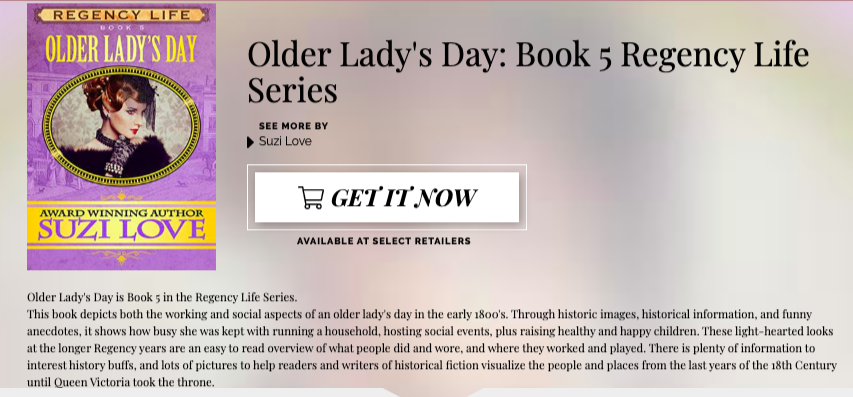
What did an older lady do in the Bridgerton family’s and Jane Austen’s times, or the early 1800s. An easy to read overview of what an older lady did, wore, and how she lived in the early 19th Century. Information for history buffs and pictures for readers and writers of historical fiction. Older Lady’s Day, Regency Life Series, Book 5, by Suzi Love. books2read.com/suziloveOLD
Through historic images, historical information, and funny anecdotes, it shows how an older lady in Jane Austen’s times fills her day, where she goes, and with whom she spends her time. This light-hearted look at the longer Regency years is an easy to read overview of what people did and wore, and where they worked and played. There is plenty of information to interest history buffs, and lots of pictures to help readers and writers of historical fiction visualize the people and places from the last years of the 18th Century until Queen Victoria took the throne.
Regency Life Series: Images, information, funny anecdotes give overview of Jane Austen’s and Bridgerton times. #bridgerton #RegencyEra #JaneAusten #BritishHistory https://books2read.com/suziloveROver
Writer Or Reader Of Regency Era?What did Jane Austen and friends wear? Women’s clothing changed dramatically in early 1800s. New silhouette copied simplistic styles of Greeks and Romans. High-waisted white dresses and flowing skirts with color and warmth added by outerwear and accessories. Fashion Women 1801-1804 History Notes Book 25 https://books2read.com/SuziLoveFashionWomen1801-1804
Definition Empire Style Dress: High-waisted white gowns defined women’s fashion during the Regency Era. ‘Empire’ is the name given to the period when Napoleon Bonaparte built his French Empire. High-waisted, loose gowns were adopted by the aristocracy as a symbol of turning away from the elaborate clothing worn in the 1700s. This sort of high-waisted dress would have been worn by Jane Austen and her contemporaries in England.
Definition Shawls: The shawl started off in India as a fine wool garment for men that could be worn as a scarf, turban or as a mantle: the word comes from the Persian shäl. Originally imported from the East, European Kashmir shawls were made first in Norwich and Edinburgh in Britain in the late 18th century. Shawls were an essential item in the early 1800s to cover the thin gowns women wore. They were made of muslin, gauze, silk, wool, and velvet, though cashmere shawls were the softest and most prized.
Love the Bridgerton family and Jane Austen? Reader Or Writer of Regency Era stories? Mourning and riding fashion, dresses, hats, shoes, reticules or bags, underclothing and fashion accessories. books2read.com/SuziLoveFashionWomen1815-1819
History Notes 28 Fashion Women 1815-1819: This book looks at what was fashionable for women in the Georgian Era and at the end of the Regency Era in Britain and the reconstruction in Europe after the wars. Lifestyles were freer and fashions expressed this by becoming the focus of most women’s lives. A wardrobe full of opulent accessories was requisite. Includes mourning and riding fashion, dresses, hats, shoes, reticules or bags, underclothing, and fashion accessories.