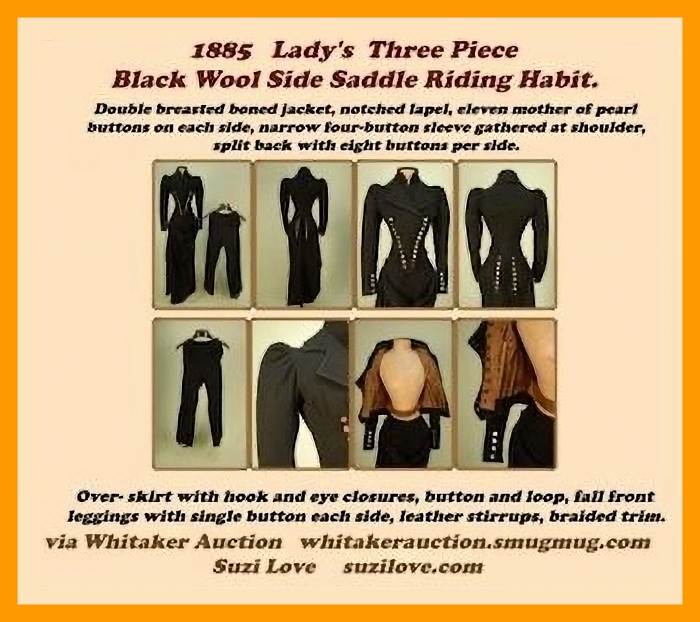
1885 Three Piece Side Saddle Riding Habit. Double breasted boned jacket with notched lapel, mother of pearl buttons, sleeve gathered at shoulder, over- skirt with side hook & eye closures, button and loop, fall front leggings, leather stirrups, braided trim. via suzilove.com Whitaker Auction whitakerauction.smugmug.com
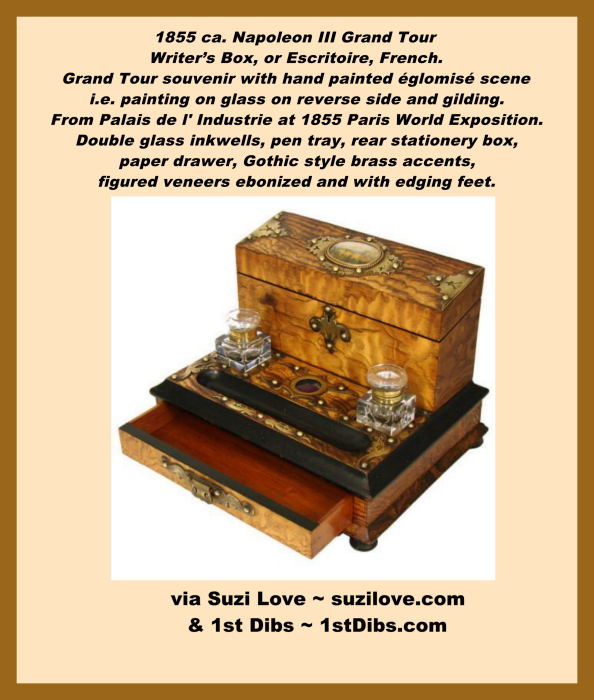
1855 ca. Napoleon III Grand Tour Influenced Travel Writer’s Box, Or Ecritoire, French. Double inkwell with rear stationery box, Gothic style brass accents and Grand Tour souvenir hand painted eglomise scene, the Palais de l’ Industrie from the 1855 Paris World Exposition! Figured veneers, ebonized edging, feet and pen tray and brass or bronze accents. via 1st Dibs 1stdibs.com
1890 ca. Ivory, Enamel, and Gold Carnet de Bal, or Dance Card. Formerly in the collection of lady Mairi Bury. Ribs are of ivory, numbered front to back from 1 to 24, either end decorated with polychrome enamel with a lotus flower motif, attached by chain to a ring. Maker’s marks, fitted case, Payne and Sons. via Sotheby’s Auctions. sothebys.com
Spencers Or Regency Jackets By Suzi Love. History Notes Book 4. What was fashionable for outer wear in past centuries? Call them what you like: Spencers, short jackets, or Regency jackets were very popular. Take a look at the jackets being worn by women in the early 1800s or the times of Jane Austen. books2read.com/suziloveSpencers
Definition: Spencer – Short, bodice hugging, usually long sleeved, outer jacket. For warmth and for fashion.
Definition Caroline Spencer: Worn during the Directoire and First Empire (1790-1815 C.E.). Spencer with pelerine cape that was made of white kerseymere and trimmed with light blue satin cut on bias.
Spencers were short jackets cut to match the high waistlines of Empire dresses. They often copied military styling, such as braiding, shoulder decoration, buttons and loop fasteners, and wrist adornments. They were generally of complex construction, often with a diamond shaped piece in the back.
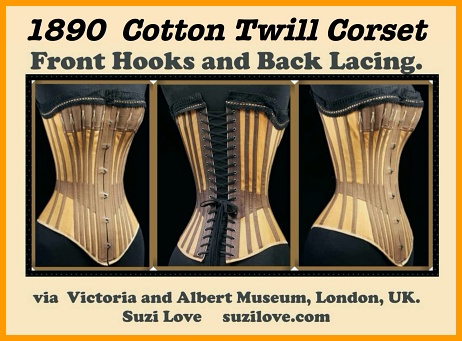
1890 Cotton Twill Corset, England or Germany. Machine stitched with front hooks and back lacing and made in two parts. Brown corset with the bones covered with a darker cotton twill, black fabric covered busks and a trimming of black machine-made cotton lace. Lined with white cotton twill and the top and bottom are bound with reddish brown tape.
The front fastens with a busk and the backs are provided with metal eyelets for a lace. The corset is hip length, curving to a rounded point in the front and less deeply at the back. The bones are close-set and splayed out at the bust and hips, and at the tops are trimmed with fancy stitching in cream. There is a band of dark brown cording at the top, covering the breasts. At the waist there is a V-shaped band in darker brown stitching. With metal fastenings. via http://collections.vam.ac.uk/item/O351699/corset-unknown/
Corsets 1880-1900 History Notes Book 20 This book shows how a fashionable silhouette became of paramount importance and how a well-fitted corset became a fashion essential. As well as a decorative fashion item, tight lacing gave a narrow waist and the desired feminine form under clothing. https://books2read.com/SuziLoveCorsetBook20
Cartoons For Riders At The Hunt. Typical comical scenes from The Bridgertons and Jane Austen’s Daily Lives. From: 1860 Mr. Sponge’s Sporting Tour by Robert Smith Surtees. via Google Books (PD-100)
1890-1920 ca. Sterling Silver Chatelaine, England. Center Medallion With Portraits, three drops of monogrammed mesh purse, globe-shaped watch and book-shaped case. Via Augusta Auctions – augusta-auction.com
Definition
The word Chatelaine is French and means the keeper of the keys
Chatelaine” derives from the Latin word for castle
In Medieval times, the chatelaine was in charge of the day-to-day running of the castle.
What did a chatelaine do?
Most important task was keeper of the keys.
Also ordered supplies, did bookkeeping, supervised servants, taught castle children, and organized guests.
19th Century Late. Sterling Silver Five Piece Writing or Desk Set, Peru (under German Company). Hinged cut crystal inkwell with beveled edges, wheel cut starburst at base, wax seal with blank matrix, blotter, dip pen and letter opener. Each with guilloche enamel featuring yellow rose with lush green leaves on pale blue background, trimmed with a lighter shade of blue enamel. Dip pen with allover pale blue guilloche enamel, pen nib marked 14k Gold Plated.
Top Hat Styles Chart during the 1800s, from the Regency Era through to the Victorian years. Most popular style was cone shaped and tall in height. Originally made of beaver and very short but later from silk and taller. Tall crown, widens at top, narrow brim turns up slightly at sides. https://books2read.com/SuziLoveFashionMen1800-1819










![19th Century Late SterlingSilverFivePieceWritingorDeskSetPeru_Dippenwithpaleblueguillocheenamel_pennib14kGoldPlatedbatch.jpg ]
19th Century Late. Sterling Silver Five Piece Writing or Desk Set, Peru (under German Company). Hinged cut crystal inkwell with beveled edges, wheel cut starburst at base, wax seal with blank matrix, blotter, dip pen and letter opener. Each with guilloche enamel featuring yellow rose with lush green leaves on pale blue background, trimmed with a lighter shade of blue enamel. Dip pen with allover pale blue guilloche enamel, pen nib marked 14k Gold Plated.](https://suzilove.files.wordpress.com/2021/06/writing_19th_century_late_writing-and-desk-setperu_lge-1_lge_sml.jpg?w=554)

