“There is nothing I would not do for those who are really my friends. I have no notion of loving people by halves, it is not my nature.” Jane Austen ~ Northanger Abbey (1817) #JaneAusten #RegencyEra #Quotation



“There is nothing I would not do for those who are really my friends. I have no notion of loving people by halves, it is not my nature.” Jane Austen ~ Northanger Abbey (1817) #JaneAusten #RegencyEra #Quotation
What salads were served in Jane Austen and the Bridgerton households?
Salads
“Persons in health, who feel a craving for salad, may indulge in the enjoyment of it to a great extent with perfect impunity, if not with positive benefit.
Oil, when mixed in salad, appears to render the raw vegetables and herbs more digestible.
Vinegar likewise promotes the digestion of lettuce, celery, and beet-root.
“Endive is very wholesome, strengthening, and easy of digestion; but when strong seasoning is added to it, it becomes an epicurean sauce. — Mayo.”
Recipe for a Winter Salad, by the late Rev. Sydney Smith.
Two large potatoes, passed through kitchen sieve, Unwonted softness to the salad give, Of mordent mustard add a single spoon;
To add a double quantity of salt;
Three times the spoon with oil of Lucca crown,
And once with vinegar, procured from town.
True flavor needs it, and your poet begs
The pounded yellow of two well-boiled eggs.
Let onion atoms lurk within the bowl,
And, scarce suspected, animate the whole;
And, lastly, on the flavored compound toss
A magic teaspoon of anchovy sauce.
Then, though green turtle fail, though venison’s tough, And ham and turkey are not boiled enough,
Serenely full the Epicure may say,-
Fate cannot harm me—I have dined to-day!
The Spanish proverb says four persons are wanted to make a good salad: a spendthrift for oil, a miser for vinegar, a counsellor for salt, and a madman to stir all up.
1859 Hints for the Table by John Timbs.
1800s Typical Salads: Cucumber, Beetroot and Potato, Macedone Salad, Tomato Salad, Jellied Russian and Italian Salads, Prawn Salad, Egg and Lettuce, Lobster Salad and Salad Dumas. From: Mrs. Beeton’s Book of Household Management. via Google Books (PD-150)


“Indulge your imagination in every possible flight.” Jane Austen Pride and Prejudice (1813) #JaneAusten #RegencyEra #Quote


1817 May Pink Evening Dress, English. A white lace dress over a blush-coloured satin slip. The dress is disposed round the bottom of the skirt in festoons, which display a little of the slip; each festoon is ornamented with a bouquet of blue-belles, pinks, and rose-buds. The festoons are surmounted by a rollio of intermingled pink and white saton. We refer to our print for the form of the body, which is novel and tasteful. The sleeve is very short and full; it is finished at the bottom by quillings of blond. The hair is dressed in a plain braid across the face, and a few loose ringlets at the sides. The hind hair forms a tuft, which is concealed by the head-dress, a high wreath of fancy flowers. Pearl necklace. White kid slippers and gloves. Fashion Plate via Rudolph Ackermann’s ‘The Repository of Arts’.


19th Century Early. Ladies blue leather boots, Probably British. Side inserts and loops for pulling up. The style of boots the Bridgerton ladies and Jane Austen and her contemporaries would have worn when walking in the countryside. via Metropolitan Museum, NYC, U.S.A. metmuseum.org


1750 Hyde Park Corner, London, U.K. From Mr. Crace’s Collection from Old and New London By E. Walford, 1878.

1750 Hyde Park Corner, London, U.K. #London #BritishHistory #Art
Tweet
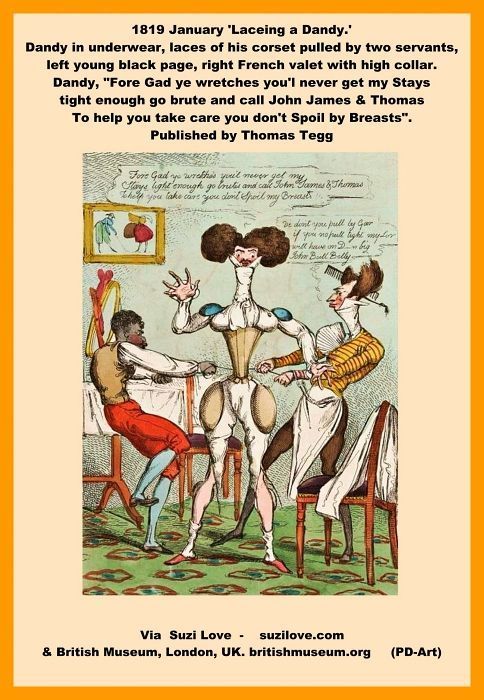
1819 January ‘Laceing a Dandy.’ Dandy in underwear, laces of his corset pulled by two servants, left young black page, right French valet with high collar. Dandy, “Fore Gad ye wretches you’ll never get my Stays tight enough go brute and call John James & Thomas, To help you take care you don’t Spoil by Breasts”. Published by: Thomas Tegg. Hand colored etching. Via British Museum, London, UK. britishmuseum.org (PD-Art)

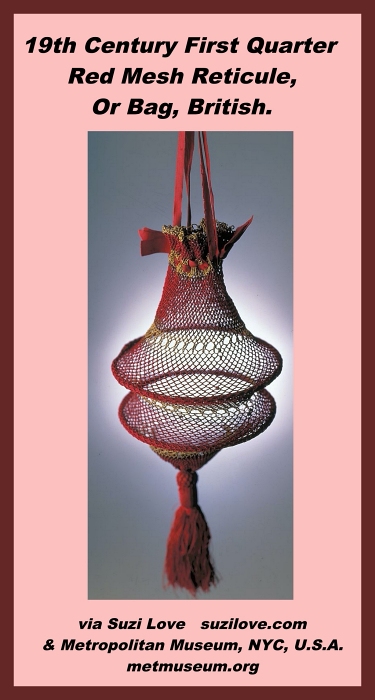
19th Century First Quarter Red Mesh Reticule, British. Small mesh bags known as reticules were the must-have “it bags” of 1800-1825. Too small for carrying much more than a few coins, reticules were often shown in satirical prints as a fashionable foible of women’s attire. Knit into an elegant lantern-like shape, this example survives with its original ribbon trim making it a particularly lovely and rare example of a short-lived fashion trend. via Metropolitan Museum, N.Y.C., U.S.A. metmuseum.org
Definition Reticule: Bag or purse, often with a drawstring to pull closed and usually made of cloth or covered cardboard and often decorated with beading or embroidery. A reticule, or purse, or handbag, was usually carried by a woman during the Regency period to carry all their daily necessities. Earlier, women used pockets that tied at the waistline and were hidden in the folds of their skirts. Empire style, or early 1800s, high-waisted dresses made it impossible to either sewn in a pocket or to tie on a pocket. So women began carrying small, decorated bags called Reticules, or ridicules, which generally pulled close at the top with a drawstring.

1826 Cheltenham Spa, England. From Regency Life Around England In Jane Austen’s Times. From The English Spy By Robert Cruikshank. via Google Books (PD-180)





1800-1810 ca. Yellow Kid Women’s Slippers, British. The sort of shoes Jane Austen and her female friends and family would have worn. Kid shoes bound in kid over white linen, very pointed toes, fronts trimmed with yellow silk tassel fixed by small steel buckle, back of shoe faced with yellow kid
printed with pattern in black, heel of kid and leather. via Manchester Galleries ~ manchestergalleries.org
Shoes in the early 1800s were flat or low heeled and occasionally decorated with a bow or floral embellishments and it wasn’t until the 1820s that square, rather than rounded or pointed toes became fashionable. Made of soft kid or cloth, these delicate shoes were flimsy and wore out quickly. There was often no difference between a left or right shoe, so when one slipper had a hole it was easily replaced. Slippers were often bought in multiples at a time so there were spares.