1826 House Of Lords In High Debate. From A Regency Gentleman’s Life. From The English Spy By Robert Cruikshank.
Light-hearted look at a young man’s day in the early 1800s. Depicts the ups and downs of a young gentleman’s day in the Regency Era, or Jane Austen’s years. Through historic images, historical information, and funny anecdotes, it shows how a young man about town fills his day, where he goes, and who he spends time with. This light-hearted look at the longer Regency years is an easy to read overview of what people did and wore, and where they worked and played. There is plenty of information to interest history buffs, and lots of pictures to help readers and writers of historical fiction visualize the people and places from the last years of the 18th Century until Queen Victoria took the throne. Regency Life Series Book 3 Young Gentleman’s Day.com/suziloveYGD
1809 September Mother and Daughter Mild Mourning Dresses, English. “Our plate will be found to represent a lady and her infant in slight mourning habits: the former composed of black gossamer net, or imperial gauze, worn over a white satin slip. A half train. A round frock front, and short French sleeves, each edged with a rich Vandyke lace. A cestus, or belt, of white satin edged with gold bullion and finished in front with a rich cord and cone tassels, suspended from topaz studs. Pearl necklace and bracelets, with topaz snaps. Hair in the eastern style, with a Spartan diadem, and comb of topaz or gold. Circassian scarf of grey Spanish silk with a Tuscan border in black embroidery, tassels to correspond, confined on one shoulder with a topaz broach. Shoes of grey satin, with clasps of jet, or rosettes of black bugles. White gloves of French kid; and fan of black crape, with gold spangled devices. ‘In deep mourning, this robe should be formed of black crape, and worn over black sarsnet. The ornaments and trimmings of every description must be of bugles or jet. The shoes of queen’s silk. The scarf, black crape or imperial silk, spotted and bordered with bugles. Jet tassels and broach. The child’s dress is a simple frock of black crape muslin, tucked small, and worn over a cambric skirt. A plain net-lace tucker, and cap to match. Grey kid slippers, with black clasps.’ Fashion Plate via Rudolph Ackermann’s ‘The Repository’ of Arts.
Because many men across Europe were fighting in wars during these years, women often had a reason to dress in black. The loss of numerous family members and friends meant that black was a mainstay in any lady’s wardrobe. Black dresses, hats, capes, shoes, gloves, fans and jewelry would have been essentials, with touches of white, grey or purple being added for times of half mourning. Early publications of Rudolph Ackermann’s ‘The Repository of Arts’ had many fashion plates that included children, but the plate below with a child in ’slight’ mourning dress is very unusual. With this fashion plate is a description of how this ’slight’ mourning could be adapted for deep mourning.
Fabrics for deep mourning would be flat, rather than shiny, hats would be black with little embellishment, and jewelry would be subdued. Slight mourning allowed the white dress trimming, white gloves and these grey satin shoes.
Definition Van Dyke: V-shaped lace and trims named after a 17th Century Flemish painter, Sir Anthony Van Dyck, known for painting V-shaped lace collars and scalloped edges on sitters.
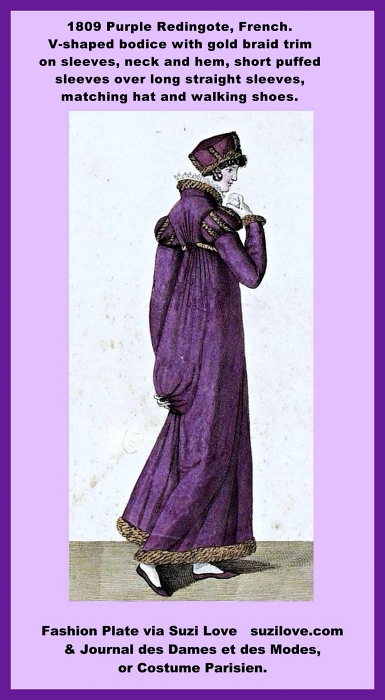
1809 Purple Redingote, Or Coat, French. V-shaped bodice with gold braid trim on sleeves, neck and hem, short puffed sleeves over long straight sleeves, matching hat and walking shoes. Fashion Plate via Journal des Dames et des Modes, or Costume Parisien.
Definition Redingote Or Pelisse: Long fitted outdoor coat worn over other garments for warmth. French word developed from English words, riding coat. Redingotes or Pelisses were needed to cover the flimsy dresses made of lightweight fabrics of the Regency years to provide warmth and some protection from windy conditions when gowns might lift and cause modesty issues. Jane Austen and her contemporaries often walked to places and so would have needed the warmth of a Pelisse or coat in the cold British winters.
Fashion Women 1805-1809 History Notes Book 26 What did Jane Austen and friends wear? https://books2read.com/SuziLoveFashionWomen1805-1809
1826 An Affair Of Honor Decided With Pistols In Hyde Park London, U.K. A Regency Gentleman’s Life. From The English Spy By Robert Cruikshank. By the Regency Era, dueling was outlawed, yet duels still happened because the courts were made up of peers who were reluctant to charge another peer with murder as a result of a duel. Gentlemen considered a duel a matter of honor and death was preferable to being labeled a coward.
Duels had a code of honor and were fought not so much to kill the opponent as to gain satisfaction and restore honor by demonstrating a willingness to risk your life. Originally dueling was only for the male members of nobility but then extended to all members of the upper classes. At first, duels were fought with swords but by the Regency Era, duels with pistols were more common. Some duels were also fought between women.
Favorite dueling grounds near London included Hampstead Heath, Chalk Farm and the common land that extended south of the Thames over modern Battersea, Putney and Wimbledon. The windmill there was a popular landmark beneath which duelists often agreed to meet. These locations were convenient for their proximity to the city, yet also sufficiently remote to avoid interruption and in the event of a fatality, attractively close to potential getaway routes on the roads out of London.
1826 An Affair Of Honor Decided With Pistols In Hyde Park London, U.K. A Regency Gentleman’s Life. From The English Spy By Robert Cruikshank.
Reticule Or Bag: Purse, often with a drawstring to pull closed and usually made of cloth or covered cardboard and often decorated with beading or embroidery. Carried by a woman during the Regency period to carry all their daily necessities. in the place of pockets.
Spencer: Short jacket, cropped at the waist, worn over a dress, or gown. Delicate and regency dresses provided so little protection from the cold, so over garments were essential for warmth, modesty and good health.
Pelisse Or redingote Or Walking Dress: Coat worn over clothing of both sexes for warmth and protection from the elements.
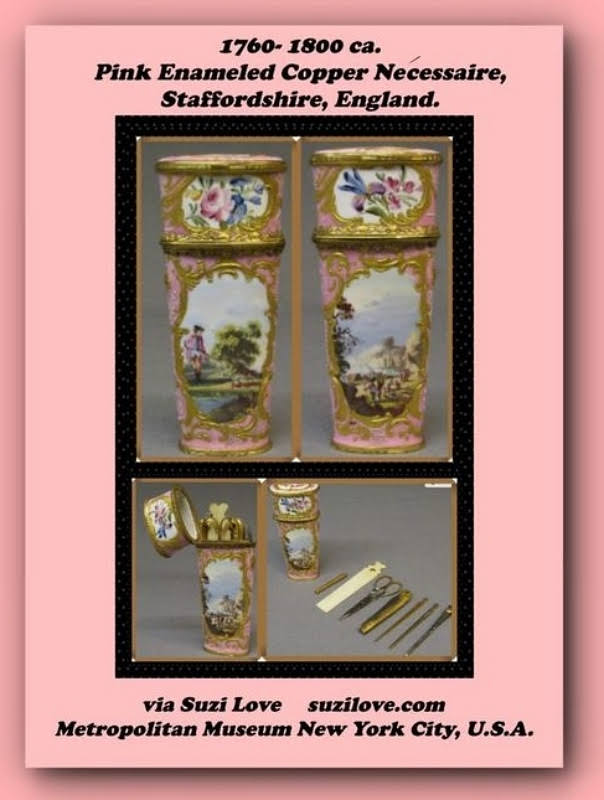
1760-1800 ca. Pink Enamel and Copper Necessaire Or Etui, Staffordshire, England. Dimensions: 3 3/4 x 1 5/8 in. (9.5 x 4.1 cm) Credit: Pierpont Morgan, 1917 via Metropolitan Museum, N.Y.C., U.S.A. metmuseum.org
Definition Necessaire Or Etui: Small toiletry, writing, or sewing containers were called Necessaire or Etui: Tiny boxes or containers were carried in large castles or sprawling manor houses so a lady or gentleman had their essentials with them all day. They were also important when traveling by coach, trains, or on ships where space was always limited. A necessaire or Etui was easily carried in a bag, reticule, or pocket so essentials were on hand for personal grooming, to repair a ripped hem, replace a button, to embroider, or to write a note or letter.
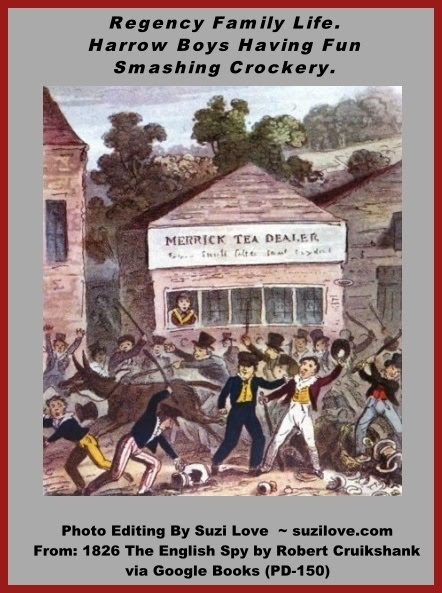
1826 Harrow Boys Having Fun Smashing Crockery. Regency Family Life. Photo Editing By Suzi Love. From: 1826 The English Spy By Robert Cruikshank via Google Books (PD-150)
1800s Typical Breakfast and Tea China, England. Tea cups, Bread and Butter plates, Teapot, Butter Dish, Coffee Cups, Tea Set, Milk Jug, Water Jug, Bread Dish, Sardine Dish, Bacon Dish, Marmalade Jar and Breakfast Cups. From: 1860 Mrs. Isabella Beeton’s Book of Household Management. These are the sort of salads that Jane Austen’s family would have eaten to accompany main dishes during the early 1800s, or Regency Era.
Travel and Luggage By Suzi Love History Notes Book 10. How did people travel in Jane Austen’s times. In past centuries? What did they take with them to make their long journeys easier? Travel by road, ship, canal, or railway all took a long time and had dangers so people learned to prepare. And then, in the nineteenth century, road improvements, inventions, and scientific developments made travel more pleasurable. books2read.com/SuziLoveTravel
“There is nothing I would not do for those who are really my friends. I have no notion of loving people by halves, it is not my nature.” Jane Austen ~ Northanger Abbey (1817) #JaneAusten #RegencyEra #Quotation
Fashion Women 1815-1819 History Notes Book 28 https://books2read.com/SuziLoveFashionWomen1815-1819