1840s Woman’s Shoes or Slippers, Probably United States. Square toes, silk satin, sueded leather, linen, and kid leather. via Los Angeles County Museum of Art, California, USA. collections.lacma.org Shoes in the early 1800s were flat or low heeled and occasionally decorated with a bow or floral embellishments. From the 1820s onwards, square toes became fashionable.
1840s Woman’s Shoes or Slippers, Probably United States. Square toes, silk satin, sueded leather, linen, and kid leather. via Suzi Love suzilove.com
& Los Angeles County Museum of Art, California, USA.
collections.lacma.org
19th Century Early Women’s Cotton Caps. Worn as morning caps, night caps, or under other hats. With lappets, hanging ties, or tails, which were also called ‘follow me lads’, or ‘flirtation ribbons’. via Museum of Fine Arts, Boston, U.S.A. mfa.org. via Museum of Fine Arts, Boston, U.S.A. mfa.org
Definition Caps: Worn as morning caps, night caps, or under other hats. Jane Austen and her family and female friends would have worn caps like these, sometimes during the morning at home, to bed to keep their long hair from becoming knotted, or under a bonnet to hold a hairstyle in place. Caps sometimes had hanging ties, or tails, were also called ‘follow me lads’, or ‘flirtation ribbons’.
Definition Lappets: Two long strips of material, often lace, hanging from top of head down back or over shoulders. Sometimes extensions of a headdress and a requirement for court dress.
Fashion Women 1815-1819 History Notes Book 28 https://books2read.com/SuziLoveFashionWomen1815-1819
19th Century First Half Woman’s Embroidered Cap, French. In the 19th Century, women wore some sort of headwear during the day and the evening. Finely decorated cotton caps were worn during the morning with informal or At-Home, dress and at night with nightwear. These caps had fine embroidery, ruffles, lace edgings on the streamers, embroidered, pointed edges of the ruffles, ties, and streamers, known as ‘follow me lads’ or ‘flirtation ribbons’.
19th Century First Half Woman’s Embroidered Cap, French. Cotton mull with cotton embroidery, linen bobbin lace insertion, silk ribbon, round gathered crown with spoked wheel design in center surrounded by long leafed wreath, outside this a wreath of carnations, same carnations around forehead band and neck band, design embroidered with white linen thread, white taffeta ribbon run through the embroidered net casing and tied in center back. via Museum of Fine Arts, Boston, U.S.A. mfa.org
1810–1850 ca. Corset, American or European. Front lacing, extra wide straps for under a square neckline dress. via Metropolitan Museum, N.Y.C., U.S.A. metmuseum.org
Surviving stays, or corsets as they became to be called in the nineteenth century, show that both longline and shorter corsets were worn and that they were made of cotton, silk and sateen. A lot of these corsets were front fastening, plus many were laced at both the front and the back so our aristocratic fictional heroines could indeed dress and undress themselves without the assistance of a maid.
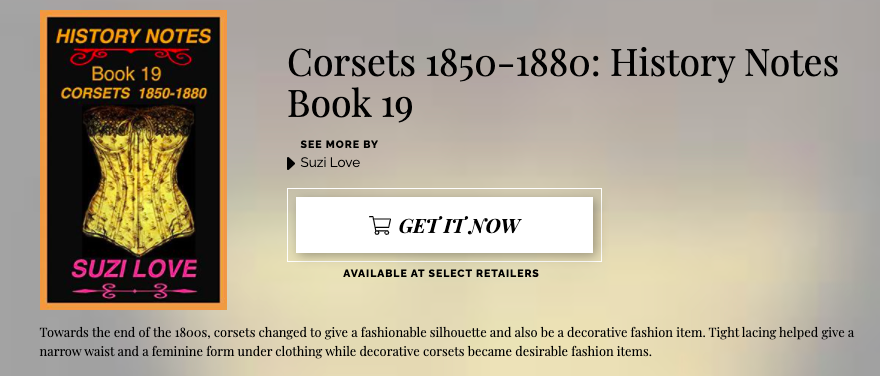
Corsets 1810-1830 History Notes Book 17 This book shows how corsets changed to fit well under clothing, give maximum support and comfort. Corsets pushed up breasts and showed off the bust line beneath a square-cut and low-cut neckline as in the early 1800s, or Regency years. Jane Austen and her female and friends wore these corsets. https://books2read.com/SuziLoveCorsetBook17
1800 ca. Brown Striped Trousers, American or European. Button front waistband, small drop down flap, or fall, pockets, and with extra fullness in the back for ease of movement. via Metropolitan Museum, N.Y.C., U.S.A. The style of men’s pants that replaced breeches as the fashionable pants item for men in Jane Austen’ times.
pants_1800 Collage View. Brown Striped Trousers, American or European. via metmuseum 1800 Brown Striped Trousers, American or European. via metmuseum_Waistband_Sml1800 Brown Striped Trousers, American or European. via metmuseum. Back View.1800 Brown Striped Trousers, American or European. via metmuseum. Front View.23_d2d_fashionmen1800-1819https://books2read.com/SuziLoveFashionMen1800-1819
1775-1825 ca. Bridgerton and Jane Austen Style Black Silk Breeches, American or European. #Bridgerton #JaneAusten #GeorgianEra #RegencyFashion books2read.com/SuziLoveFashionMen1800-1819
1805-1810 ca. Blue Silk Slippers With Silk Bow and Ribbon Ankle Ties. Woven square pattern and round toes. via Manchester City Galleries, UK.
Shoes in the early 1800s were flat or low heeled and occasionally decorated with a bow or floral embellishments and it wasn’t until the 1820s that square, rather than rounded or pointed toes became fashionable. Made of silk, soft kid or cloth, these delicate shoes were flimsy and wore out quickly. There was often no difference between a left or right shoe, so when one slipper had a hole it was easily replaced. Slippers were often bought in multiples at a time so there were spares.
Fashion Women 1805-1809 History Notes Book 26 What did Jane Austen and friends wear? https://books2read.com/SuziLoveFashionWomen1805-1809
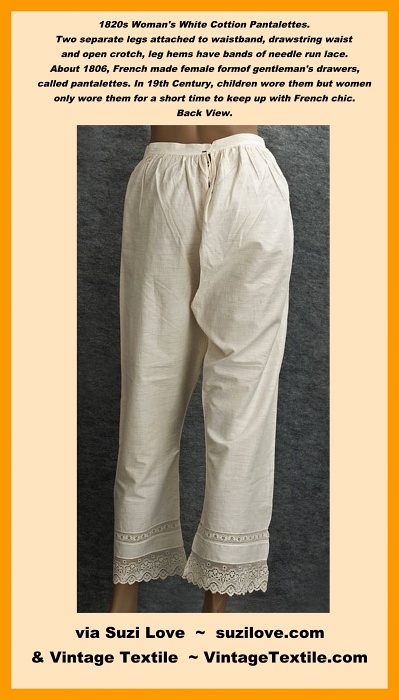
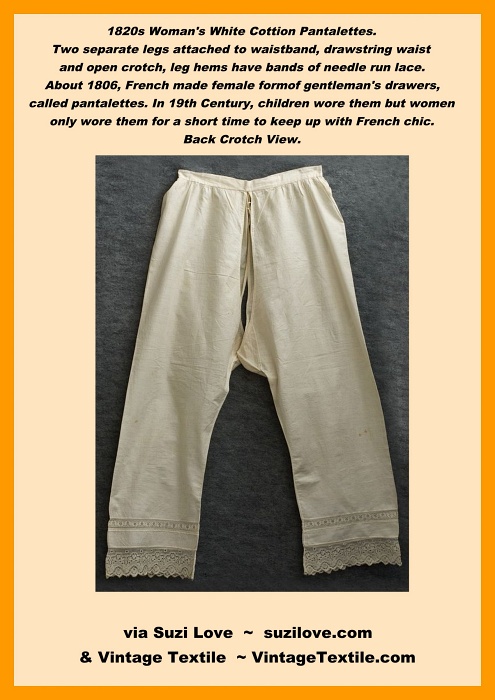
1820s Woman’s White Cotton and Lace Trimmed Pantalettes with Two Separate Legs. About 1806, French made female form of gentleman’s drawers, pantalettes. During the 19th Century, children wore them but women only wore them for a short time to keep up with French chic. The predecessor of women’s panties appeared about 1806 in the form of drawers like those worn by gentleman. Always the leader in forward chic, the French quickly came up with the female version—pantalettes. While the style persisted throughout the 19th century for children, pantalettes for adult women were only a passing fad. The pantalettes consist of two separate legs attached to a drawstring waistband, leaving the crotch open. The legs are bordered at the bottom with bands of needle run lace. The pantalettes are completely hand stitched and close in back with one mother-of-pearl button. The open edges of the crotch are finished with corded piping. via vintagetextile.com
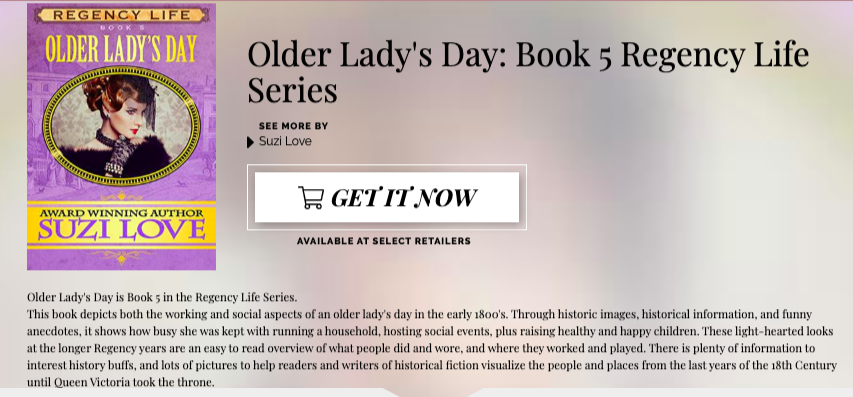
Easy to read overview of what an older lady did, wore, and how she lived in Jane Austen and Bridgerton’s time. Information for history buffs and pictures for readers and writers of historical fiction. Older Lady’s Day Regency Life Series Book 5 by Suzi Love books2read.com/suziloveOLD